
AIM OSCE / OSPE • MBBS
🤝 Station 9 — Obtaining Informed Consent Before an Invasive Procedure
Rapid Revision • Professional Communication • Consent Skills • Viva
🎯 Task
You are asked to speak with a competent adult patient before a planned invasive procedure.
Demonstrate how you would obtain valid informed consent using appropriate professional communication.
⚡ Model Station Answer
What to say in the exam
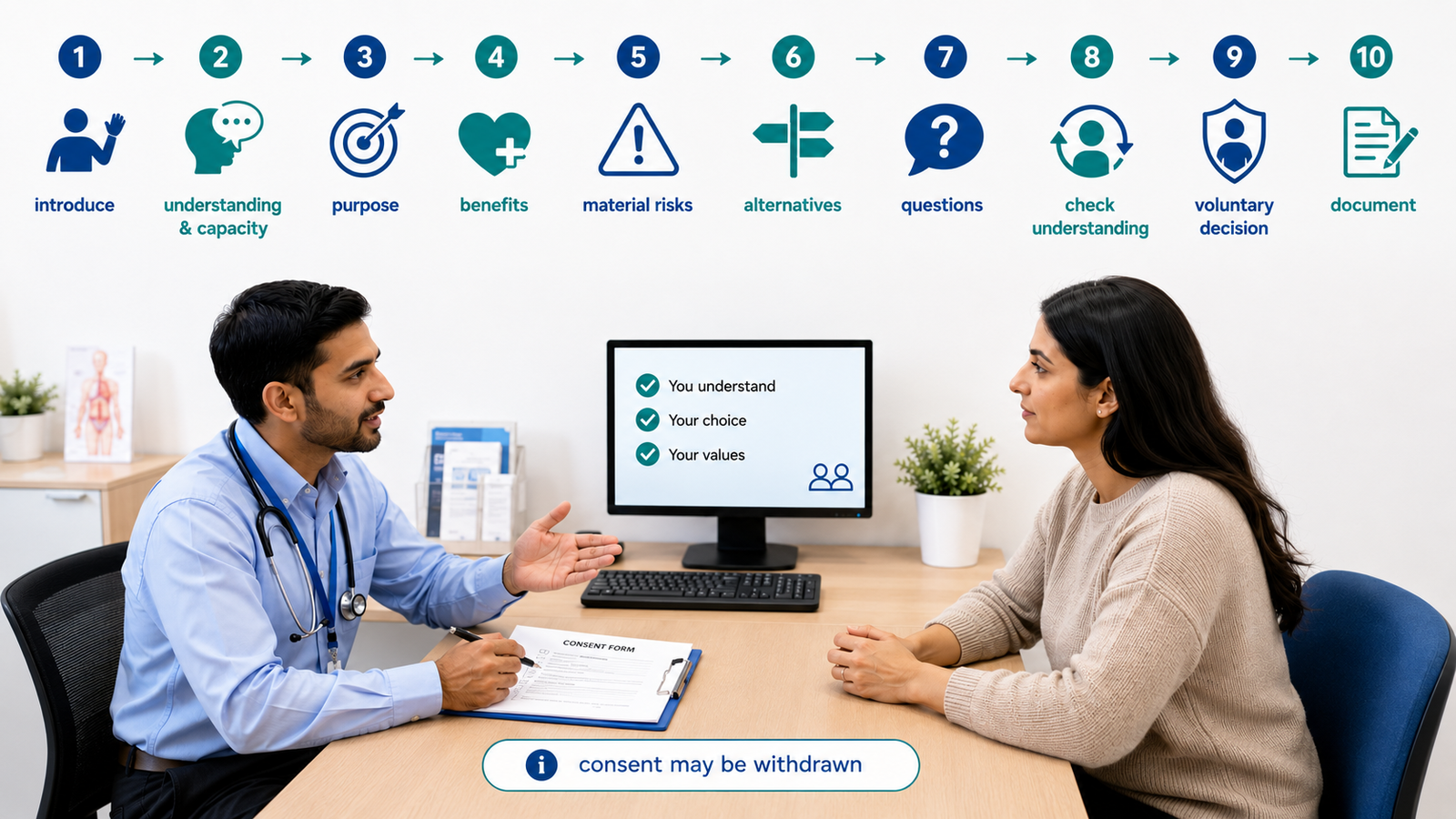
- I would introduce myself, confirm the patient’s identity and assess their understanding and decision-making capacity.
- I would explain the nature and purpose of the procedure, its expected benefits, important or material risks, and reasonable alternatives, including the option of not proceeding where relevant.
- I would use clear non-technical language, encourage questions and check the patient’s understanding.
- I would ensure the decision is voluntary and free from pressure, then obtain explicit consent if the patient wishes to proceed.
- I would explain that consent may be withdrawn and document the consent discussion appropriately.
🔎 Stepwise Procedure / Approach
- Prepare appropriately.
Review the proposed procedure and relevant clinical information so that you can explain it accurately. - Introduce yourself and confirm identity.
Ensure privacy, establish rapport and explain that you would like to discuss the proposed procedure. - Assess understanding and capacity.
Determine what the patient already understands and ensure they can understand, retain and use the information needed to make the decision. - Explain the proposed procedure.
Describe its purpose and what it involves in clear, patient-friendly language without unnecessary technical terminology. - Discuss benefits, material risks and alternatives.
Include reasonable alternatives and the consequences or option of not undergoing the procedure when relevant. - Invite questions and address concerns.
Allow the patient to express priorities, fears or preferences and answer within your level of competence. - Check understanding.
Ask the patient to summarize the important information in their own words where appropriate, and correct misunderstandings. - Confirm voluntariness and decision.
Ensure there is no coercion or undue pressure. If the patient freely agrees and has capacity, obtain explicit consent according to local policy. - Close and document.
Explain that the patient may withdraw consent, complete any required consent documentation and record the discussion appropriately.
🖼️ Visual Learning
Informed Consent OSCE — Complete Communication Sequence
🎥 Practical Video
Communication Skills: Informed Consent for a Medical Procedure OSCE
Source: LAJ Academy • Clinical Communication Skills
A practical OSCE-style demonstration of conducting an informed-consent discussion for a medical procedure, useful for observing structure, information delivery and patient communication.
📝 Important Viva Questions
Q1. What is informed consent?
Answer: It is a voluntary agreement to a proposed intervention made by a patient with decision-making capacity after receiving and understanding sufficient relevant information.
Q2. What are the essential requirements for valid consent?
Answer: The patient should have decision-making capacity, receive adequate relevant information and make the decision voluntarily without coercion.
Q3. What information should normally be discussed before an invasive procedure?
Answer: The nature and purpose of the procedure, expected benefits, important or material risks, reasonable alternatives and the option or consequences of not proceeding where relevant.
Q4. Does signing a consent form alone constitute valid informed consent?
Answer: No. A signed form documents consent but does not replace an adequate consent discussion and voluntary informed decision.
Q5. How can you check whether the patient has understood the information?
Answer: Ask the patient to explain the important information or their understanding in their own words and clarify any misunderstanding.
Q6. Can a competent adult refuse a recommended invasive procedure?
Answer: Yes. A patient with decision-making capacity may refuse the procedure after appropriate information has been provided, and the decision should be respected and documented.
Q7. Can a patient withdraw consent after initially agreeing?
Answer: Yes. Consent is an ongoing process and a patient with capacity may withdraw consent before or during an intervention where it remains possible and safe to stop.