
AIM OSCE / OSPE • MBBS
💊 Station 1 — Prescription Writing for Myocardial Infarction
Rapid Revision • Prescription Writing • Viva
🎯 Task
CANDIDATE TASK
A 58-year-old man is being discharged after an acute myocardial infarction treated with PCI. He is haemodynamically stable, has no drug allergy or major contraindication, and has mild left-ventricular systolic dysfunction. Write an appropriate discharge prescription using correct prescribing conventions.
⚡ Model Station Answer What to say in the exam
- I would first confirm the patient details, allergies, current medicines, renal function, blood pressure and reperfusion plan.
- The prescription should contain appropriate dual antiplatelet therapy, a high-intensity statin, ACE inhibitor and beta-blocker, with an anti-anginal medicine for recurrent pain where appropriate.
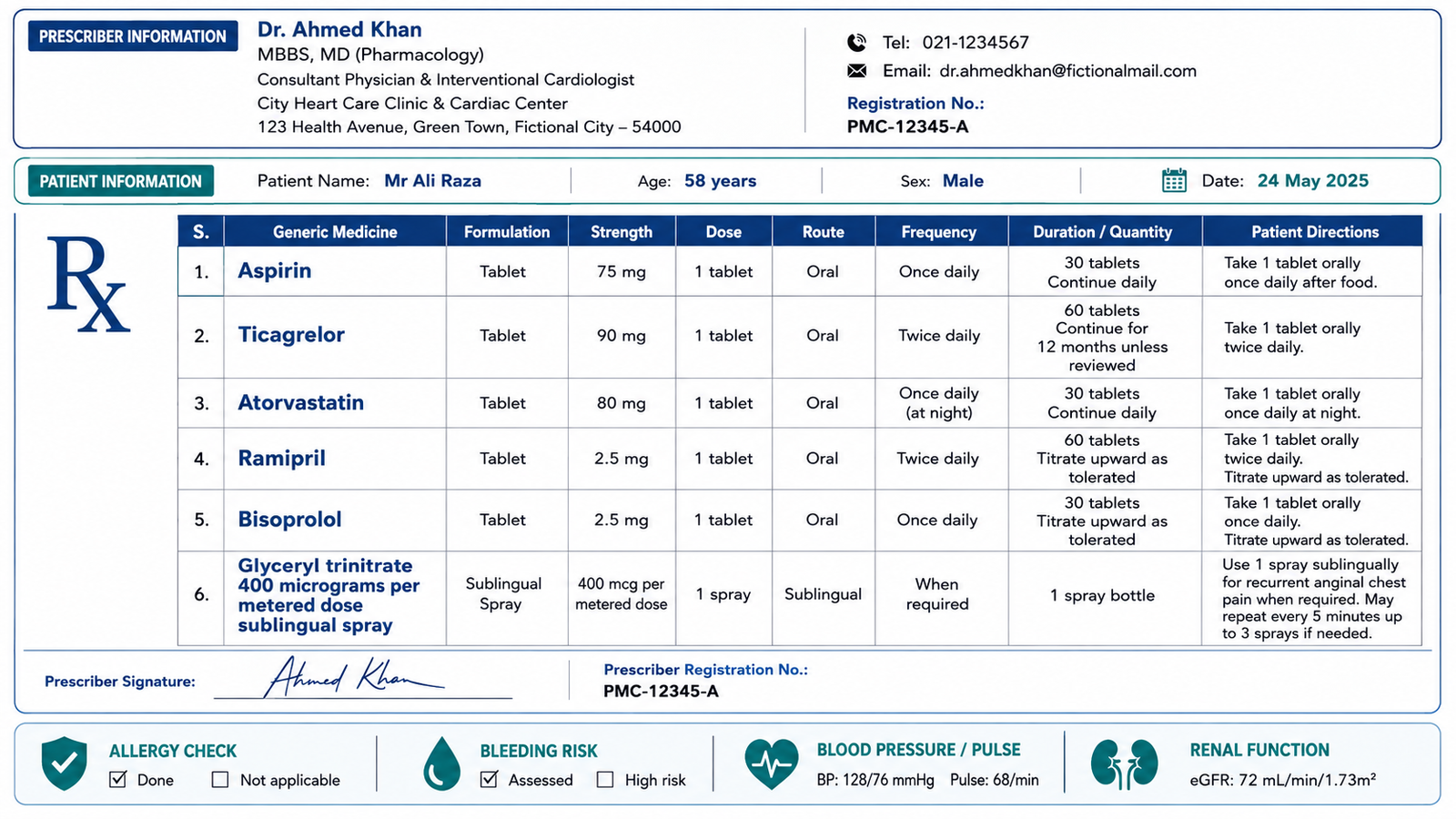
- For this stable post-PCI patient, an examination example is aspirin + ticagrelor, atorvastatin, ramipril, bisoprolol and sublingual glyceryl trinitrate.
- I would write every medicine by generic name with its strength, dose, route, frequency and duration, then date and sign the prescription.
🔎 Stepwise Procedure / Approach
- Review the clinical scenario. Confirm the diagnosis, PCI/reperfusion status and whether this is an acute or discharge prescription.
- Check patient safety. Confirm allergies, bleeding risk, blood pressure, pulse, renal function and important contraindications.
- Enter patient details. Write the patient’s name, age, sex or date of birth, relevant identifier/address and prescription date.
- Write “Rx”. Use generic medicine names and avoid unclear abbreviations.
- Prescribe secondary-prevention medicines. State formulation, strength, dose, route, frequency and intended duration clearly.
- Add essential patient directions. Ensure instructions are understandable and identify any medicine that is to be used only when required.
- Check the completed prescription. Look specifically for omitted doses, duplicate antithrombotic therapy, contraindications and ambiguous units.
- Authenticate the prescription. Add prescriber name, signature, qualification/registration details and date as required.
Patient: Mr Ahmad Khan, 58 years | Date: __________
Rx
Tablet Aspirin 75 mg — Take one tablet orally once daily. Continue long term unless contraindicated.
Tablet Ticagrelor 90 mg — Take one tablet orally twice daily. Duration according to the post-ACS/PCI antiplatelet plan, commonly up to 12 months when appropriate.
Tablet Atorvastatin 80 mg — Take one tablet orally once daily.
Tablet Ramipril 2.5 mg — Take one tablet orally twice daily; titrate according to blood pressure, renal function and tolerance.
Tablet Bisoprolol 2.5 mg — Take one tablet orally once daily; titrate according to pulse, blood pressure and ventricular function.
Glyceryl trinitrate 400 micrograms/dose sublingual spray — Use one spray under the tongue for recurrent anginal chest pain while following emergency advice.
Prescriber: ____________________ Signature: ____________________
Exam safety point: Antiplatelet selection and duration depend on the reperfusion/PCI strategy, bleeding risk and local ACS protocol. Do not prescribe blindly without checking contraindications and concurrent anticoagulation.
🖼️ Visual Learning
VISUAL 1
Correct Post-MI Prescription Layout
🎥 Practical Video
Prescription Writing: Essential Components and Practical Examples
Source: Santiniketan Medical College & Hospital
This MBBS pharmacology teaching demonstration reviews the required parts of a prescription and shows practical examples of constructing complete prescriptions.
📝 Important Viva Questions
Q1. What are the essential medicine-related components of a prescription?
Answer: Generic medicine name, formulation, strength, dose, route, frequency, duration or quantity, and clear directions for use.
Q2. Why is aspirin prescribed after myocardial infarction?
Answer: Aspirin irreversibly inhibits platelet cyclo-oxygenase and reduces thromboxane A2-mediated platelet aggregation, lowering the risk of recurrent arterial thrombosis.
Q3. Why is a second antiplatelet drug commonly added after acute MI treated with PCI?
Answer: Dual antiplatelet therapy reduces recurrent ischemic events and stent thrombosis. The agent and duration depend on PCI strategy and bleeding risk.
Q4. Why is a high-intensity statin prescribed after myocardial infarction?
Answer: It markedly lowers LDL cholesterol and reduces the risk of further atherosclerotic cardiovascular events.
Q5. What should be checked before starting an ACE inhibitor after MI?
Answer: Check blood pressure, renal function and serum potassium, and exclude important contraindications such as previous ACE-inhibitor angioedema.
Q6. When should a beta-blocker be used cautiously or avoided?
Answer: Use caution with significant bradycardia, hypotension, high-grade heart block, acute decompensated heart failure or severe bronchospastic disease.
Q7. Name two common prescription-writing errors an examiner may look for.
Answer: Missing or ambiguous dose/frequency and failure to document patient or prescriber details. Unclear abbreviations and unsafe units are also important errors.