
Station 10 — Child Growth Assessment: Anthropometry, Shakir’s Tape and Growth Chart
🎯 Candidate Task
Identify the instruments provided, assess the child’s anthropometric measurements including mid-upper arm circumference, weight and height/length, and interpret the findings. Plot the supplied measurements on the growth chart and state your interpretation.
⚡ Model Station Answer
- Identification: This is a Shakir’s/MUAC tape used to measure mid-upper arm circumference as a rapid assessment of nutritional status.
- Anthropometry: I would measure MUAC at the midpoint of the left upper arm and obtain accurate weight and height or recumbent length as appropriate for the child.
- Interpretation: I would compare the measurements with the appropriate age-specific or standard nutritional reference supplied at the station.
- Growth chart: I would select the correct chart, plot age against the supplied anthropometric measurement, identify the child’s position or trend and state whether growth is appropriate or abnormal.
🔎 How to Perform / Approach
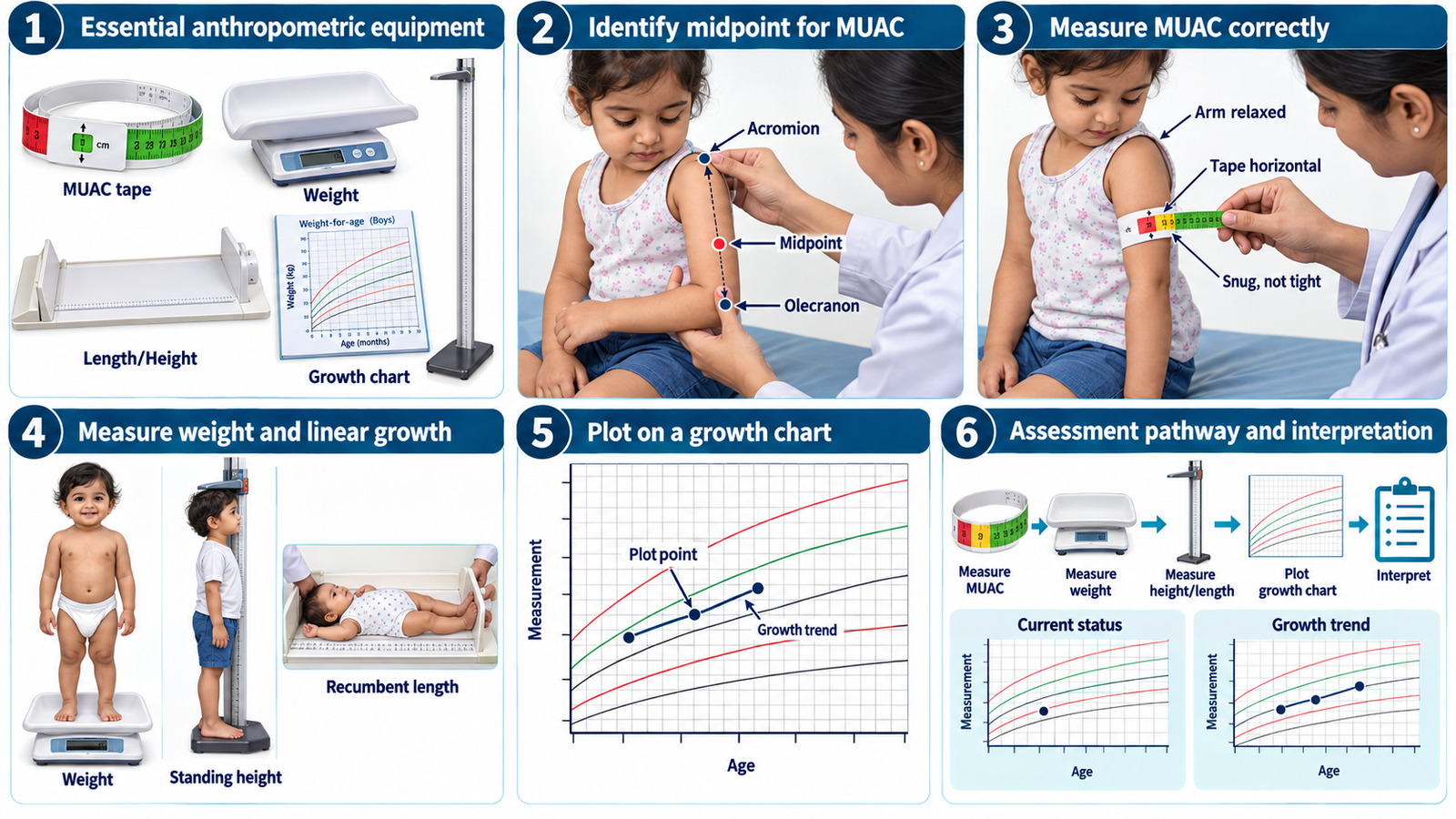
- Step 1 — Identify the equipment.
Recognize the MUAC/Shakir’s tape, weighing scale, length board or stadiometer and the relevant child growth chart. - Step 2 — Find the MUAC midpoint.
With the left arm relaxed, identify the acromion at the shoulder and olecranon at the elbow, measure the distance between them and mark the midpoint. - Step 3 — Measure MUAC.
Wrap the tape horizontally around the midpoint without compressing the soft tissue, ensure it is snug and read the circumference at eye level. - Step 4 — Measure weight.
Use an appropriate calibrated scale, remove unnecessary heavy clothing or footwear where applicable, ensure the child is positioned safely and record the measurement accurately. - Step 5 — Measure height or length.
Measure recumbent length in a child requiring a length board or standing height in an older child using the appropriate instrument and correct positioning. - Step 6 — Interpret the anthropometry.
Compare the MUAC, weight and height/length with the reference or classification provided at the station and state whether the finding is within the expected range or indicates impaired nutritional/growth status. - Step 7 — Plot and interpret the growth chart.
Confirm the correct age and chart, locate age on the horizontal axis and the required measurement on the vertical axis, mark their intersection accurately and interpret the position and serial growth trend.
🖼️ Visual Learning
Child Anthropometry, MUAC Measurement and Growth-Chart Plotting
📝 Important Viva Questions
1. What is Shakir’s tape used to measure?
Answer: It measures the mid-upper arm circumference (MUAC) and is used as a rapid anthropometric assessment of nutritional status.
2. Between which two landmarks is the midpoint for MUAC determined?
Answer: The midpoint is determined between the acromion process of the shoulder and the olecranon process of the elbow.
3. How should the MUAC tape be applied?
Answer: It should be wrapped horizontally around the marked midpoint of the relaxed upper arm, lying snugly against the skin without compressing the soft tissue.
4. What information is required before plotting a measurement on a growth chart?
Answer: The child’s correct age and the required anthropometric measurement must be known, and the appropriate growth chart must be selected.
5. Why are serial measurements on a growth chart more useful than a single measurement?
Answer: Serial plotted measurements demonstrate the child’s growth trend, allowing recognition of appropriate progression or growth faltering over time.