
Station 1 — Prescription Writing in Graves’ Disease
🎯 Candidate Task
An adult patient has newly diagnosed Graves’ disease with troublesome palpitations and tremor. Baseline blood tests are satisfactory and there is no contraindication to beta-blocker therapy. Write an appropriate initial prescription and state the essential safety advice.
⚡ Model Station Answer
Prescription:
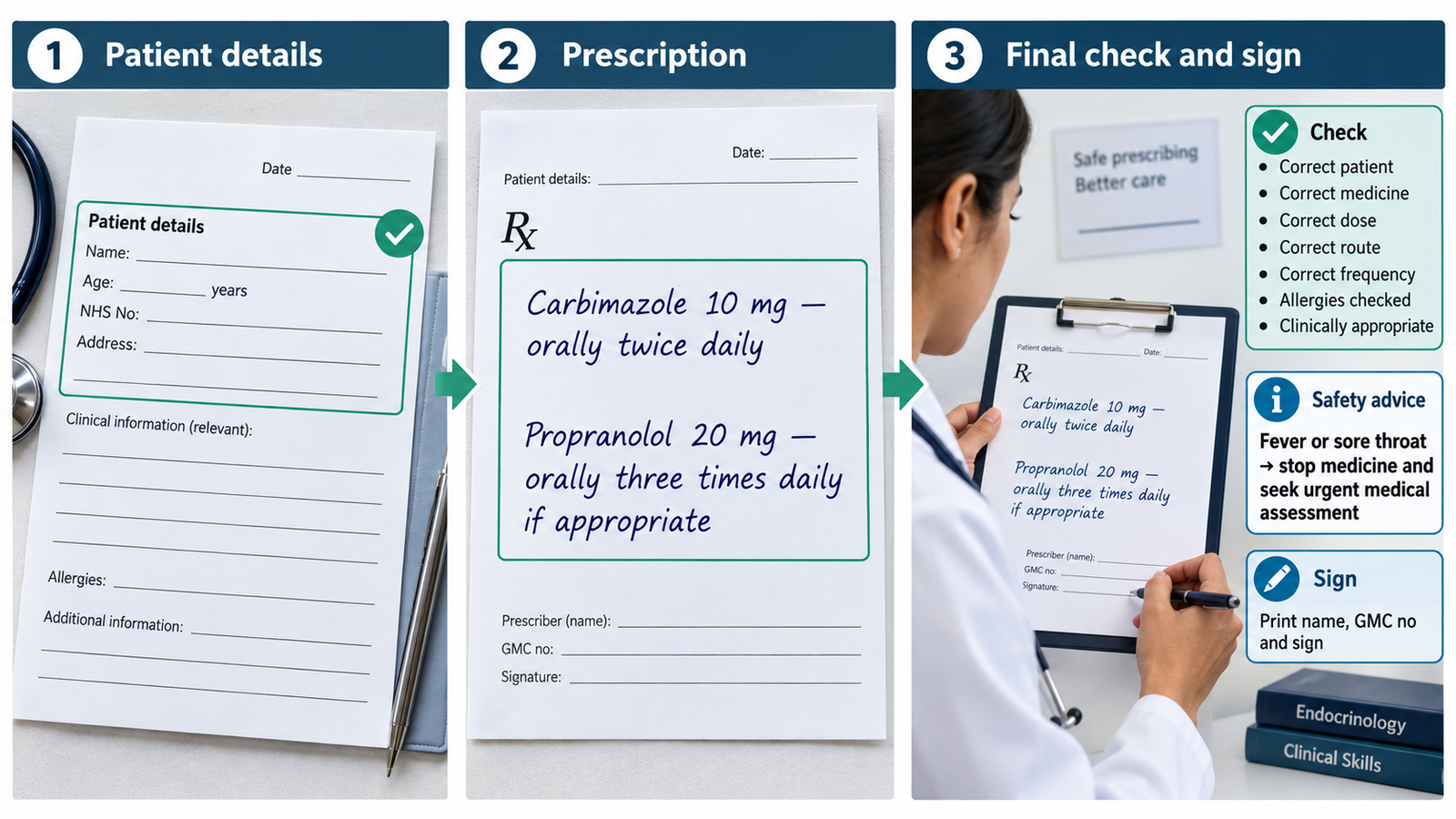
Rx
Carbimazole 10 mg tablets — Take 10 mg orally twice daily.
Propranolol 20 mg tablets — Take 20 mg orally three times daily for symptomatic control, provided there is no contraindication.
Review clinical response and thyroid function tests in approximately 4–6 weeks and adjust antithyroid treatment accordingly.
Safety: Advise the patient to stop carbimazole and seek urgent medical assessment with a blood count if fever, sore throat or other features of infection develop.
🔎 How to Perform / Approach
- Step 1 — Review the scenario: Confirm the indication is Graves’ hyperthyroidism and check information relevant to safe prescribing.
- Step 2 — Complete patient details: Enter the patient’s identifiers and the prescription date.
- Step 3 — Prescribe the antithyroid drug: Write carbimazole using its generic name with a clear strength, dose, route and frequency.
- Step 4 — Control adrenergic symptoms: Add propranolol when indicated and when no beta-blocker contraindication is present.
- Step 5 — Write unambiguous instructions: Avoid unclear abbreviations and make the dose and frequency easily readable.
- Step 6 — Check safety: Confirm appropriate baseline monitoring and give the important carbimazole warning regarding fever or sore throat.
- Step 7 — Authenticate: Recheck the prescription for errors or omissions, then sign and provide prescriber details as required.
🖼️ Visual Learning
Writing a Safe Prescription for Graves’ Disease
📝 Important Viva Questions
1. What is the role of carbimazole in Graves’ disease?
Answer: Carbimazole reduces thyroid hormone synthesis and is commonly used as antithyroid therapy for Graves’ hyperthyroidism.
2. Why may propranolol be prescribed initially?
Answer: It provides rapid symptomatic relief of adrenergic manifestations such as palpitations, tremor and tachycardia while antithyroid treatment takes effect.
3. What important warning should a patient taking carbimazole receive?
Answer: The patient should stop carbimazole and seek urgent medical assessment if fever, sore throat or other signs of infection develop because of the risk of agranulocytosis.
4. What baseline tests are commonly checked before starting carbimazole?
Answer: A full blood count and liver function tests should be checked, together with appropriate thyroid function assessment.
5. Name one important contraindication to propranolol.
Answer: Bronchial asthma is an important contraindication because non-selective beta-blockade can precipitate bronchospasm.