
Course Content
🩺 OSCE Station 1 — Prescription Writing in Graves’ Disease
KMU clinical activity: Graves’ disease — formulation of an appropriate prescription. Learning Objectives The student should be able to: Formulate a prescription for a patient with Graves’ disease.
0/1
🩸 OSCE Station 2 — Diabetes Mellitus: Glucose Testing and Prescription Writing
KMU clinical activities: Diabetes mellitus prescription + glucose estimation in urine and blood. Learning Objectives The student should be able to: Check glucose in urine. Check blood glucose in a given sample. Formulate an appropriate prescription for a patient with Type 1 diabetes mellitus. Formulate an appropriate prescription for a patient with Type 2 diabetes mellitus.
0/1
🔬 OSCE Station 3 — Microscopic Identification of Multinodular Goitre
KMU clinical activity: Goitre — microscopic identification. Learning Objectives The student should be able to: Identify the important microscopic features of multinodular goitre. Recognize multinodular goitre when presented as a histopathology slide or image at the station.
0/1
🔬 OSCE Station 4 — Gynecological Pathology: Pap Smear and Uterine Fibroid
KMU clinical activities: Pap smear interpretation + microscopic identification of uterine fibroids. Learning Objectives The student should be able to: Interpret a Pap smear slide. Identify the important microscopic features of uterine fibroids. Differentiate the two when presented as cytology/histopathology specimens or images at the station.
0/1
🎗️ OSCE Station 5 — Microscopic Identification of Carcinoma of the Breast
KMU clinical activity: Carcinoma breast — microscopic identification. Learning Objectives The student should be able to: Identify the important microscopic features of carcinoma of the breast. Recognize carcinoma of the breast when presented as a histopathology slide or image at the station.
0/1
⚖️ OSCE Station 6 — Forensic Examination in Sexual Offences: Examination, Sampling and Preservation of Evidence
KMU clinical activities: Examination of a rape victim and assailant + examination of a sodomy victim and assailant. Learning Objectives The student should be able to: Take appropriate consent from a rape victim. Demonstrate or describe the examination of a rape victim/manikin. Describe the procedure for taking samples from the victim/manikin/item. Describe the correct sealing and preservation of specimens. Describe the procedure for examining a victim of sodomy. Describe the procedure for taking appropriate samples in such a case. Describe the correct sealing and preservation of specimens obtained during the examination.
0/1
💊 OSCE Station 7 — Contraceptive Identification and Counselling
KMU clinical activity: Contraception. Learning Objectives The student should be able to: Identify a given contraceptive device or drug. Explain its merits and demerits. Discuss the appropriate method of administration/use of the given contraceptive device or drug.
0/1
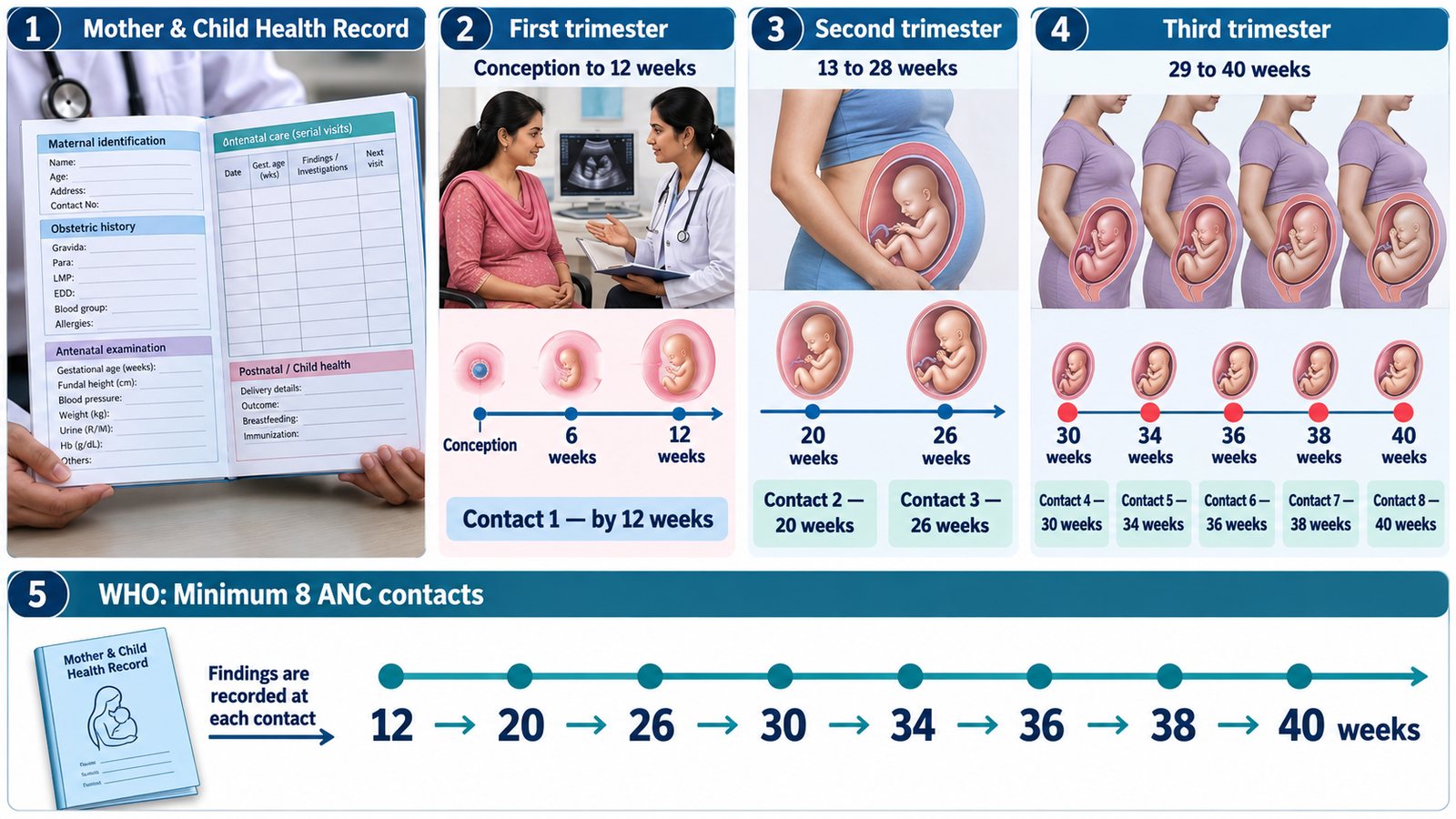
🤰 OSCE Station 8 — Antenatal Care: Maternal Health Chart and WHO Visit Schedule
KMU clinical activity: Mother and child health. Learning Objectives The student should be able to: Identify the relevant mother-and-child-health chart presented at the station. Devise an appropriate schedule for antenatal visits according to WHO criteria.
0/1
💉 OSCE Station 9 — EPI Schedule, Vaccine Identification and Immunization Counselling
KMU clinical activities: EPI schedule + vaccination and immunization. Learning Objectives The student should be able to: Counsel a mother regarding the EPI schedule. Identify a given vaccine. Explain the uses of the vaccine. Discuss its schedule of administration. Interpret the VVM (vaccine vial monitor). Discuss the use of VVM in epidemics.
0/1
👶 OSCE Station 10 — Child Growth Assessment: Anthropometry, Shakir’s Tape and Growth Chart
KMU clinical activities: IMCI anthropometric measures/Shakir’s tape + growth chart. Learning Objectives The student should be able to: Identify the relevant anthropometric model/instrument. Measure the mid-upper arm circumference using Shakir’s tape. Calculate or determine the weight and height of the child as required by the station. Interpret the anthropometric results. Identify a growth chart. Plot data on the growth chart using a given clinical scenario. Interpret the different parts and findings of the growth chart.
0/1
📊 OSCE Station 11 — Interpretation of Demographic Indicators
KMU clinical activity: Demographic indicators. Learning Objectives The student should be able to interpret a given demographic indicator, including: Population pyramid Human Development Index (HDI) Physical Quality of Life Index (PQLI) Population growth rate Dependency ratio
0/1
AIM OSPE/OSCE Lab — Endocrine & Reproduction-II Module | 4th Year MBBS
AIM OSCE / OSPE • MBBS

Station 8 — Antenatal Care: Maternal Health Chart and WHO Visit Schedule

4th Year • GIT / Hepatobiliary • Rapid Revision • Practical Skills • Viva

🎯 Candidate Task

Identify the mother-and-child-health chart provided at the station. State the recommended antenatal-care contact schedule for an uncomplicated pregnancy according to WHO criteria.

⚡ Model Station Answer

  • Identification: This is a mother-and-child-health record/chart used to document and follow maternal and fetal care during pregnancy.
  • WHO recommendation: A minimum of 8 antenatal contacts is recommended for an uncomplicated pregnancy.
  • Schedule: First contact by 12 weeks, followed by contacts at 20, 26, 30, 34, 36, 38 and 40 weeks.
  • The chart should be updated at each contact so that maternal and fetal progress can be followed longitudinally.

🔎 How to Perform / Approach

  1. Step 1 — Identify the chart.
    Recognize it as a mother-and-child-health or antenatal record containing maternal, pregnancy and follow-up information.
  2. Step 2 — Confirm pregnancy details.
    Look for relevant identifiers such as gestational age, expected date of delivery and previous antenatal entries.
  3. Step 3 — Recall the WHO model.
    State that WHO recommends a minimum of 8 antenatal contacts rather than the older four-visit model.
  4. Step 4 — First trimester.
    Arrange the 1st contact by 12 weeks of gestation.
  5. Step 5 — Second trimester.
    Arrange the 2nd contact at 20 weeks and the 3rd at 26 weeks.
  6. Step 6 — Third trimester.
    Arrange contacts at 30, 34, 36, 38 and 40 weeks.
  7. Step 7 — Document and individualize.
    Record each contact on the maternal-health chart and arrange additional assessment when maternal or fetal risk requires closer follow-up.
Easy recall: 12 → 20 → 26 → 30 → 34 → 36 → 38 → 40 weeks
Exam wording: WHO uses the term “contact” rather than simply “visit” because antenatal care should involve active assessment, support and communication between the woman and healthcare provider.

🖼️ Visual Learning

VISUAL 1

Mother-and-Child Health Chart and WHO Eight-Contact ANC Schedule
 

📝 Important Viva Questions

1. How many antenatal contacts does WHO recommend for an uncomplicated pregnancy?

Answer: WHO recommends a minimum of 8 antenatal contacts.

2. When should the first antenatal contact occur?

Answer: The first contact should occur in the first trimester, preferably by 12 weeks of gestation.

3. What are the two recommended second-trimester contact timings?

Answer: The second-trimester contacts are scheduled at 20 and 26 weeks.

4. What are the five recommended third-trimester contact timings?

Answer: They are at 30, 34, 36, 38 and 40 weeks of gestation.

5. Why is a mother-and-child-health chart important?

Answer: It provides a longitudinal record of pregnancy care, allowing maternal and fetal information and subsequent antenatal contacts to be documented and followed.

Scroll to Top
💬 WhatsApp Support