
Course Content
🩺 OSCE Station 1 — Prescription Writing in Graves’ Disease
KMU clinical activity: Graves’ disease — formulation of an appropriate prescription. Learning Objectives The student should be able to: Formulate a prescription for a patient with Graves’ disease.
0/1
🩸 OSCE Station 2 — Diabetes Mellitus: Glucose Testing and Prescription Writing
KMU clinical activities: Diabetes mellitus prescription + glucose estimation in urine and blood. Learning Objectives The student should be able to: Check glucose in urine. Check blood glucose in a given sample. Formulate an appropriate prescription for a patient with Type 1 diabetes mellitus. Formulate an appropriate prescription for a patient with Type 2 diabetes mellitus.
0/1
🔬 OSCE Station 3 — Microscopic Identification of Multinodular Goitre
KMU clinical activity: Goitre — microscopic identification. Learning Objectives The student should be able to: Identify the important microscopic features of multinodular goitre. Recognize multinodular goitre when presented as a histopathology slide or image at the station.
0/1
🔬 OSCE Station 4 — Gynecological Pathology: Pap Smear and Uterine Fibroid
KMU clinical activities: Pap smear interpretation + microscopic identification of uterine fibroids. Learning Objectives The student should be able to: Interpret a Pap smear slide. Identify the important microscopic features of uterine fibroids. Differentiate the two when presented as cytology/histopathology specimens or images at the station.
0/1
🎗️ OSCE Station 5 — Microscopic Identification of Carcinoma of the Breast
KMU clinical activity: Carcinoma breast — microscopic identification. Learning Objectives The student should be able to: Identify the important microscopic features of carcinoma of the breast. Recognize carcinoma of the breast when presented as a histopathology slide or image at the station.
0/1
⚖️ OSCE Station 6 — Forensic Examination in Sexual Offences: Examination, Sampling and Preservation of Evidence
KMU clinical activities: Examination of a rape victim and assailant + examination of a sodomy victim and assailant. Learning Objectives The student should be able to: Take appropriate consent from a rape victim. Demonstrate or describe the examination of a rape victim/manikin. Describe the procedure for taking samples from the victim/manikin/item. Describe the correct sealing and preservation of specimens. Describe the procedure for examining a victim of sodomy. Describe the procedure for taking appropriate samples in such a case. Describe the correct sealing and preservation of specimens obtained during the examination.
0/1
💊 OSCE Station 7 — Contraceptive Identification and Counselling
KMU clinical activity: Contraception. Learning Objectives The student should be able to: Identify a given contraceptive device or drug. Explain its merits and demerits. Discuss the appropriate method of administration/use of the given contraceptive device or drug.
0/1
🤰 OSCE Station 8 — Antenatal Care: Maternal Health Chart and WHO Visit Schedule
KMU clinical activity: Mother and child health. Learning Objectives The student should be able to: Identify the relevant mother-and-child-health chart presented at the station. Devise an appropriate schedule for antenatal visits according to WHO criteria.
0/1
💉 OSCE Station 9 — EPI Schedule, Vaccine Identification and Immunization Counselling
KMU clinical activities: EPI schedule + vaccination and immunization. Learning Objectives The student should be able to: Counsel a mother regarding the EPI schedule. Identify a given vaccine. Explain the uses of the vaccine. Discuss its schedule of administration. Interpret the VVM (vaccine vial monitor). Discuss the use of VVM in epidemics.
0/1
👶 OSCE Station 10 — Child Growth Assessment: Anthropometry, Shakir’s Tape and Growth Chart
KMU clinical activities: IMCI anthropometric measures/Shakir’s tape + growth chart. Learning Objectives The student should be able to: Identify the relevant anthropometric model/instrument. Measure the mid-upper arm circumference using Shakir’s tape. Calculate or determine the weight and height of the child as required by the station. Interpret the anthropometric results. Identify a growth chart. Plot data on the growth chart using a given clinical scenario. Interpret the different parts and findings of the growth chart.
0/1
📊 OSCE Station 11 — Interpretation of Demographic Indicators
KMU clinical activity: Demographic indicators. Learning Objectives The student should be able to interpret a given demographic indicator, including: Population pyramid Human Development Index (HDI) Physical Quality of Life Index (PQLI) Population growth rate Dependency ratio
0/1
AIM OSPE/OSCE Lab — Endocrine & Reproduction-II Module | 4th Year MBBS
AIM OSCE / OSPE • MBBS

Station 9 — EPI Schedule, Vaccine Identification and Immunization Counselling

4th Year • GIT / Hepatobiliary • Rapid Revision • Practical Skills • Viva

🎯 Candidate Task

A vaccine vial and an EPI schedule are provided. Identify the vaccine, explain its use and schedule, counsel the mother regarding routine immunization, and interpret the vaccine vial monitor (VVM), including its importance during epidemic or outreach vaccination.

⚡ Model Station Answer

Vaccine identification: I would identify the vaccine from its label, antigen name, presentation and route, then state the disease or diseases it prevents.

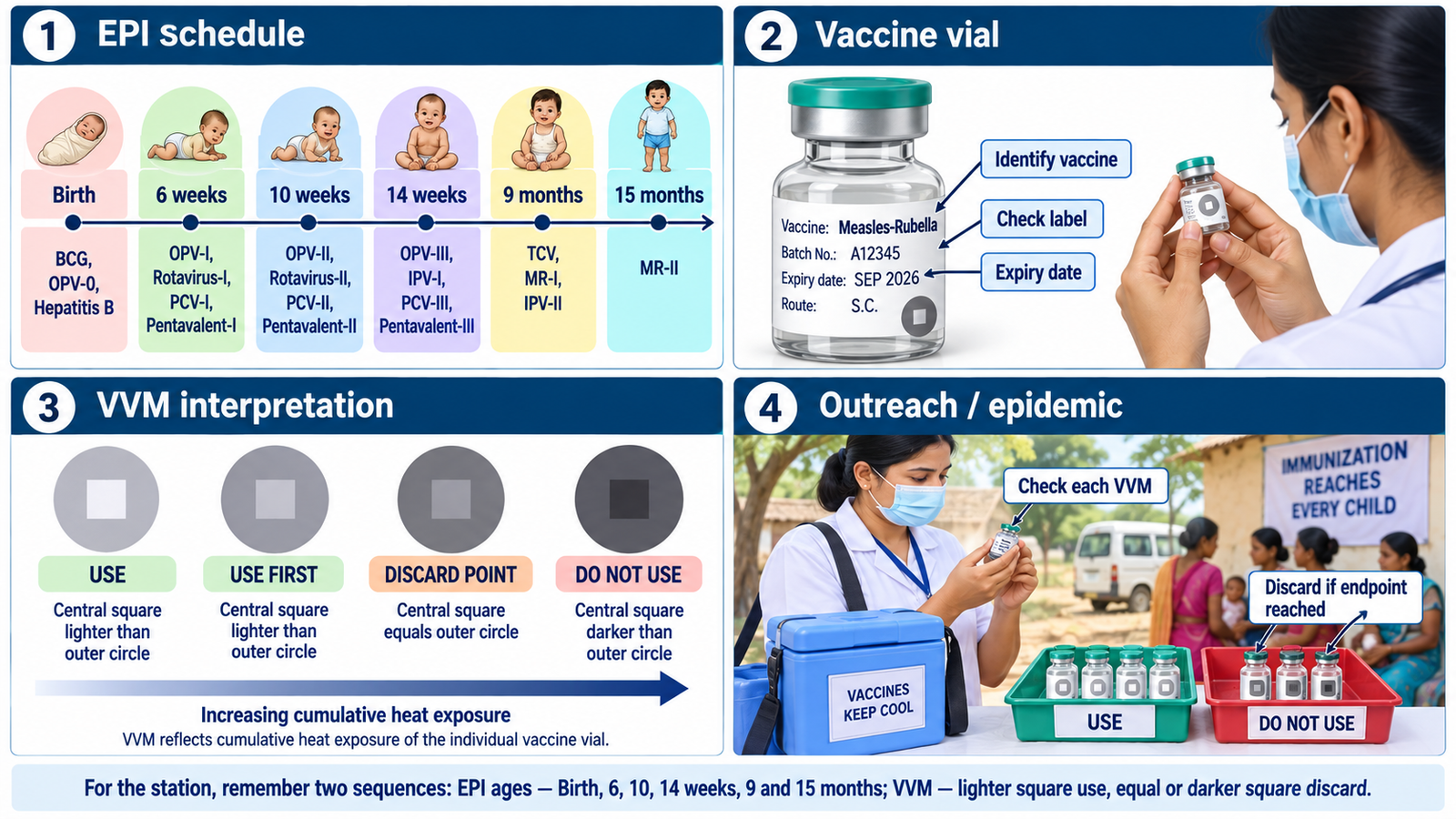
EPI counselling: Pakistan’s routine childhood schedule is organized at birth, 6 weeks, 10 weeks, 14 weeks, 9 months and 15 months. The mother should bring the child on time and keep the vaccination card safely.

VVM: If the inner square remains lighter than the outer circle, the vaccine may be used. If the square becomes the same colour as or darker than the outer circle, the vial has reached the discard point and must not be used.

Epidemic/outreach use: VVM helps health workers judge cumulative heat exposure of individual vials and safely prioritize usable vaccines during field vaccination activities.

🔎 How to Perform / Approach

  1. Step 1 — Identify the vaccine: Read the vial label and state the vaccine name and disease prevented.
  2. Step 2 — State its schedule: Mention the correct age or ages at which that vaccine is given under the EPI schedule.
  3. Step 3 — Counsel the mother: Explain that vaccines should be given on schedule and the immunization card should be brought at every visit.
  4. Step 4 — Check the VVM: Compare the colour of the inner square with the surrounding reference circle.
  5. Step 5 — Interpret: Inner square lighter = usable; equal to or darker than the circle = discard.
  6. Step 6 — Apply during outbreaks: Use the VVM to assess heat exposure of individual vials during outreach or mass vaccination activities.
  7. Step 7 — Close counselling: Confirm the next vaccination visit and invite the mother to ask questions.

Pakistan EPI — Rapid Schedule

Birth: BCG + OPV-0 + Hepatitis B birth dose

6 weeks: OPV-I + Rotavirus-I + PCV-I + Pentavalent-I

10 weeks: OPV-II + Rotavirus-II + PCV-II + Pentavalent-II

14 weeks: OPV-III + IPV-I + PCV-III + Pentavalent-III

9 months: TCV + MR-I + IPV-II

15 months: MR-II

Easy sequence: Birth → 6 → 10 → 14 weeks → 9 → 15 months.

🖼️ Visual Learning

VISUAL 1

Pakistan EPI Schedule and Vaccine Vial Monitor
 

📝 Important Viva Questions

1. What does a vaccine vial monitor measure?

Answer: A VVM indicates the cumulative heat exposure experienced by an individual vaccine vial over time.

2. When can a vaccine with a VVM still be used?

Answer: It can be used while the inner square remains lighter than the surrounding reference circle, provided other requirements such as expiry are also satisfactory.

3. What is the VVM discard point?

Answer: The discard point is reached when the inner square becomes the same colour as the outer circle; if it is equal or darker, the vaccine must not be used.

4. Why is the VVM particularly useful during epidemic or outreach vaccination?

Answer: It allows health workers to assess cumulative heat exposure of individual vaccine vials in field conditions and helps determine which vials remain usable.

5. At what ages are the routine childhood EPI visits completed up to 15 months?

Answer: The key visits are at birth, 6 weeks, 10 weeks, 14 weeks, 9 months and 15 months.

Scroll to Top
💬 WhatsApp Support