
Course Content
💊 Station 1 — Prescription Writing for Pulmonary Tuberculosis
Learning Outcomes Write an appropriate prescription for a supplied case of pulmonary tuberculosis. Include the essential components of a complete prescription: drugs, dose, route, frequency and duration. Demonstrate rational and safe anti-tuberculous prescribing according to the supplied clinical scenario.
0/1
⚖️ Station 2 — Differentiation of Hanging and Strangulation on a Model
Learning Outcomes Examine the provided model and differentiate hanging from strangulation. Demonstrate the important distinguishing features on the model. State the relevant medico-legal significance of the demonstrated findings.
0/1
⚖️ Station 3 — Identification of Different Types of Hanging on a Model
Learning Outcomes Examine the provided model depicting hanging. Differentiate the demonstrated types of hanging. Identify the features on the model that support the classification.
0/1
😷 Station 4 — Identification and Correct Wearing of Respiratory Masks
Learning Outcomes Identify the different masks provided at the station. State their appropriate uses. Demonstrate the correct protocol for wearing the selected mask.
0/1
💨 Station 5 — Correct Use of a Metered-Dose Inhaler with Spacer
Learning Outcomes Demonstrate the correct stepwise use of a metered-dose inhaler with a spacer. Perform the steps in the correct sequence. Demonstrate appropriate coordination of inhaler actuation and inhalation using the spacer.
0/1
💊 Station 6 — Prescription Writing for Acute and Chronic Asthma
Learning Outcomes Write an appropriate prescription for a supplied acute or chronic asthma scenario. Select appropriate medication(s), dose, route, frequency and duration. Demonstrate safe and complete prescription-writing practice.
0/1
🚨 Station 7 — Prescription Writing for Status Asthmaticus
Learning Outcomes Recognize that the supplied scenario represents severe/status asthmaticus requiring emergency treatment. Write the appropriate emergency pharmacological prescription/order. Include appropriate drugs, routes and dosing instructions in a clear prescription format.
0/1
📈 Station 8 — Interpretation of Spirometry in Asthma/COPD
Learning Outcomes Interpret a provided spirometry report. Identify an obstructive ventilatory pattern when present. Relate the spirometry findings to the supplied asthma/COPD clinical scenario.
0/1
🩺 Station 9 — Focused Assessment of an Asthma/COPD Patient
Learning Outcomes Perform a focused routine assessment of a patient with asthma or COPD. Identify important findings and relevant complications/red flags. Determine when specialist referral is required.
0/1
🩻 Station 10 — Identification of Common Abnormalities on Chest X-Ray
Learning Outcomes Examine a provided chest radiograph systematically. Identify and describe the major radiological abnormality demonstrated. Correlate the radiological finding with the supplied respiratory clinical scenario.
0/1
🫁 AIM OSPE/OSCE Lab — Respiratory-II Module | 3rd Year MBBS
AIM OSCE / OSPE • MBBS

Station 5 — Correct Use of a Metered-Dose Inhaler with Spacer

Rapid Revision • Practical Skills • Viva

🎯 Task

Candidate Task

You are provided with a pressurised metered-dose inhaler and spacer. Demonstrate the correct use of the device in the appropriate sequence, verbalising any important completion or safety steps.

⚡ Model Station Answer

I would check the inhaler and spacer, remove the cap, inspect the mouthpiece and shake the pMDI well before fitting it securely into the spacer. I would sit or stand upright, breathe out away from the device, seal my lips around the spacer mouthpiece and press the canister once, then immediately breathe in slowly and deeply. I would hold my breath for up to 10 seconds if comfortable and breathe out gently. If another puff is prescribed, I would wait briefly, shake again and repeat one puff at a time; after an inhaled corticosteroid, I would rinse my mouth and spit out the water.

🔎 Stepwise Procedure / Approach

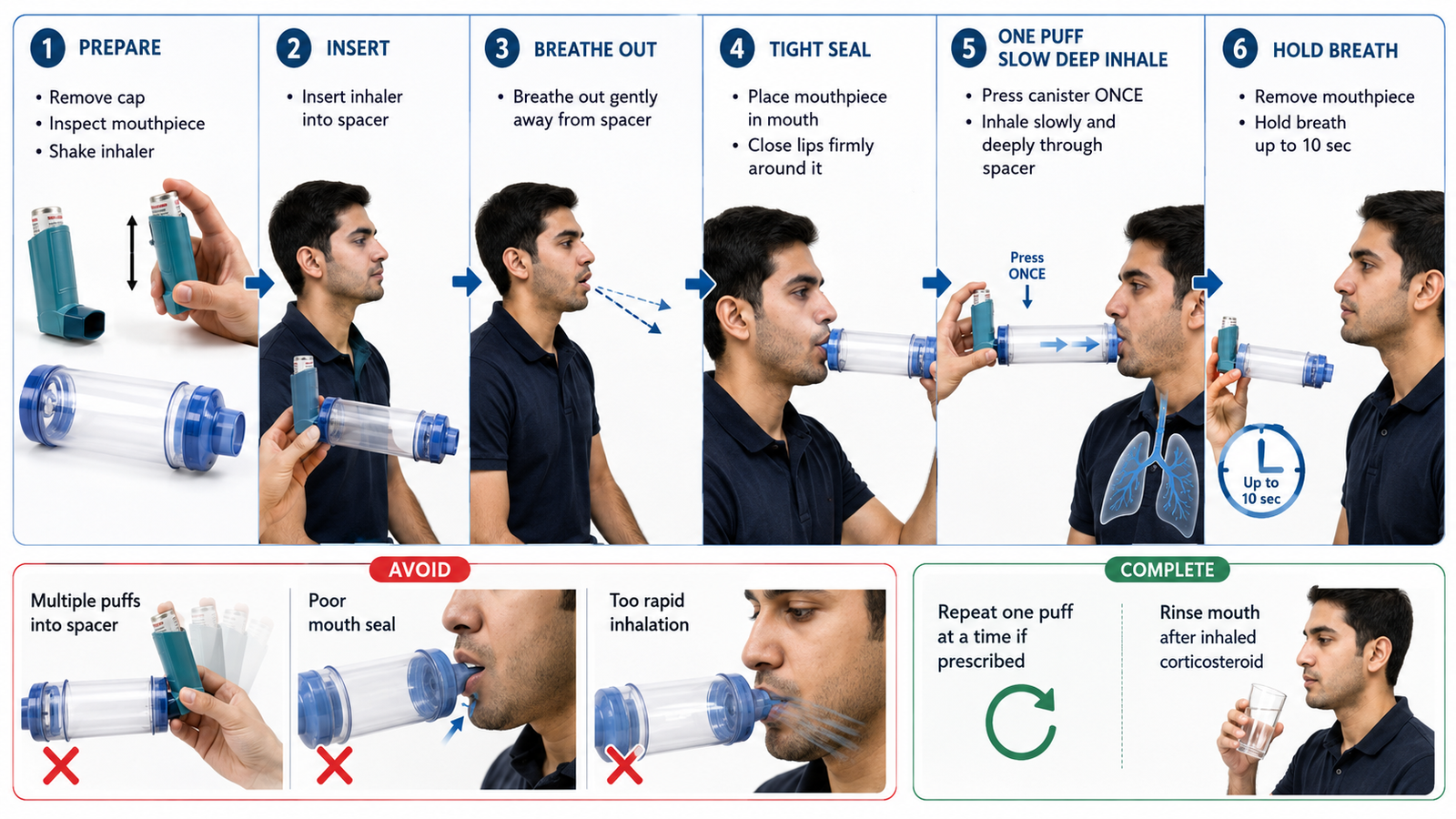
  1. Prepare the device. Perform hand hygiene, check the prescribed inhaler and ensure that the inhaler and spacer are clean and undamaged.
  2. Inspect and shake. Remove the inhaler cap, check that the mouthpiece is clear and shake the pMDI well. Prime the inhaler when required according to its instructions.
  3. Assemble correctly. Insert the pMDI mouthpiece firmly into the rear opening of the spacer.
  4. Position appropriately. Sit or stand upright with the head in a comfortable neutral or slightly elevated position.
  5. Breathe out first. Exhale gently and as fully as comfortable away from the spacer.
  6. Create a good seal. Place the spacer mouthpiece between the teeth and close the lips firmly around it without obstructing the opening.
  7. Actuate and inhale. Press the inhaler canister once and immediately inhale slowly and steadily through the spacer until the lungs feel full. Avoid firing several doses into the chamber together.
  8. Hold the breath. Remove the mouthpiece and hold the breath for up to 10 seconds, or as long as comfortably possible, then breathe out gently.
  9. Repeat correctly if required. For another prescribed puff, wait about 30–60 seconds, shake the inhaler again and repeat the technique one puff at a time.
  10. Complete the procedure. Replace the caps. If an inhaled corticosteroid has been used, rinse the mouth with water and spit it out.
Common OSCE error: Multiple actuations into the spacer, delayed inhalation after actuation, a poor lip seal or inhaling too rapidly can reduce effective drug delivery.

🖼️ Visual Learning

VISUAL 1

Correct pMDI + Spacer Technique — Examination Sequence
🎥 Practical Video

🎥 Practical Demonstration
How to use a pMDI inhaler with a spacer — single breath and hold
Source: Asthma + Lung UK • Inhaler technique series endorsed by the UK Inhaler Group

A practical demonstration of assembling the pMDI and spacer, breathing out, creating a mouthpiece seal, administering one puff, inhaling slowly and steadily, breath-holding and repeating a prescribed dose correctly.


▶ Watch Practical Video


📝 Important Viva Questions

Q1. Why is a spacer used with a pressurised metered-dose inhaler?

Answer: It reduces the need for precise hand-breath coordination, improves delivery of aerosol to the lungs and reduces deposition of medicine in the mouth and throat.

Q2. How many puffs should be actuated into the spacer at one time?

Answer: One puff at a time. If another dose is prescribed, the inhaler should be shaken again and the technique repeated.

Q3. How should the patient inhale after actuating the pMDI into the spacer?

Answer: The patient should inhale slowly and steadily through the mouth until the lungs feel full.

Q4. For how long should the breath ideally be held after inhalation?

Answer: Up to about 10 seconds, or for as long as the patient can comfortably manage.

Q5. What does a whistle from some valved spacers usually indicate?

Answer: It usually indicates that the patient is inhaling too rapidly and should breathe in more slowly.

Q6. What alternative technique can be used if the patient cannot take and hold one deep breath?

Answer: After one actuation into the spacer, the patient may use slow tidal breathing for several breaths, commonly about five breaths, when this technique is recommended.

Q7. What should the patient do after using an inhaled corticosteroid?

Answer: Rinse the mouth with water and spit the water out to reduce local adverse effects such as oral candidiasis and dysphonia.

([asthmaandlung.org.uk][1])

[1]: https://www.asthmaandlung.org.uk/living-with/inhaler-videos/spacer-single-breath?utm_source=chatgpt.com “How to use a pMDI inhaler with a spacer – single breath and hold | Asthma + Lung UK”

Scroll to Top
💬 WhatsApp Support