
⚖️ Station 3 — Identification of Different Types of Hanging on a Model
Rapid Revision • Model Recognition • Forensic Medicine • Viva
🎯 Task
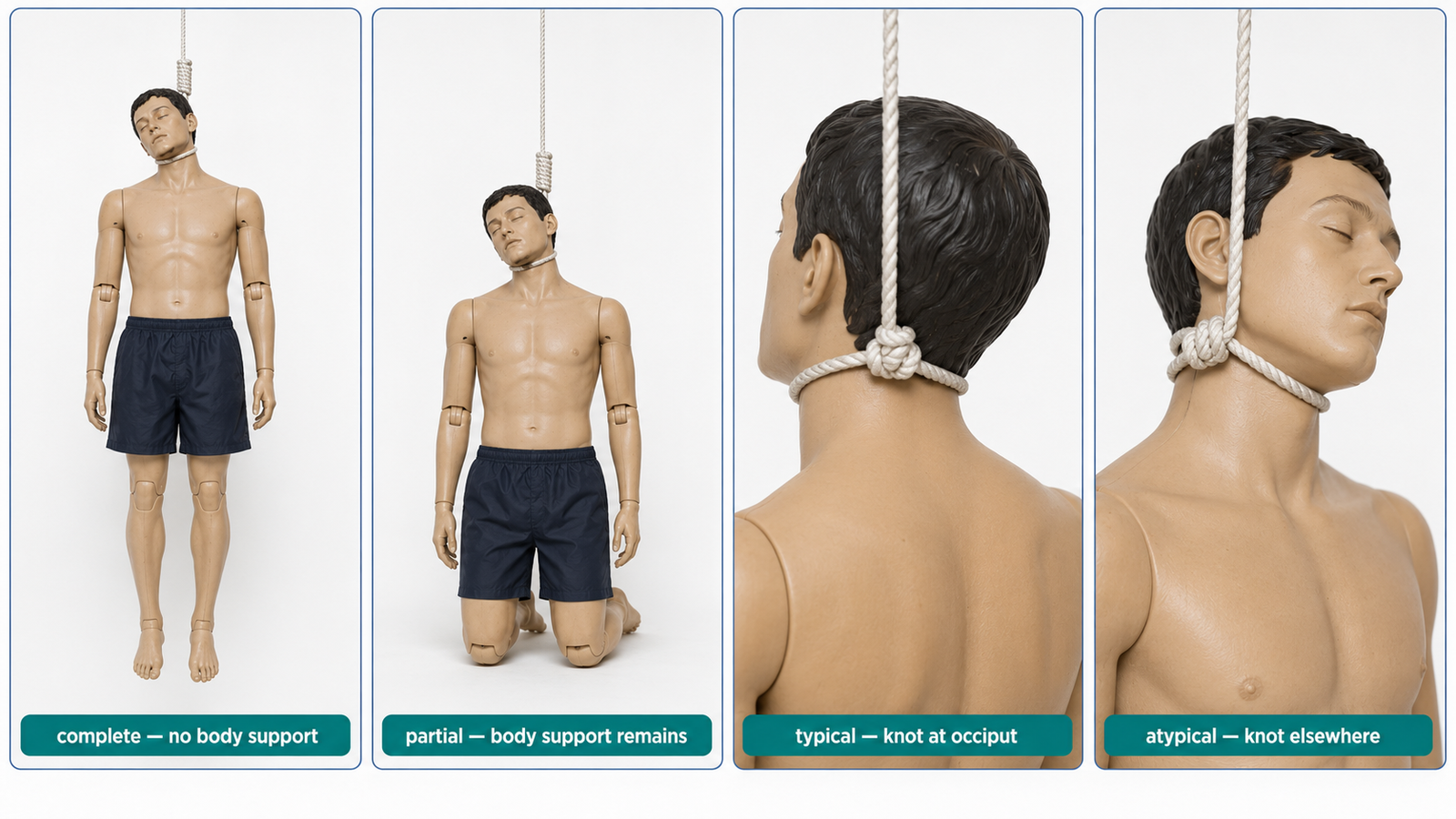
Examine the provided forensic teaching model. Identify and classify the type of hanging demonstrated, and state the visible features on the model that support your classification.
⚡ Model Station Answer — What to say in the exam
🔎 Stepwise Procedure / Approach
- Observe the whole model first. Determine the relationship of the body to the suspension point and any supporting surface.
- Assess body suspension. Look specifically for whether the feet, knees, buttocks or another body part remain in contact with the ground or another support.
- Classify by suspension. No body support indicates complete hanging; persistent support of any body part indicates incomplete/partial hanging.
- Locate the knot. Examine where the ligature knot is positioned in relation to the back, sides and front of the neck.
- Classify by knot position. A knot at the occiput in the posterior midline supports typical hanging; a knot at another position supports atypical hanging.
- Correlate all visible features. Do not classify the model from a single feature if both suspension and knot position can be assessed.
- State the answer clearly. Name the demonstrated type and immediately mention the visible feature that justifies your classification.
🖼️ Visual Learning
Recognition of Complete, Partial, Typical and Atypical Hanging
🎥 Practical Video
🎥 Practical Demonstration — Hanging: Types and Forensic Features
Source: Forensic with Priyanka
Useful MBBS-focused demonstration and explanation of the major classifications of hanging, including complete versus partial and typical versus atypical hanging.
📝 Important Viva Questions
Answer: Hanging is a form of mechanical asphyxia caused by constriction of the neck by a ligature, where the constricting force is produced by the weight of the whole body or part of the body.
Answer: In complete hanging, the body is fully suspended and no part of it is supported by the ground or another surface.
Answer: In partial hanging, some part of the body remains supported while the neck is still subjected to constriction by the ligature through partial body weight.
Answer: Typical hanging is conventionally described when the knot is situated over the occiput in the posterior midline.
Answer: Atypical hanging is hanging in which the knot is situated at a position other than the occipital posterior midline, such as the side or front of the neck.
Answer: No. Partial hanging may occur with the feet, knees, buttocks or another part of the body supported, provided sufficient body weight acts through the ligature to constrict the neck.
Answer: Yes. Complete or partial refers to the degree of body suspension, whereas typical or atypical refers to the position of the knot; therefore both descriptions may apply to the same case.