
AIM OSCE / OSPE • MBBS
Station 7 — Prescription Writing for Status Asthmaticus
Rapid Revision • Emergency Prescribing • Viva
🎯 Task
CANDIDATE TASK
A 28-year-old adult with known asthma presents with marked breathlessness, inability to complete sentences, respiratory rate 32/min, SpO₂ 88% on room air and markedly reduced peak expiratory flow. Write the immediate emergency pharmacological prescription/order, clearly stating the drugs, doses, routes and dosing instructions.
⚡ Model Station Answer
⚡ Model Station Answer
What to write / say in the exam
This is a severe, potentially life-threatening acute asthma exacerbation requiring immediate supervised emergency treatment.
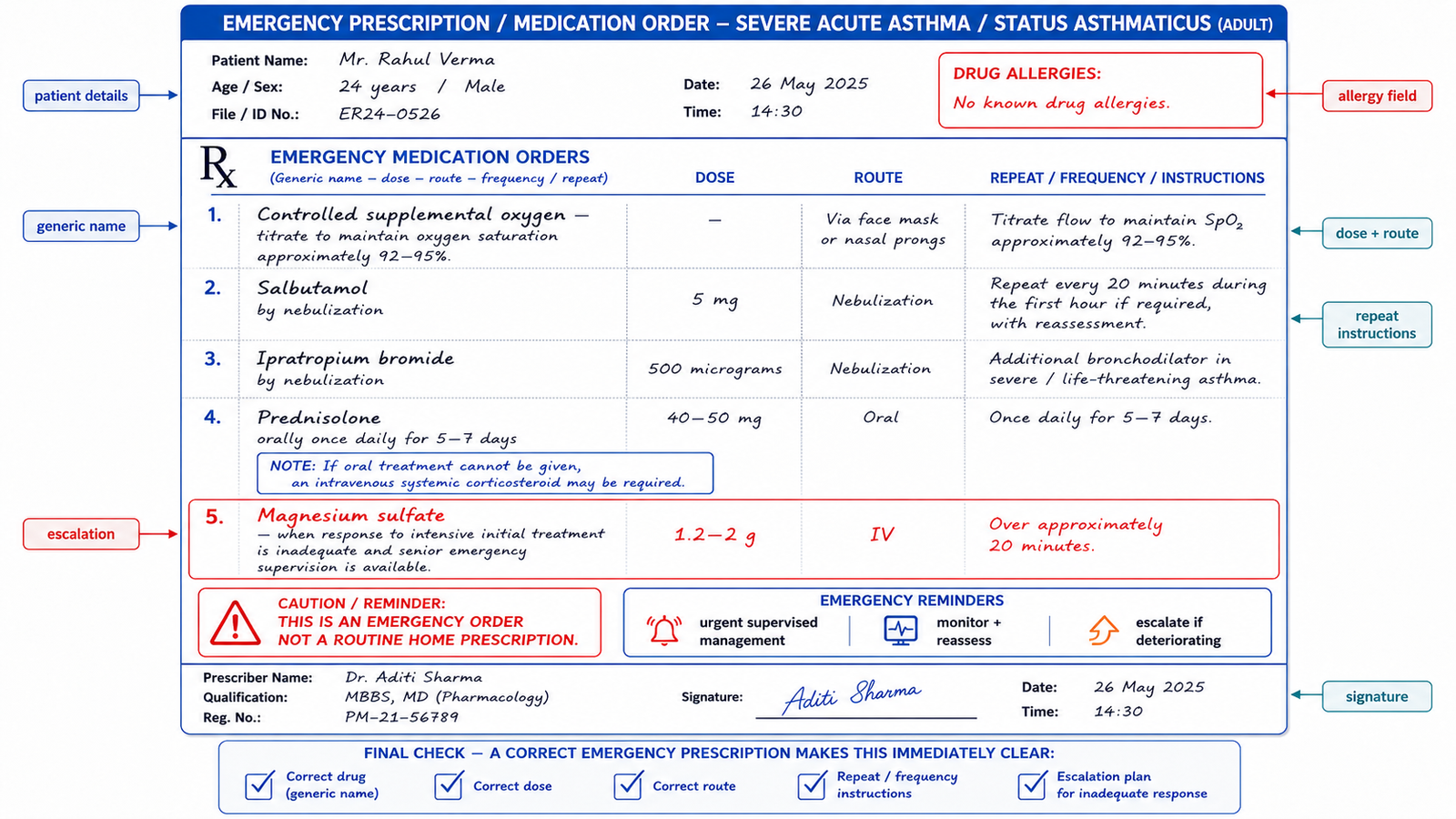
Rx
1. Oxygen: Give controlled supplemental oxygen and titrate to maintain adult SpO₂ approximately 92–95%.
2. Salbutamol: 5 mg by nebulization; repeat every 20 minutes during the first hour if required, with close reassessment.
3. Ipratropium bromide: 500 micrograms by nebulization, given with repeated bronchodilator treatment during initial management of severe/life-threatening asthma.
4. Prednisolone: 40–50 mg orally once daily, usually for 5–7 days. If oral treatment cannot be given, use an appropriate intravenous systemic corticosteroid according to the emergency protocol.
5. If inadequate response to intensive initial treatment: consider magnesium sulfate 1.2–2 g IV over approximately 20 minutes with senior/emergency supervision.
Emergency point: Status asthmaticus is not managed as a routine home prescription. Call for senior/emergency help, monitor continuously and escalate to critical care if the patient deteriorates or has life-threatening features.
🔎 Stepwise Procedure / Approach
- Review the scenario first. Recognize severe or life-threatening asthma and treat the prescription as an emergency order.
- Check patient identifiers, allergies, date and time. Confirm that the prescription/order belongs to the correct patient.
- Prescribe supplemental oxygen with a clearly stated target saturation rather than writing “oxygen PRN”.
- Prescribe rapid inhaled bronchodilation. Write salbutamol with the exact dose, nebulized route and repeat instructions.
- Add inhaled ipratropium in severe or life-threatening exacerbation and specify the nebulized dose.
- Prescribe an early systemic corticosteroid. State drug, dose, route, frequency and intended short course.
- Escalate if response is inadequate. Consider IV magnesium sulfate under supervised acute-care management rather than adding routine sedatives or unnecessary drugs.
- Check the completed order. Verify generic drug names, units, routes, frequencies, allergies and avoid ambiguous abbreviations.
- Authenticate the prescription. Add prescriber name/identifier, signature and date/time according to local practice.
Exam tip: Marks are commonly lost by writing only drug names without the dose + route + frequency/repeat instruction, or by forgetting patient details, allergies, date/time and prescriber authentication.
🖼️ Visual Learning
VISUAL 1
Emergency Prescription Writing for Severe / Status Asthmaticus
🎥 Practical Video
🎥 Practical Demonstration — ABCDE Assessment: Asthma Exacerbation
Source: Geeky Medics
Demonstrates recognition and immediate management of an acute asthma exacerbation using an ABCDE emergency approach, including treatment, reassessment and escalation relevant to the clinical context in which the emergency prescription is written.
📝 Important Viva Questions
Q1. Why is status asthmaticus treated as a medical emergency?
Answer: It is a severe asthma exacerbation that may fail to respond adequately to usual reliever therapy and can progress to respiratory failure, so rapid treatment, monitoring and escalation are required.
“`
Q2. What is the principal rapid bronchodilator used initially?
Answer: An inhaled short-acting β₂-agonist such as salbutamol, administered repeatedly during initial treatment according to severity and response.
Q3. Why is ipratropium added in severe acute asthma?
Answer: It provides additional bronchodilation when combined with a short-acting β₂-agonist and is particularly useful in severe or life-threatening exacerbations.
Q4. Why should systemic corticosteroids be given early?
Answer: They suppress airway inflammation, reduce the risk of continuing deterioration or relapse and improve recovery, although their clinical effect is not immediate.
Q5. When may intravenous magnesium sulfate be considered?
Answer: It may be considered in severe or life-threatening exacerbation when the response to intensive initial bronchodilator and corticosteroid treatment is inadequate.
Q6. Which prescribing details must accompany every emergency drug order?
Answer: The prescription should clearly state the generic drug name, dose, route and frequency or repeat instructions, together with patient identifiers, allergies, date/time and prescriber authentication.
Q7. Name two drugs or treatments that should not be prescribed routinely in an uncomplicated asthma exacerbation.
Answer: Sedatives should be avoided, and antibiotics should not be prescribed routinely unless there is a separate clinical indication for bacterial infection.