
😷 Station 4 — Identification and Correct Wearing of Respiratory Masks
Rapid Revision • Practical Skills • Viva
🎯 Task
Examine the respiratory masks provided at the station. Identify each mask, state its appropriate use, and demonstrate the correct method of wearing the mask selected by the examiner.
⚡ Model Station Answer
What to say in the exam
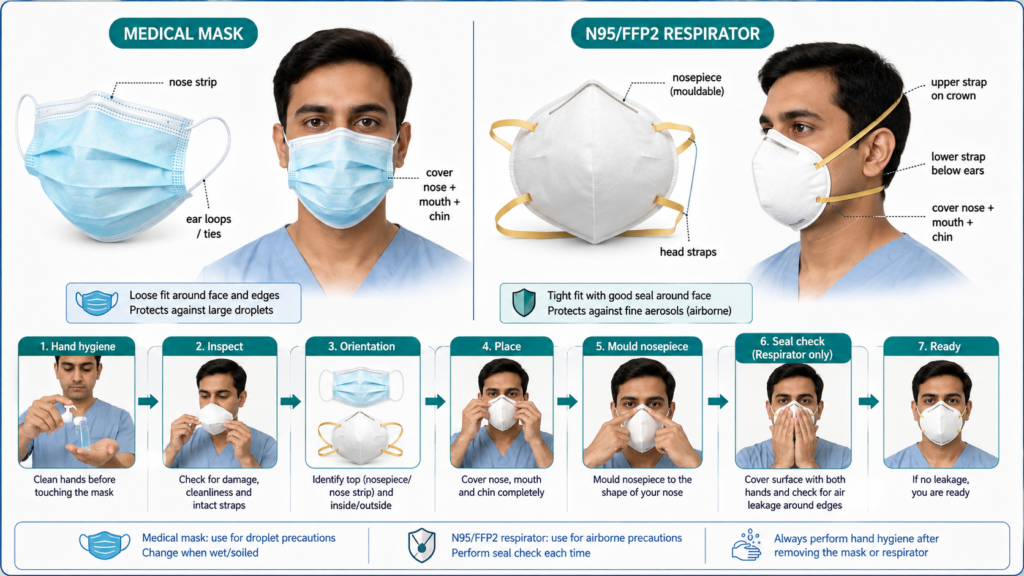
Medical/surgical mask: A loose-fitting medical mask used mainly for droplet and splash protection and source control; it does not provide the tight facial seal of a respirator.
N95/FFP2-type respirator: A close-fitting filtering facepiece respirator used when protection from airborne particles is required; correct fit is essential.
Correct wearing: I perform hand hygiene, inspect and orient the mask correctly, cover the nose, mouth and chin, secure the straps, mould the nosepiece and, for a respirator, perform a user seal check.
🔎 Stepwise Procedure / Approach
- Perform hand hygiene before handling the mask or respirator.
- Inspect and identify the mask. Check that it is clean, dry, intact and appropriate for the required clinical situation.
- For a medical/surgical mask, identify the upper edge with the nosepiece and place the mask over the nose, mouth and chin with the correct surface facing outward.
- Secure the ear loops or ties and mould the nosepiece over the bridge of the nose. Adjust the mask so there are no obvious side gaps.
- For an N95/FFP2-type respirator, cup it over the nose and chin. Position the lower strap below the ears and the upper strap high on the crown of the head, according to the manufacturer’s design.
- Mould the respirator nosepiece using both hands and perform a user seal check. Reposition the respirator if air leakage is detected around its edges.
- While wearing it, avoid unnecessary touching of the front. Replace the device if it becomes damaged, visibly soiled or excessively damp, according to local infection-control policy.
- To remove it, perform hand hygiene as required and handle only the straps, ties or ear loops, avoiding the contaminated front. Dispose of or reprocess it according to the device and institutional policy, then perform hand hygiene again.
🖼️ Visual Learning
Medical Mask vs N95/FFP2 Respirator — Recognition and Correct Wearing
🎥 Practical Video
🎥 Put on N95 Respirator
This short practical demonstration shows correct N95 placement, head-strap positioning, moulding of the nosepiece and the fit/seal check expected during respirator donning.
📝 Important Viva Questions
Q1. What is the main difference between a medical mask and an N95 respirator?
Answer: A medical mask is loose-fitting and mainly provides droplet, splash and source-control protection, whereas an N95 is a tight-fitting respirator designed to reduce inhalation of airborne particles.
Q2. When is a particulate respirator such as an N95 required?
Answer: It is used when airborne respiratory protection is indicated, including situations specified by infection-control precautions and aerosol-generating procedures where appropriate.
Q3. Which parts of the face must a correctly worn mask cover?
Answer: It must cover the nose, mouth and chin securely.
Q4. What is a user seal check?
Answer: It is a check performed after donning a tight-fitting respirator to detect leakage around its edges and confirm that an adequate facial seal has been achieved.
Q5. Is a user seal check the same as respirator fit testing?
Answer: No. A seal check is performed each time the respirator is worn, while formal fit testing assesses whether a particular respirator model and size adequately fits the wearer.
Q6. Why can facial hair interfere with an N95 respirator?
Answer: Hair lying between the respirator sealing surface and the skin can create gaps and prevent an effective facial seal.
Q7. What is a common OSCE mistake while removing a used mask?
Answer: Touching the potentially contaminated front surface. The mask should be removed using the straps, ties or ear loops, followed by appropriate hand hygiene.