
AIM OSCE / OSPE • MBBS
💊 Station 6 — Prescription Writing for Acute and Chronic Asthma
Rapid Revision • Prescription Skill • Safe Prescribing • Viva
🎯 Task
You are provided with an adult patient scenario involving acute or chronic asthma. Write a complete and appropriate prescription, including the medication, formulation, strength, dose, route, frequency and duration or quantity, and ensure that the prescription is safely completed and authenticated.
⚡ Model Station Answer
I will first confirm the patient details, date, allergies, current medicines and clinical scenario, then prescribe using generic names with the formulation, strength, dose, route, frequency and duration or quantity clearly stated.
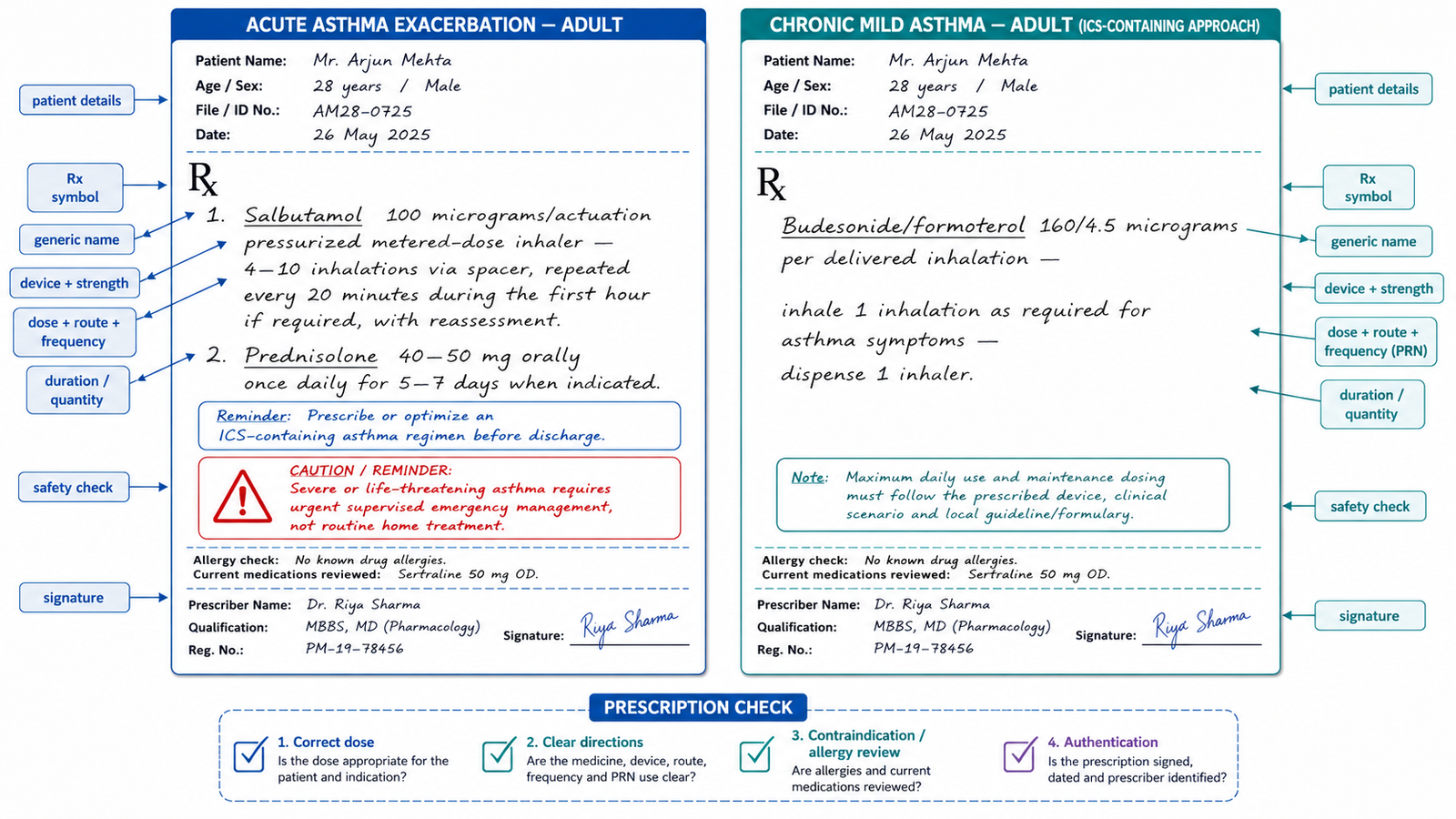
Salbutamol 100 micrograms/actuation pMDI: give 4–10 inhalations via spacer, repeated every 20 minutes for the first hour if required, with reassessment.
Prednisolone 40–50 mg orally once daily for 5–7 days when systemic corticosteroid treatment is indicated. Ensure appropriate ICS-containing therapy is prescribed before discharge.
Budesonide/formoterol 160/4.5 micrograms per delivered inhalation: inhale 1 inhalation as required for asthma symptoms; dispense one inhaler. The prescribed device, maximum permitted daily use and further maintenance dosing must match the supplied scenario and locally available preparation.
I will finally check for dose errors, duplication, contraindications and unclear abbreviations, then add the required prescriber identification, date and signature.
Exam safety: A severe or life-threatening acute attack requires urgent assessment and emergency management; it should not be treated as a routine outpatient prescription-writing exercise. Match the final prescription to the exact scenario and local formulary.
🔎 Stepwise Procedure / Approach
- Review the supplied scenario. Decide whether the prescription is for an acute exacerbation or ongoing chronic control and assess the severity described.
- Check prescribing safety. Review age, drug allergies, previous asthma treatment, current medicines, important comorbidities and any contraindications.
- Enter patient details and date. Use the identifiers provided in the station and do not invent missing clinical information.
- Select an appropriate asthma regimen. Acute exacerbations require rapid bronchodilator therapy and, when indicated, a short systemic corticosteroid course; chronic asthma requires an ICS-containing treatment strategy.
- Write each medicine completely. State the generic name, dosage form or inhaler device, strength and prescribed dose.
- Give unambiguous directions. State the route, frequency, PRN indication where relevant, and any essential maximum-use instruction.
- Specify duration or quantity. State the corticosteroid course length and/or the number of inhalers or other quantity to be supplied as appropriate.
- Perform a final prescription check. Look specifically for omitted strength, route, frequency, duration, quantity, inappropriate duplication or unsafe abbreviations.
- Authenticate the prescription. Complete the prescriber identification, registration field where required, date and signature.
🖼️ Visual Learning
Visual 1 — Acute vs Chronic Asthma Prescription Writing
🎥 Practical Video
🎥 Practical Demonstration — Prescription Writing 101
Source: Medical School HQ
This teaching video demonstrates the practical structure of a prescription, including patient identifiers, medication and strength, dose and route, frequency, quantity/refills and prescriber authentication. Apply the same writing framework to the asthma regimen supplied in the OSCE station.
📝 Important Viva Questions
Q1. What essential information should be written for each prescribed medicine?
The generic medicine name, dosage form or device, strength, dose, route, frequency and duration or quantity should be clearly stated.
Q2. What is the preferred general principle for long-term asthma pharmacotherapy?
Long-term asthma treatment should contain an inhaled corticosteroid; SABA-only treatment is not preferred as ongoing therapy because it does not treat the underlying airway inflammation.
Q3. Give an example of an ICS-containing reliever regimen for mild asthma in an adult.
A commonly used example is low-dose budesonide/formoterol 160/4.5 micrograms per delivered inhalation, one inhalation as required, with device-specific maximum use and local prescribing guidance followed.
Q4. What is the usual adult oral prednisolone course for an asthma exacerbation when systemic corticosteroids are indicated?
40–50 mg orally once daily for 5–7 days is a commonly recommended adult course.
Q5. What is an important role of salbutamol during an acute asthma exacerbation?
It is a rapid-acting inhaled bronchodilator used to relieve acute bronchoconstriction, preferably delivered by pMDI with a spacer when appropriate.
Q6. What should you check before finalizing an asthma prescription?
Check allergies, current medicines, treatment duplication, contraindications, correct inhaler/device and dose, route, frequency, duration or quantity, and complete prescriber authentication.
Q7. Name common prescription-writing errors in an OSCE.
Missing patient details, formulation or strength, unclear dose or frequency, omitted route or duration, unsafe abbreviations, inappropriate drug selection and failure to date or sign the prescription.