
⚖️ Station 2 — Differentiation of Hanging and Strangulation on a Model
🎯 Task
Examine the provided neck models and differentiate the findings of hanging from strangulation. Demonstrate the important distinguishing features and state their relevant medicolegal significance.
⚡ Model Station Answer
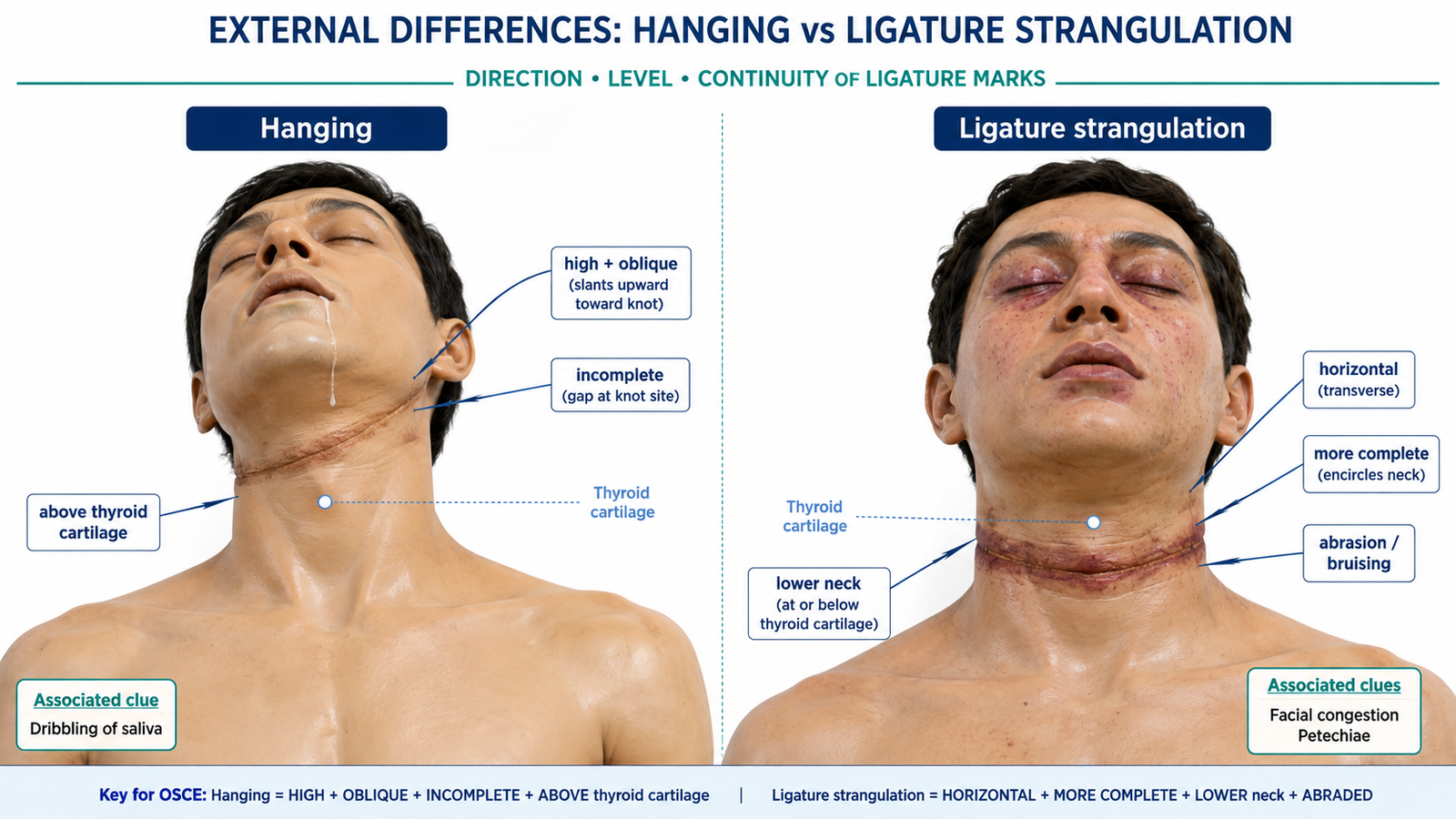
Hanging: The ligature mark is classically high in the neck, oblique and incomplete, usually ascending toward the knot and commonly lying above the thyroid cartilage.
Ligature strangulation: The mark is usually horizontal or transverse, lower in the neck and more completely encircling the neck, often with surrounding abrasion or bruising.
Associated clues: Dribbling of saliva may support hanging, whereas facial congestion, petechiae and soft-tissue injury of the neck are generally more prominent in strangulation.
Medicolegal significance: Hanging is most commonly suicidal and strangulation is most commonly homicidal, but the manner of death must be decided only after correlation with the scene, history and complete postmortem examination.
🔎 Stepwise Procedure / Approach
- Inspect both neck models systematically. First identify the ligature mark or area of neck compression without immediately assuming the diagnosis.
- Trace the direction of the mark. Look for an oblique upward course versus a horizontal or transverse course.
- Assess its level. Determine whether the mark lies predominantly above the thyroid cartilage or lower around the central neck.
- Assess continuity. Look for an incomplete mark or gap near the knot position versus a more complete circumferential mark.
- Examine the character of the mark. Hanging typically produces a dry, pale or parchment-like mark; strangulation may show greater abrasion, bruising or ecchymosis.
- Look for associated modeled findings. Note salivary dribbling if demonstrated, facial congestion or petechiae, and any associated neck or struggle injuries shown on the model.
- State the interpretation and medicolegal significance. Identify the pattern as most consistent with hanging or strangulation and explain that no single external finding alone establishes the manner of death.
🖼️ Visual Learning
Hanging vs Ligature Strangulation — Model Recognition
🎥 Practical Video
A focused examination-oriented comparison of the major forensic findings used to distinguish hanging from strangulation, useful for reinforcing ligature-mark recognition before the station.
📝 Important Viva Questions
Answer: Hanging is constriction of the neck by a ligature in which the constricting force is produced by the weight of the whole body or part of the body.
Answer: It is compression of the neck by a ligature tightened by an external force other than the weight of the body.
Answer: In hanging the mark is usually high, oblique and incomplete; in ligature strangulation it is usually lower, horizontal or transverse and more completely circumferential.
Answer: Because the ligature is pulled upward toward the point of suspension or knot by the weight of the body.
Answer: Salivary dribbling is a useful finding supporting antemortem hanging, although its absence does not exclude hanging.
Answer: Hanging is usually suicidal, whereas strangulation is usually homicidal. These are general patterns and not absolute rules.
Answer: No. The ligature mark must be interpreted together with scene findings, circumstances, other external and internal injuries and the complete postmortem examination.