
AIM OSCE / OSPE • MBBS
Station 9 — Focused Assessment of an Asthma/COPD Patient
Rapid Revision • Clinical Assessment • Examination • Viva
🎯 Task
Perform a focused routine assessment of this adult patient with asthma or COPD.
Present your important findings, identify any concerning features or complications, and state whether further escalation or specialist assessment is required.
⚡ Model Station Answer
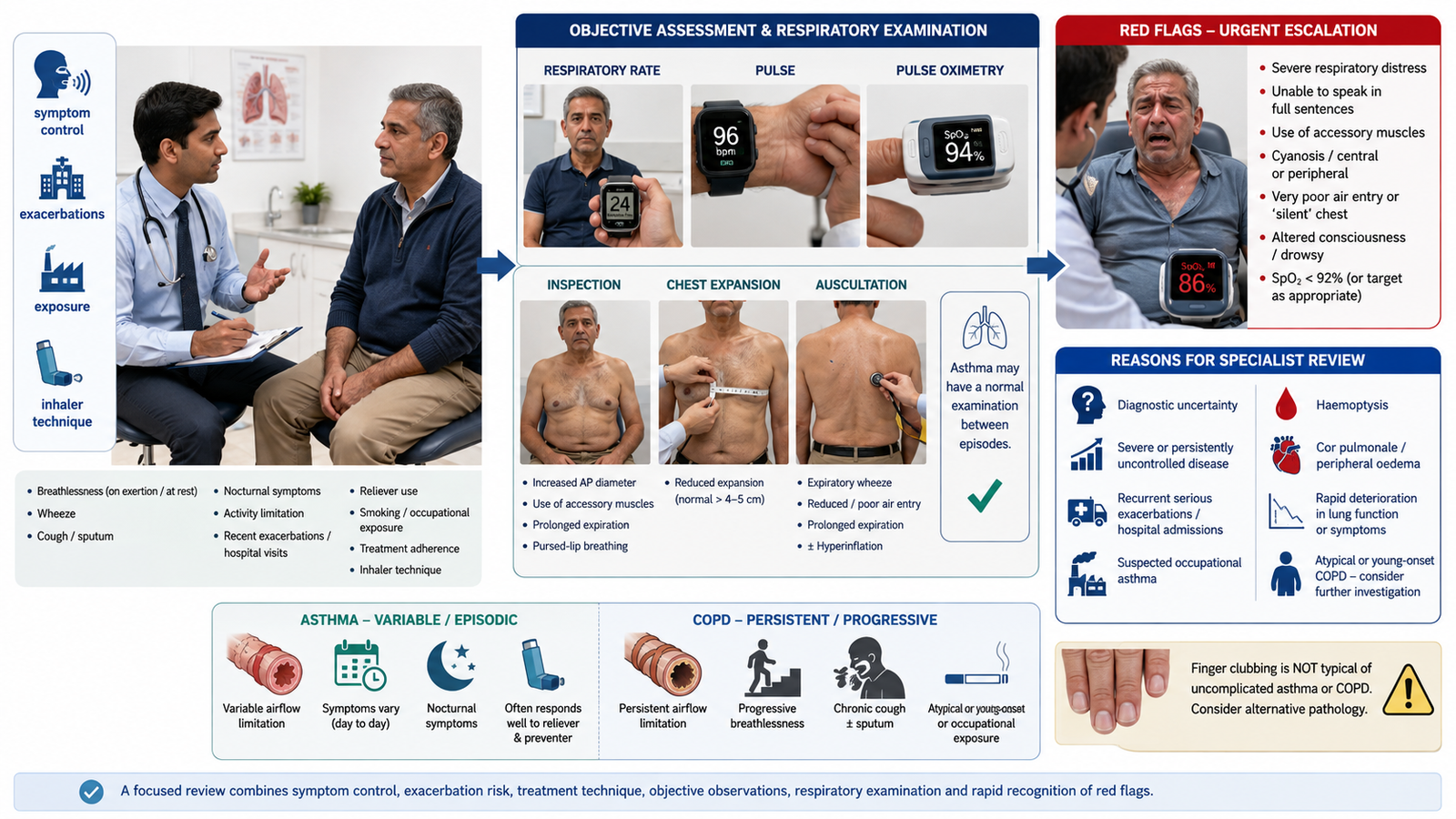
- I would assess current respiratory symptoms, functional limitation, nocturnal symptoms, reliever use and recent exacerbations or hospital attendance.
- I would review smoking or occupational exposure, treatment adherence and inhaler technique, then record respiratory rate, pulse and oxygen saturation.
- I would perform a focused respiratory examination for wheeze, reduced air entry, hyperinflation and signs of complications such as cyanosis, cachexia or cor pulmonale.
- Marked respiratory distress, silent chest, cyanosis, altered consciousness or significant hypoxaemia require urgent escalation.
- Specialist referral is appropriate for diagnostic uncertainty, severe or persistently uncontrolled disease, recurrent serious exacerbations, suspected occupational asthma, haemoptysis, cor pulmonale/hypoxaemia, rapid deterioration or atypical features.
🔎 Stepwise Procedure / Approach
- Introduce yourself, confirm identity and obtain consent.
Observe immediately whether the patient appears comfortable or acutely breathless. - Assess current symptoms and control.
Ask about breathlessness, wheeze, cough, sputum, chest tightness, nocturnal symptoms and limitation of normal activity. - Assess exacerbation risk.
Ask about recent worsening, courses of oral corticosteroids or antibiotics, emergency visits, hospital admissions and increasing reliever use. - Identify relevant triggers and risk factors.
Ask about smoking or vaping, occupational exposure, allergens or environmental triggers and important respiratory comorbidities. - Review current treatment.
Check prescribed inhalers, adherence and whether the patient can demonstrate correct inhaler technique. - Record observations.
Assess respiratory rate, pulse, oxygen saturation and general condition; review peak flow or spirometry results if available. - Perform a focused respiratory examination.
Inspect breathing pattern and chest shape, assess expansion and percussion where indicated, and auscultate for wheeze, reduced air entry or additional sounds. - Look for complications and alternative pathology.
Check for cyanosis, weight loss/cachexia, raised JVP or peripheral oedema, and note unexpected findings such as clubbing or haemoptysis. - Identify red flags.
Severe breathlessness at rest, inability to speak normally, marked use of accessory muscles, silent or very poorly ventilated chest, cyanosis, altered consciousness or significant hypoxaemia require urgent assessment. - Conclude and decide on referral.
Summarise control and examination findings, identify reversible reasons for poor control, and recommend specialist review when disease is severe, atypical, uncertain or inadequately controlled despite appropriate routine care.
🖼️ Visual Learning
Focused Asthma/COPD Assessment — What to Check in the OSCE
🎥 Practical Video
🎥 Respiratory Examination | OSCE Guide | UKMLA | CPSA | PLAB 2
A practical OSCE demonstration of systematic respiratory examination, including inspection, chest expansion, percussion, auscultation and presentation of findings.
📝 Important Viva Questions
Answer: Asthma usually produces variable or episodic symptoms, often with nocturnal or trigger-related worsening. COPD more often causes persistent progressive breathlessness with chronic cough or sputum in a patient with significant smoking or inhalational exposure.
Answer: Frequent symptoms, night waking, activity limitation, increasing reliever use and recurrent exacerbations or emergency attendance suggest poor control.
Answer: Incorrect technique and poor adherence are common reversible causes of apparently uncontrolled obstructive airway disease and should be addressed before unnecessary treatment escalation.
Answer: Findings may include prolonged expiration, reduced air entry, wheeze, hyperinflation and reduced chest expansion. Advanced disease may produce cachexia, cyanosis or signs of cor pulmonale.
Answer: No. Examination may be completely normal between symptomatic episodes, so the history and appropriate objective assessment remain important.
Answer: No. Clubbing should prompt consideration of another or additional pathology such as bronchiectasis or bronchogenic malignancy.
Answer: Severe respiratory distress, inability to speak normally, cyanosis, very poor air entry or silent chest, significant hypoxaemia or altered consciousness require urgent assessment and management.
Answer: Consider referral for diagnostic uncertainty, severe or persistently uncontrolled disease, recurrent serious exacerbations, suspected occupational asthma, haemoptysis, cor pulmonale or hypoxaemia, rapid deterioration, symptoms disproportionate to lung-function impairment or atypical/young-onset COPD.