
Station 1 — Obesity: Anthropometric Measurement & Risk Assessment
MS Module • Medicine • Final Year MBBS
Rapid Revision • Clinical Skills • Practical Skills • Viva
🎯 Candidate Task
Demonstrate the measurement of height, weight and waist circumference in the simulated patient. Calculate and interpret the body mass index (BMI), classify the patient’s weight status and identify the associated clinical risks.
⚡ Model Station Answer
Measurements: Record weight in kg, height in metres and waist circumference in cm using correct technique.
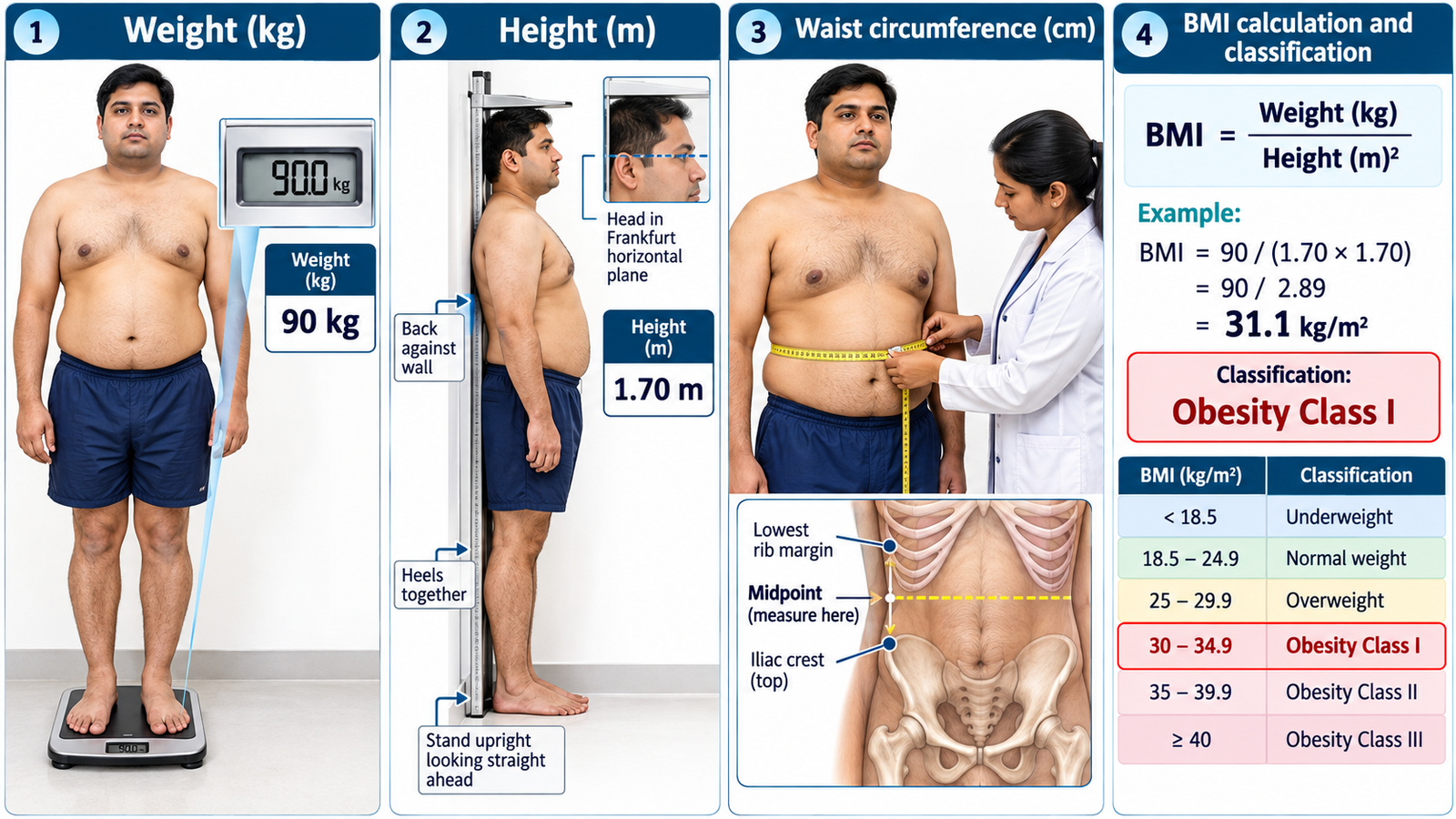
BMI: Weight (kg) ÷ height² (m²).
Classification: Underweight <18.5; normal 18.5–24.9; overweight 25–29.9; obesity class I 30–34.9, class II 35–39.9 and class III ≥40 kg/m².
Central obesity: Increased waist circumference indicates additional cardiometabolic risk; South Asian risk thresholds commonly used are ≥90 cm in men and ≥80 cm in women.
Clinical risks: Type 2 diabetes, hypertension, cardiovascular disease, obstructive sleep apnea and osteoarthritis.
🔎 How to Perform / Approach
- Introduce and prepare: Confirm identity, explain the measurements, obtain consent, maintain privacy and perform hand hygiene.
- Measure weight: Use a calibrated scale on a firm, level surface; remove shoes and heavy outer clothing. Record in kg.
- Measure height: Stand barefoot against a stadiometer, heels on the floor, body upright, head in the Frankfurt horizontal plane. Record in metres.
- Measure waist circumference: Identify the midpoint between the lowest palpable rib and iliac crest; place a non-stretch tape horizontally without compressing skin. Measure after normal expiration.
- Calculate BMI: Divide weight in kg by the square of height in metres. State the BMI in kg/m².
- Classify findings: Apply the standard adult BMI categories and interpret waist circumference using appropriate ethnic and sex-specific thresholds.
- Assess clinical risk: Relate increased BMI and central adiposity to diabetes, hypertension, cardiovascular disease, sleep apnea and weight-bearing joint disease.
🖼️ Visual Learning
Anthropometric Assessment — Height, Weight, Waist Circumference & BMI
🎥 Practical Demonstration
CDC / NHANES — Anthropometric Procedure Videos
Watch Part 2 (Weight), Part 3 (Standing Height) and Part 5 (Circumferences) for standardized measurement technique.
📝 Important Viva Questions
Q1. What is the formula for body mass index?
Answer: BMI = weight in kilograms divided by height in metres squared (kg/m²).
Q2. How is obesity classified using BMI?
Answer: Class I: 30–34.9; Class II: 35–39.9; Class III: ≥40 kg/m².
Q3. How is waist circumference measured correctly?
Answer: Measure horizontally at the midpoint between the lowest rib and iliac crest, at the end of normal expiration, without compressing the skin.
Q4. What waist measurements indicate increased central obesity risk in South Asian adults?
Answer: Commonly used thresholds are ≥90 cm for men and ≥80 cm for women.
Q5. Name four important complications of obesity.
Answer: Type 2 diabetes mellitus, hypertension, cardiovascular disease and obstructive sleep apnea.