
Station 7 — Gastric Lavage & Poisoning Counselling
MS Module • Medicine • Final Year MBBS
Rapid Revision • Clinical Skills • Practical Skills • Viva
🎯 Candidate Task
A patient presents following a potentially serious oral poisoning. Assess whether gastric lavage is appropriate, identify contraindications and safety precautions, demonstrate the procedure on the provided mannequin if indicated, and explain the management and follow-up advice to the patient or family.
⚡ Model Station Answer
Indication: Gastric lavage is not routine. It may be considered exceptionally after a potentially life-threatening ingestion, usually within one hour, following specialist risk–benefit assessment.
Contraindications: Unprotected airway, corrosive ingestion, high-aspiration-risk hydrocarbons or significant gastrointestinal bleeding/perforation risk.
Technique: Stabilize ABCs, ensure airway protection, position appropriately and demonstrate controlled gastric aspiration and lavage through a suitable orogastric tube on the mannequin.
Complications: Aspiration, hypoxia, airway injury, gastrointestinal perforation and fluid/electrolyte disturbances.
Counselling: Explain the limited benefits and potential risks, required observation, treatment plan, warning symptoms and follow-up, including psychosocial assessment where appropriate.
🔎 How to Perform / Approach
- Assess and stabilize: Ensure staff safety, summon senior/toxicology assistance and assess ABCs, consciousness, oxygenation and circulation. Treat immediate life-threatening problems first.
- Decide whether lavage is justified: Establish the substance, estimated amount, time and route of ingestion. Consider lavage only in exceptional, potentially life-threatening recent ingestions after expert advice.
- Exclude contraindications: Check airway protective reflexes and assess for corrosive ingestion, aspiration-prone hydrocarbons, gastrointestinal bleeding or perforation risk. An unprotected airway must not undergo lavage.
- Prepare the mannequin: Explain the procedure and consent process. Demonstrate PPE, suction, monitoring, appropriate large-bore orogastric tube and lavage equipment. Position the mannequin in the left lateral position where appropriate, with airway management equipment available.
- Demonstrate the procedure: In the supervised simulation, show measurement and gentle passage of the tube, confirmation of gastric rather than respiratory placement, initial aspiration and controlled small-volume aliquot instillation followed by drainage according to institutional protocol. Monitor fluid recovery.
- Identify complications: Monitor for coughing, desaturation, aspiration, bleeding, abdominal pain and hemodynamic deterioration. Stop the procedure if complications are suspected and reassess immediately.
- Counsel patient and family: Explain why lavage is or is not appropriate, expected monitoring, possible antidotes/supportive treatment and the need to report breathing difficulty, persistent vomiting, confusion or worsening symptoms.
- Document and arrange follow-up: Record the ingestion history, clinical findings, decision and consent, procedural details if performed, complications and treatment plan. Arrange relevant toxicology, medical and mental-health follow-up where indicated.
🖼️ Visual Learning
Gastric Lavage — Indications, Orogastric Technique & Safety Precautions
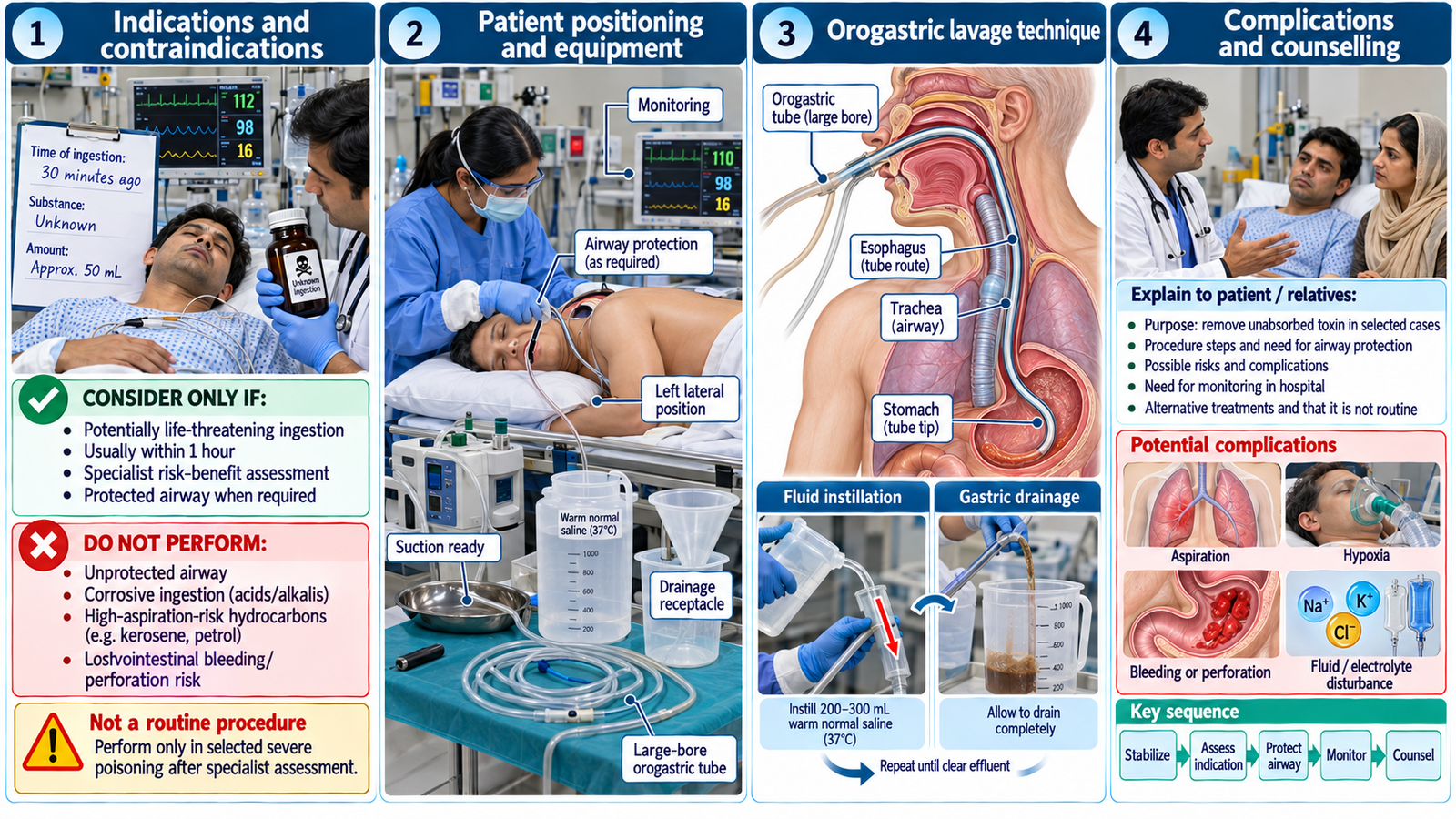
🎥 Practical Demonstration
Gastric Lavage Procedure Algorithm — Practical Skills Demonstration
A procedural demonstration to help visualize gastric lavage equipment and technique. Review critically alongside current toxicology recommendations, which discourage routine gastric lavage and require strict contraindication screening and airway precautions.
📝 Important Viva Questions
Q1. Is gastric lavage routinely recommended in acute poisoning?
Answer: No. It is generally avoided and may be considered only exceptionally after a recent, potentially life-threatening ingestion following expert risk–benefit assessment.
Q2. What are the major contraindications to gastric lavage?
Answer: Unprotected airway, corrosive ingestion, high-aspiration-risk hydrocarbon ingestion and significant risk of gastrointestinal bleeding or perforation.
Q3. Why is airway protection essential before gastric lavage?
Answer: To reduce aspiration of gastric contents or lavage fluid into the lungs, particularly in patients with impaired consciousness or protective reflexes.
Q4. Name four important complications of gastric lavage.
Answer: Aspiration pneumonitis, hypoxia, gastrointestinal or pharyngeal injury and fluid/electrolyte disturbances.
Q5. What counselling and follow-up are important after an episode of poisoning?
Answer: Explain monitoring and treatment, advise urgent review for breathing difficulty, confusion or persistent vomiting, and arrange appropriate medical and psychosocial follow-up, particularly after intentional poisoning.