
Station 5 — Acute Poisoning: Emergency Assessment & Stabilization
MS Module • Medicine • Final Year MBBS
Rapid Revision • Clinical Skills • Practical Skills • Viva
🎯 Candidate Task
An adult patient is brought to the emergency department with altered consciousness following suspected ingestion of an unknown substance. Demonstrate your initial emergency assessment, identify important clinical findings, obtain a focused toxicological history, and outline the urgent investigations and stabilization priorities.
⚡ Model Station Answer
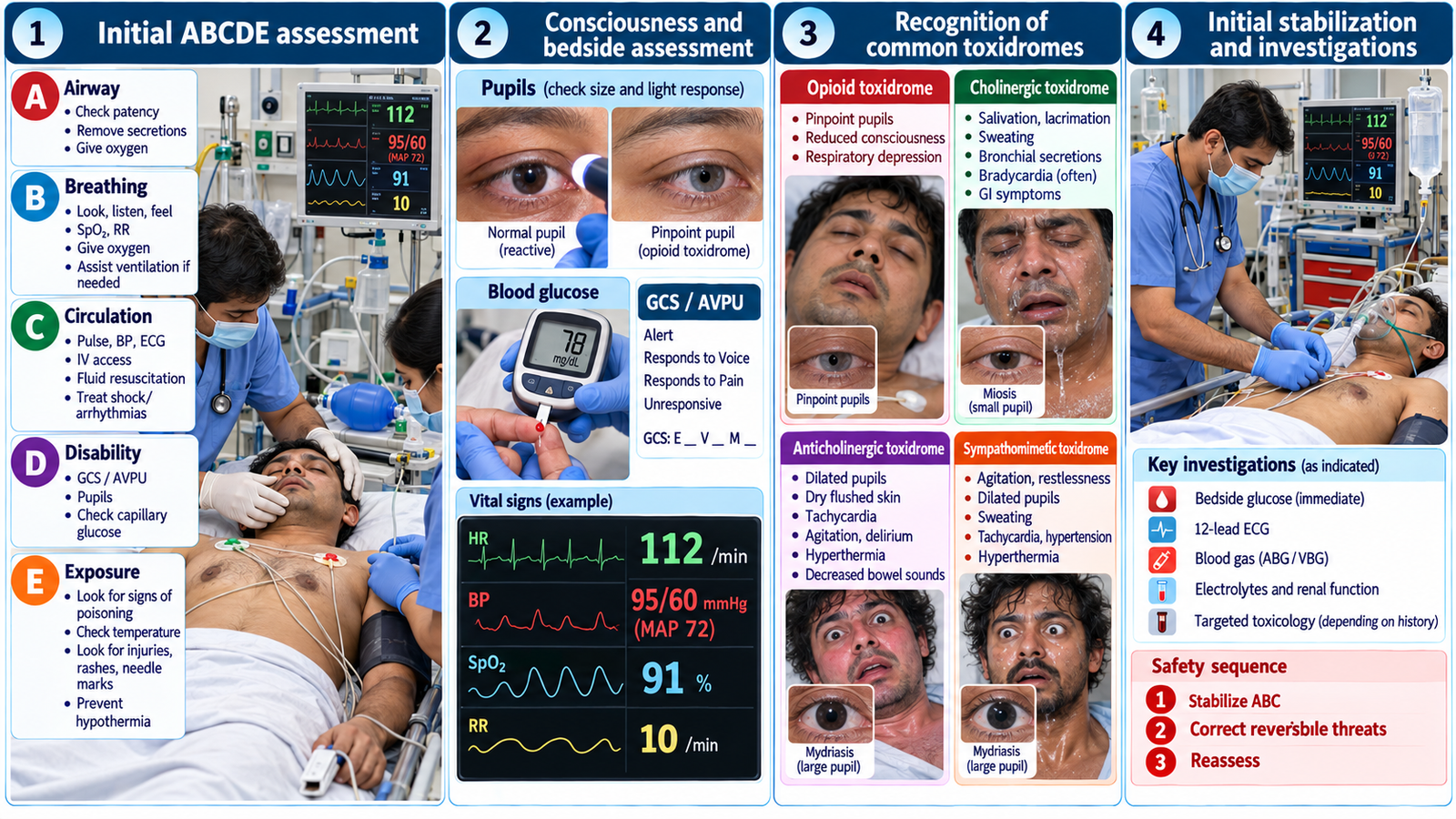
Immediate priority: Ensure personal safety, call for emergency assistance and assess airway, breathing and circulation using ABCDE.
Consciousness: Assess GCS or AVPU, pupils, capillary blood glucose and evidence of seizures or respiratory depression.
Poison identification: Ask about the substance, estimated dose, time, route, co-ingestants and possible intentional exposure; recognize characteristic toxidromes.
Investigations: Bedside glucose, ECG, blood gas, electrolytes, renal function and targeted toxicology, including paracetamol level when indicated.
Stabilization: Support airway and ventilation, establish IV access, treat hypoglycemia or seizures promptly, give an appropriate antidote when indicated and arrange monitored emergency care.
🔎 How to Perform / Approach
- Recognize the emergency: Ensure scene and staff safety, use appropriate PPE, call for senior/emergency support and request resuscitation equipment.
- Airway and breathing: Check airway patency, protective reflexes, respiratory rate, oxygen saturation and chest movement. Give oxygen if hypoxemic and assist ventilation or secure the airway when indicated.
- Circulation: Assess pulse, BP, capillary refill and perfusion. Attach ECG monitoring, obtain IV access and treat shock with appropriate fluid resuscitation and reassessment.
- Disability and exposure: Assess AVPU/GCS, pupils, bedside glucose, temperature, seizures, skin findings and possible needle marks. Correct hypoglycemia promptly.
- Focused toxicological history: Obtain information from the patient, relatives or ambulance staff: substance, dose, timing, route, co-ingestants, medications and possible deliberate self-harm. Check packaging if available.
- Recognize toxidromes: Identify opioid toxicity (pinpoint pupils, respiratory depression), cholinergic toxicity (salivation, sweating, bronchorrhea), anticholinergic toxicity (dry skin, mydriasis, tachycardia) or sympathomimetic toxicity (agitation, sweating, tachycardia).
- Investigate and stabilize: Obtain ECG, blood glucose, blood gas, electrolytes, renal function and indicated toxicology tests. Treat immediately reversible threats; consider naloxone for suspected opioid-induced respiratory depression and other specific antidotes when indicated.
- Reassess and escalate: Monitor vital signs, consciousness, oxygenation and ECG continuously as clinically indicated. Arrange appropriate observation, toxicology advice or critical-care referral for persistent instability.
🖼️ Visual Learning
Acute Poisoning — ABCDE Assessment, Toxidrome Recognition & Initial Stabilization
🎥 Practical Demonstration
ABCDE Assessment — Resuscitation Council UK
Practical demonstration of systematic emergency patient assessment, recognition of deterioration and immediate resuscitation priorities. Apply the same sequence when approaching an acutely poisoned patient.
📝 Important Viva Questions
Q1. What is the first priority in a patient presenting with acute poisoning?
Answer: Ensure safety, summon help and assess and stabilize airway, breathing and circulation using the ABCDE approach.
Q2. Which clinical findings suggest opioid poisoning?
Answer: Reduced consciousness, respiratory depression and pinpoint pupils. Naloxone is indicated for suspected opioid-induced respiratory depression.
Q3. What clinical features suggest organophosphate poisoning?
Answer: Miosis, excessive salivation, lacrimation, bronchorrhea, sweating, diarrhea and possible muscle fasciculations.
Q4. Which initial investigations are important in suspected acute poisoning?
Answer: Bedside glucose, ECG, blood gas, electrolytes and renal function, with targeted toxicology tests based on suspected exposure.
Q5. When should a poisoned patient be considered for urgent airway protection?
Answer: When airway protective reflexes are inadequate, ventilation or oxygenation is failing, or consciousness is severely impaired with aspiration risk.