
Station 15 — Systemic Vasculitides: Adult & Pediatric Clinical Recognition
MS Module • Medicine & Pediatrics • Final Year MBBS
Rapid Revision • Clinical Skills • Practical Skills • Viva
🎯 Candidate Task
Review the provided adult and pediatric clinical images, brief histories and investigation reports. Identify the likely systemic vasculitides, interpret the important clinical and laboratory findings, and state the major complications and urgent management priorities.
⚡ Model Station Answer
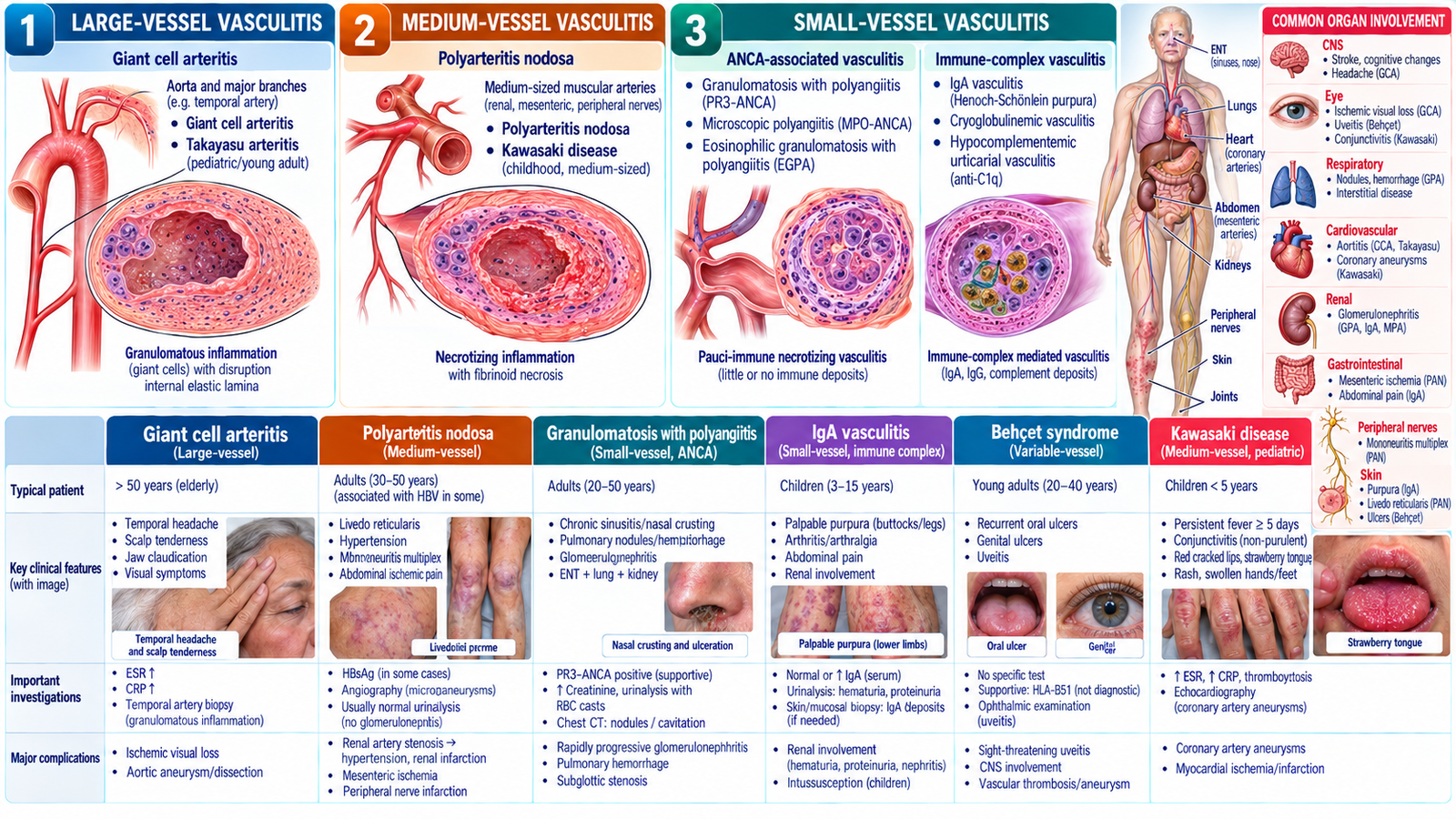
Large-vessel vasculitis: Giant cell arteritis presents with new headache, scalp tenderness, jaw claudication or visual symptoms; elevated ESR/CRP supports inflammation. Sudden visual loss is an emergency.
Medium-vessel vasculitis: Polyarteritis nodosa may cause livedo reticularis, hypertension, abdominal pain and mononeuritis multiplex, usually without glomerulonephritis.
Small-vessel vasculitis: Granulomatosis with polyangiitis causes ENT, pulmonary and renal involvement, often with PR3-ANCA positivity; IgA vasculitis presents with palpable purpura, abdominal pain, arthritis and possible nephritis.
Other characteristic syndromes: Behçet syndrome causes recurrent oral and genital ulcers with possible uveitis; Kawasaki disease presents with prolonged fever and characteristic mucocutaneous findings.
Clinical priority: Assess organ-threatening complications, interpret inflammatory, immunological and renal investigations, and arrange urgent treatment for threatened vision, rapidly progressive renal disease, pulmonary hemorrhage or Kawasaki-associated coronary risk.
🔎 How to Perform / Approach
- Identify the vessel pattern: Distinguish large-vessel features such as cranial ischemia, medium-vessel features such as organ ischemia or neuropathy, and small-vessel features such as palpable purpura and glomerulonephritis.
- Recognize giant cell arteritis: In an older adult, identify temporal headache, scalp tenderness, jaw claudication and visual symptoms. Review ESR/CRP and arrange urgent assessment; suspected visual involvement requires immediate glucocorticoid treatment.
- Recognize polyarteritis nodosa: Look for livedo reticularis, painful nodules, hypertension, abdominal ischemic pain and mononeuritis multiplex. Assess renal function, urinalysis and possible hepatitis B association.
- Recognize granulomatosis with polyangiitis: Identify chronic sinus symptoms, nasal crusting, hemoptysis, pulmonary nodules and nephritic urine findings. Interpret PR3-ANCA, creatinine, urinalysis and relevant imaging.
- Recognize IgA vasculitis and Behçet syndrome: For IgA vasculitis (Henoch-Schönlein purpura), identify lower-limb palpable purpura, abdominal pain, arthritis and renal involvement. For Behçet syndrome, identify recurrent oral/genital ulcers and ocular inflammation.
- Assess Kawasaki disease: Recognize fever for at least five days with bilateral non-purulent conjunctivitis, oral changes, polymorphous rash, extremity changes or cervical lymphadenopathy. Select echocardiography to assess coronary involvement.
- Interpret and prioritize: Correlate ESR/CRP, ANCA where appropriate, urine findings, renal function and organ-specific investigations. Urgently escalate suspected visual ischemia, pulmonary-renal syndrome, severe abdominal ischemia or Kawasaki disease requiring prompt treatment.
🖼️ Visual Learning
Systemic Vasculitides — Adult & Pediatric Clinical Findings, Investigation Interpretation & Complications
📝 Important Viva Questions
Q1. What findings suggest giant cell arteritis, and what is the immediate priority?
Answer: New temporal headache, scalp tenderness, jaw claudication and visual symptoms in an older adult suggest giant cell arteritis. Start urgent glucocorticoid treatment when strongly suspected, particularly with visual symptoms.
Q2. Which findings distinguish polyarteritis nodosa from granulomatosis with polyangiitis?
Answer: PAN affects medium-sized arteries, causing hypertension, abdominal ischemia and mononeuritis multiplex without typical glomerulonephritis. GPA commonly involves the upper airways, lungs and glomeruli.
Q3. What are the characteristic clinical manifestations of IgA vasculitis?
Answer: Palpable purpura, predominantly over the lower limbs, abdominal pain and arthritis or arthralgia, with possible renal involvement manifested by hematuria or proteinuria.
Q4. Which clinical features suggest Behçet syndrome, and what important complication must be recognized?
Answer: Recurrent oral and genital ulcers with ocular inflammation suggest Behçet syndrome. Uveitis can cause sight-threatening visual impairment.
Q5. What are the characteristic findings, major complication and initial treatment of Kawasaki disease?
Answer: Prolonged fever with conjunctivitis, oral changes, rash, extremity changes or cervical lymphadenopathy suggests Kawasaki disease. Coronary artery abnormalities are the major concern; prompt IV immunoglobulin and aspirin under pediatric supervision are standard treatment.