
AIM OSCE / OSPE • FINAL YEAR MBBS
Station 14 — Systemic Sclerosis, Sjögren Syndrome & Inflammatory Myopathy
MS Module • Medicine • Rapid Revision • Clinical Examination • Investigation Interpretation • Viva
🎯 Candidate Task
Examine the supplied clinical images and demonstrate a focused assessment of the hands, skin and proximal muscle strength on the simulated patient. Identify findings suggestive of systemic sclerosis, Sjögren syndrome or inflammatory myopathy, interpret the accompanying investigations, and identify important systemic complications.
⚡ Model Station Answer
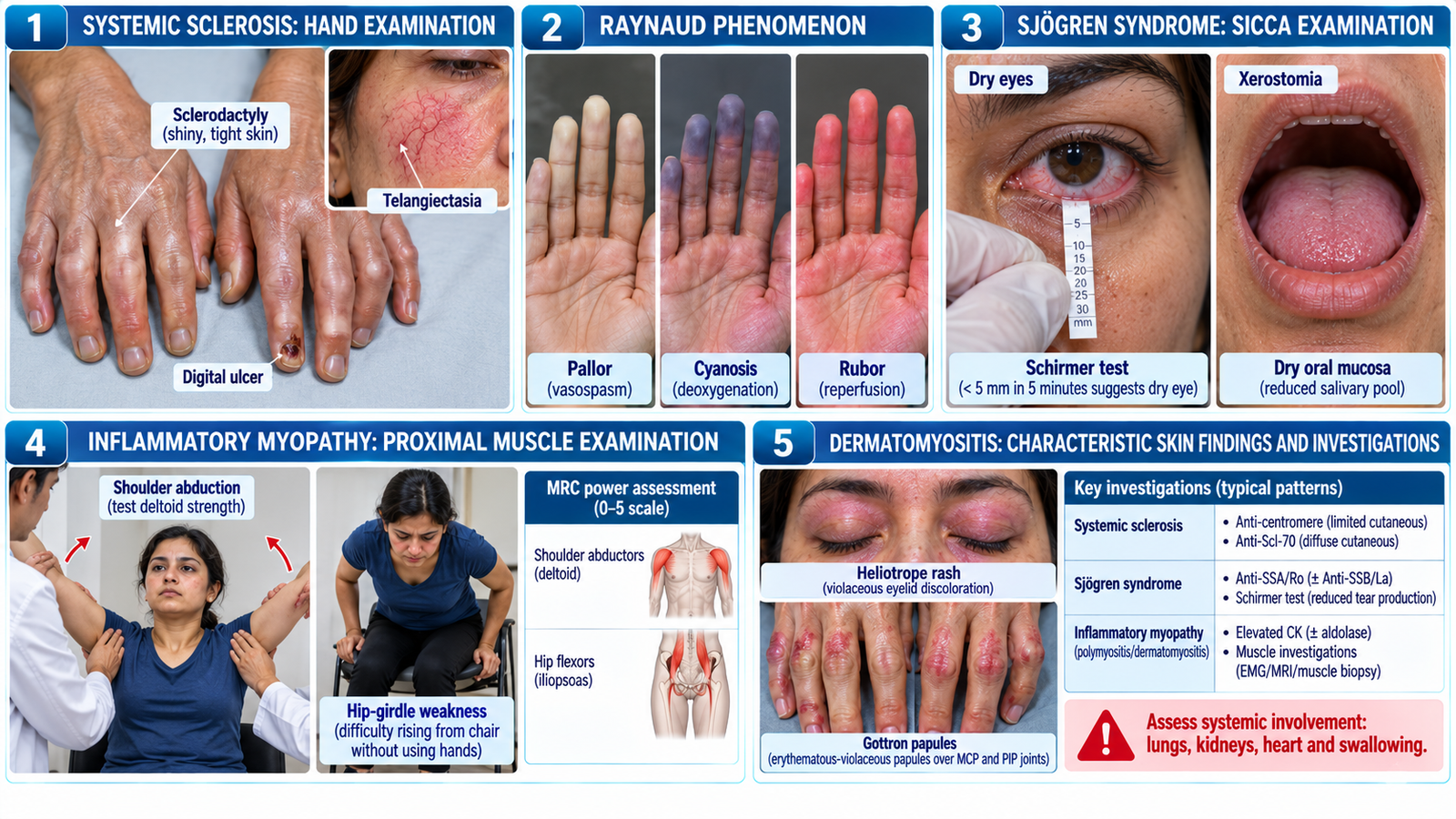
Systemic sclerosis: Sclerodactyly, skin tightening, digital ulcers, telangiectasia and Raynaud phenomenon are characteristic findings.
Sjögren syndrome: Dry eyes and dry mouth suggest sicca syndrome; anti-SSA/Ro antibodies and objective tear or salivary testing support assessment.
Inflammatory myopathy: Symmetrical proximal weakness suggests polymyositis or dermatomyositis; heliotrope rash and Gottron papules favor dermatomyositis.
Investigations and complications: Interpret ANA, disease-associated antibodies, CK and relevant organ tests. Assess for pulmonary, cardiac, renal and swallowing complications as appropriate to the suspected disorder.
🔎 How to Perform / Approach
- Prepare: Introduce yourself, obtain consent, perform hand hygiene and adequately expose the hands, face and relevant muscle groups.
- Examine for systemic sclerosis: Inspect the fingers for sclerodactyly, digital pitting scars, ulcers, fixed flexion deformities and telangiectasia. Assess skin tightening and ask about Raynaud phenomenon.
- Assess sicca manifestations: Look for dry or inflamed eyes, reduced oral moisture, dental caries and possible parotid enlargement. Ask about gritty eyes and difficulty swallowing dry food.
- Examine proximal muscle strength: Assess bilateral shoulder abduction and hip flexion against resistance using the MRC scale. Observe rising from a chair without using the arms, where safe.
- Recognize dermatomyositis: Inspect the eyelids for heliotrope discoloration and the dorsal MCP/PIP joints for Gottron papules. Correlate these findings with symmetrical proximal weakness.
- Interpret investigations: Review anti-centromere and anti-Scl-70 antibodies for systemic sclerosis, anti-SSA/Ro for Sjögren syndrome, and CK, muscle-associated antibodies and relevant muscle investigations for inflammatory myopathy.
- Identify systemic complications: Consider interstitial lung disease, pulmonary hypertension, renal involvement and gastrointestinal dysmotility in systemic sclerosis; ocular injury and dental complications in Sjögren syndrome; and dysphagia, respiratory weakness or cardiac involvement in inflammatory myopathy.
🖼️ Visual Learning
Connective Tissue Disease Examination — Hands, Sicca Signs & Proximal Muscle Weakness
📝 Important Viva Questions
Q1. What characteristic hand findings suggest systemic sclerosis?
Answer: Sclerodactyly, tight shiny skin, digital ulcers, pitting scars, telangiectasia and flexion contractures are important findings.
Q2. How is Sjögren syndrome clinically recognized and investigated?
Answer: Persistent dry eyes and dry mouth suggest sicca syndrome. Schirmer testing, anti-SSA/Ro antibodies and salivary gland assessment help support the diagnosis.
Q3. How do you examine proximal muscle weakness?
Answer: Test shoulder abduction and hip flexion against resistance using the MRC scale and observe functional tasks such as rising from a chair without arm support.
Q4. Which findings distinguish dermatomyositis from polymyositis?
Answer: Heliotrope rash and Gottron papules are characteristic of dermatomyositis. Both disorders may produce symmetrical proximal muscle weakness with elevated muscle enzymes.
Q5. What important systemic complications must be recognized in these disorders?
Answer: Systemic sclerosis may cause interstitial lung disease, pulmonary hypertension and renal crisis; Sjögren syndrome may cause ocular and dental complications; inflammatory myopathy may cause dysphagia, respiratory weakness and cardiac involvement.