
AIM OSCE / OSPE • FINAL YEAR MBBS
Station 10 — Genetic Counselling & Perinatal Diagnosis
MS Module • Gynaecology • Rapid Revision • Communication Skills • Clinical Interpretation • Viva
🎯 Candidate Task
A couple with a family history of thalassemia seeks premarital genetic counselling and advice about reproductive risks. Review the supplied family history, explain the inheritance pattern and reproductive risk, discuss relevant screening and perinatal diagnostic options, and counsel the couple using a respectful, non-directive approach.
⚡ Model Station Answer
Risk assessment: “I would review your family history, draw a pedigree and offer appropriate thalassemia carrier screening to both partners.”
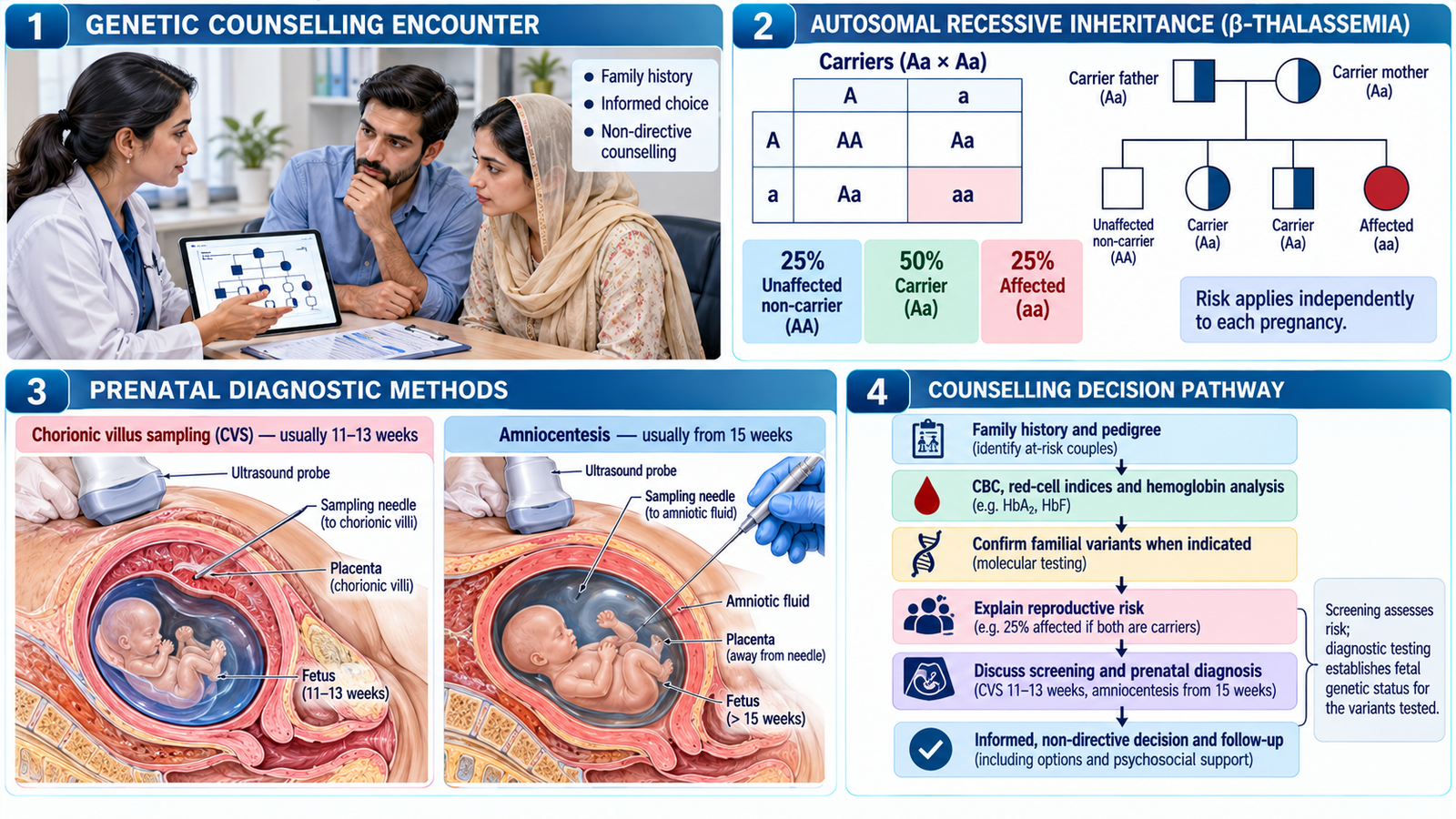
Inheritance: “If both of you carry a pathogenic variant causing the same autosomal recessive form of thalassemia, each pregnancy has a 25% chance of an affected child, a 50% chance of a carrier child and a 25% chance of a child inheriting neither variant.”
Diagnosis: “We can discuss prenatal diagnostic options such as chorionic villus sampling or amniocentesis, with genetic testing directed at the familial variants.”
Counselling: “The choice is yours. I will explain the benefits, limitations and risks of testing, answer your questions and support your informed decision without pressure.”
🔎 How to Perform / Approach
- Establish rapport: Introduce yourself, ensure privacy, obtain consent and ask what the couple already understands about thalassemia and genetic testing.
- Take a focused family history: Ask about affected relatives, carrier status, previous affected children, pregnancy outcomes and consanguinity. Construct a three-generation pedigree where possible.
- Interpret inheritance: Explain autosomal recessive transmission using a simple pedigree or Punnett square. Distinguish confirmed carrier status from risk based solely on family history.
- Offer relevant screening: Discuss complete blood count, red-cell indices and hemoglobin analysis, with molecular testing when indicated to clarify the familial thalassemia variants.
- Explain perinatal diagnosis: Distinguish screening from definitive diagnosis. Discuss chorionic villus sampling, usually at 11–13 weeks, and amniocentesis, generally from 15 weeks, with appropriate specialist genetic testing and procedure-related risks.
- Discuss reproductive options: Explain available choices, including proceeding with pregnancy with or without prenatal diagnosis and specialist discussion of other reproductive options where available. Avoid directing the couple toward a particular decision.
- Close professionally: Check understanding, address emotional or cultural concerns respectfully, maintain confidentiality and offer referral for specialist genetic counselling and follow-up.
🖼️ Visual Learning
Thalassemia Genetic Counselling — Pedigree, Reproductive Risk & Prenatal Diagnosis
📝 Important Viva Questions
Q1. What is the risk of an affected child if both parents are beta-thalassemia carriers?
Answer: Each pregnancy has a 25% risk of an affected child, a 50% chance of a carrier child and a 25% chance of a child inheriting neither familial variant.
Q2. What initial investigations are appropriate for thalassemia carrier screening?
Answer: Complete blood count with red-cell indices and hemoglobin analysis, usually by HPLC or electrophoresis; molecular testing may be required for confirmation.
Q3. What is the difference between chorionic villus sampling and amniocentesis?
Answer: CVS samples placental tissue, usually at 11–13 weeks; amniocentesis samples amniotic fluid, generally from 15 weeks. Both can provide fetal material for diagnostic genetic testing.
Q4. What is the difference between prenatal screening and prenatal diagnosis?
Answer: Screening estimates the likelihood of a fetal condition, whereas diagnostic testing can confirm or exclude the specific genetic abnormality being investigated, subject to test limitations.
Q5. What are the essential principles of genetic counselling?
Answer: Accurate risk communication, informed consent, confidentiality, empathy and non-directive support for the couple’s reproductive decisions.