
AIM OSCE / OSPE • FINAL YEAR MBBS
Station 8 — Environmental Emergencies: Clinical Recognition & Initial Management
MS Module • Medicine • Rapid Revision • Emergency Skills • Clinical Interpretation • Viva
🎯 Candidate Task
Review the supplied clinical scenarios involving environmental or physical emergencies. Identify the likely condition, interpret the important clinical findings, outline appropriate initial management and recognize life-threatening complications requiring urgent intervention.
⚡ Model Station Answer
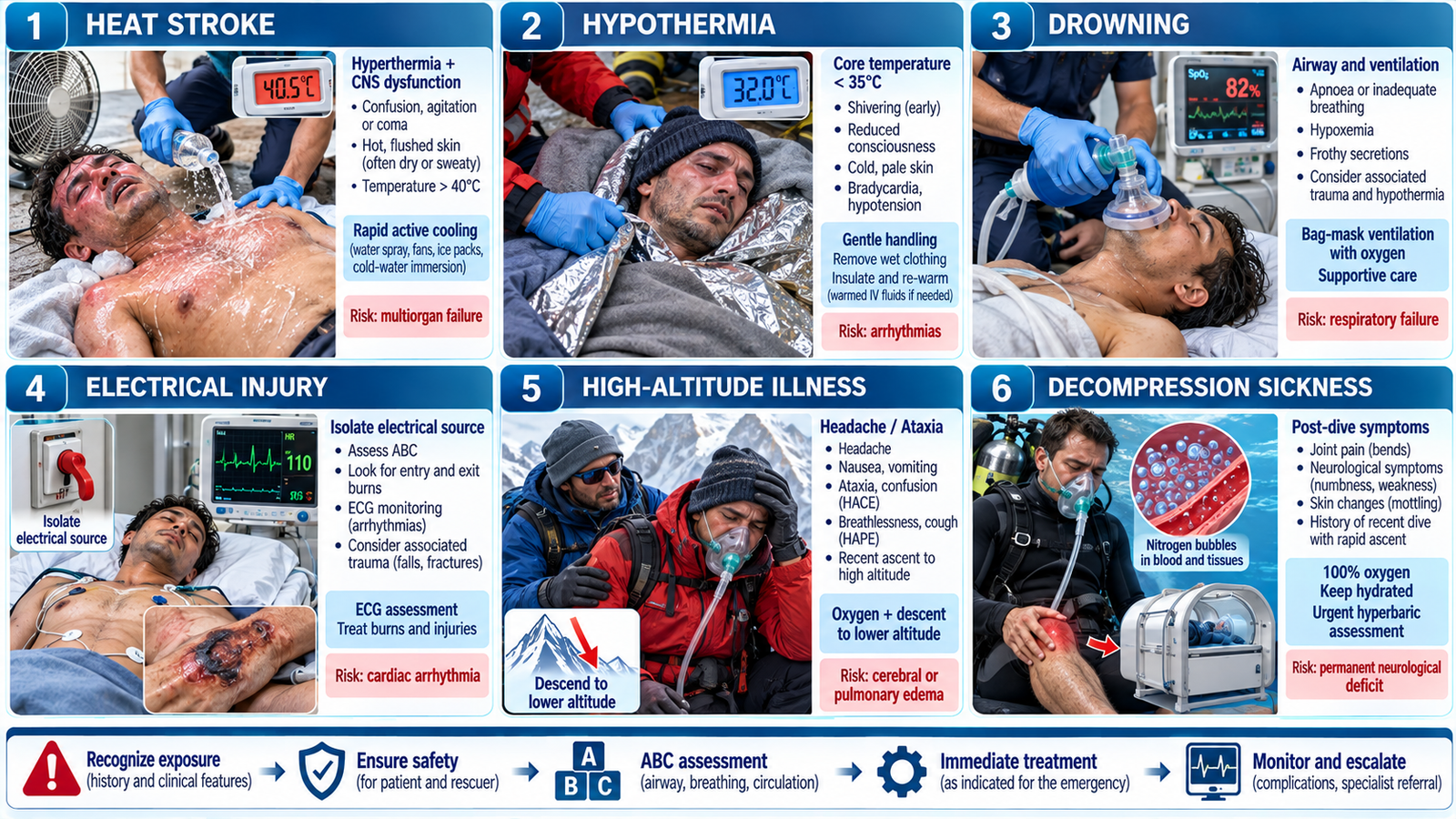
Heat stroke: Severe hyperthermia with central nervous system dysfunction requires immediate active cooling and resuscitation.
Hypothermia: Core temperature below 35°C indicates hypothermia; prevent further heat loss, handle gently and begin appropriate rewarming.
Drowning/electrocution: Ensure scene safety, assess airway, breathing and circulation, provide CPR or ventilation when indicated, and evaluate for respiratory or cardiac complications.
Altitude/diving emergencies: Give oxygen and arrange descent for severe altitude illness; suspected decompression sickness requires high-concentration oxygen and urgent hyperbaric specialist assessment.
🔎 How to Perform / Approach
- Ensure safety and recognize the emergency: Identify environmental exposure and assess scene safety, particularly electrical hazards, water rescue and extreme temperatures. Call for assistance.
- Perform initial assessment: Assess airway, breathing, circulation, consciousness and temperature. Record vital signs, oxygen saturation and ECG when indicated.
- Recognize heat illness: Differentiate heat exhaustion from heat stroke by the presence of severe hyperthermia and neurological dysfunction, including confusion, seizures or coma. Start immediate active cooling for heat stroke.
- Identify and manage hypothermia: Measure core temperature where possible, remove wet clothing, insulate the patient and use appropriate passive or active rewarming. Monitor for arrhythmias and circulatory instability.
- Interpret drowning and electrical injury: Following drowning, prioritize oxygenation and ventilation; after electrocution, ensure electrical isolation and assess for cardiac arrest, arrhythmias, burns and associated trauma.
- Recognize altitude and diving emergencies: Identify headache, ataxia or altered consciousness after ascent as possible high-altitude illness; recognize joint pain, neurological deficits or breathlessness after diving as possible decompression sickness.
- Initiate treatment and escalate: Provide appropriate cooling or warming, oxygen and resuscitation as required. Arrange urgent descent for severe altitude illness, hyperbaric assessment for decompression sickness and emergency referral for life-threatening complications.
🖼️ Visual Learning
Environmental Emergencies — Recognition & Immediate Response
📝 Important Viva Questions
Q1. How do you differentiate heat exhaustion from heat stroke?
Answer: Heat exhaustion usually occurs without severe central nervous system dysfunction. Heat stroke involves severe hyperthermia with confusion, seizures or coma and requires immediate active cooling.
Q2. How is hypothermia classified by core temperature?
Answer: Mild: 32–<35°C; moderate: 28–<32°C; severe: <28°C. Severe hypothermia carries a high risk of life-threatening arrhythmias and cardiac arrest.
Q3. What is the immediate priority in a patient rescued from drowning?
Answer: Assess breathing and circulation, provide effective oxygenation and ventilation, and initiate CPR when indicated. Hypoxia is the principal immediate threat.
Q4. What are the important life-threatening complications of electrical injury?
Answer: Cardiac arrhythmias or arrest, respiratory arrest, deep tissue injury and serious trauma. Scene safety and initial cardiac assessment are essential.
Q5. How do you differentiate high-altitude cerebral edema from decompression sickness, and what is the initial management?
Answer: High-altitude cerebral edema occurs after ascent and causes ataxia or altered consciousness; urgent descent and oxygen are priorities. Decompression sickness occurs after a pressure reduction, typically after diving, and requires high-concentration oxygen and urgent hyperbaric assessment.