🩺 Station 9 — Anatomical Position, Terms and Movements
AIM OSPE/OSCE Lab — Practical Station | KMU Style | MBBS Practical + Viva
📋 Complete OSPE Station Content
OSPE Station Name
Anatomical Position, Terms and Movements
Learning Target
- Demonstrate anatomical position and correctly identify anatomical planes, positional terms, and basic body movements.
- Apply anatomical terminology to describe body parts, joint movements, and clinical positioning accurately.
Required Material
Human skeleton/model or student volunteer
Anatomical chart or diagram
Joint movement chart
Pointer
OSPE answer sheet/checklist
Student Task / Procedure
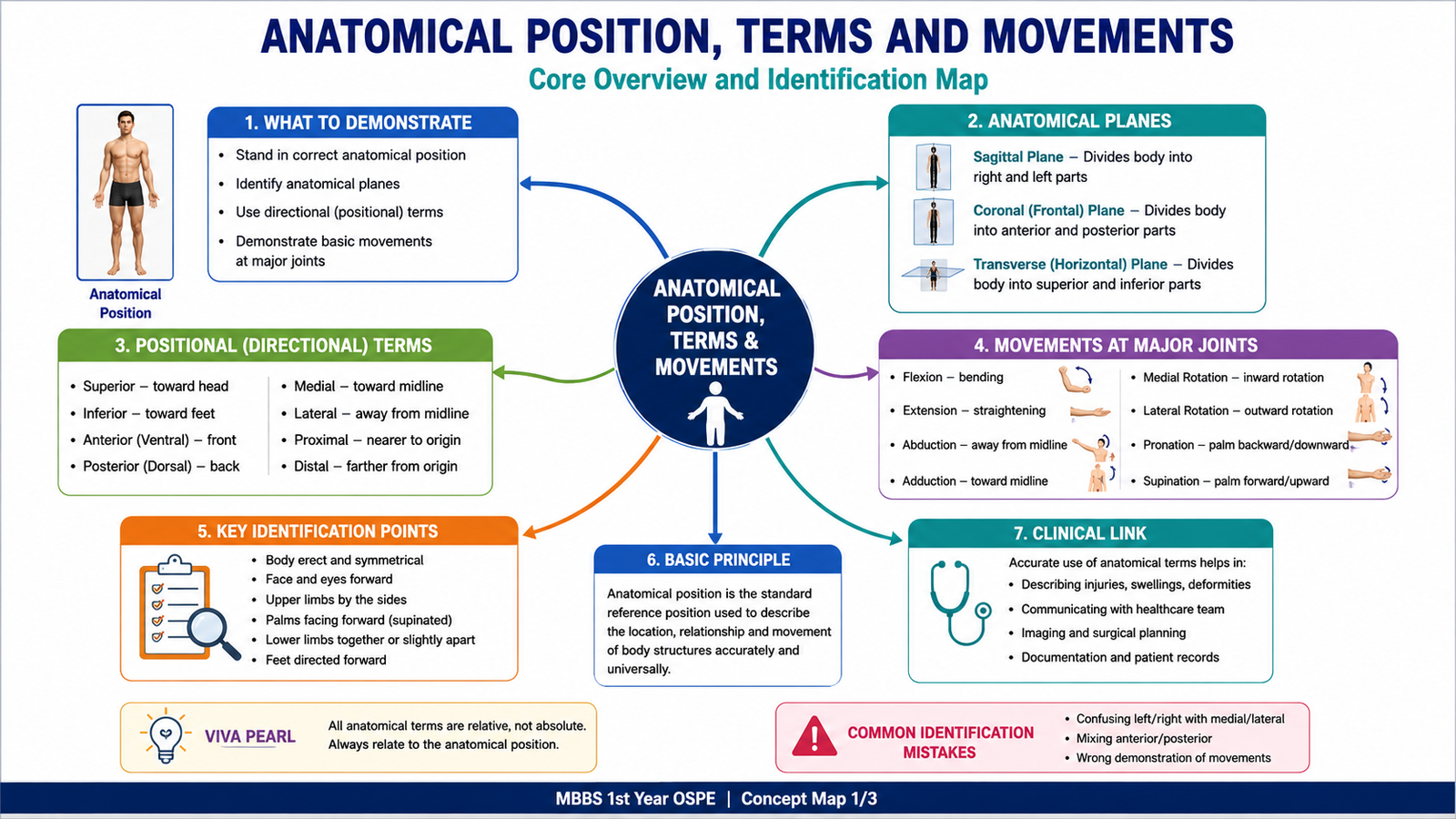
- Stand in anatomical position.
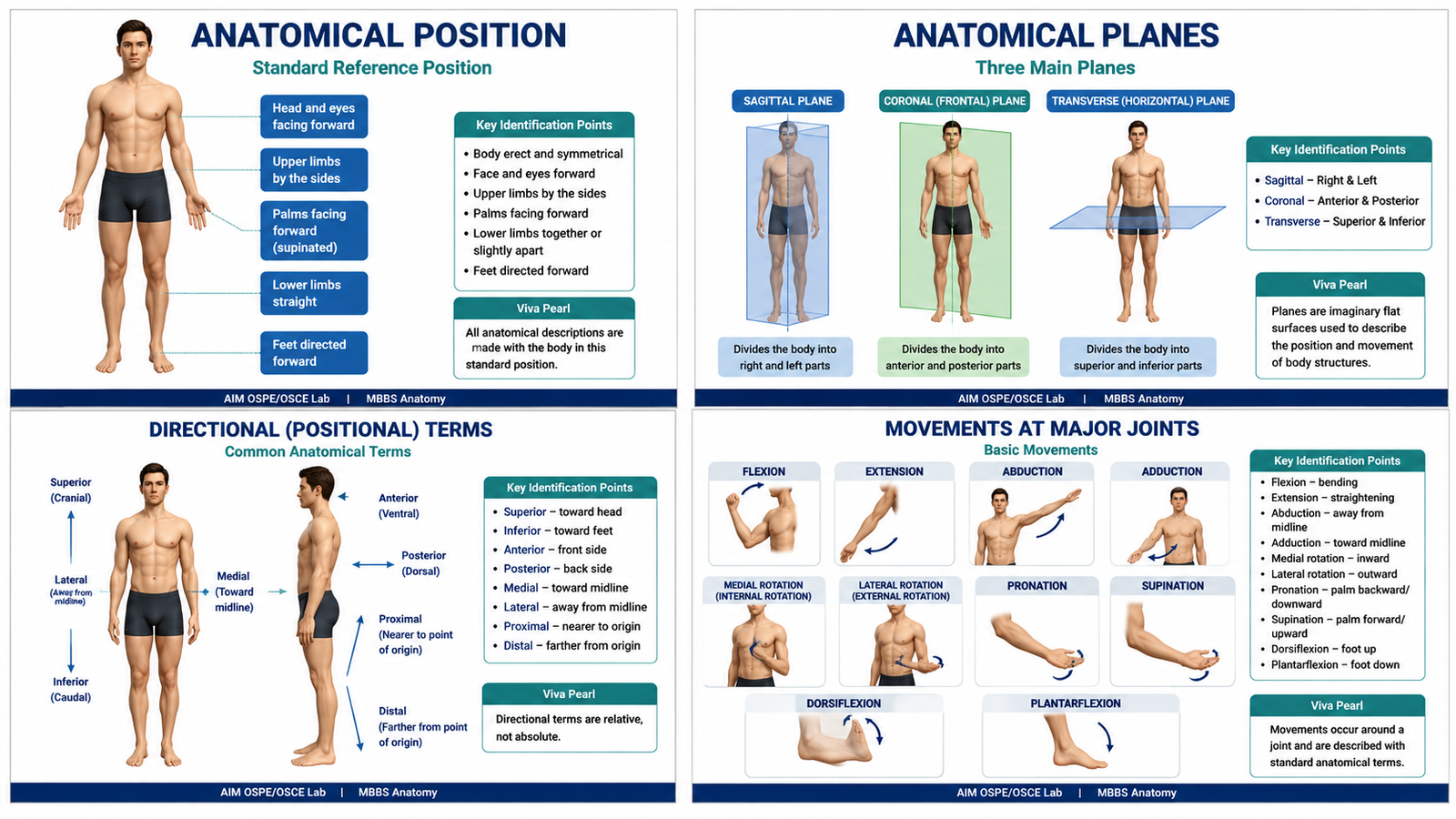
- Demonstrate the position of head, eyes, upper limbs, palms, lower limbs, and feet.
- Identify the three main anatomical planes: sagittal, coronal, and transverse.
- Use correct anatomical terms to describe location, such as superior, inferior, anterior, posterior, medial, lateral, proximal, and distal.
- Demonstrate basic movements at major joints: flexion, extension, abduction, adduction, rotation, pronation, supination, dorsiflexion, and plantarflexion.
- Describe one clinical example where correct anatomical terminology is important.
Observation / Identification Points
Correct standing anatomical position
Face and eyes directed forward
Upper limbs by the side
Palms facing forward
Lower limbs together or slightly apart
Feet directed forward
Correct identification of sagittal, coronal, and transverse planes
Correct use of directional terms
Correct demonstration of joint movements
Ability to relate terms to clinical communication
Result / Interpretation
Anatomical position is the standard reference position used to describe the location, relationship, and movement of body structures. Correct anatomical terminology prevents confusion in clinical examination, imaging, surgical description, and documentation of injuries.
Clinical significance:
A fracture, wound, swelling, neurological deficit, or joint movement must be described using standard anatomical terms so that all healthcare professionals understand the exact site and direction.
Common Student Mistakes
- Keeping palms facing backward instead of forward.
- Confusing medial with lateral.
- Confusing anterior with posterior.
- Mixing sagittal and coronal planes.
- Demonstrating abduction/adduction incorrectly at the shoulder or hip.
AIM Feedback
To improve, always begin from anatomical position before describing any structure or movement. Remember that anatomical terms are not based on your own right or left side while facing the patient; they are based on the patient’s anatomical position. Practice movements at your own shoulder, elbow, wrist, hip, knee, ankle, and forearm to build confidence for OSPE demonstration.
Most Important Viva Questions for This Topic
- What is anatomical position?
Ideal answer: It is the standard reference position in which the body stands erect, face and eyes forward, upper limbs by the sides, palms facing forward, and feet directed forward. - Why is anatomical position important?
Ideal answer: It provides a universal reference for describing body parts, positions, relationships, and movements without confusion. - What are the three main anatomical planes?
Ideal answer: Sagittal plane, coronal or frontal plane, and transverse or horizontal plane. - What is the sagittal plane?
Ideal answer: A vertical plane that divides the body into right and left parts. - What is the coronal plane?
Ideal answer: A vertical plane that divides the body into anterior and posterior parts. - What is the transverse plane?
Ideal answer: A horizontal plane that divides the body into superior and inferior parts. - Differentiate medial and lateral.
Ideal answer: Medial means nearer to the midline, while lateral means farther from the midline. - Differentiate proximal and distal.
Ideal answer: Proximal means nearer to the point of origin or attachment, while distal means farther from it. - What is flexion?
Ideal answer: Flexion is bending movement that usually decreases the angle between two body parts. - What is extension?
Ideal answer: Extension is straightening movement that usually increases the angle between two body parts. - Differentiate abduction and adduction.
Ideal answer: Abduction is movement away from the midline, while adduction is movement toward the midline. - Differentiate pronation and supination.
Ideal answer: Pronation is medial rotation of the forearm so the palm faces backward or downward. Supination is lateral rotation of the forearm so the palm faces forward or upward.
🖼️ Visual / Image Support
🧩 Concept Map / Interpretation Support