
AIM OSCE / OSPE • MBBS
Station 7 — Competitive Antagonism on Isolated Rabbit Ileum
Rapid Revision • Experimental Pharmacology • Tracing Interpretation • Viva
🎯 Task
CANDIDATE TASK
You are provided with an isolated rabbit ileum experiment using an agonist together with a second drug. Describe how you would demonstrate the drug interaction, interpret the resulting tracing or dose–response curves, and state the pharmacological relationship demonstrated.
⚡ Model Station Answer
What to say in the exam
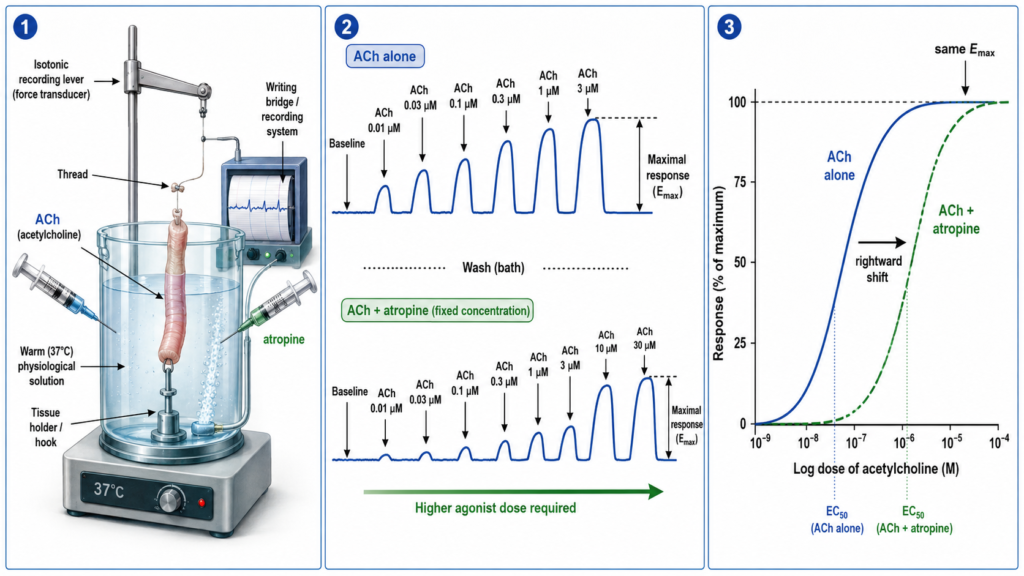
Finding: After addition of the antagonist, the same dose of agonist produces a smaller response and a higher agonist dose is required.
Interpretation: Increasing the agonist concentration can restore the original maximum response, so the antagonism is surmountable.
Dose–response curve: There is an approximately parallel rightward shift, increased EC50 and reduced agonist potency, with essentially unchanged Emax.
Conclusion: This demonstrates reversible competitive antagonism.
🔎 Stepwise Procedure / Approach
- Mount the isolated ileal segment correctly in an organ bath containing suitable physiological solution and allow the tissue response to stabilize.
- Give progressively increasing doses or concentrations of the agonist and record the graded contractions using the same contact and washing cycle.
- Continue until the maximum response is obtained and establish the control agonist dose–response relationship.
- Wash the preparation, add a fixed concentration of the antagonist and allow adequate contact or equilibration.
- Repeat the graded agonist doses while the antagonist remains present and record the responses.
- Compare the two sets of responses: in the presence of antagonist, higher agonist concentrations are required to produce equivalent contractions.
- Confirm that sufficiently increasing the agonist can still produce approximately the same maximum response. A parallel rightward shift with preserved Emax indicates surmountable competitive antagonism.
Exam link: With acetylcholine + atropine, atropine competitively blocks muscarinic receptors. If the station instead uses histamine + an H1 antihistamine, apply the same principle of surmountable competitive receptor antagonism.
🖼️ Visual Learning
VISUAL 1
Competitive Antagonism: Experiment, Tracing and Dose–Response Shift
🎥 Practical Video
🎥 Practical Demonstration — ANS Control of Gut Smooth Muscle
Monash University • Medicine, Nursing and Health Sciences
This practical resource demonstrates the rabbit ileum preparation and experimental setup and allows students to observe how agonists and antagonists, including acetylcholine and atropine, alter ileal contractions.
📝 Important Viva Questions
Q1. What is competitive antagonism?
It occurs when an antagonist competes reversibly with an agonist for the same receptor binding site and its effect can be overcome by increasing the agonist concentration.
Q2. Why is competitive antagonism called surmountable?
Because sufficiently increasing the concentration of the agonist can overcome the antagonist and restore the maximum response.
Q3. What happens to the agonist dose–response curve in competitive antagonism?
It undergoes an approximately parallel shift to the right while the maximum response remains essentially unchanged.
Q4. What happens to EC50 and potency of the agonist?
EC50 increases, meaning a higher agonist concentration is required; therefore the apparent potency of the agonist decreases.
Q5. What happens to the efficacy or Emax of the agonist?
The maximum response is essentially preserved, so the agonist’s efficacy is not reduced by a simple reversible competitive antagonist.
Q6. What pharmacological interaction is demonstrated by acetylcholine and atropine on rabbit ileum?
Atropine produces reversible competitive antagonism of acetylcholine at muscarinic receptors.
Q7. How would you distinguish competitive from non-competitive antagonism using the dose–response curve?
Competitive antagonism typically produces a surmountable rightward shift with preserved Emax, whereas non-competitive antagonism typically reduces the attainable maximum response.