
Station 9 — Medico-Legal Autopsy Report
🎯 Task
Review the supplied postmortem findings of a 32-year-old male showing a right temporoparietal scalp laceration, underlying depressed skull fracture and extradural hemorrhage with compression of the brain. Complete the important components of the medico-legal autopsy report and formulate an appropriate final opinion from these findings.
⚡ Model Station Answer
Report: I would record the identification and case particulars, relevant history, external examination, postmortem changes, injuries and systematic internal examination findings.
Important findings: There is a right temporoparietal scalp injury with an underlying depressed skull fracture and associated extradural hemorrhage producing brain compression.
Specimens: Any material preserved for histopathology, toxicology or other investigation should be clearly documented where indicated.
Final opinion: Death is due to craniocerebral injury resulting from blunt force trauma to the head. The documented injuries are antemortem and sufficient to account for death.
🔎 Stepwise Procedure / Approach
- Confirm the case particulars. Record the postmortem number, identity of the deceased where known, relevant police/case information, place, date and time of examination.
- Review the supplied history. Note the circumstances provided to the examining doctor without adding assumptions or unsupported information.
- Document external examination systematically. Record general condition, clothing where relevant, postmortem changes and all external injuries with their site, type and dimensions when supplied.
- Record internal examination findings. Document the cranial, thoracic and abdominal findings systematically, emphasizing significant injuries or disease.
- Correlate related findings. In this case, connect the scalp injury with the underlying skull fracture, extradural hemorrhage and brain compression.
- Document specimens or investigations. State clearly whether material has been preserved or submitted for toxicology, histopathology or another relevant examination.
- Formulate the final opinion. Base the cause of death only on the demonstrated findings and avoid speculation beyond the available evidence.
- Complete and authenticate the report. Recheck important entries and provide the appropriate date, signature, name and professional identification according to the prescribed report format.
🖼️ Visual Learning
Structured Medico-Legal Autopsy Report: Findings to Final Opinion
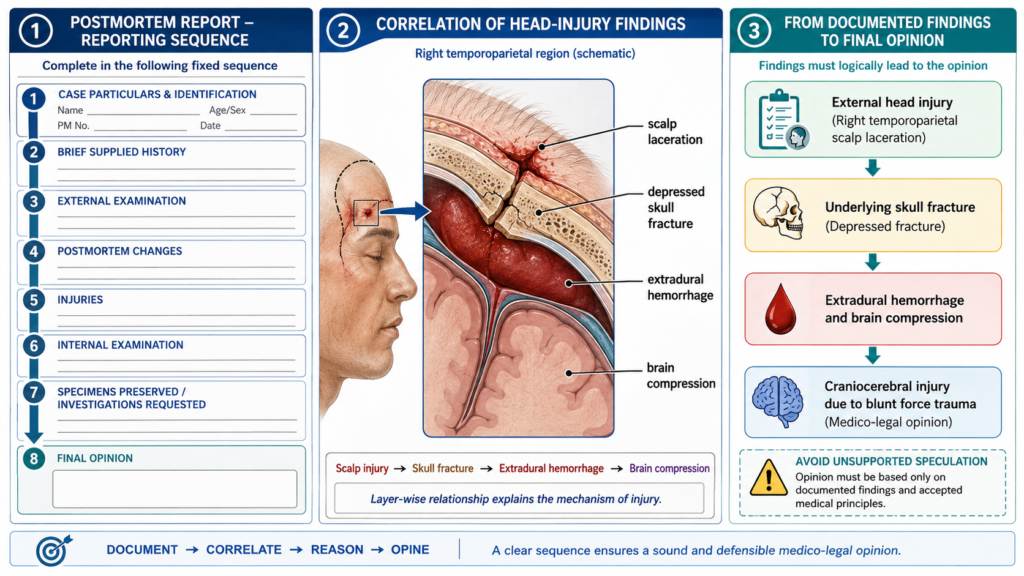
Demonstrates the general approach to autopsy examination and helps students understand how systematic postmortem findings are obtained before documentation and formulation of the final medico-legal opinion.
📝 Important Viva Questions
Q1. What are the major components of a medico-legal autopsy report?
Answer: Case and identification particulars, relevant history, external examination, postmortem changes and injuries, internal examination, specimens or investigations where required, and the final opinion.
Q2. On what should the final autopsy opinion be based?
Answer: It should be based on the documented external and internal findings together with relevant available investigations and circumstances, without unsupported speculation.
Q3. How should an injury be described in an autopsy report?
Answer: Describe its type, exact anatomical site, dimensions and relevant characteristics, using objective medico-legal terminology.
Q4. What is the important intracranial finding in the supplied case?
Answer: An extradural hemorrhage associated with the skull fracture and producing compression of the brain.
Q5. What is the appropriate cause-of-death opinion in this case?
Answer: Death is due to craniocerebral injury resulting from blunt force trauma to the head.
Q6. What should be done if the cause of death cannot be finalized until laboratory results are available?
Answer: The opinion should be kept pending or provisional as appropriate until the required investigation results are available rather than giving an unsupported final cause.
Q7. What is a common examination mistake while writing the final opinion?
Answer: Giving an opinion that is more specific than the supplied evidence supports. The conclusion must remain consistent with the documented postmortem findings.