
Course Content
🔬 Station 1 — Identification of Lipoma
Learning Outcomes Identify a lipoma from a provided gross specimen/image or histopathology slide. Identify the key morphological features supporting the diagnosis. Differentiate the lesion from an obviously malignant soft-tissue lesion when asked.
0/1
🔬 Station 2 — Identification of Squamous Cell Carcinoma
Learning Outcomes Identify squamous cell carcinoma from a provided gross/microscopic specimen. Recognize the important morphological features of squamous differentiation. State the diagnosis from the findings provided.
0/1
🔬 Station 3 — Fibroadenoma of Breast: Gross & Microscopic Identification
Learning Outcomes Identify fibroadenoma from a gross specimen or histological image. Recognize the important gross and microscopic points of identification. Give the final pathological identification.
0/1
🧬 Station 4 — Karyogram Preparation & Chromosomal Abnormality Identification
Learning Outcomes Arrange chromosomes appropriately to prepare a karyogram. Determine chromosomal sex from the karyogram. Identify a common numerical chromosomal abnormality from a provided karyogram.
0/1
⚗️ Station 5 — Tissue Organ Bath: Identification, Setup & Tyrode Solution
Learning Outcomes Identify the major components of a tissue organ bath. State the function of the important components. Identify the constituents/purpose of Tyrode's solution. Demonstrate the basic placement/fixation of isolated ileal tissue in the organ bath.
0/1
📈 Station 6 — Acetylcholine Dose–Response & Ceiling Effect
Learning Outcomes Demonstrate the effect of increasing doses of acetylcholine on isolated rabbit ileum. Recognize the ceiling effect. Interpret a provided tracing/dose-response recording. Plot or interpret the corresponding dose-response graph.
0/1
📉 Station 7 — Competitive Antagonism on Isolated Rabbit Ileum
Learning Outcomes Demonstrate/recognize surmountable antagonism using an agonist and antagonist. Interpret the experimental tracing. Explain the change in response after addition of the antagonist. Identify the pharmacological relationship demonstrated.
0/1
👁️ Station 8 — Rabbit Eye Pharmacology: Identify the Unknown Drug
Learning Outcomes Assess/interpret pupil size, conjunctival appearance, corneal reflex and light reflex. Compare the test eye with the control eye. Interpret the pattern produced by an autonomic or local anaesthetic drug. Identify the most likely unknown drug from the observed findings.
0/1
📝 Station 9 — Medico-Legal Autopsy Report
Learning Outcomes Review supplied postmortem findings systematically. Complete the important components of an autopsy report. Formulate an appropriate final opinion from the supplied findings.
0/1
🧪 Station 10 — Toxicology Sample Collection & Preservation
Learning Outcomes Select the appropriate viscera/specimens required for toxicological examination. Select the appropriate preservative/container. Demonstrate or describe correct collection, labelling and handling of the sample. State essential precautions before dispatch.
0/1
⚰️ Station 11 — Identification of Postmortem Changes
Learning Outcomes Identify the postmortem change demonstrated on a model/image/specimen. Describe its characteristic features. Differentiate commonly confused postmortem changes where appropriate. State its basic medico-legal significance, particularly in relation to time since death.
0/1
🚑 Station 12 — Gastric Lavage / Stomach Wash on Manikin
Learning Outcomes Prepare the equipment required for gastric lavage. Demonstrate the correct sequence of gastric lavage on a manikin. Maintain patient safety and correct positioning during the procedure. Recognize situations in which the procedure should not be attempted.
0/1
🧪🔬 AIM OSPE/OSCE Lab — Multisystem-I Module | 3rd Year MBBS
AIM OSCE / OSPE • MBBS

🧬 Station 4 — Karyogram Preparation & Chromosomal Abnormality Identification

Rapid Revision • Practical Skills • Viva

🎯 Task

CANDIDATE TASK

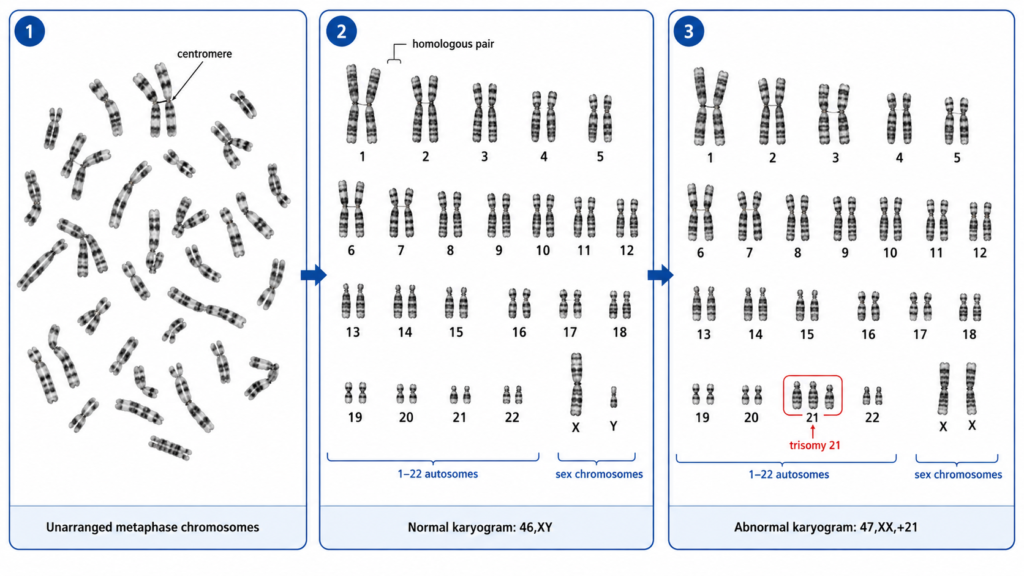
You are provided with a set of human metaphase chromosomes and a karyogram arrangement sheet. Arrange the chromosomes appropriately, determine the chromosomal sex, and identify any numerical chromosomal abnormality present.

⚡ Model Station Answer — What to say in the exam
Arrangement: I will pair homologous chromosomes using their size, centromere position and banding pattern, then arrange autosomal pairs 1–22 in descending order with the sex chromosomes last.
Sex: I will determine chromosomal sex from the final pair: XX indicates female and XY indicates male.
Abnormality: I will count each chromosome pair and look for an extra or missing chromosome. For example, three copies of chromosome 21 indicate trisomy 21.
Conclusion: I will report the final chromosome number, sex-chromosome constitution and numerical abnormality in standard form, such as 47,XX,+21 when appropriate.

🔎 Stepwise Procedure / Approach

  1. Count the chromosomes. First assess whether the set contains the normal total of 46 or an obvious extra or missing chromosome.
  2. Identify homologous pairs. Match chromosomes with similar length, centromere position and characteristic banding pattern.
  3. Arrange autosomes systematically. Place the homologous pairs as chromosomes 1–22, generally from largest to smallest.
  4. Check each pair. Confirm that every autosomal group contains two homologues and look specifically for a third copy or a missing chromosome.
  5. Place the sex chromosomes last. Separate the X and/or Y chromosomes from the autosomal groups.
  6. Determine chromosomal sex. Identify XX as female and XY as male.
  7. Identify the numerical abnormality. State the chromosome involved and whether there is trisomy or monosomy.
  8. Report the karyogram. State total chromosome number, sex chromosomes and abnormality clearly, for example 47,XX,+21 if those findings are present.

🖼️ Visual Learning

VISUAL 1

Preparing and Interpreting a Human Karyogram
 

🎥 Practical Video

Karyotyping | Essentials of Genetics (Practical)

Virtual University of Pakistan

A practical demonstration of karyotyping that reinforces chromosome recognition, arrangement and interpretation.


▶ Watch Practical Video

📝 Important Viva Questions

Q1. What is a karyogram?

A karyogram is an ordered display of an individual’s chromosomes arranged into homologous pairs according to their morphological characteristics.

Q2. Which features are used to match homologous chromosomes?

They are matched mainly by chromosome size, centromere position and banding pattern.

Q3. How many chromosomes are present in a normal human somatic cell?

There are 46 chromosomes, arranged as 22 pairs of autosomes and one pair of sex chromosomes.

Q4. How do you determine chromosomal sex from a karyogram?

46,XX represents a chromosomal female, while 46,XY represents a chromosomal male.

Q5. What is trisomy?

Trisomy is the presence of three copies of a particular chromosome instead of the normal two.

Q6. What chromosomal abnormality is represented by 47,XX,+21?

It represents a female with an additional chromosome 21, namely trisomy 21 or Down syndrome.

Q7. At which stage of cell division are chromosomes commonly examined for conventional karyotyping?

They are commonly examined during metaphase, when chromosomes are highly condensed and individually recognizable.

Scroll to Top
💬 WhatsApp Support