
⚗️ Station 5 — Tissue Organ Bath: Identification, Setup & Tyrode Solution
🎯 Task
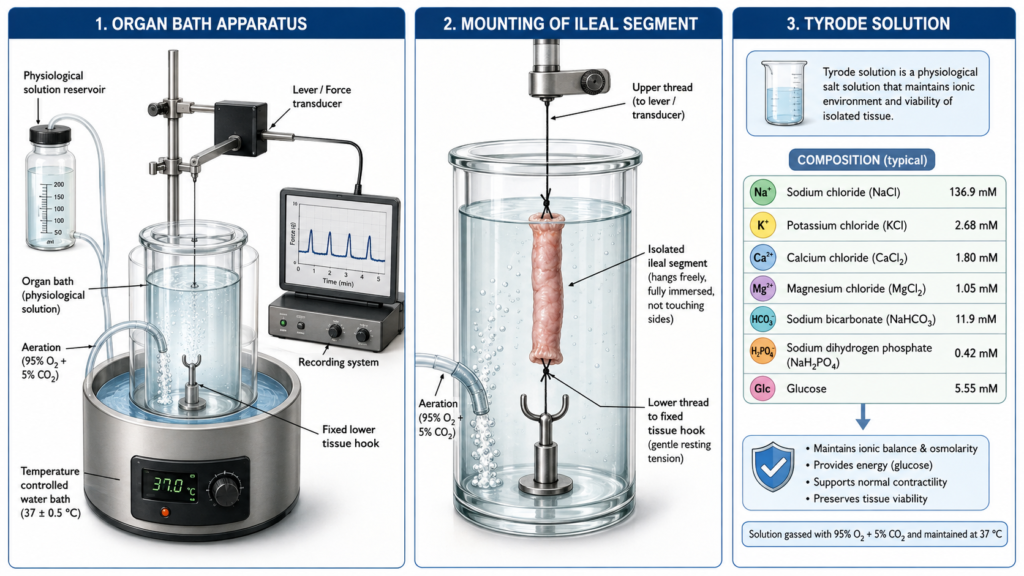
Examine the apparatus and solution provided. Identify the important components, state their functions and the constituents/purpose of the physiological solution, then demonstrate how an isolated ileal segment would be mounted in the setup.
⚡ Model Station Answer
Identification: This is a tissue organ bath used to study responses of an isolated tissue to drugs.
Setup: The ileal segment is immersed in warm, aerated physiological solution, with one end fixed to the tissue holder and the other connected to a recording lever or force transducer.
Tyrode solution: It contains NaCl, KCl, CaCl₂, MgCl₂, NaHCO₃, NaH₂PO₄ and glucose in water and provides a physiological ionic environment for tissue viability.
Function: Temperature control, aeration and recording mechanisms allow contraction or relaxation of the isolated tissue to be observed.
🔎 Stepwise Procedure / Approach
- Identify the main apparatus. Locate the organ bath chamber, physiological-solution reservoir, aeration system, tissue holder and recording lever/transducer.
- Check the bathing solution. Fill the tissue chamber with Tyrode solution and maintain it at an appropriate physiological temperature according to the practical setup.
- Aerate the solution. Ensure continuous gentle bubbling so that the isolated tissue remains adequately oxygenated and the solution is mixed.
- Prepare the ileal segment. Use a suitable isolated segment with threads securely tied to both ends without crushing the tissue.
- Fix the lower end. Attach one end of the ileum to the fixed tissue hook inside the organ bath.
- Connect the upper end. Attach the other end to the recording lever or force transducer, keeping the tissue vertically suspended and completely immersed.
- Apply gentle resting tension. Adjust the recording system according to the practical protocol without overstretching the tissue.
- Allow stabilization. Maintain warm, aerated Tyrode solution and allow the preparation to equilibrate before recording drug-induced responses.
🖼️ Visual Learning
Tissue Organ Bath — Components, Ileum Mounting & Tyrode Solution
🎥 Practical Video
🎥 Practical Demonstration — Organ Bath Pharmacology
Demonstrates the organ bath setup, calibration and practical use of an isolated-tissue system, helping you recognize how the apparatus is assembled and used to record tissue responses.
📝 Important Viva Questions
Answer: It is an apparatus used to maintain an isolated living tissue under controlled conditions so its response to drugs or other stimuli can be recorded.
Answer: It provides a physiological ionic and nutrient environment that helps maintain the viability and normal activity of the isolated tissue.
Answer: NaCl, KCl, CaCl₂, MgCl₂, NaHCO₃, NaH₂PO₄ and glucose dissolved in water.
Answer: One end is tied to a fixed tissue hook and the other to a recording lever or force transducer while the tissue remains immersed in physiological solution.
Answer: Aeration helps maintain tissue oxygenation and promotes adequate mixing of the bathing solution.
Answer: Isolated tissue function is temperature-sensitive, so maintaining an appropriate physiological temperature helps preserve stable and reproducible responses.
Answer: It detects and records changes in tissue contraction or relaxation produced spontaneously or following administration of a drug.