
AIM OSCE / OSPE • MBBS
🧪 Station 10 — Toxicology Sample Collection & Preservation
Rapid Revision • Practical Skills • Viva
🎯 Task
“`
Candidate Task
You are provided with specimen containers, preservatives and materials from a suspected poisoning case. Select the appropriate specimens and preservatives, demonstrate or describe correct collection, labelling and handling, and state the essential precautions before dispatch for toxicological examination.
⚡ Model Station Answer
Specimens: I would preserve the stomach with contents, a segment of small intestine with contents, representative liver and kidney tissue, and collect blood and urine where available.
Preservation: Each specimen is kept in an appropriate separate, clean, leak-proof container with the preservative selected according to the suspected poison and local forensic laboratory protocol. Formalin must not be used for chemical toxicology.
Labelling: Every container is correctly identified, tightly closed, sealed and labelled with case details, specimen, preservative, collection details and examiner identification.
Dispatch: I would prevent contamination, maintain the seal and documented chain of custody, send the required forwarding documents and dispatch the specimens promptly to the forensic toxicology laboratory.
🔎 Stepwise Procedure / Approach
Prepare safely. Wear appropriate PPE, confirm the case identification and arrange clean containers, labels, seals and required preservatives before collection.
- Select the routine toxicology specimens. Preserve the stomach with its contents, a segment of small intestine with contents, representative liver and kidney tissue, plus blood and urine where available. Additional samples are selected according to the suspected poison.
- Keep specimens separate. Place viscera, blood, urine and any additional material in correctly sized, clean, leak-proof containers. Do not mix unrelated samples.
- Select the preservative correctly. Use the preservative recommended for the suspected toxic agent and the receiving forensic laboratory. Saturated sodium chloride is a commonly taught preservative for viscera where appropriate; rectified spirit is used only when suitable and must be avoided when it could interfere with detection of the suspected poison.
- Handle special samples appropriately. Blood intended for alcohol estimation is collected in a properly sealed tube containing sodium fluoride with an anticoagulant such as potassium oxalate. Suspected volatile poisons require an airtight container and careful minimization of volatile loss.
- Label each container immediately. Record the case/postmortem number or patient identification, specimen type, preservative used, date and time of collection, and the collecting doctor’s identification/signature according to local protocol.
- Close and seal securely. Check the lid for leakage, apply the authorized tamper-evident seal and ensure that the specimen identity corresponds exactly with the documentation.
- Complete dispatch requirements. Send the laboratory requisition/forwarding documentation, specimen of the seal and a separately labelled control sample of preservative when required. Maintain a documented chain of custody and obtain acknowledgement at handover.
| Material | Practical OSPE Handling |
|---|---|
| Stomach + contents | Collect together in a clean wide-mouth, leak-proof container. |
| Small intestine + contents | Preserve an appropriate segment with its contents according to local protocol. |
| Liver + kidney | Preserve representative tissue in a separate suitable container. |
| Blood | Collect separately in a suitable sealed tube; use the required preservative for the requested analysis. |
| Urine | Collect separately in a clean, properly labelled leak-proof container where available. |
Exam caution: Never automatically use the same preservative for every poison. Always match the preservative to the suspected toxic substance and local forensic laboratory protocol. Do not use formalin for specimens intended for chemical toxicological analysis.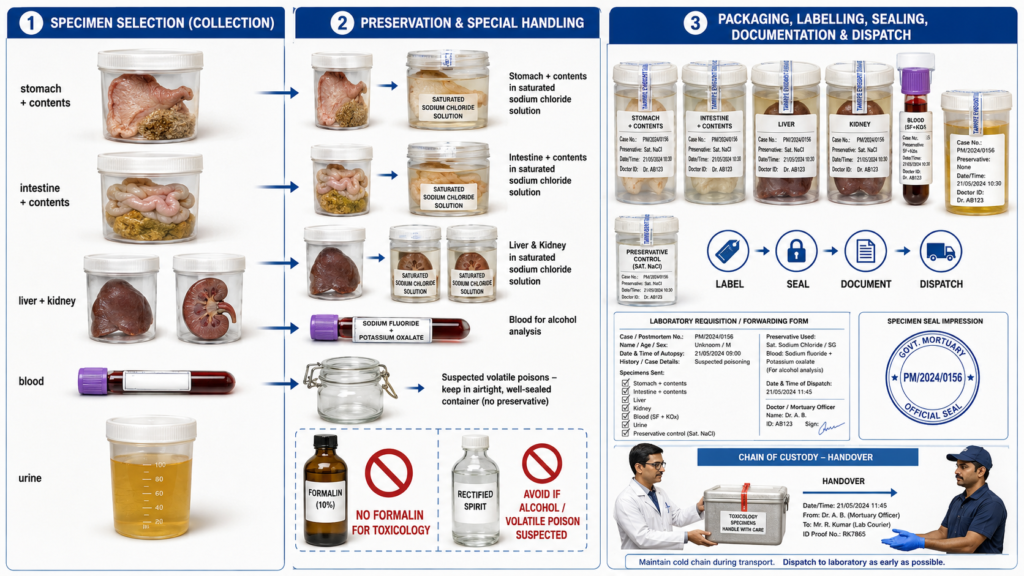
🖼️ Visual Learning
VISUAL 1
Toxicology Specimens, Preservatives & Dispatch Sequence
🎥 Practical Video
🎥 Preservation and Dispatch of Viscera
Source: Rashid Latif Medical Complex — Forensic Medicine Digital Lectures
This forensic medicine teaching resource demonstrates preservation and dispatch of viscera and helps reinforce specimen selection, preservation and handling for practical examination preparation.
📝 Important Viva Questions
Q1. Which specimens are routinely collected in a suspected poisoning case for toxicological examination?
Answer: Common specimens include stomach with contents, small intestine with contents, liver, kidney, blood and urine. Additional specimens are selected according to the suspected poison.
Q2. Why are the stomach and its contents important in poisoning?
Answer: They may contain unabsorbed poison and can provide direct evidence of an orally ingested toxic substance.
Q3. Which preservative is commonly taught for routine viscera?
Answer: Saturated sodium chloride solution is commonly used where appropriate. The final preservative must always be selected according to the suspected poison and local forensic laboratory protocol.
Q4. Why should formalin not be used for specimens sent for chemical toxicological analysis?
Answer: Formalin can chemically alter or interfere with toxicological analysis. It is primarily a tissue fixative for histopathology rather than a routine preservative for chemical toxicology.
Q5. How is blood preserved when alcohol estimation is required?
Answer: It is collected in a properly sealed tube containing sodium fluoride to inhibit glycolysis and an appropriate anticoagulant such as potassium oxalate.
Q6. What essential information should appear on a toxicology specimen label?
Answer: Case or postmortem identification, specimen type, preservative used, date and time of collection and the collecting doctor’s identification/signature according to local protocol.
Q7. What is the most important medicolegal precaution during dispatch?
Answer: Maintain specimen identity and integrity by secure sealing, complete documentation and an uninterrupted chain of custody from collection until receipt by the forensic laboratory.