🩺 Station 2 — Lower Limb Sensory Examination
AIM OSPE/OSCE Lab — Practical Station | KMU Style | MBBS Practical + Viva
📋 Complete OSPE Station Content
OSPE Station Name
Station 2 — Lower Limb Sensory Examination
Module: Neuroscience
Year: 2nd Year MBBS
Subject / Integration: Anatomy + Physiology + Clinical Integration
Learning Target
By the end of this station, the student should be able to:
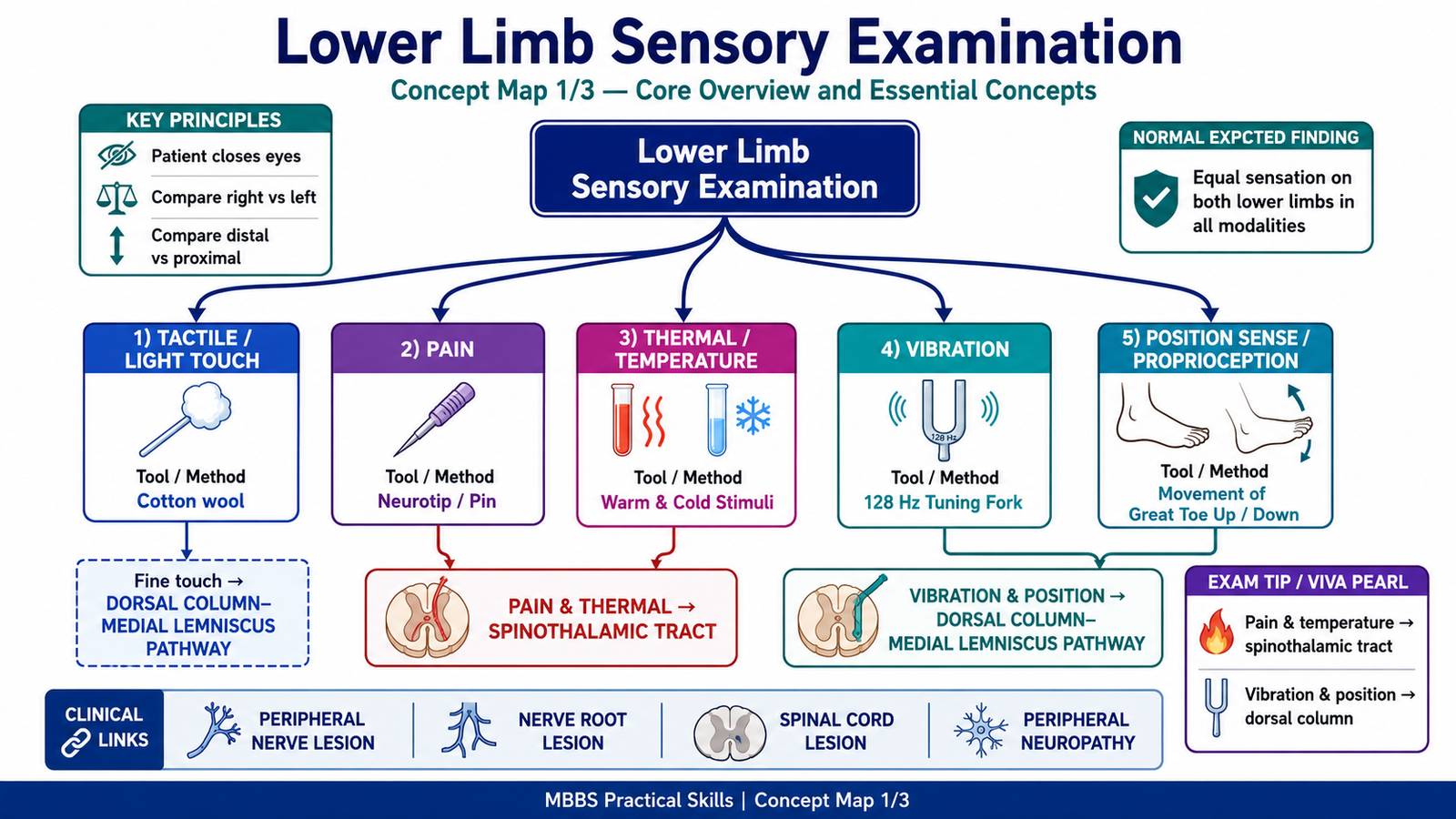
- Perform basic sensory examination of the lower limb using tactile, pain, thermal, vibration, and position sense.
- Interpret sensory findings clinically by relating them to peripheral nerves, spinal pathways, and common neurological lesions.
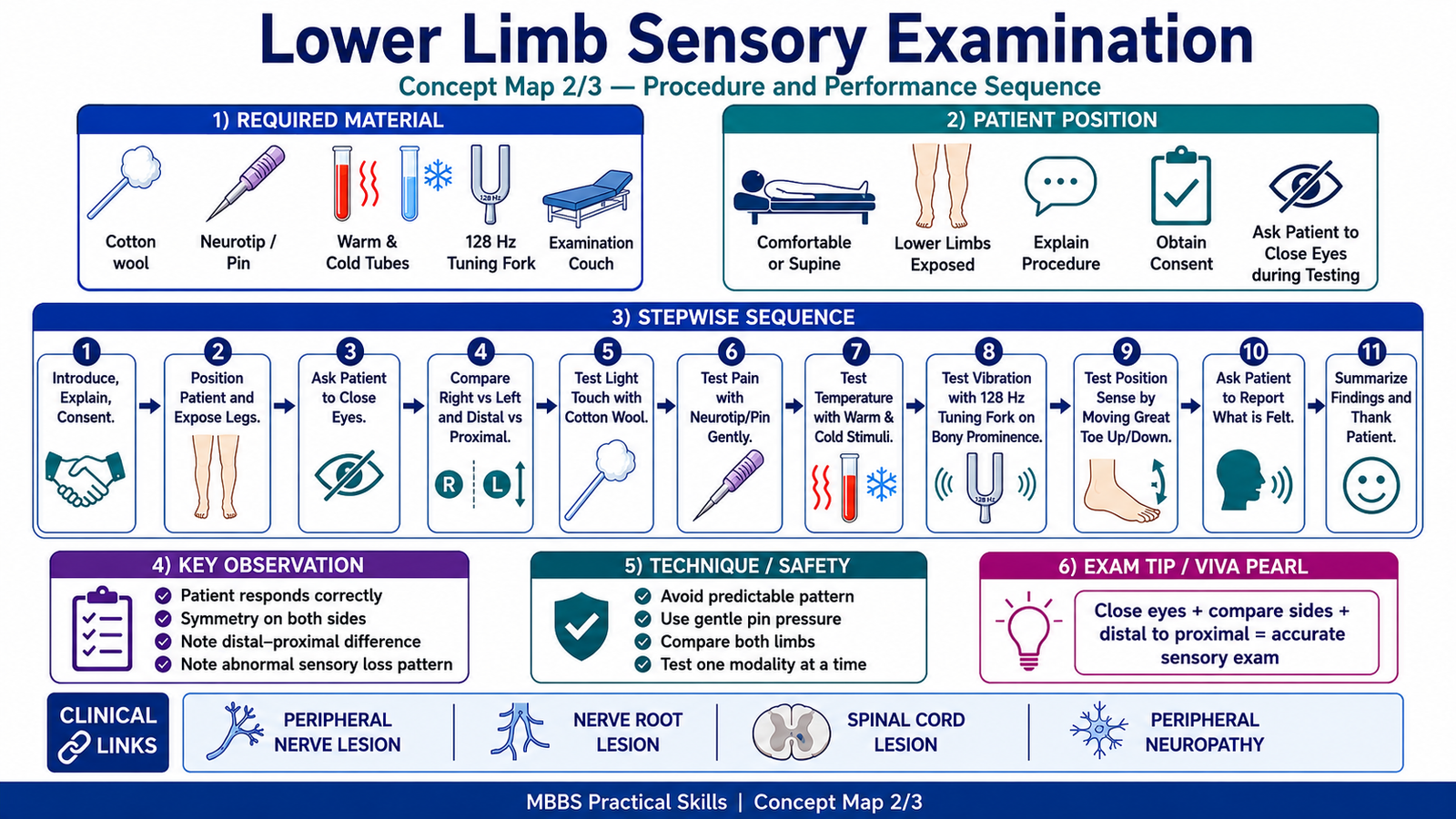
Required Material
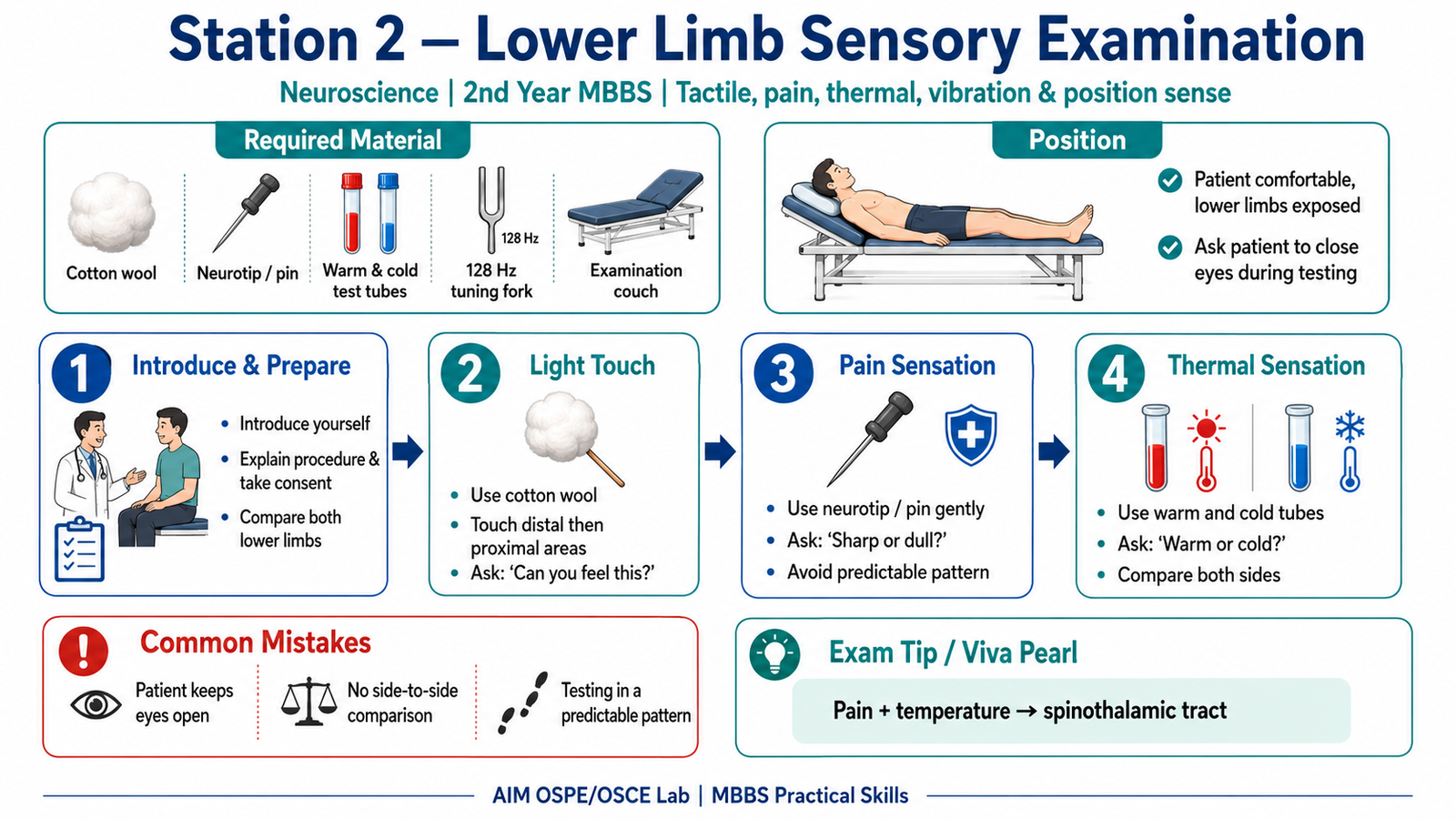
- Examination couch
- Cotton wool
- Neurotip / disposable pin
- Test tubes with warm and cold water
- 128 Hz tuning fork
- Patient / simulated patient
- Alcohol swab or tissue
- Marking checklist
- Hand sanitizer
Student Task / Procedure
Perform sensory examination of the lower limb.
- Introduce yourself and confirm patient identity.
- Explain the procedure and take consent.
- Ask the patient to close their eyes during testing.
- Compare both lower limbs and compare distal with proximal areas.
- Test light touch using cotton wool.
- Test pain sensation using a neurotip or pin.
- Test thermal sensation using warm and cold test tubes.
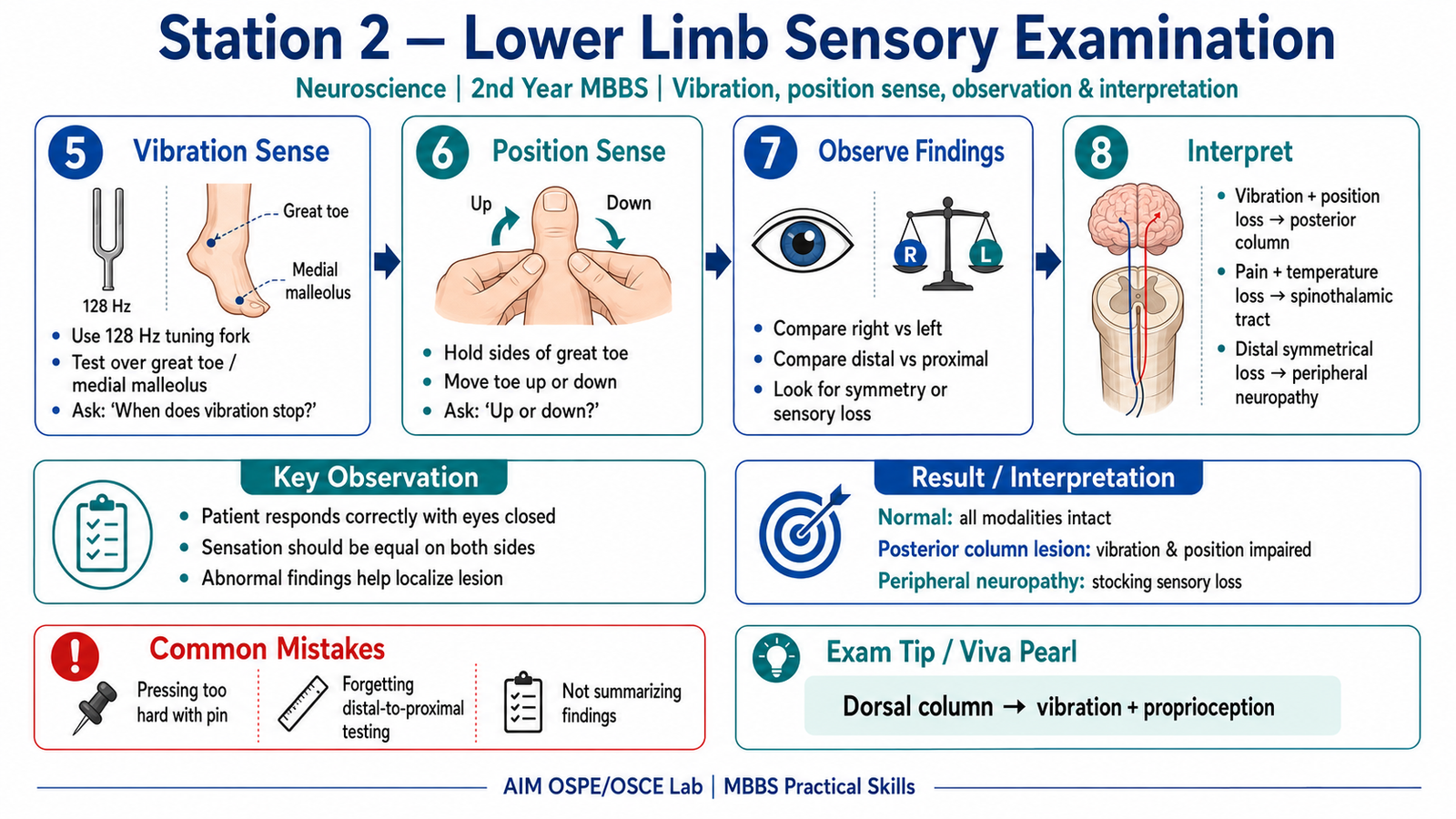
- Test vibration sense using a 128 Hz tuning fork over bony prominences.
- Test position sense at the great toe.
- Thank the patient and summarize your findings.
Observation / Identification Points
Key Performance Points
The student should demonstrate:
- Proper communication and consent.
- Correct patient positioning.
- Testing with eyes closed.
- Comparing right and left sides.
- Comparing distal and proximal sensation.
- Avoiding repeated testing in a predictable pattern.
- Correct use of each sensory tool.
- Asking the patient to report what they feel.
- Identifying reduced, absent, exaggerated, or symmetrical sensations.
- Relating abnormal findings to possible neurological lesion level.
Result / Interpretation
Normal sensory examination shows equal sensation on both lower limbs for light touch, pain, temperature, vibration, and joint position sense.
Reduced or absent sensation may indicate:
- Peripheral nerve lesion if sensory loss follows a nerve distribution.
- Dermatomal lesion if sensory loss follows a spinal nerve root pattern.
- Posterior column lesion if vibration and position sense are impaired.
- Spinothalamic tract lesion if pain and temperature sensations are impaired.
- Peripheral neuropathy if sensory loss is symmetrical and distal, commonly in a “stocking” pattern.
Clinical significance: Sensory examination helps localize neurological lesions and differentiate peripheral nerve, spinal cord, and sensory pathway involvement.
Viva Questions
1. Which pathway carries vibration and position sense?
Ideal Answer:
The dorsal column–medial lemniscus pathway carries vibration, proprioception, and fine touch.
2. Which pathway carries pain and temperature sensation?
Ideal Answer:
The spinothalamic tract carries pain and temperature sensation.
3. Why should the patient close their eyes during sensory examination?
Ideal Answer:
To prevent visual clues and ensure the response is based only on sensory perception.
4. Why do we compare both lower limbs?
Ideal Answer:
Comparison helps detect asymmetry, which may suggest a unilateral nerve, root, or spinal cord lesion.
5. Where is vibration sense commonly tested in the lower limb?
Ideal Answer:
It is commonly tested over bony prominences such as the great toe, medial malleolus, tibial tuberosity, or anterior superior iliac spine.
Common Student Mistakes
- Testing sensation while the patient’s eyes are open.
- Not comparing right and left sides.
- Using too much pressure during pain testing.
- Forgetting vibration or position sense.
- Testing in a predictable pattern.
- Not explaining findings clinically.
AIM Feedback
Sensory examination is not only about touching the skin with different tools. The main aim is to identify which type of sensation is affected and then localize the lesion. Always test with the patient’s eyes closed, compare both sides, move from distal to proximal, and remember the pathway: pain and temperature travel through the spinothalamic tract, while vibration and position sense travel through the dorsal column pathway.
🖼️ Visual / Image Support
🧩 Concept Map / Interpretation Support