🩺 Station 6 — Upper Limb Deep Tendon Reflexes
AIM OSPE/OSCE Lab — Practical Station | KMU Style | MBBS Practical + Viva
📋 Complete OSPE Station Content
OSPE Station Name
Station 6 — Upper Limb Deep Tendon Reflexes
Biceps, Triceps and Supinator Reflexes
Learning Target
By the end of this station, the student should be able to:
- Elicit biceps, triceps and supinator reflexes correctly on both upper limbs.
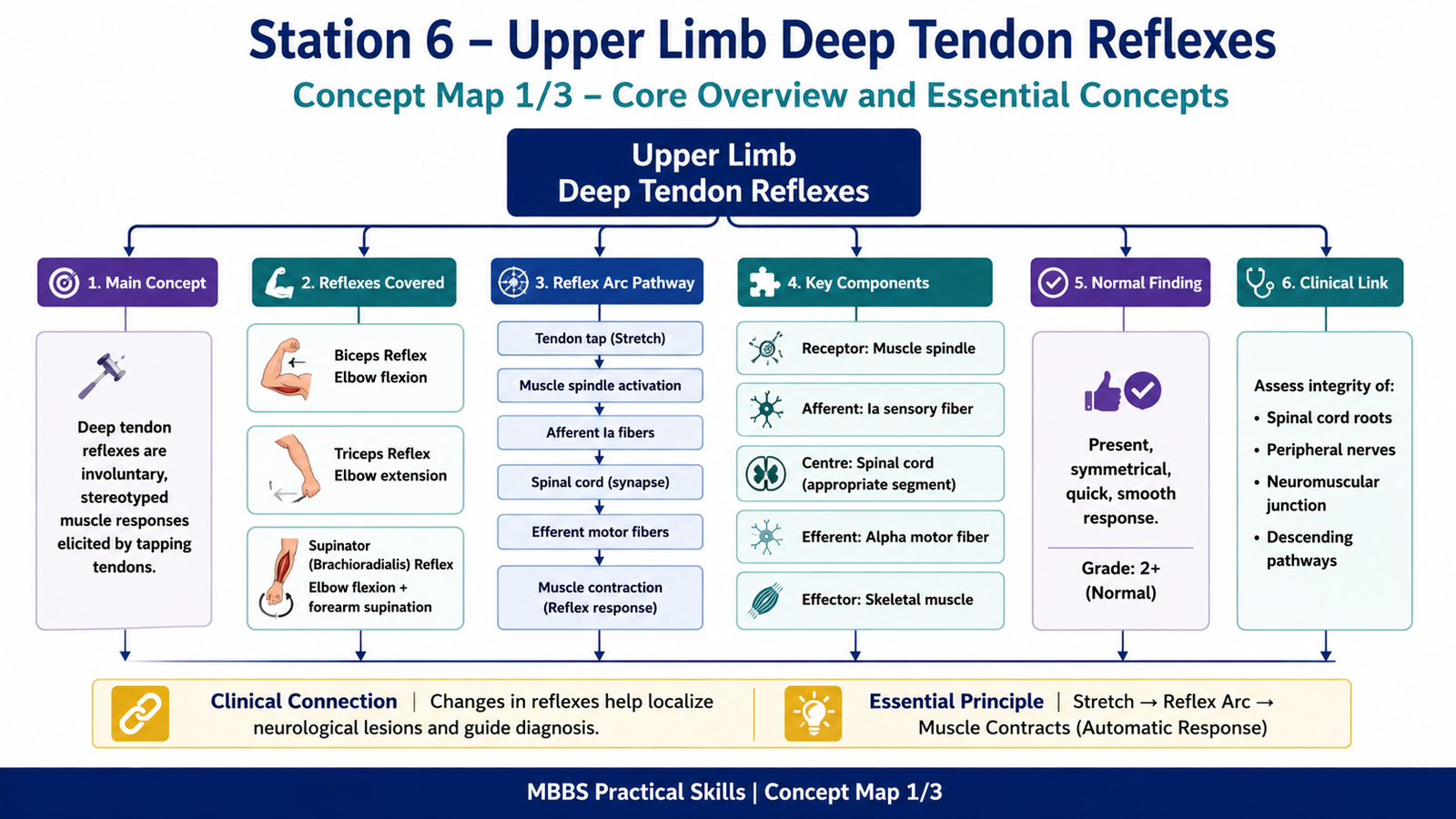
- Interpret upper limb deep tendon reflexes in relation to spinal segments, peripheral nerves and UMN/LMN lesions.
Required Material
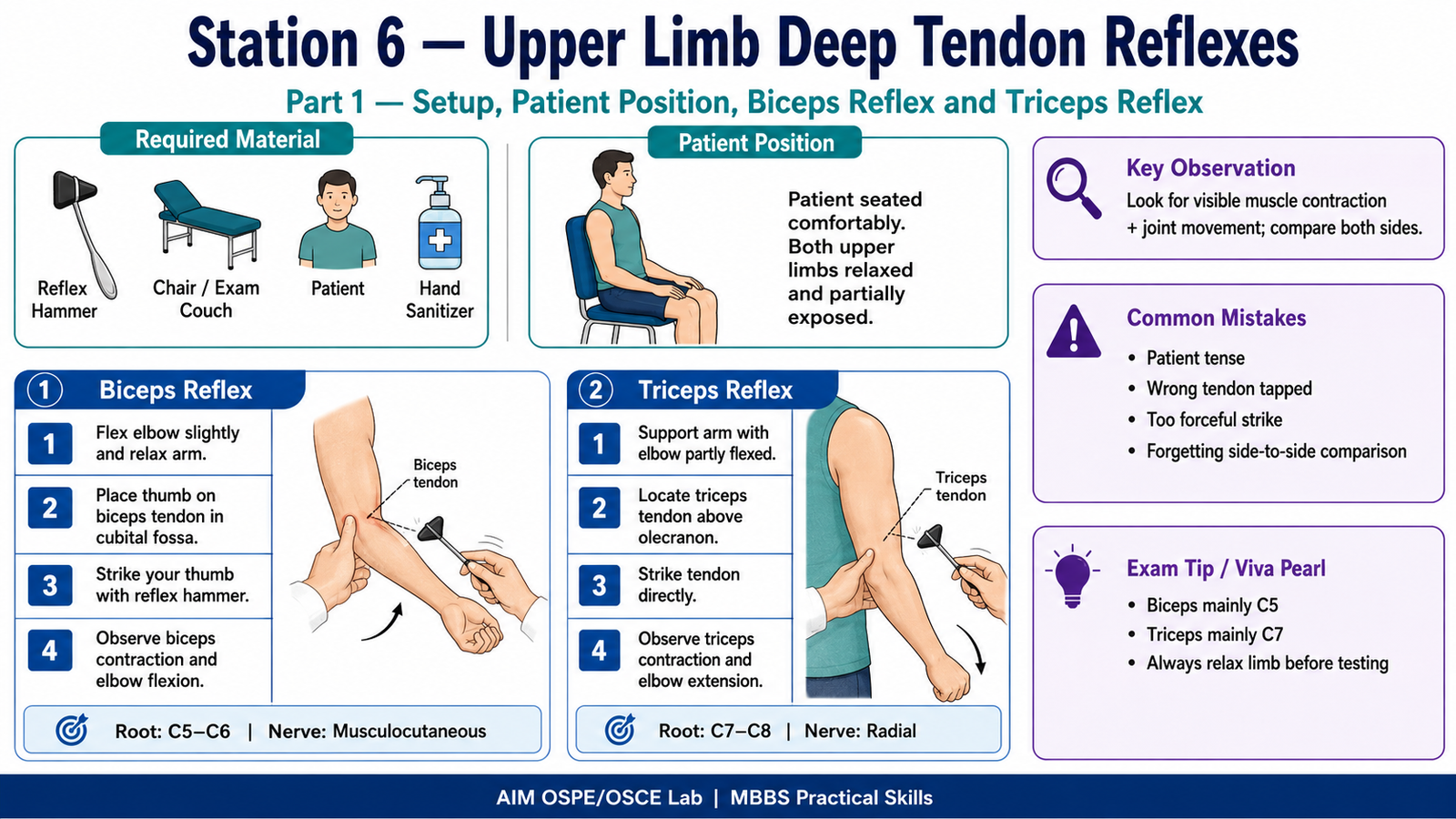
Reflex hammer
Examination couch or chair
Patient / simulated patient
Hand sanitizer
LMS checklist / marking sheet
Student Task / Procedure
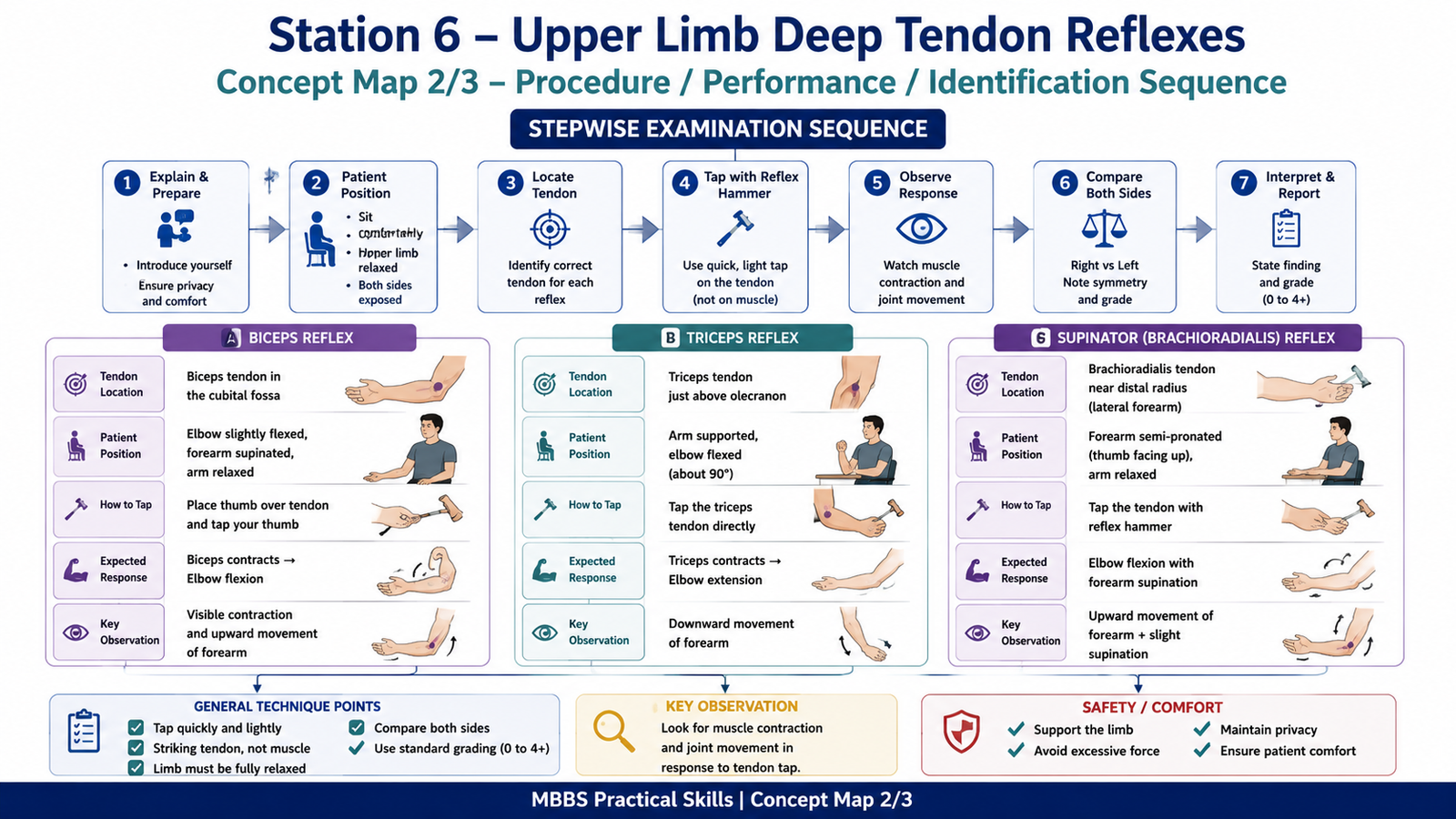
- Introduce yourself and explain the procedure briefly.
- Ask the patient to sit comfortably and relax both upper limbs.
- Expose the upper limb adequately while maintaining privacy.
- Test each reflex on both sides and compare right with left.
Biceps Reflex
- Slightly flex the patient’s elbow.
- Place your thumb over the biceps tendon in the cubital fossa.
- Strike your thumb with the reflex hammer.
- Observe contraction of biceps and flexion at the elbow.
Triceps Reflex
- Support the patient’s arm with the elbow partially flexed.
- Locate the triceps tendon just above the olecranon.
- Strike the triceps tendon directly.
- Observe contraction of triceps and extension at the elbow.
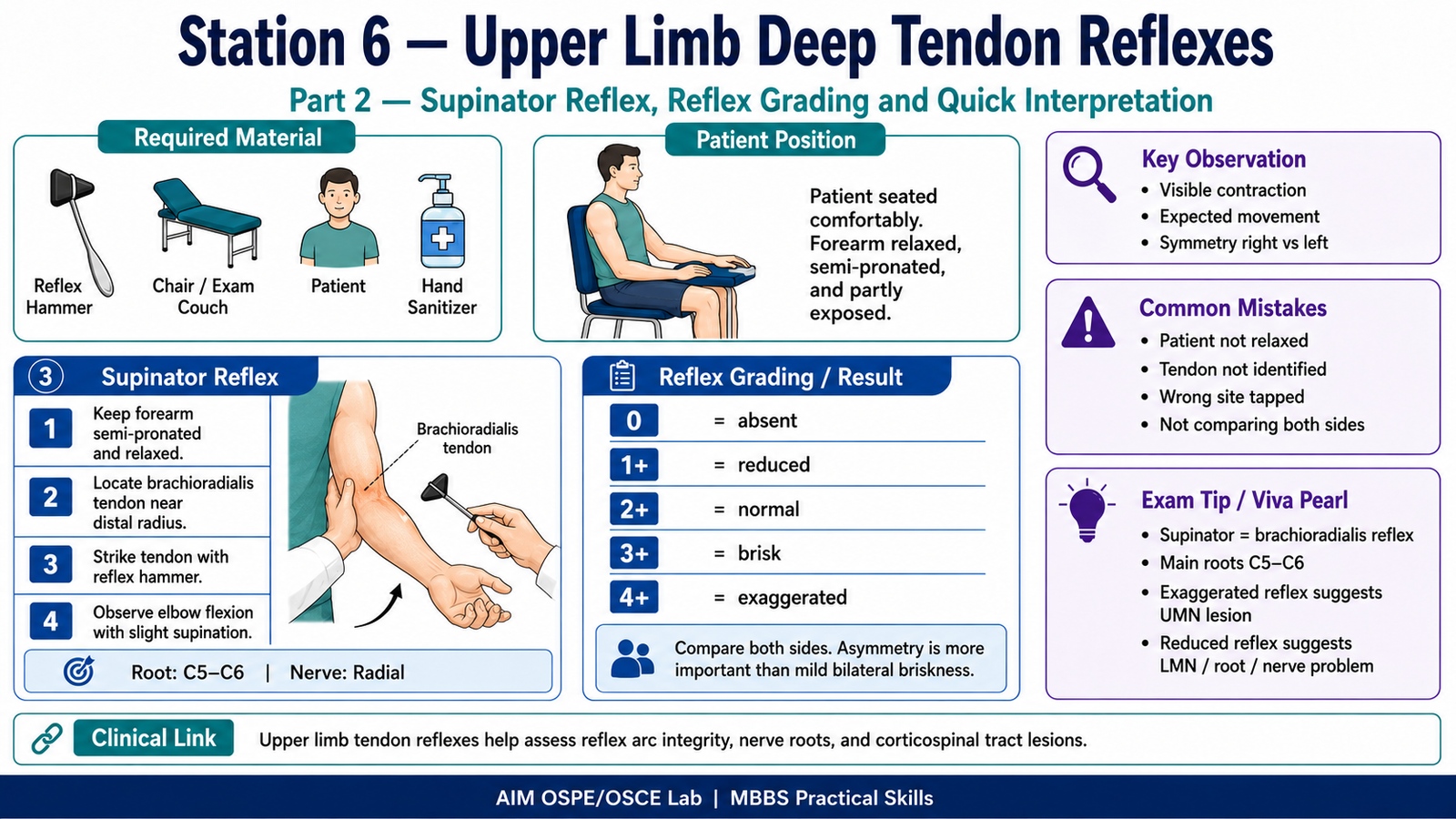
Supinator / Brachioradialis Reflex
- Keep the forearm semi-pronated and relaxed.
- Locate the brachioradialis tendon near the distal radius.
- Strike the tendon with the reflex hammer.
- Observe elbow flexion with slight supination of the forearm.
Observation / Identification Points
The student should demonstrate:
Proper patient positioning and relaxation
Correct tendon identification
Correct use of reflex hammer
Testing of both sides for comparison
Observation of muscle contraction and joint movement
Recognition of normal, reduced, absent or exaggerated reflexes
Important reflex roots and nerves:
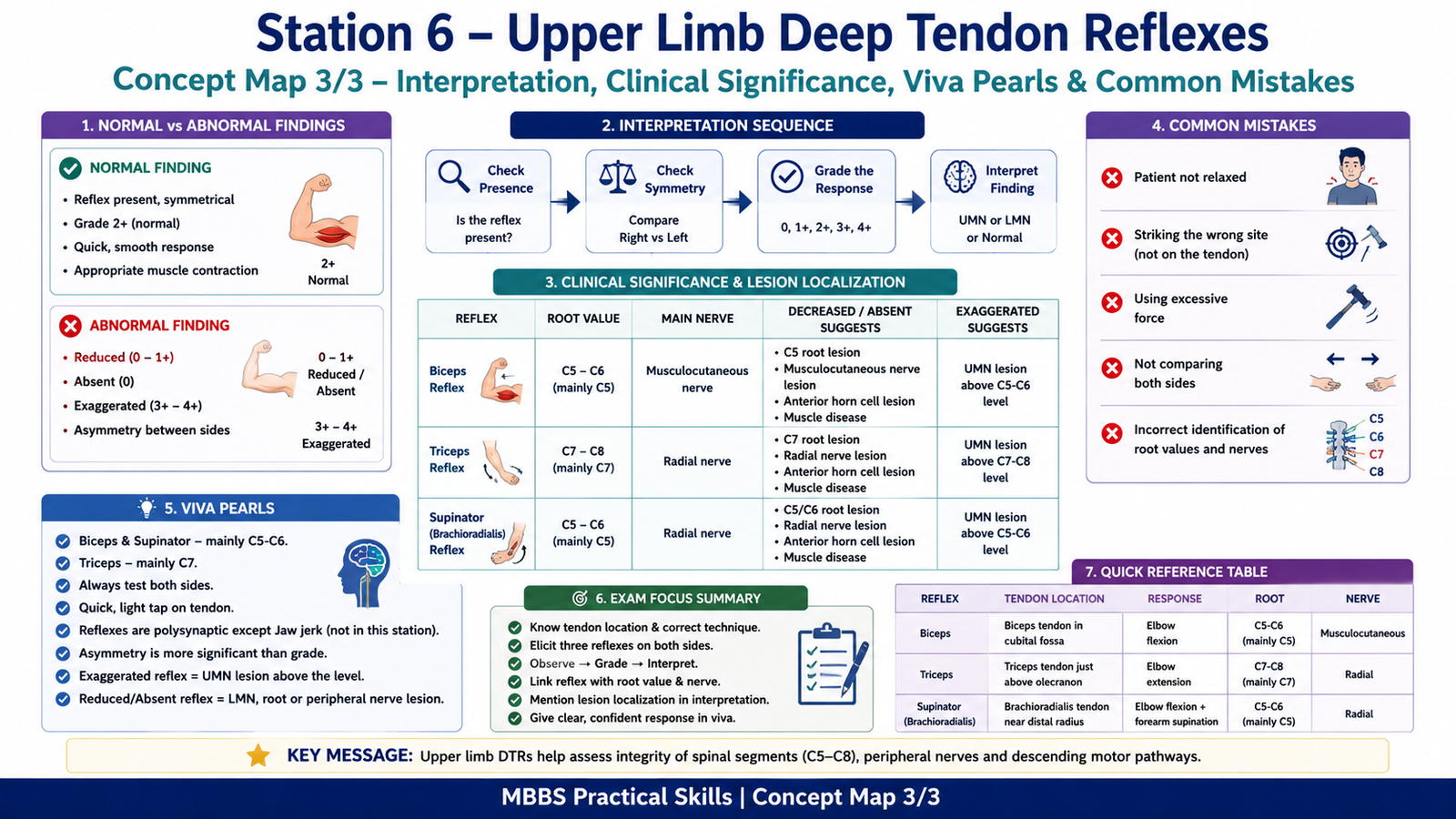
Biceps reflex: C5–C6, mainly C5; musculocutaneous nerve
Triceps reflex: C7–C8, mainly C7; radial nerve
Supinator / brachioradialis reflex: C5–C6; radial nerve
Result / Interpretation
Normal finding: Reflex is present, symmetrical and graded as 2+.
Reflex grading:
0 = absent
1+ = reduced
2+ = normal
3+ = brisk
4+ = exaggerated with clonus
Interpretation:
Reduced or absent reflex suggests a lower motor neuron lesion, peripheral nerve lesion, root lesion, muscle disease or poor relaxation.
Exaggerated reflex suggests an upper motor neuron lesion above the reflex arc level.
Asymmetry between right and left sides is more important than a slightly brisk reflex on both sides.
Clinical significance:
Upper limb deep tendon reflexes help assess integrity of spinal cord segments, peripheral nerves and descending motor pathways.
Viva Questions
- What is the root value of the biceps reflex?
Ideal answer: C5–C6, mainly C5. - Which nerve mediates the biceps reflex?
Ideal answer: Musculocutaneous nerve. - What is the root value of the triceps reflex?
Ideal answer: C7–C8, mainly C7. - Which nerve mediates the supinator reflex?
Ideal answer: Radial nerve. - What does an exaggerated deep tendon reflex suggest?
Ideal answer: It suggests an upper motor neuron lesion above the level of the reflex arc.
Common Student Mistakes
Testing the reflex while the patient is tense.
Striking the wrong site instead of the tendon.
Forgetting to compare both sides.
Using excessive force with the reflex hammer.
Not knowing the root values of each reflex.
AIM Feedback
To improve, first make the limb relaxed because reflexes are difficult to elicit in a tense patient. Always locate the tendon before striking. Use a quick, controlled tap rather than force. After eliciting the reflex, interpret it by asking three questions: Is it present? Is it symmetrical? Is it normal, reduced or exaggerated? For viva, remember the key root values: biceps C5–C6, supinator C5–C6 and triceps C7–C8.
🖼️ Visual / Image Support
🧩 Concept Map / Interpretation Support