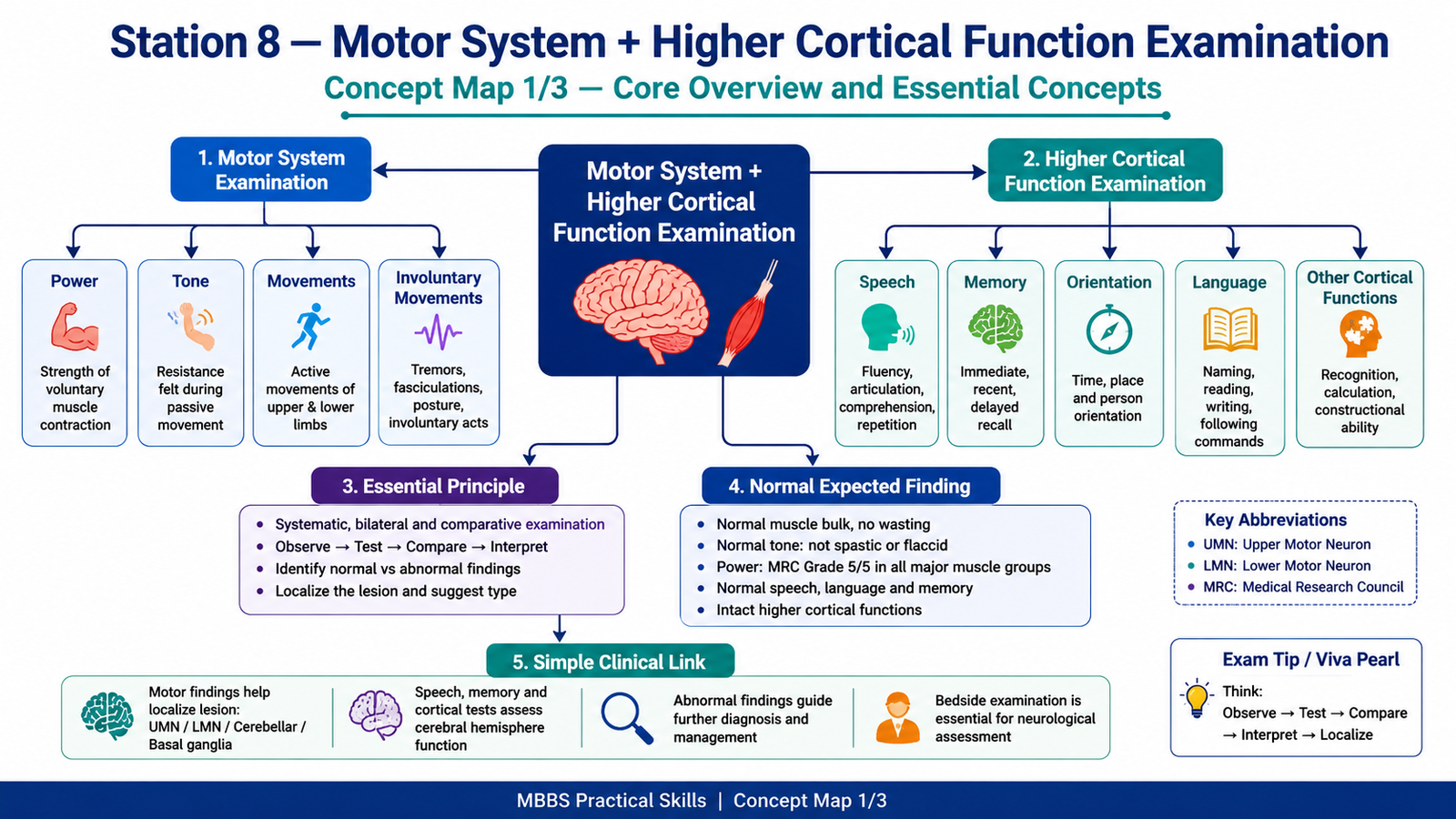
🩺 Station 8 — Motor System + Higher Cortical Function Examination
AIM OSPE/OSCE Lab — Practical Station | KMU Style | MBBS Practical + Viva
📋 Complete OSPE Station Content
OSPE Station Name
Station 8 — Motor System + Higher Cortical Function Examination
Learning Target
By the end of this station, the student should be able to:
- Perform a basic motor system examination of upper and lower limbs, including power, tone, movements, and abnormal motor findings.
- Assess basic speech, memory, and higher cortical functions and interpret their clinical significance at MBBS level.
Required Material
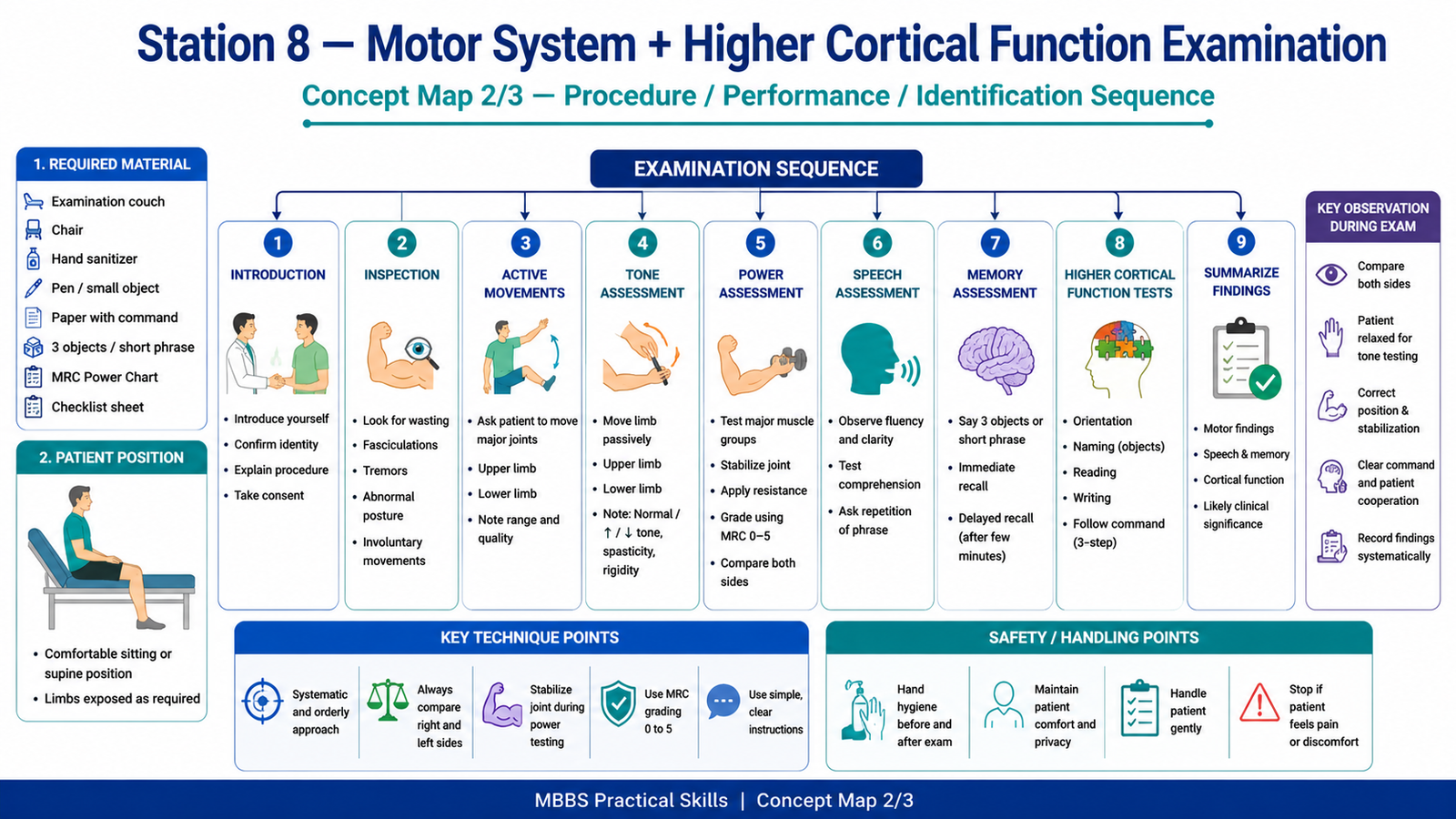
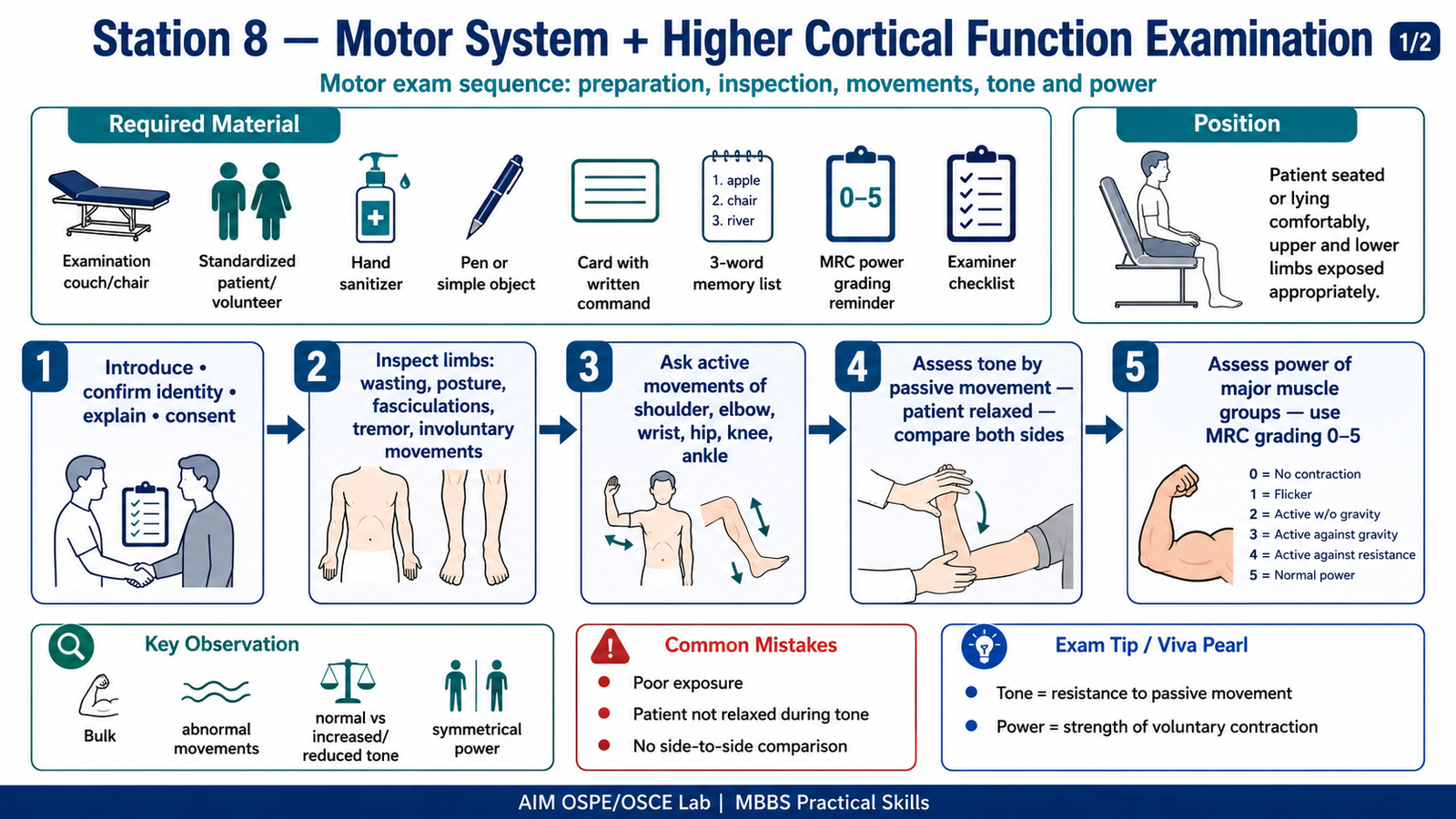
- Examination couch or chair
- Standardized patient / volunteer
- Hand sanitizer
- Pen or simple object for naming test
- Paper with a simple written command
- Short memory phrase or 3 unrelated objects
- MRC power grading chart
- Checklist sheet for examiner
Student Task / Procedure
Perform the examination in the following steps:
- Introduce yourself, confirm patient identity, explain the procedure, and take consent.
- Position the patient comfortably and expose upper and lower limbs appropriately.
- Inspect upper and lower limbs for wasting, abnormal posture, fasciculations, tremors, or involuntary movements.
- Ask the patient to perform active movements of major joints of upper and lower limbs.
- Assess tone in upper limbs and lower limbs by passive movement.
- Assess power of major muscle groups using the MRC grading system.
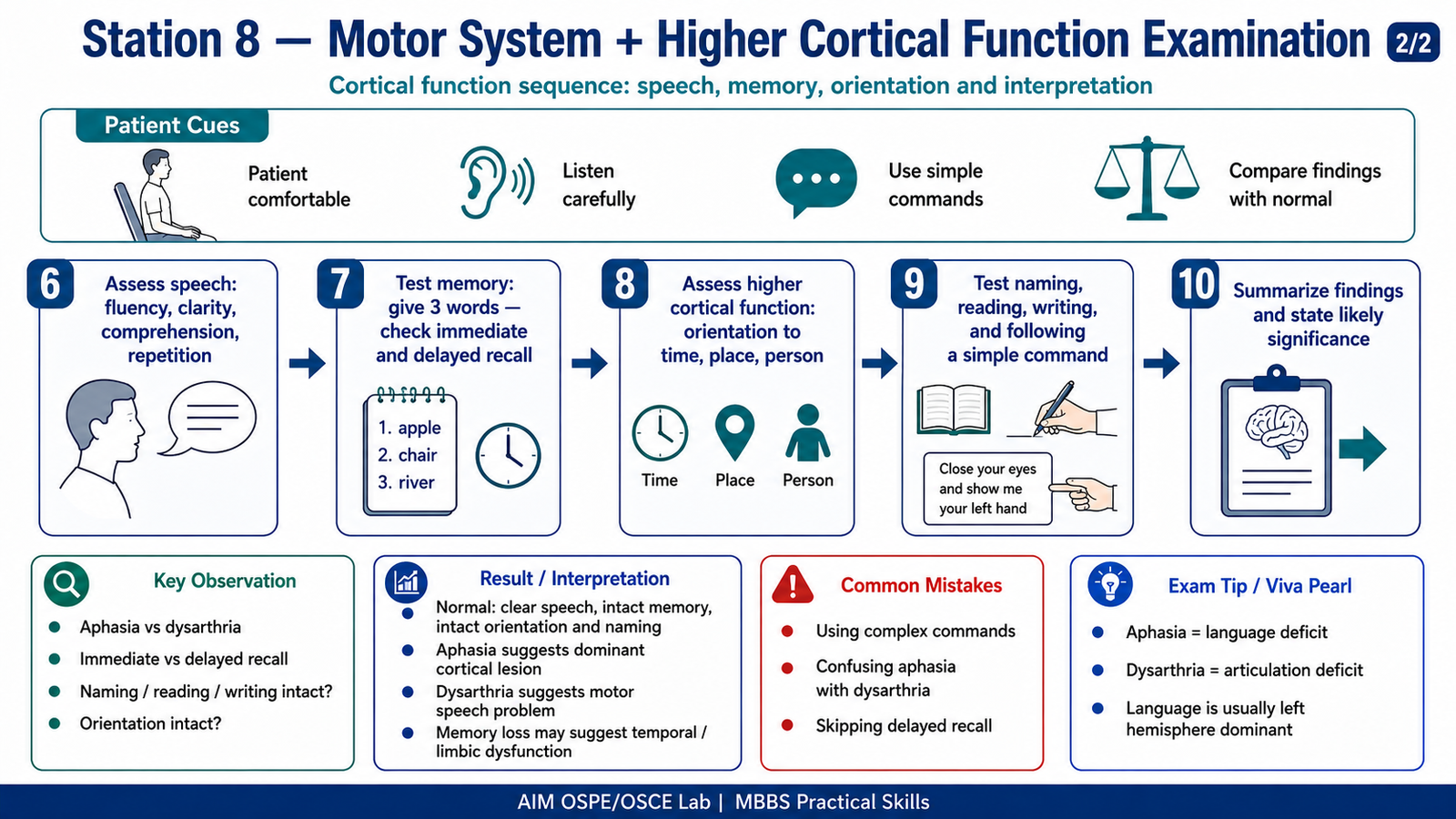
- Observe speech for fluency, clarity, comprehension, and repetition.
- Test memory using 3-object recall or a short phrase.
- Assess simple higher cortical functions such as orientation, naming, reading, writing, and following a command.
- Summarize your findings and mention the likely clinical significance.
Observation / Identification Points
The student should demonstrate or identify:
- Proper consent, patient comfort, and correct limb exposure
- Inspection for:
- Muscle wasting
- Fasciculations
- Tremor
- Abnormal posture
- Involuntary movements
- Tone assessment:
- Normal tone
- Increased tone/spasticity
- Rigidity
- Reduced tone/flaccidity
- Power assessment using MRC grading:
- Grade 0: No contraction
- Grade 1: Flicker of contraction
- Grade 2: Movement with gravity eliminated
- Grade 3: Movement against gravity
- Grade 4: Movement against resistance
- Grade 5: Normal power
- Speech assessment:
- Dysarthria
- Aphasia
- Fluency
- Comprehension
- Repetition
- Memory assessment:
- Immediate recall
- Recent memory
- Delayed recall
- Higher cortical function assessment:
- Orientation
- Naming
- Reading
- Writing
- Following commands
- Recognition of simple cortical dysfunction
Result / Interpretation
Normal findings include normal muscle bulk, no fasciculations or abnormal movements, normal tone, full power with MRC grade 5/5, clear speech, intact comprehension, intact naming, intact orientation, and normal recall.
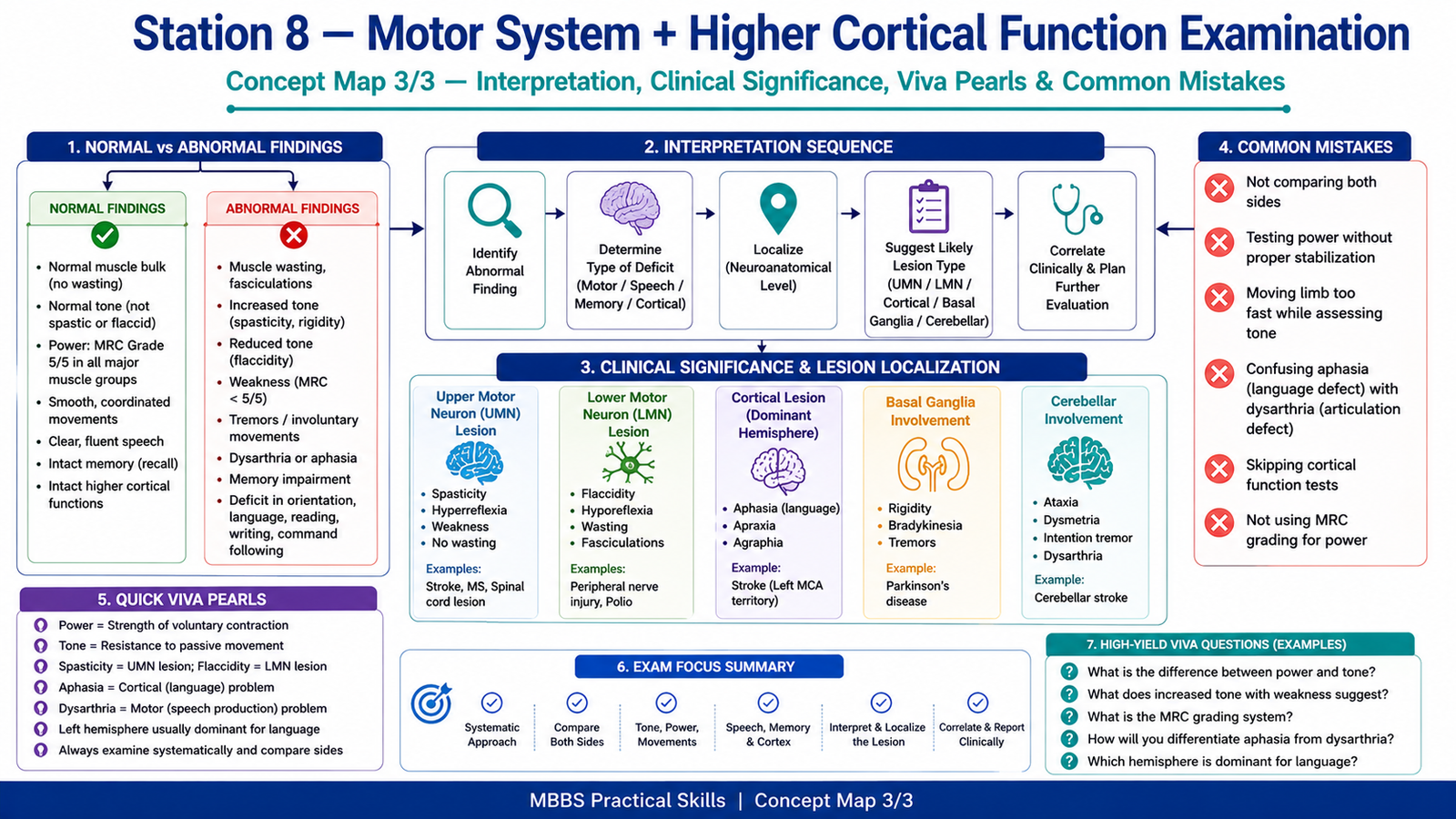
Abnormal motor findings may suggest upper motor neuron, lower motor neuron, basal ganglia, cerebellar, or peripheral nerve involvement depending on the pattern. Increased tone with weakness may suggest an upper motor neuron lesion, while reduced tone with wasting and fasciculations may suggest a lower motor neuron lesion.
Speech and higher cortical function abnormalities may indicate cortical involvement, especially dominant cerebral hemisphere lesions. Aphasia suggests a language problem, while dysarthria suggests a motor articulation problem. Memory impairment may suggest dysfunction of limbic system, temporal lobe, or diffuse cortical processes.
Viva Questions
1. What is the difference between power and tone?
Power is the strength of voluntary muscle contraction, while tone is the resistance felt during passive movement of a relaxed limb.
2. What does increased tone with weakness suggest?
It commonly suggests an upper motor neuron lesion, especially if associated with spasticity.
3. What is the MRC grading system used for?
It is used to grade muscle power from 0 to 5.
4. What is the difference between aphasia and dysarthria?
Aphasia is impairment of language function, usually due to cortical lesions. Dysarthria is difficulty in articulation due to motor weakness or coordination problems.
5. Which cerebral hemisphere is usually dominant for language?
The left cerebral hemisphere is dominant for language in most people.
Common Student Mistakes
- Testing power without stabilizing the joint properly
- Moving the limb too quickly while assessing tone
- Confusing aphasia with dysarthria
- Forgetting to compare right and left sides
- Not using MRC grading while reporting power
AIM Feedback
Your motor examination should be systematic and comparative. Always inspect first, then assess tone, movements, and power. During tone testing, keep the patient relaxed and move the limb passively. During power testing, isolate each major muscle group and grade strength using the MRC scale. For higher cortical function, focus on simple bedside tests: speech, orientation, naming, commands, reading, writing, and memory. A good answer is not only “normal” or “abnormal” but also explains what the abnormality suggests clinically.
🖼️ Visual / Image Support
🧩 Concept Map / Interpretation Support