🩺Station 11 — Creatinine in 24-Hour Urine
AIM OSPE/OSCE Lab — Practical Station | KMU Style | MBBS Practical + Viva
📋 Complete OSPE Station Content
OSPE Station Name
Station 11 — Creatinine in 24-Hour Urine
Module: Renal
Year: 2nd Year MBBS
Subject / Integration: Biochemistry + Physiology + Clinical Integration
Learning Target
- Explain correct handling and collection of a 24-hour urine sample for creatinine estimation.
- Interpret urinary creatinine and creatinine clearance as indicators of renal function.
Required Material
- 24-hour urine collection container
- Fresh urine aliquot from 24-hour urine sample
- Measuring cylinder
- Test tubes and test tube rack
- Pipettes / droppers
- Creatinine standard solution
- Alkaline picrate reagent / Jaffe reagent
- Distilled water
- Colorimeter / spectrophotometer
- Gloves
- Labeling sticker / marker
- Result sheet
- Calculator
Student Task / Procedure
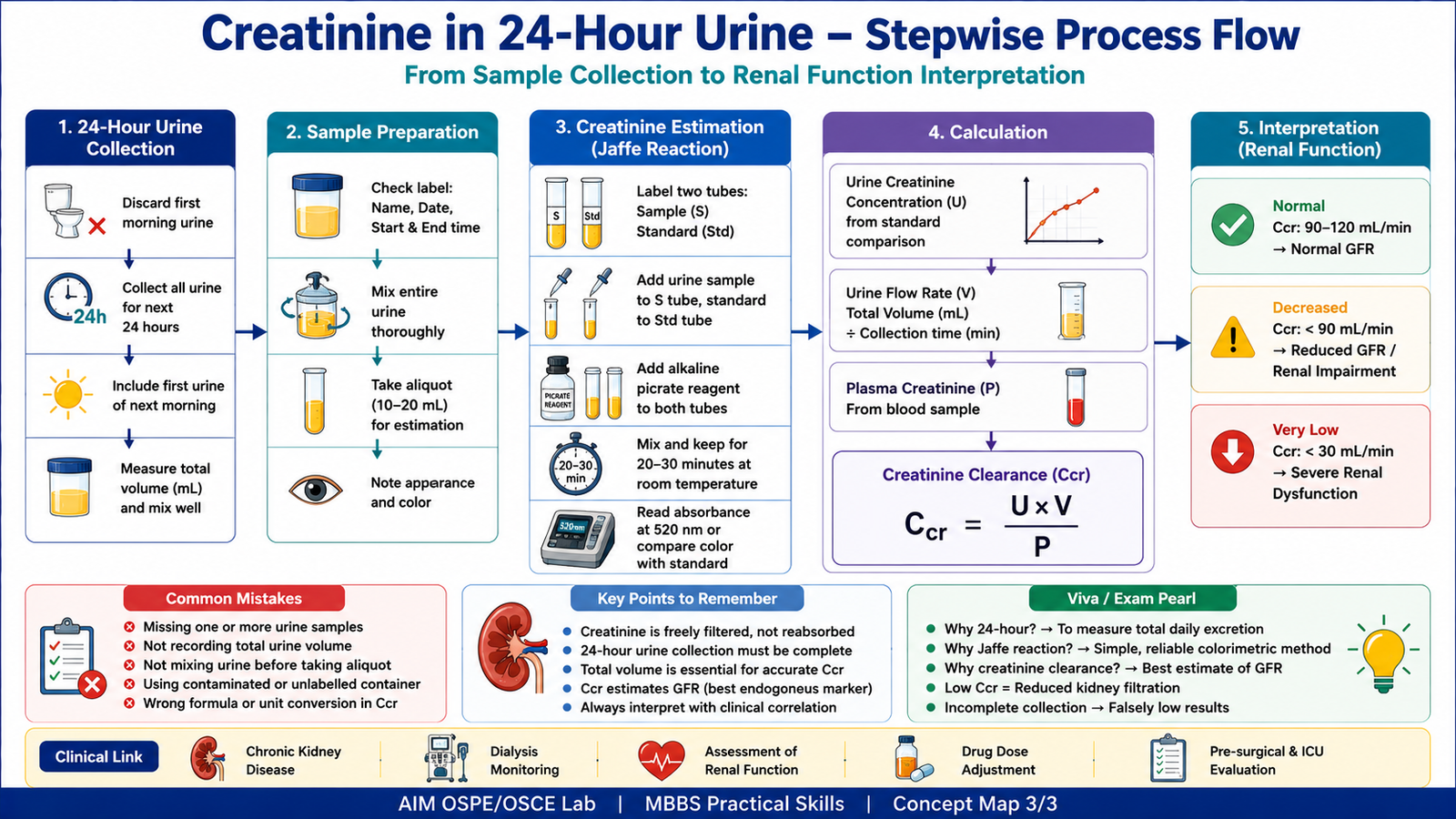
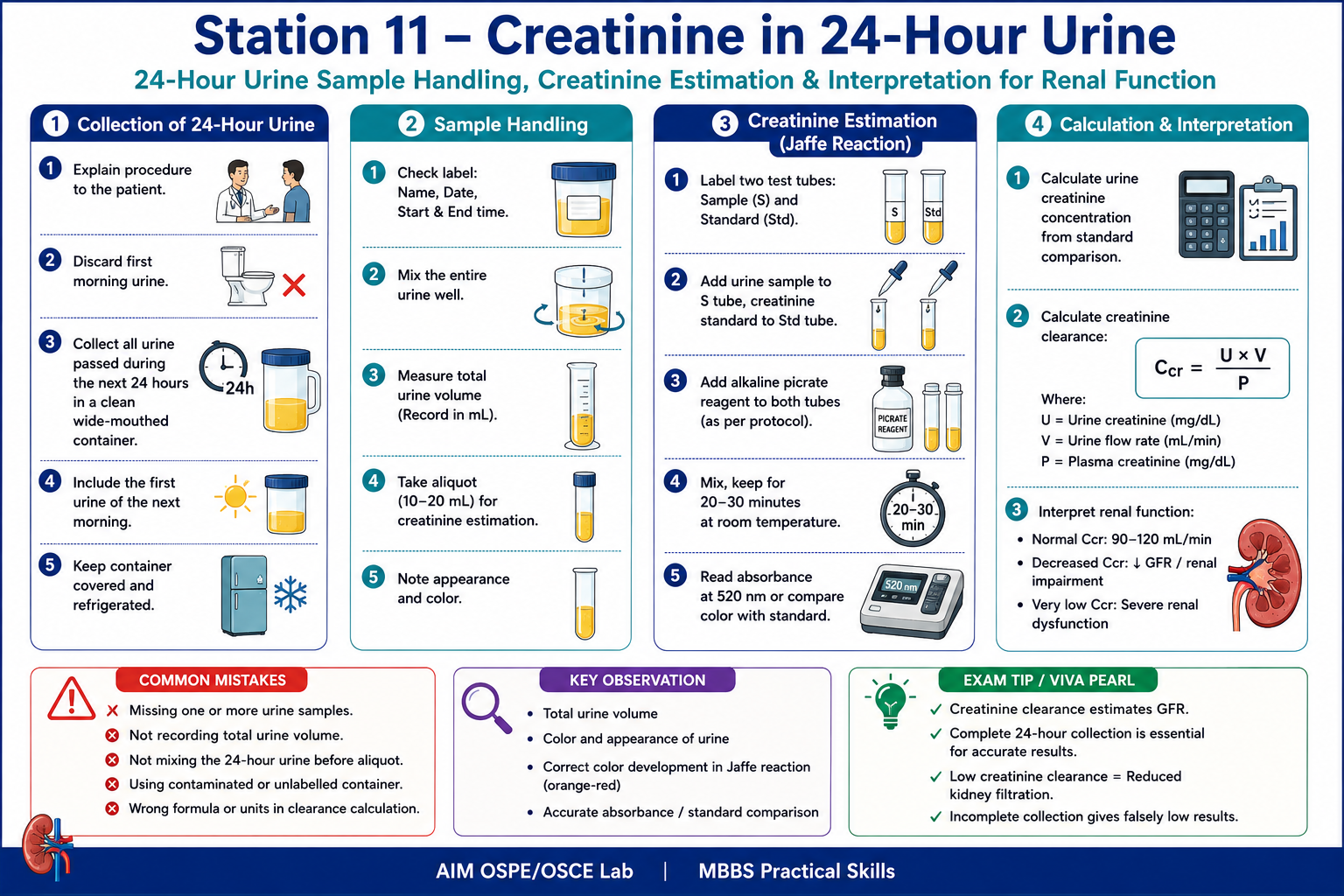
- Wear gloves and check the label on the 24-hour urine container.
- Confirm that the sample was collected for a complete 24 hours.
- Mix the 24-hour urine sample gently.
- Measure and record the total urine volume.
- Take a small aliquot for creatinine estimation.
- Add creatinine reagent as instructed in the practical setup.
- Compare the color with standard / read absorbance using colorimeter.
- Calculate urine creatinine concentration if data are provided.
- Use the formula for creatinine clearance if plasma creatinine is given.
- Write the renal function interpretation.
Observation / Identification Points
- Correct identification of 24-hour urine sample
- Proper understanding of 24-hour urine collection method
- Total urine volume must be recorded
- Sample must be mixed before taking aliquot
- Correct use of reagent and standard
- Correct recognition of orange-red color in Jaffe reaction
- Correct use of creatinine clearance formula
- Interpretation in relation to renal function / GFR
Result / Interpretation
Principle
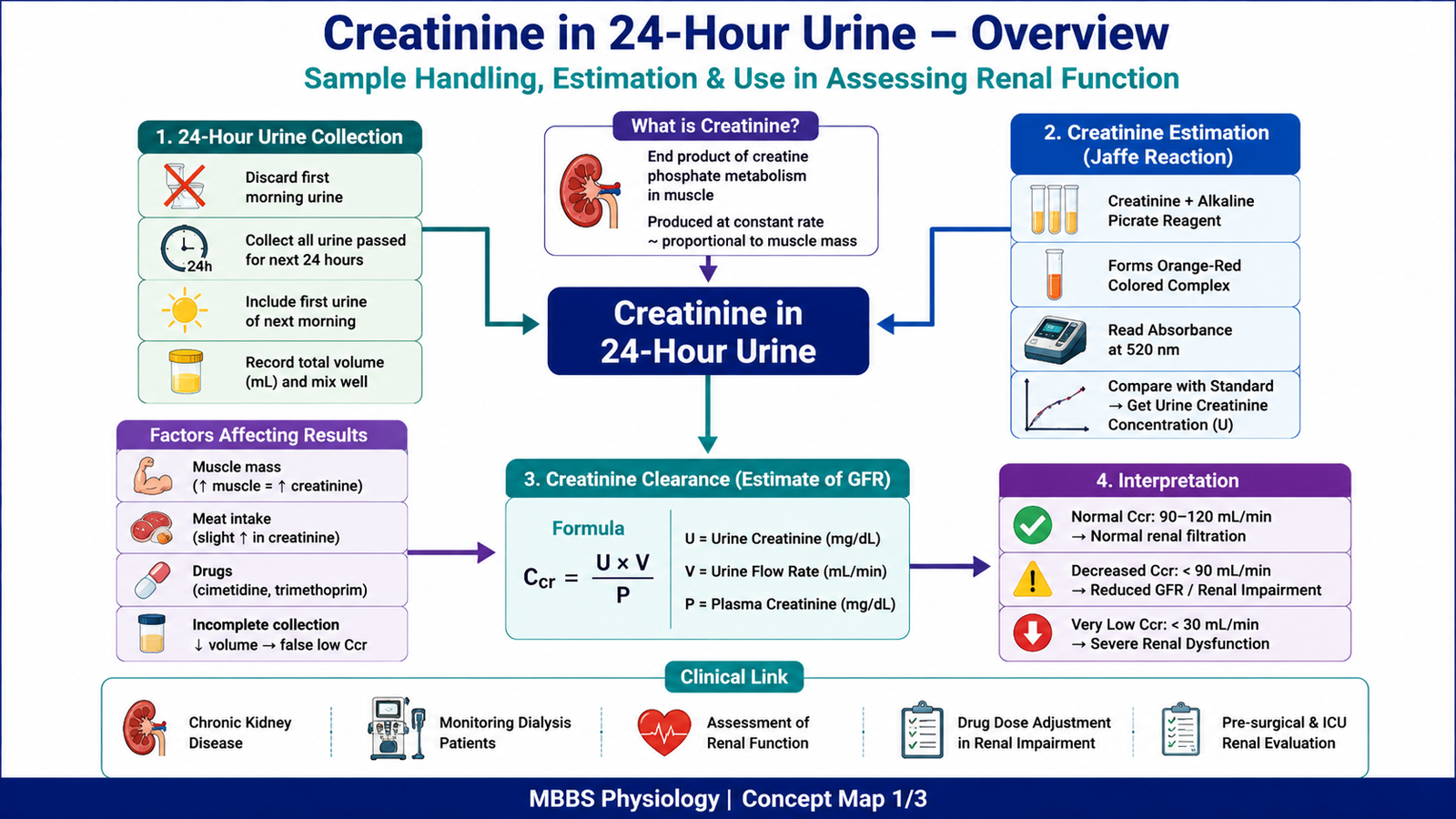
Creatinine reacts with alkaline picrate to form an orange-red colored complex. The intensity of color is proportional to creatinine concentration and can be measured colorimetrically.
Important Formula
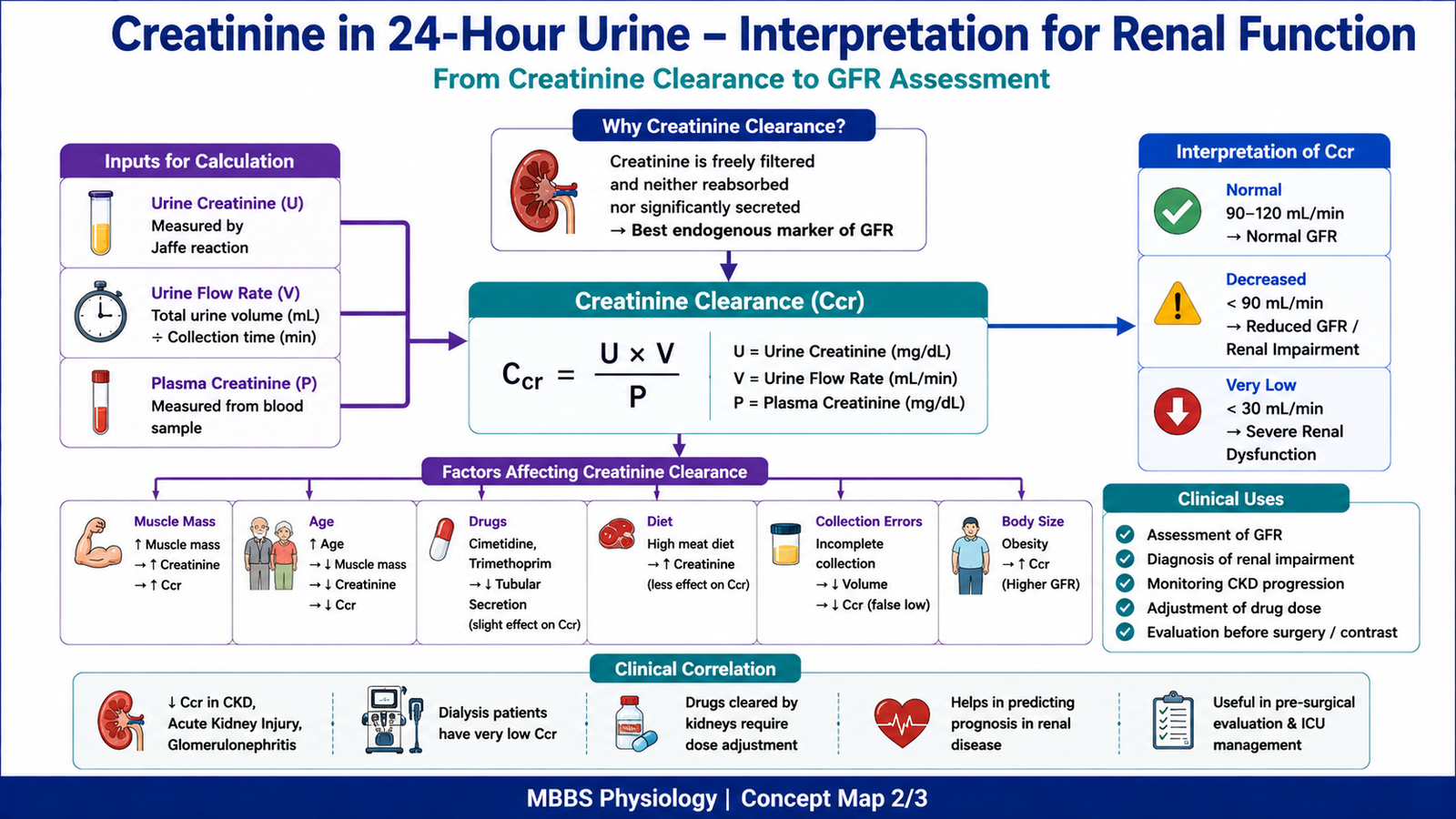
Creatinine Clearance = U × V / P
Where:
- U = Urine creatinine concentration
- V = Urine flow rate in mL/min
- P = Plasma creatinine concentration
Interpretation
| Finding | Interpretation |
|---|---|
| Normal creatinine clearance | Suggests normal glomerular filtration |
| Decreased creatinine clearance | Suggests reduced GFR / renal impairment |
| Very low urinary creatinine | May indicate incomplete urine collection or reduced muscle mass |
| Abnormally low 24-hour volume | May suggest oliguria or incomplete collection |
| Abnormally high 24-hour volume | May suggest polyuria, diabetes mellitus, or concentrating defect |
Clinical Significance:
Creatinine clearance is used as an estimate of glomerular filtration rate, helping assess renal function. It is especially useful when evaluating suspected kidney disease, reduced filtration, or progression of renal impairment.
Viva Questions
1. Why is a 24-hour urine sample used for creatinine estimation?
Because creatinine excretion varies during the day, so 24-hour collection gives a better estimate of total daily excretion.
2. What is the principle of creatinine estimation?
Creatinine reacts with alkaline picrate to form an orange-red complex in the Jaffe reaction.
3. What does creatinine clearance estimate?
It estimates glomerular filtration rate.
4. Write the formula for creatinine clearance.
Creatinine clearance = U × V / P.
5. What does decreased creatinine clearance indicate?
Reduced GFR and impaired renal function.
Common Student Mistakes
- Forgetting to record the total 24-hour urine volume.
- Taking an aliquot without mixing the full urine sample.
- Confusing urine creatinine concentration with creatinine clearance.
- Forgetting that plasma creatinine is needed to calculate clearance.
- Not converting 24-hour urine volume into mL/min when calculating clearance.
AIM Feedback
Creatinine estimation becomes clinically meaningful only when sample collection is correct. In OSPE, always remember the sequence: complete 24-hour collection → mix sample → record total volume → estimate urine creatinine → use plasma creatinine → calculate clearance → interpret GFR. A low creatinine clearance usually means reduced renal filtration, but an incomplete 24-hour sample can falsely lower the result.
🖼️ Visual / Image Support
🧩 Concept Map / Interpretation Support