
🩺 Station 12 — Free, Total and Combined Acidity of Gastric Juice
AIM OSPE/OSCE Lab — Practical Station | KMU Style | MBBS Practical + Viva
📌 Station Overview
Module: Cardiovascular System
Year: 1st Year MBBS
Focus: Identification • Procedure • Interpretation • Viva
Total Marks: 5
📋 Complete OSPE Station Content
Learning Target
By the end of this station, the student should be able to:
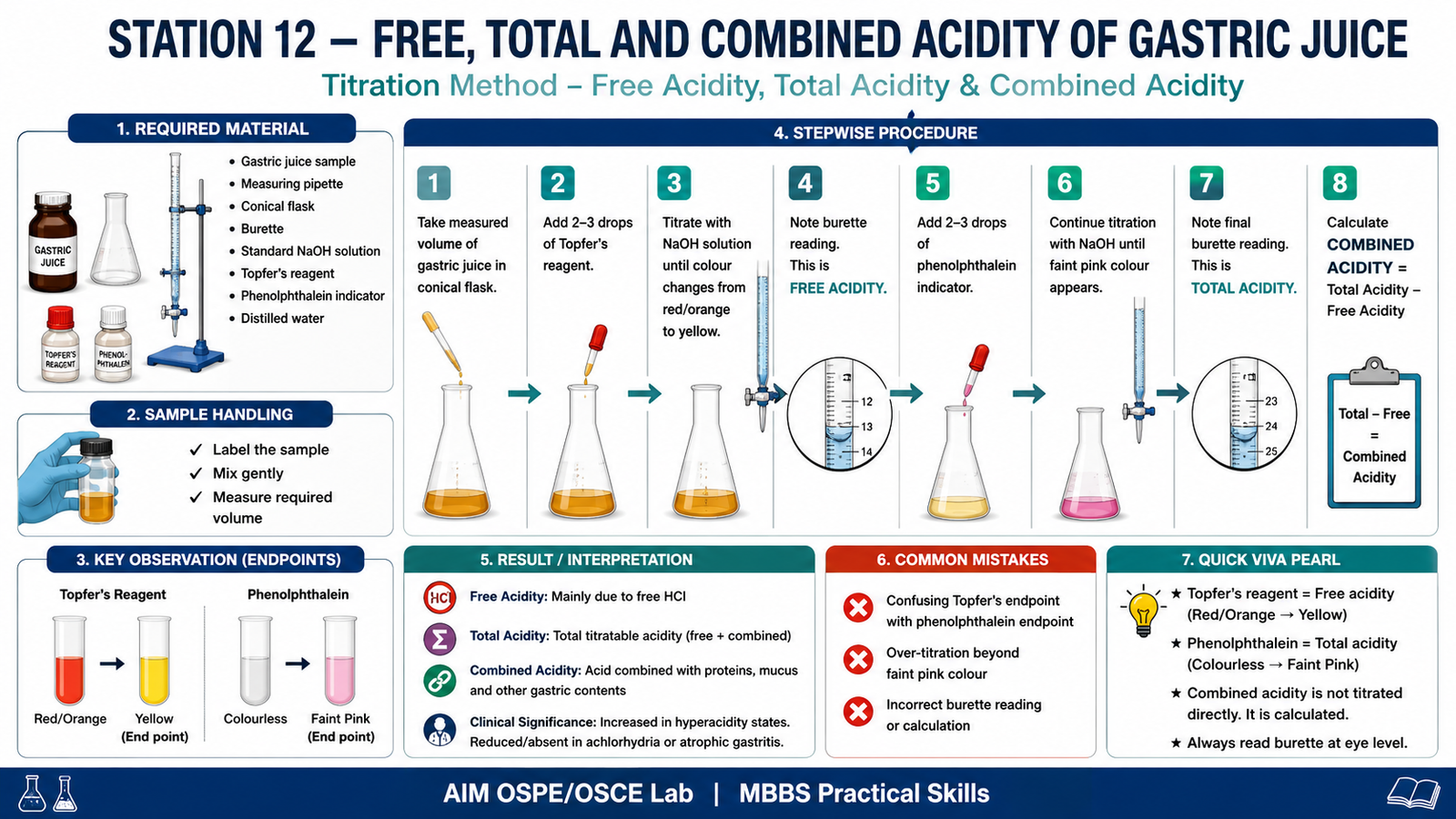
- Perform titration of gastric juice to estimate free acidity, total acidity, and combined acidity.
- Interpret the titration endpoints and calculate acidity using the correct formula.
Required Material
- Gastric juice sample
- Measuring pipette
- Conical flask
- Burette
- Standard sodium hydroxide solution
- Topfer’s reagent
- Phenolphthalein indicator
- Distilled water
- White tile/background
- Gloves and waste container
Student Task / Procedure
- Wear gloves and check the labeled gastric juice sample.
- Take the required measured volume of gastric juice in a conical flask.
- Add 2–3 drops of Topfer’s reagent.
- Titrate with standard sodium hydroxide until the color changes from red/orange to yellow.
- Note the burette reading. This reading gives free acidity.
- Add 2–3 drops of phenolphthalein indicator to the same flask.
- Continue titration until a faint pink color appears.
- Note the final burette reading. This reading gives total acidity.
- Calculate:
Combined acidity = Total acidity − Free acidity - Record the result with proper units.
Observation / Identification Points
The student should demonstrate:
- Proper handling and labeling of gastric juice sample.
- Correct use of pipette, burette, and conical flask.
- Correct identification of first endpoint with Topfer’s reagent.
- Correct identification of final endpoint with phenolphthalein.
- Correct calculation of free, total, and combined acidity.
- Clean and safe laboratory technique.
Result / Interpretation
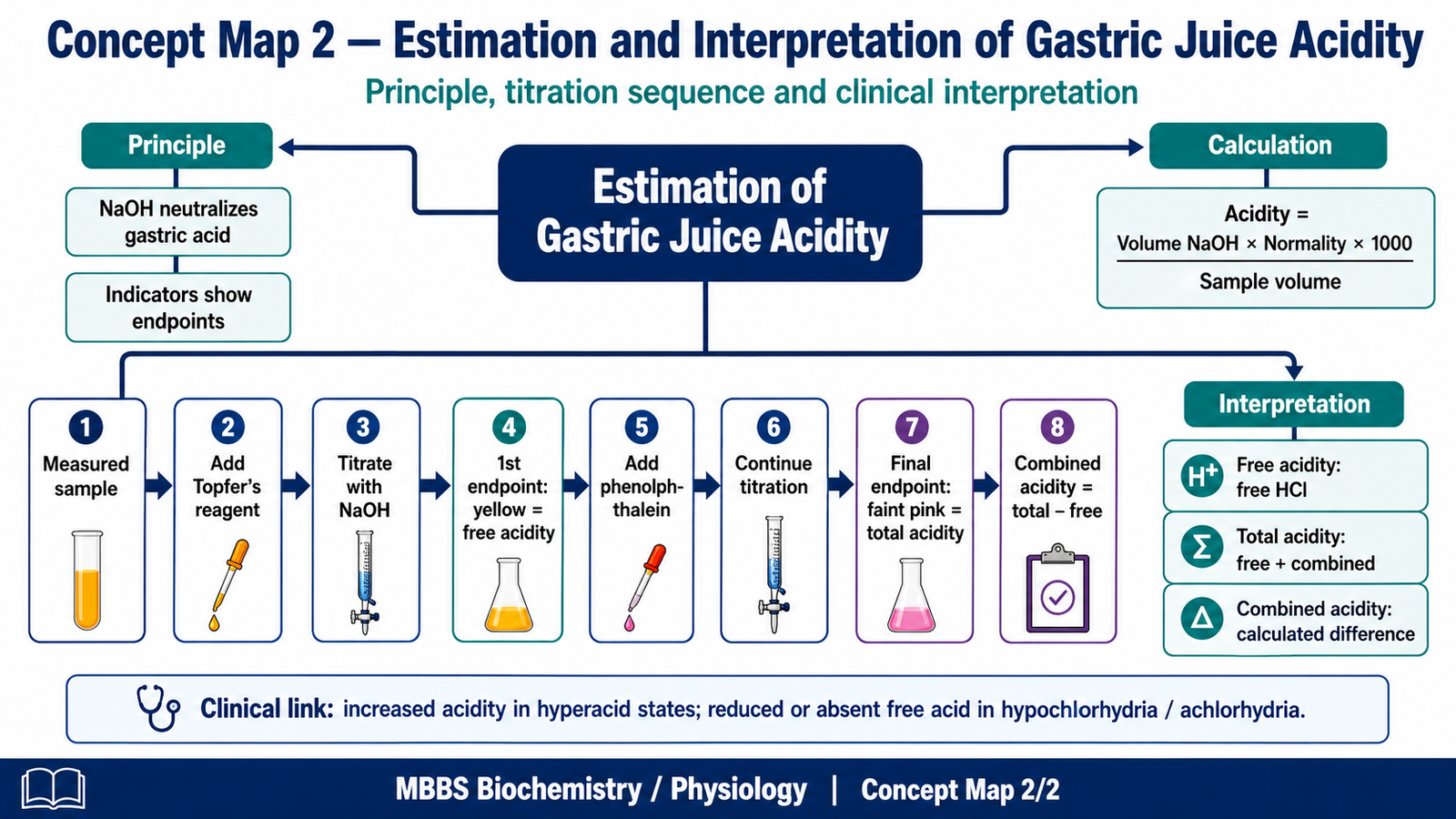
Principle:
Gastric acidity is estimated by titrating gastric juice with standard sodium hydroxide using suitable indicators.
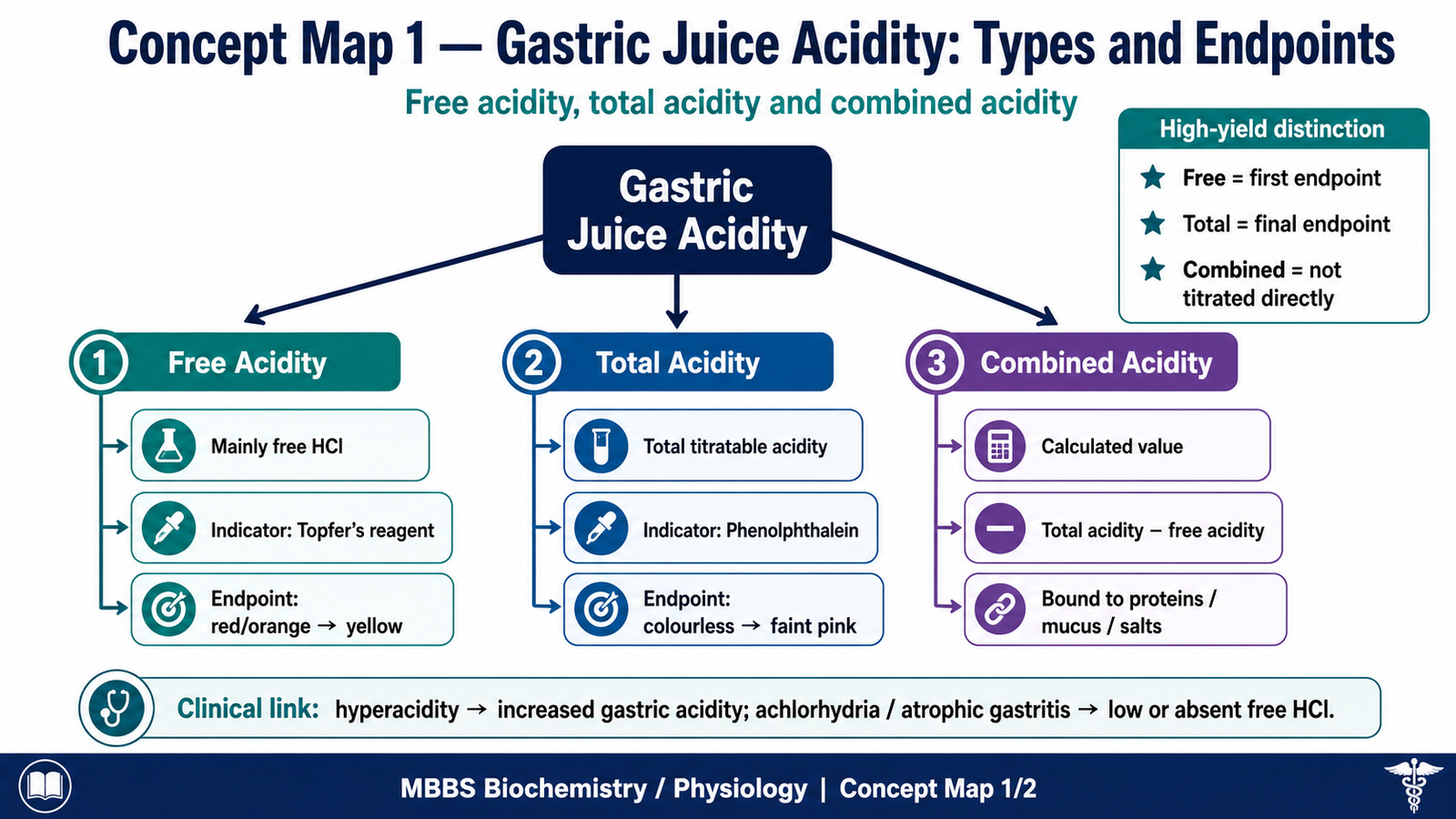
Free acidity:
Represents mainly free hydrochloric acid in gastric juice.
Total acidity:
Represents the total titratable acidity of gastric juice, including free and combined acid.
Combined acidity:
Represents acid combined with proteins, mucus, and other gastric contents.
Formula:
Acidity = Volume of NaOH used × Normality of NaOH × 1000 / Volume of gastric juice sample
Combined acidity = Total acidity − Free acidity
Clinical significance:
Increased gastric acidity may be associated with hyperacidity states. Reduced or absent free acid may be seen in conditions with reduced gastric acid secretion.
Viva Questions
1. What is free acidity of gastric juice?
Ideal Answer:
Free acidity is mainly due to free hydrochloric acid present in gastric juice.
2. Which indicator is used for free acidity?
Ideal Answer:
Topfer’s reagent is used to detect free acidity.
3. Which indicator is used for total acidity?
Ideal Answer:
Phenolphthalein is used to detect total acidity.
4. How is combined acidity calculated?
Ideal Answer:
Combined acidity is calculated by subtracting free acidity from total acidity.
5. Why is gastric acid important physiologically?
Ideal Answer:
It activates pepsinogen, helps protein digestion, and kills many ingested microorganisms.
Marking Scheme
Total Marks: 5
| Component | Marks |
|---|---|
| Correct identification / performance | 2 |
| Key observation / procedure steps | 1 |
| Interpretation / principle | 1 |
| Viva answer | 1 |
Checklist Breakdown
| Checklist Item | Marks |
| Handles sample safely and measures correct volume | 0.5 |
| Uses Topfer’s reagent and identifies free acidity endpoint | 0.75 |
| Uses phenolphthalein and identifies total acidity endpoint | 0.75 |
| Records burette readings correctly | 0.5 |
| Calculates combined acidity correctly | 0.5 |
| Explains principle or interpretation | 1 |
| Answers viva question correctly | 1 |
Common Student Mistakes
- Confusing the endpoint of Topfer’s reagent with phenolphthalein.
- Forgetting that combined acidity is calculated as total acidity minus free acidity.
- Not recording burette readings carefully before and after titration.
AIM Feedback
Focus on the sequence of titration: first estimate free acidity using Topfer’s reagent, then continue titration for total acidity using phenolphthalein. Always remember that combined acidity is not titrated directly; it is calculated from the difference between total and free acidity.
🖼️ Visual / Image Support
🧩 Concept Map / Interpretation Support
🎥 Video Demonstration / Procedure Support
Watch this short practical video to revise the titration method for estimating free, total, and combined acidity of gastric juice, including endpoint recognition and calculation.