
🩺 Station 14 — Estimation of Titratable Acidity of Urine
AIM OSPE/OSCE Lab — Practical Station | KMU Style | MBBS Practical + Viva
📌 Station Overview
Module: Cardiovascular System
Year: 1st Year MBBS
Focus: Identification • Procedure • Interpretation • Viva
Total Marks: 5
📋 Complete OSPE Station Content
Learning Target
By the end of this station, the student should be able to:
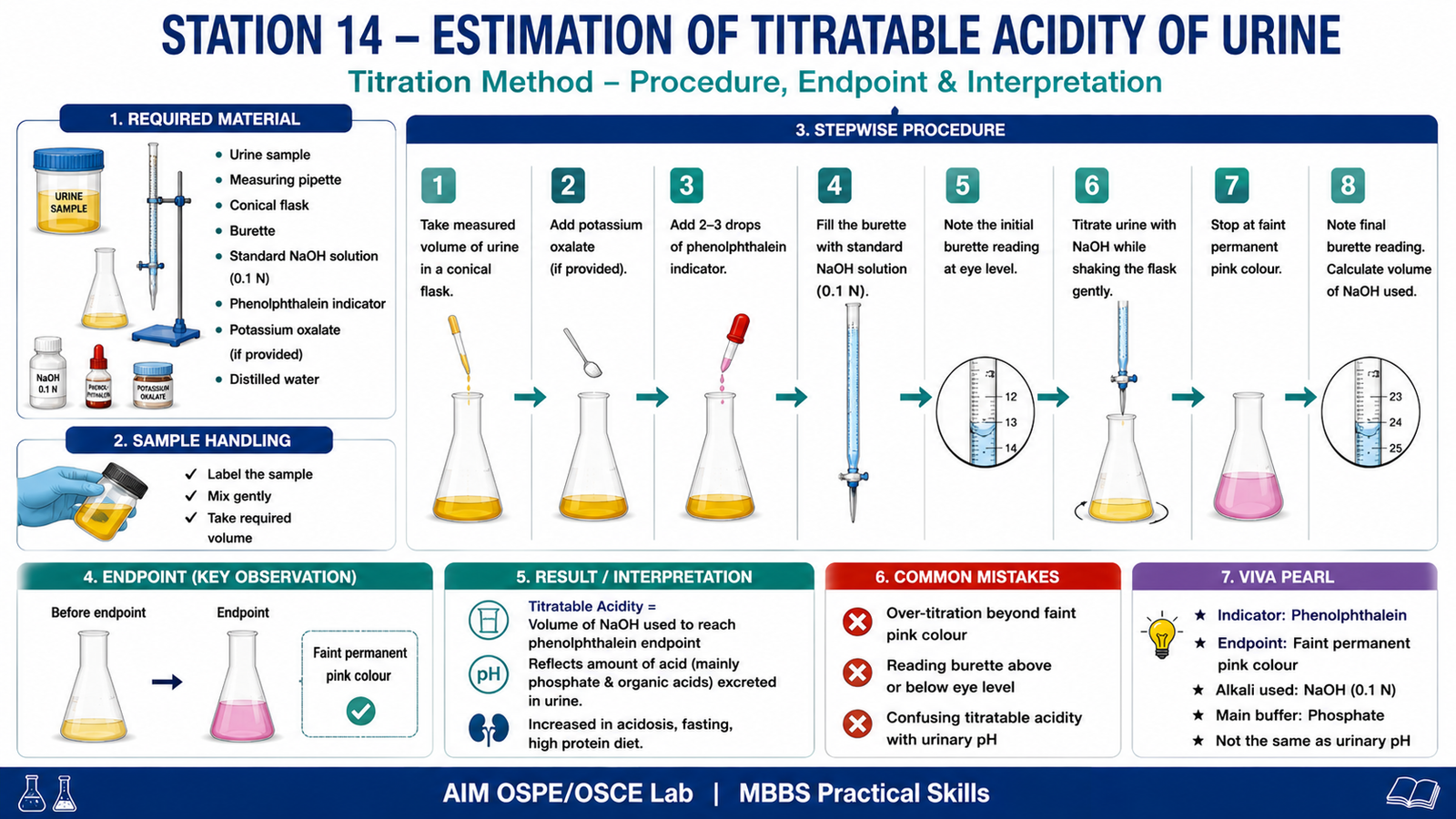
- Perform titration of urine to estimate titratable acidity.
- Identify the correct endpoint and interpret the result in relation to urinary acid excretion.
Required Material
- Fresh urine sample
- Measuring pipette
- Conical flask
- Burette
- Standard sodium hydroxide solution, usually 0.1 N NaOH
- Phenolphthalein indicator
- Potassium oxalate powder, if provided
- Distilled water
- White tile/background
- Gloves and waste container
Student Task / Procedure
- Wear gloves and check the labeled urine sample.
- Mix the urine sample gently.
- Take the required measured volume of urine in a conical flask.
- Add potassium oxalate, if provided.
- Add 2–3 drops of phenolphthalein indicator.
- Fill the burette with standard NaOH solution.
- Note the initial burette reading.
- Titrate the urine with NaOH slowly while shaking the flask.
- Stop when a faint permanent pink color appears.
- Note the final burette reading.
- Calculate the volume of NaOH used.
- Record the result as titratable acidity of urine.
Observation / Identification Points
The student should demonstrate:
- Proper handling and labeling of urine sample.
- Correct use of pipette, conical flask, and burette.
- Addition of phenolphthalein indicator before titration.
- Slow titration near the endpoint.
- Correct endpoint identification: faint permanent pink color.
- Accurate burette reading at eye level.
- Correct interpretation of titratable acidity.
Result / Interpretation
Principle:
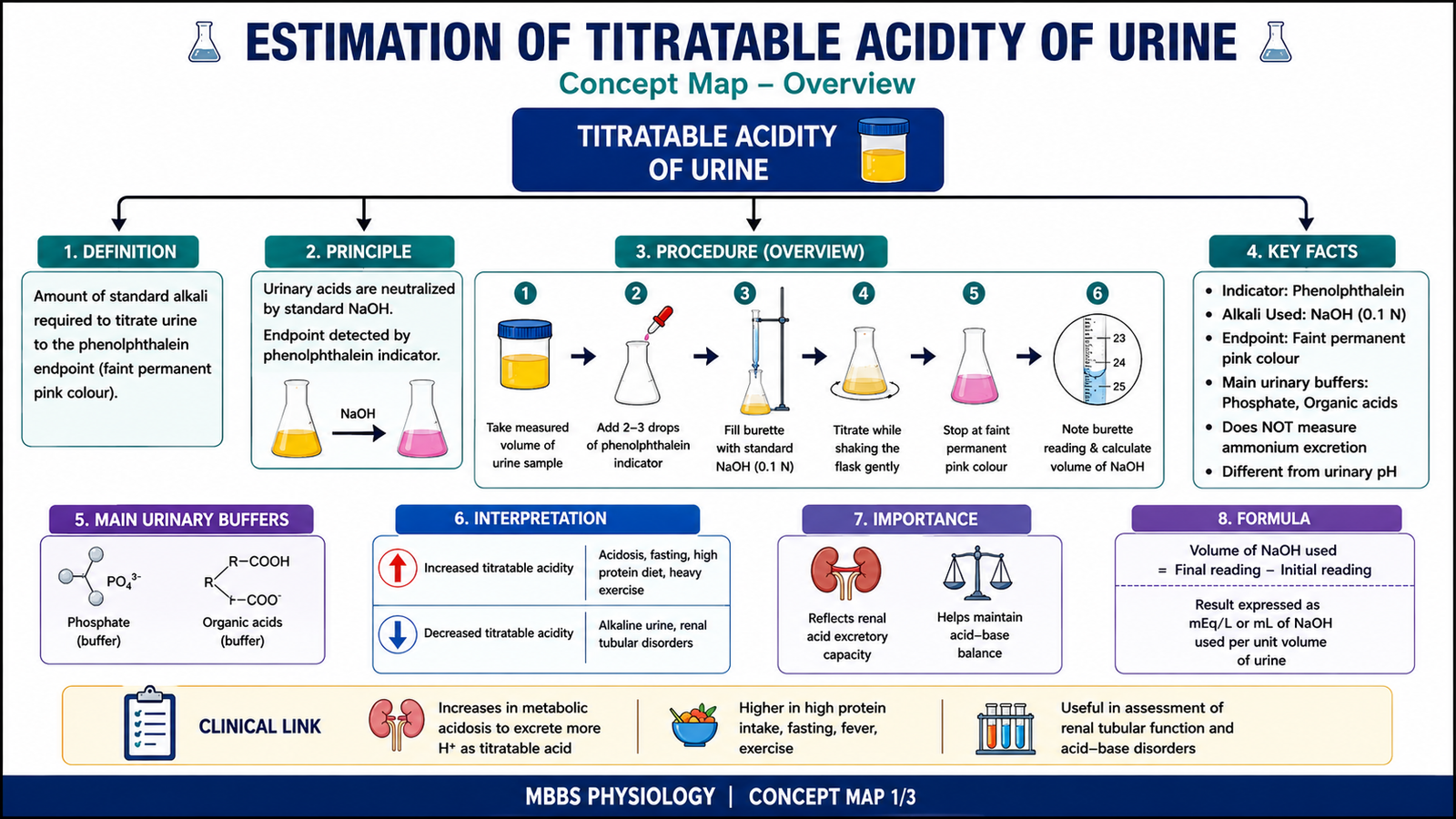
Titratable acidity of urine is estimated by titrating acidic urine with standard sodium hydroxide until the phenolphthalein endpoint is reached.
Endpoint:
Faint permanent pink color.
Main urinary buffers contributing to titratable acidity:
- Phosphate buffer
- Organic acids
Important point:
Titratable acidity does not directly measure ammonium ion excretion.
Simple calculation concept:
Volume of NaOH used = Final burette reading − Initial burette reading
The result is usually expressed as the amount of standard alkali required to neutralize urinary acids.
Clinical significance:
Increased titratable acidity may occur when the body needs to excrete more acid, such as in acidosis, fasting, or high protein intake. Reduced titratable acidity may occur in alkaline urine.
Viva Questions
1. What is titratable acidity of urine?
Ideal Answer:
It is the amount of standard alkali required to titrate urine to the phenolphthalein endpoint.
2. Which indicator is used in this practical?
Ideal Answer:
Phenolphthalein indicator.
3. What is the endpoint of titration?
Ideal Answer:
Appearance of a faint permanent pink color.
4. Which urinary buffer mainly contributes to titratable acidity?
Ideal Answer:
Phosphate buffer is the major contributor.
5. Does titratable acidity include ammonium ion excretion?
Ideal Answer:
No. Ammonium excretion is measured separately.
Marking Scheme
Total Marks: 5
| Component | Marks |
|---|---|
| Correct identification / performance | 2 |
| Key observation / procedure steps | 1 |
| Interpretation / principle | 1 |
| Viva answer | 1 |
Checklist Breakdown
| Checklist Item | Marks |
| Handles urine sample safely and measures correct volume | 0.5 |
| Adds phenolphthalein indicator correctly | 0.5 |
| Performs titration with standard NaOH properly | 0.5 |
| Identifies faint permanent pink endpoint correctly | 0.5 |
| Notes burette reading and volume of NaOH used | 1 |
| Explains principle or interpretation | 1 |
| Answers viva question correctly | 1 |
Common Student Mistakes
- Over-titrating beyond faint pink color.
- Reading the burette above or below eye level.
- Confusing titratable acidity with urinary pH.
AIM Feedback
Remember that urinary pH only tells how acidic the urine is at one moment, while titratable acidity estimates the amount of alkali needed to neutralize urinary acids. In this station, the most important OSPE point is correct endpoint identification: faint permanent pink color with phenolphthalein.
🖼️ Visual / Image Support
🧩 Concept Map / Interpretation Support
🎥 Video Demonstration / Procedure Support
Watch this video to revise the titration method for estimating titratable acidity of urine, focusing on NaOH titration, phenolphthalein endpoint, and correct burette reading.