
🩺 Station 13 — Estimation of Serum Bilirubin
AIM OSPE/OSCE Lab — Practical Station | KMU Style | MBBS Practical + Viva
📌 Station Overview
Module: Cardiovascular System
Year: 1st Year MBBS
Focus: Identification • Procedure • Interpretation • Viva
Total Marks: 5
📋 Complete OSPE Station Content
Learning Target
By the end of this station, the student should be able to:
- Demonstrate correct handling of serum sample for bilirubin estimation.
- Interpret serum bilirubin results in relation to jaundice.
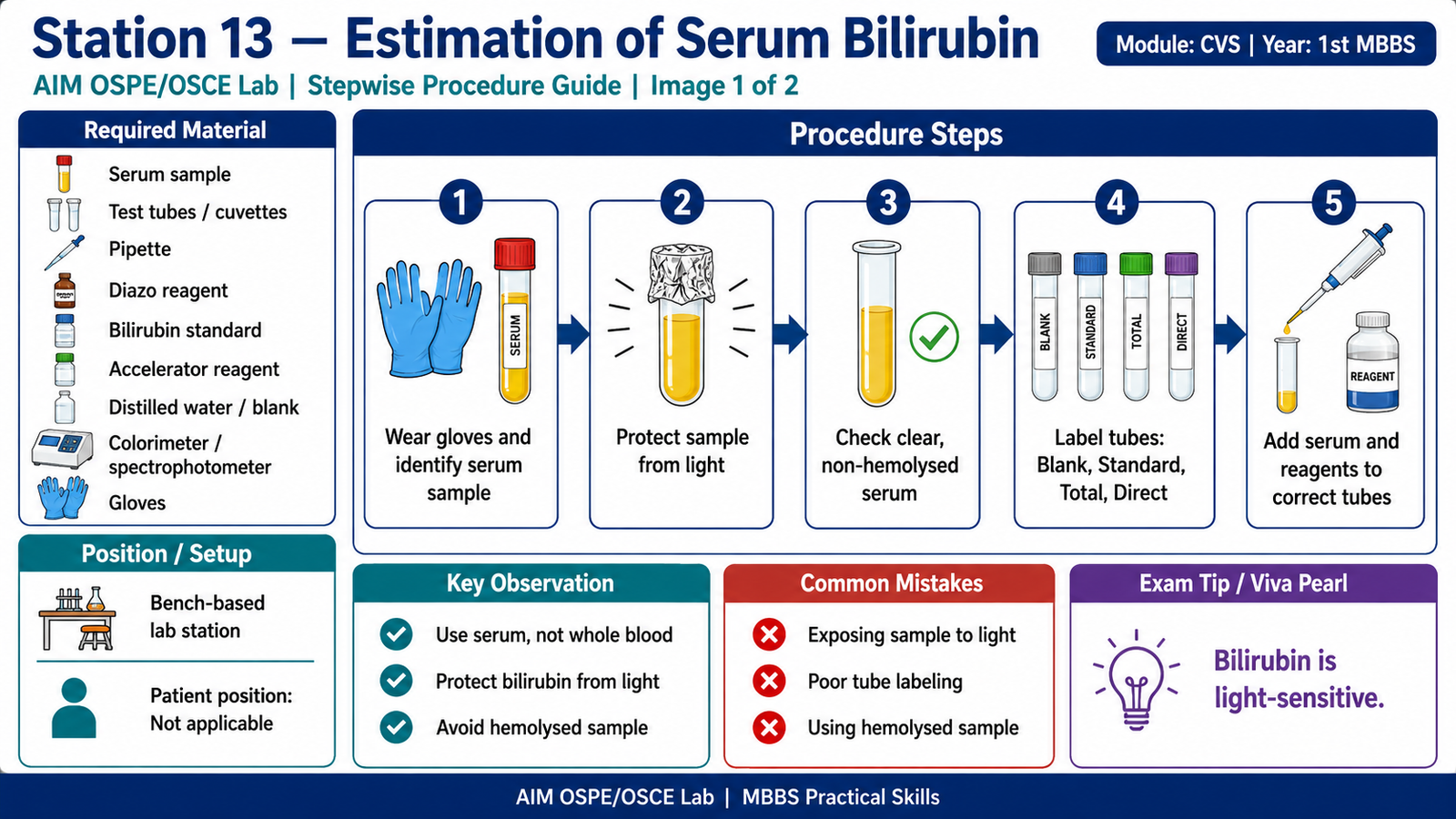
Required Material
- Serum sample
- Test tubes / cuvettes
- Pipette or micropipette
- Bilirubin standard
- Diazo reagent
- Accelerator reagent for total bilirubin
- Distilled water / blank
- Colorimeter / spectrophotometer
- Gloves
- Tube rack
- Waste container
- Aluminum foil / dark container for sample protection
Student Task / Procedure
- Wear gloves and identify the labeled serum sample.
- Protect the serum sample from direct light.
- Check that the sample is clear and non-hemolysed.
- Prepare tubes for Blank, Standard, Total Bilirubin, and Direct Bilirubin.
- Add serum sample and required reagents according to the method.
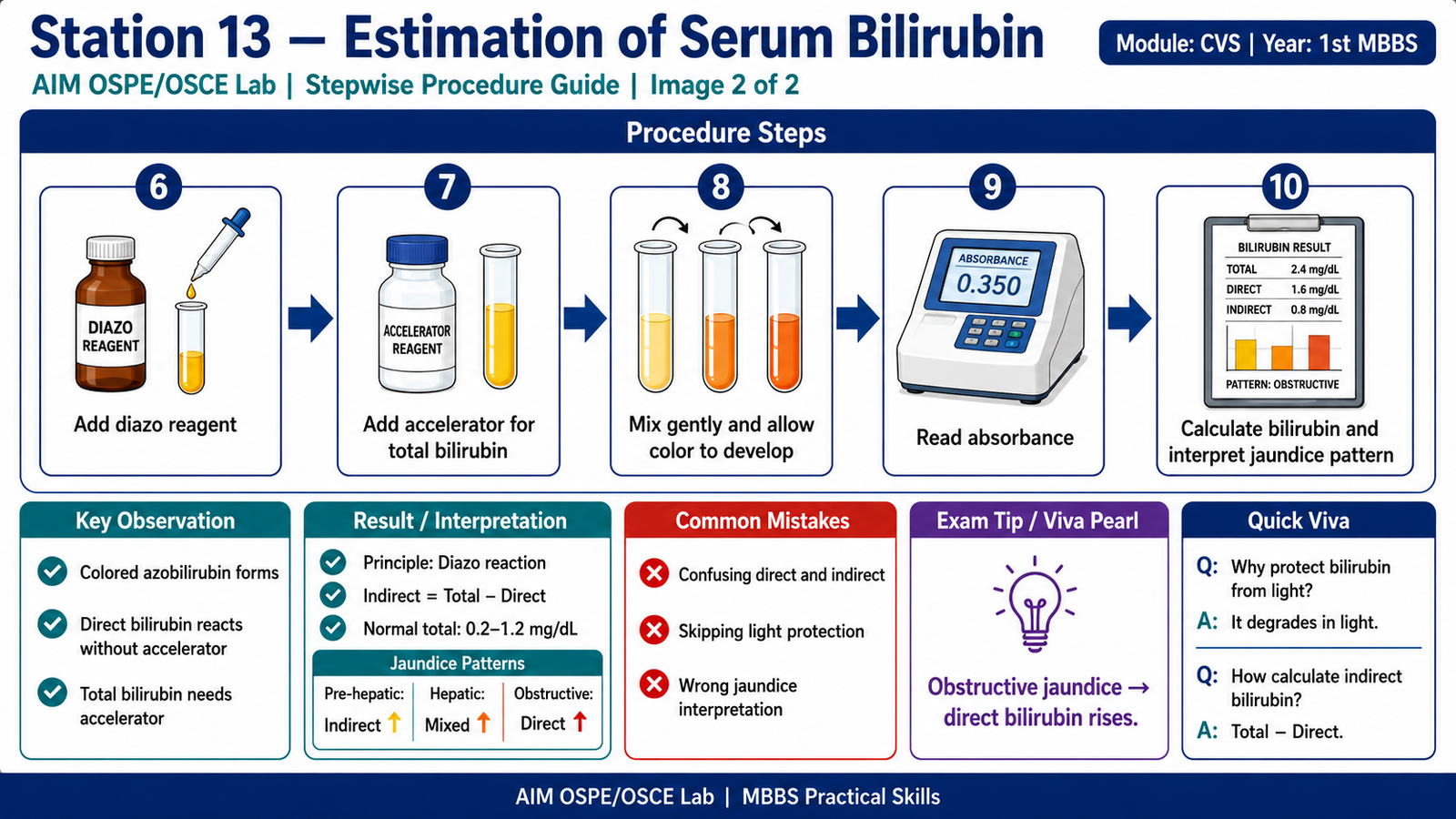
- Add diazo reagent to allow color formation.
- Use accelerator reagent for total bilirubin estimation.
- Mix gently and allow reaction time.
- Read absorbance using colorimeter / spectrophotometer.
- Calculate bilirubin level and interpret the result in jaundice.
Observation / Identification Points
The student should observe or demonstrate:
- Serum sample is used, not whole blood.
- Sample should be protected from light.
- Hemolysed sample should be avoided.
- Diazo reaction produces colored azobilirubin.
- Direct bilirubin reacts without accelerator.
- Total bilirubin requires accelerator.
- Indirect bilirubin is calculated from total and direct bilirubin.
Result / Interpretation
Principle:
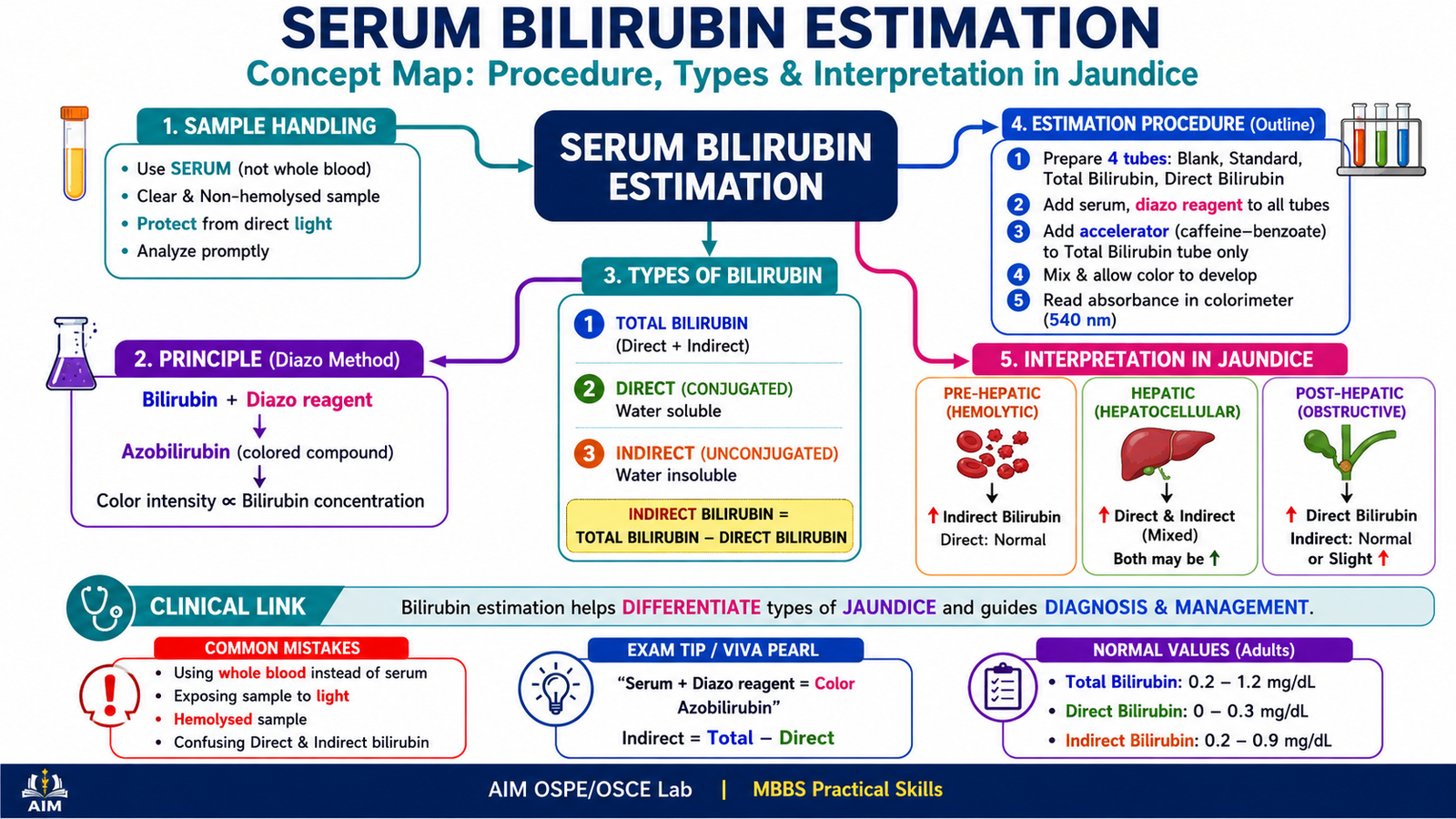
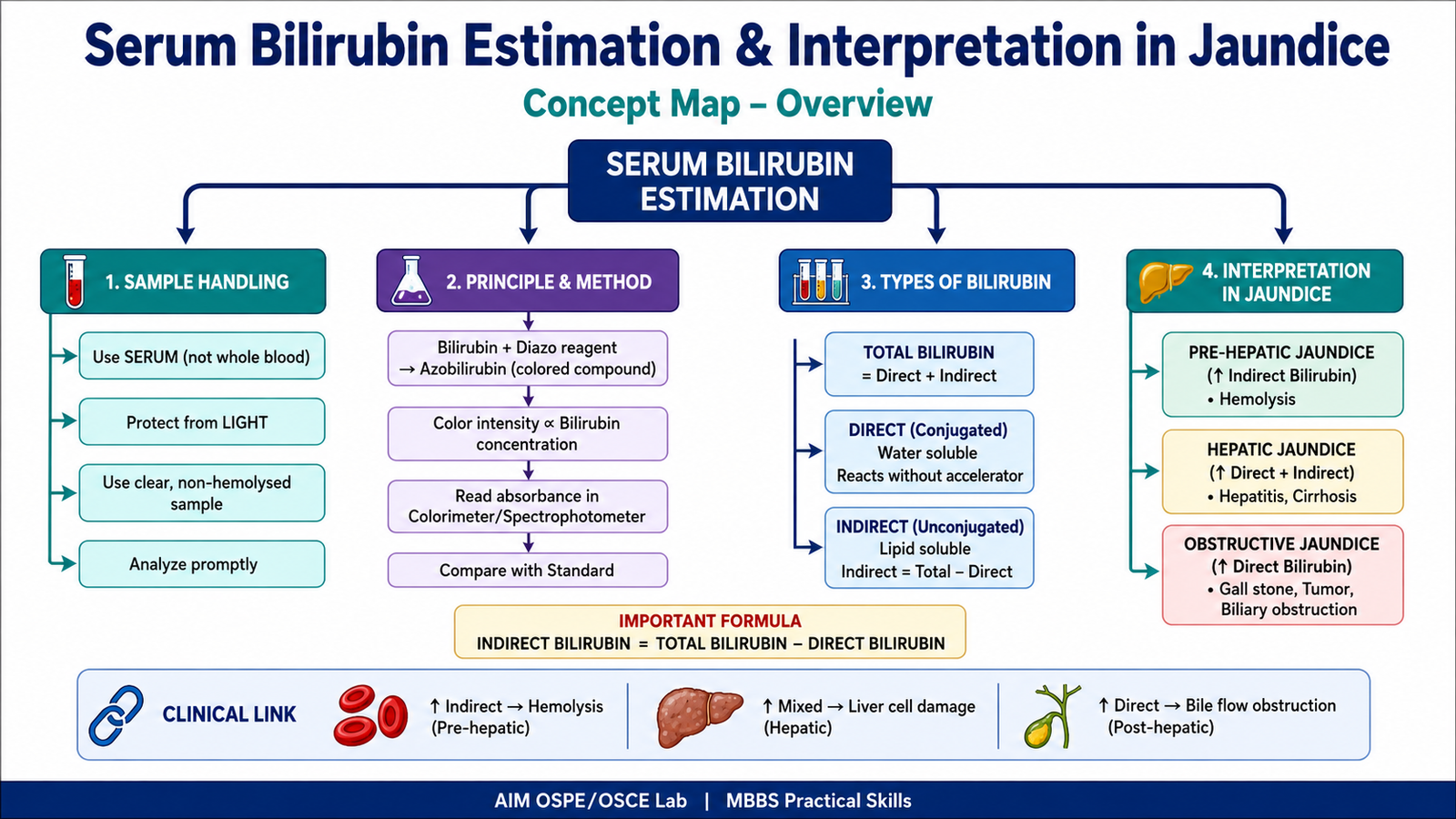
Bilirubin reacts with diazo reagent to form a colored compound called azobilirubin. The intensity of color is proportional to bilirubin concentration.
Important Formula:
Indirect bilirubin = Total bilirubin − Direct bilirubin
Normal Values:
- Total bilirubin: approximately 0.2–1.2 mg/dL
- Direct bilirubin: usually less than 0.3 mg/dL
- Indirect bilirubin: calculated value
Interpretation in Jaundice:
| Pattern | Main Finding | Common Clinical Link |
|---|---|---|
| Pre-hepatic jaundice | Increased indirect bilirubin | Hemolysis |
| Hepatic jaundice | Mixed increase of direct and indirect bilirubin | Hepatitis / liver cell damage |
| Obstructive jaundice | Increased direct bilirubin | Gall stone / biliary obstruction |
Clinical Significance:
Serum bilirubin estimation helps differentiate hemolytic, hepatic, and obstructive jaundice, which is highly relevant in the GIT module.
Viva Questions
1. Which sample is used for bilirubin estimation?
Answer: Serum sample.
2. Why should bilirubin sample be protected from light?
Answer: Bilirubin is light-sensitive and may degrade, causing falsely low results.
3. What is the principle of bilirubin estimation?
Answer: Bilirubin reacts with diazo reagent to form colored azobilirubin.
4. How is indirect bilirubin calculated?
Answer: Indirect bilirubin = Total bilirubin − Direct bilirubin.
5. Which type of bilirubin is increased in obstructive jaundice?
Answer: Direct / conjugated bilirubin.
Marking Scheme
Total Marks: 5
| Component | Marks |
| Correct identification / performance | 2 |
| Key observation / procedure steps | 1 |
| Interpretation / principle | 1 |
| Viva answer | 1 |
Common Student Mistakes
- Forgetting to protect the serum sample from light.
- Confusing direct and indirect bilirubin.
- Not linking bilirubin pattern with type of jaundice.
AIM Feedback
Revise this station around three key points: sample handling, diazo reaction, and jaundice interpretation. Always remember that bilirubin is light-sensitive. Direct bilirubin rises mainly in obstructive jaundice, while indirect bilirubin rises mainly in hemolysis.
🖼️ Visual / Image Support
🧩 Concept Map / Interpretation Support
🎥 Video Demonstration / Procedure Support
Watch this short practical video to revise serum bilirubin estimation by Diazo method, including serum handling, total/direct bilirubin testing, absorbance reading, and interpretation in jaundice.