
📖 Step 2 — Learning Material
🔹 1️⃣ Introduction
Blood pressure is one of the most important indicators of cardiovascular function. It represents the force exerted by circulating blood on the walls of arteries. Normal blood pressure is essential to maintain adequate blood flow to the brain, heart, kidneys, and other organs. It is mainly regulated by the heart, blood vessels, kidneys, autonomic nervous system, and hormonal mechanisms. Clinically, abnormal blood pressure regulation leads to hypertension, hypotension, stroke, heart failure, kidney disease, and cardiovascular risk. Understanding blood pressure control helps students connect physiology with community medicine and clinical practice.
🔹 2️⃣ Foundation Concepts
Key Definitions
- Blood Pressure: Force exerted by blood against arterial walls.
- Systolic Blood Pressure: Maximum arterial pressure during ventricular systole.
- Diastolic Blood Pressure: Minimum arterial pressure during ventricular diastole.
- Mean Arterial Pressure: Average pressure driving blood through tissues.
- Cardiac Output: Amount of blood pumped by heart per minute.
- Peripheral Resistance: Resistance offered by blood vessels, mainly arterioles.
- Hypertension: Persistently raised arterial blood pressure.
- Hypotension: Abnormally low arterial blood pressure causing poor tissue perfusion.
- Baroreceptors: Stretch receptors that detect changes in arterial pressure.
- Renin-Angiotensin-Aldosterone System: Hormonal system for long-term blood pressure regulation.
Basic Overview
- Blood pressure depends mainly on:
- Cardiac output
- Peripheral resistance
- Blood volume
- Arterial elasticity
- Short-term control is mainly neural.
- Long-term control is mainly renal and hormonal.
- Sympathetic stimulation increases blood pressure.
- Parasympathetic stimulation mainly decreases heart rate.
- Hypertension is often silent but damages blood vessels and organs over time.
🔹 3️⃣ Core Learning — Curriculum Coverage
1 — Definition and Determinants of Blood Pressure
🧠 CORE
- Blood pressure is the lateral pressure exerted by blood on arterial walls.
- It is commonly written as systolic/diastolic pressure.
- Normal adult blood pressure is around 120/80 mmHg.
- Systolic pressure reflects ventricular contraction.
- Diastolic pressure reflects arterial recoil during relaxation.
- Mean arterial pressure determines tissue perfusion.
- Blood pressure depends on cardiac output and total peripheral resistance.
- Arterioles are the main resistance vessels.
- Kidneys regulate blood volume and long-term blood pressure.
🔬 CONCEPT EXPLAINED
Blood pressure exists because the heart pumps blood into a closed vascular system. When the left ventricle contracts, blood is ejected into the aorta and arteries, producing systolic pressure. During ventricular relaxation, elastic recoil of large arteries maintains diastolic pressure and continuous blood flow.
Functionally:
Blood Pressure = Cardiac Output × Total Peripheral Resistance
Cardiac output depends on heart rate and stroke volume. Peripheral resistance mainly depends on arteriolar diameter. Even a small decrease in arteriolar radius greatly increases resistance and raises blood pressure.
Blood pressure exists to maintain tissue perfusion. Organs such as the brain and kidneys require continuous blood flow. If blood pressure falls too low, tissues become ischemic. If it remains too high, vessels and organs are damaged.
⚠️ CLINICAL IMPORTANCE
Persistent high blood pressure increases afterload on the heart, damages arterial walls, and increases the risk of stroke, myocardial infarction, heart failure, kidney disease, and retinopathy. Low blood pressure can reduce cerebral perfusion and cause dizziness, syncope, shock, or organ failure.
2 — Causes of High and Low Blood Pressure
🧠 CORE
- Blood pressure rises when cardiac output increases.
- Blood pressure rises when peripheral resistance increases.
- Increased blood volume raises venous return and cardiac output.
- Sympathetic overactivity causes vasoconstriction and tachycardia.
- Renal sodium and water retention increases blood volume.
- Loss of blood or fluid decreases blood pressure.
- Heart failure may reduce cardiac output and cause hypotension.
- Sepsis causes vasodilation and low peripheral resistance.
- Endocrine disorders may increase or decrease blood pressure.
🔬 CONCEPT EXPLAINED
High blood pressure occurs when the cardiovascular system is exposed to excessive pressure load. This may result from increased cardiac output, increased arteriolar resistance, increased blood volume, or hormonal activation. For example, increased salt and water retention expands extracellular fluid volume, increasing venous return and cardiac output.
Low blood pressure occurs when perfusion pressure becomes inadequate. This may result from reduced blood volume, weak cardiac pumping, excessive vasodilation, or autonomic failure. In hemorrhage, blood volume falls, venous return decreases, stroke volume falls, and arterial pressure drops.
The body constantly tries to balance pressure and flow. If this balance fails, either hypertension or hypotension develops.
⚠️ CLINICAL IMPORTANCE
Common causes of high blood pressure include essential hypertension, obesity, high salt intake, renal disease, endocrine causes, stress, and sympathetic overactivity. Common causes of low blood pressure include hemorrhage, dehydration, shock, severe infection, heart failure, and drug effects.
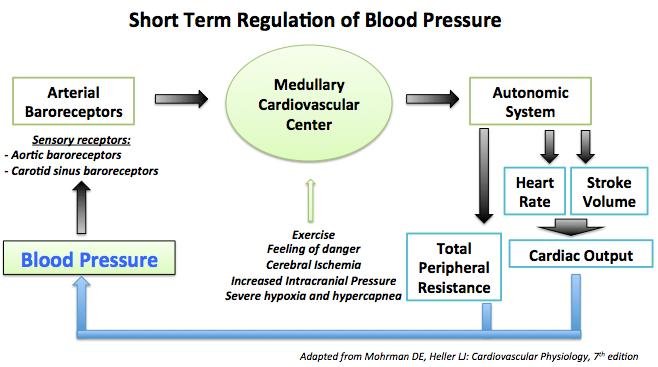
3 — Rapid Control of Blood Pressure: Neural Mechanisms
🧠 CORE
- Rapid blood pressure control occurs within seconds to minutes.
- Baroreceptor reflex is the most important short-term mechanism.
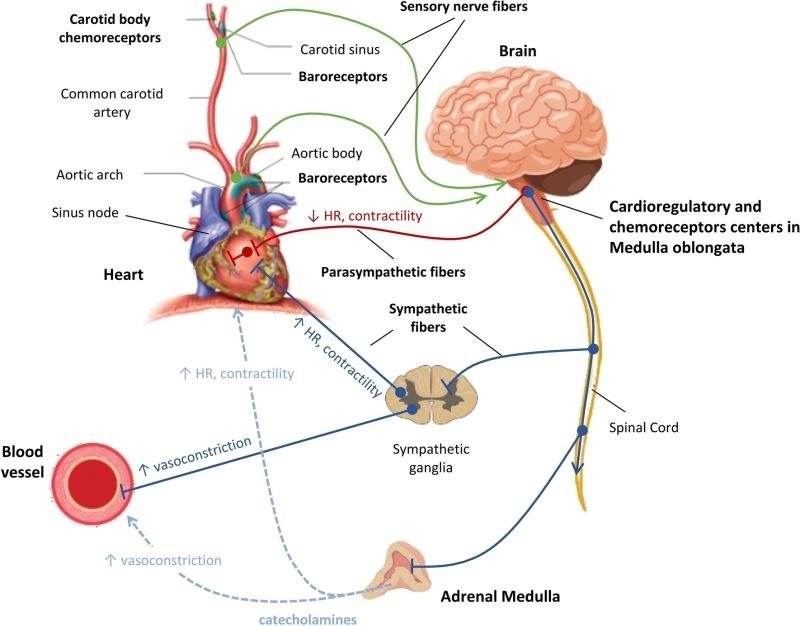
- Baroreceptors are present in carotid sinus and aortic arch.
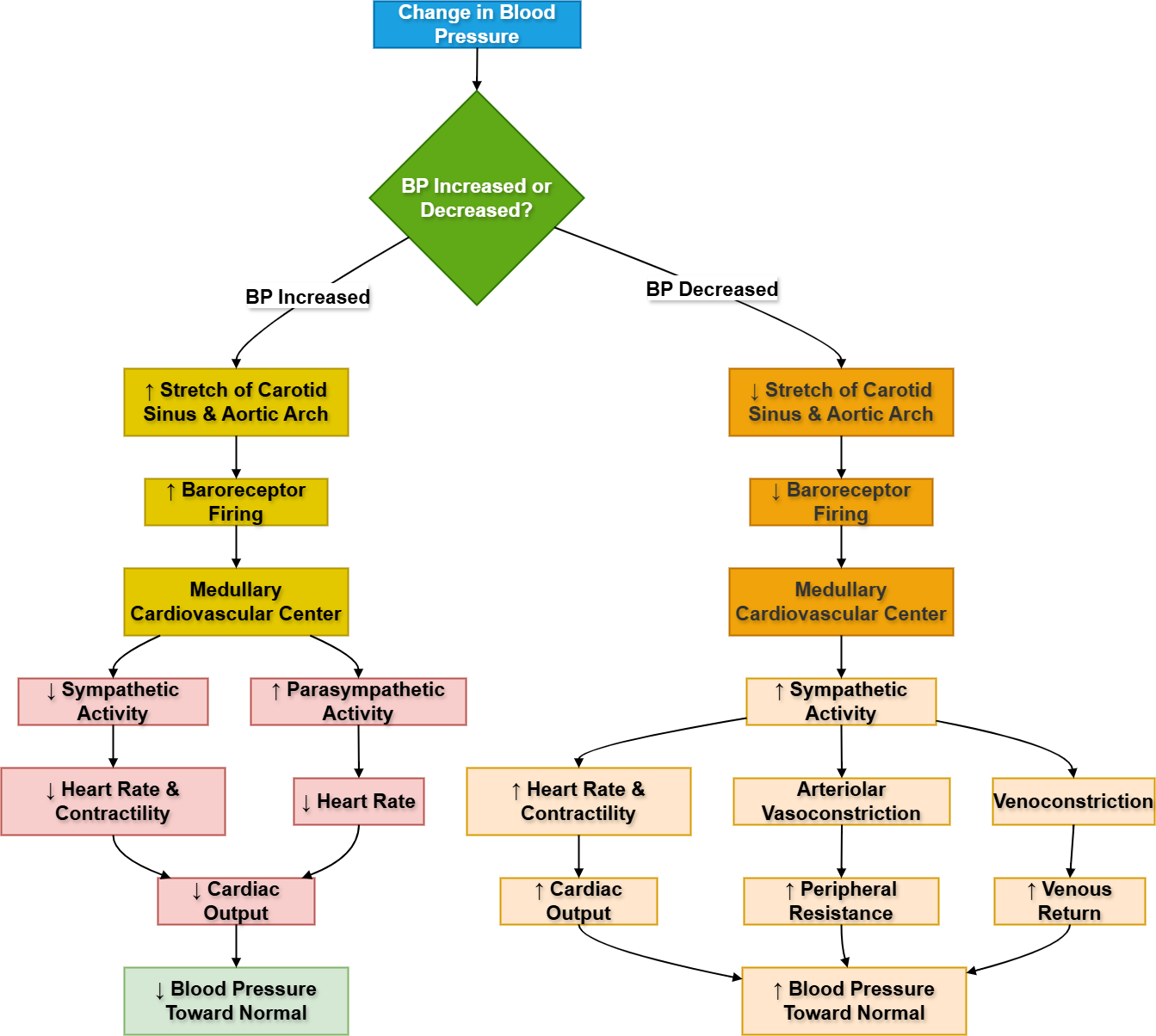
- Increased BP stretches baroreceptors.
- Baroreceptor signals travel to the medulla.
- Medulla adjusts sympathetic and parasympathetic output.
- Sympathetic activity increases heart rate, contractility, and vasoconstriction.
- Parasympathetic activity decreases heart rate.
- Chemoreceptors assist during hypoxia, hypercapnia, and acidosis.
🔬 CONCEPT EXPLAINED
The baroreceptor reflex protects the body from sudden changes in blood pressure. When blood pressure rises, arterial walls stretch more. Baroreceptors detect this stretch and send impulses to the cardiovascular centers in the medulla. The medulla responds by reducing sympathetic activity and increasing parasympathetic activity. Heart rate decreases, cardiac output falls, arterioles dilate, and blood pressure returns toward normal.
When blood pressure falls, baroreceptor firing decreases. The medulla increases sympathetic outflow. This causes tachycardia, increased myocardial contractility, venoconstriction, and arteriolar vasoconstriction. Venoconstriction increases venous return, while arteriolar constriction increases peripheral resistance.
This mechanism exists to maintain immediate perfusion to vital organs during posture change, exercise, stress, or blood loss.
⚠️ CLINICAL IMPORTANCE
Failure of rapid neural control may cause postural hypotension. In standing position, venous pooling reduces venous return. Normally, baroreceptor reflex increases sympathetic tone to maintain blood pressure. If this reflex fails, cerebral perfusion falls and the patient may feel dizzy or faint.
5 — Long-Term Control of Blood Pressure: Renal Mechanisms and RAAS
🧠 CORE
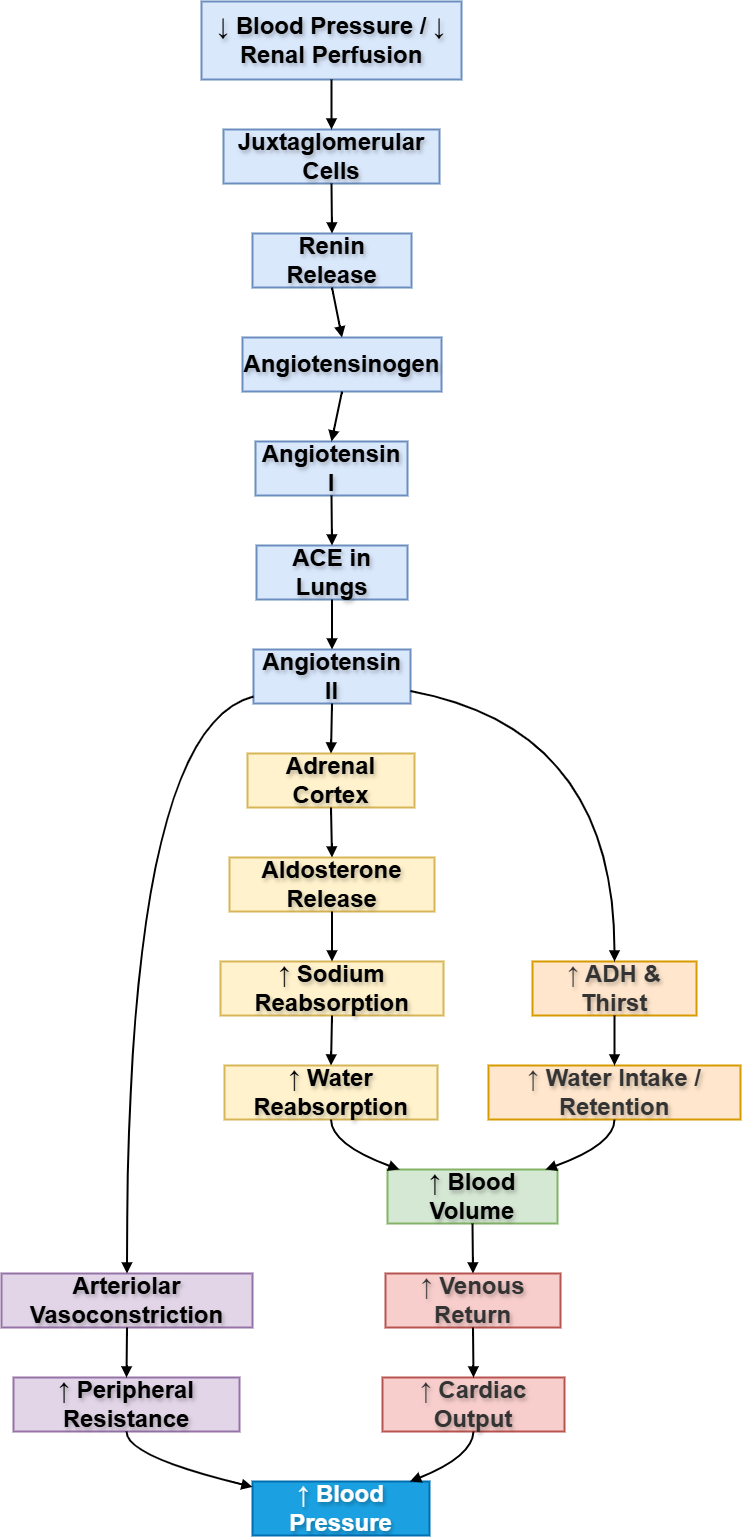
- Long-term blood pressure control depends mainly on kidneys.
- Kidneys regulate sodium and water balance.
- Increased blood volume increases cardiac output and blood pressure.
- Decreased renal perfusion stimulates renin release.
- Renin converts angiotensinogen into angiotensin I.
- ACE converts angiotensin I into angiotensin II.
- Angiotensin II causes vasoconstriction.
- Angiotensin II stimulates aldosterone release.
- Aldosterone increases sodium and water reabsorption.
- RAAS increases blood volume and blood pressure.
🔬 CONCEPT EXPLAINED
The kidneys control blood pressure by regulating extracellular fluid volume. If blood pressure falls, renal perfusion decreases. Juxtaglomerular cells release renin. Renin starts the renin-angiotensin-aldosterone system.
Angiotensin II has two major actions. First, it causes arteriolar vasoconstriction, increasing peripheral resistance. Second, it stimulates aldosterone secretion from the adrenal cortex. Aldosterone increases sodium reabsorption from renal tubules. Water follows sodium, increasing blood volume. Increased blood volume increases venous return, stroke volume, cardiac output, and blood pressure.
This system exists to protect the body during dehydration, blood loss, or low renal perfusion. However, chronic overactivation causes sustained hypertension.
⚠️ CLINICAL IMPORTANCE
Overactivity of RAAS is a major mechanism in hypertension, heart failure, and renal disease. ACE inhibitors and angiotensin receptor blockers reduce RAAS activity and are commonly used in hypertension. Long-term uncontrolled RAAS activation increases vascular resistance, fluid retention, and cardiovascular workload.
4 — Sympathetic and Parasympathetic Effects on Heart and Circulation
🧠 CORE
- Sympathetic stimulation increases heart rate.
- Sympathetic stimulation increases cardiac contractility.
- Sympathetic stimulation causes arteriolar vasoconstriction in many vascular beds.
- Sympathetic stimulation causes venoconstriction.
- Venoconstriction increases venous return.
- Parasympathetic stimulation mainly acts on SA and AV nodes.
- Parasympathetic stimulation decreases heart rate.
- Parasympathetic effect on blood vessels is limited.
- Autonomic balance maintains normal cardiovascular stability.
🔬 CONCEPT EXPLAINED
Sympathetic stimulation prepares the cardiovascular system for stress, exercise, or blood loss. It increases SA node firing, increases AV conduction, and strengthens ventricular contraction. As a result, cardiac output increases. At the same time, sympathetic nerves constrict arterioles, raising peripheral resistance. They also constrict veins, pushing blood toward the heart and increasing venous return.
Parasympathetic stimulation through the vagus nerve mainly slows the heart. It decreases SA node firing and slows AV conduction. This reduces heart rate and may reduce cardiac output. However, parasympathetic supply to most blood vessels is limited, so its direct effect on peripheral resistance is small.
⚠️ CLINICAL IMPORTANCE
Excess sympathetic activity contributes to hypertension, tachycardia, and increased cardiac workload. Excess vagal activity may cause bradycardia and hypotension. Many antihypertensive drugs reduce sympathetic effects or vascular resistance.
6 — Hypertension as a Failure of Blood Pressure Regulation
🧠 CORE
- Hypertension means persistent elevation of arterial blood pressure.
- It may be primary or secondary.
- Primary hypertension is more common.
- Secondary hypertension has an identifiable cause.
- Major mechanisms include increased resistance, increased volume, and neurohormonal activation.
- Hypertension is often asymptomatic.
- It damages blood vessels gradually.
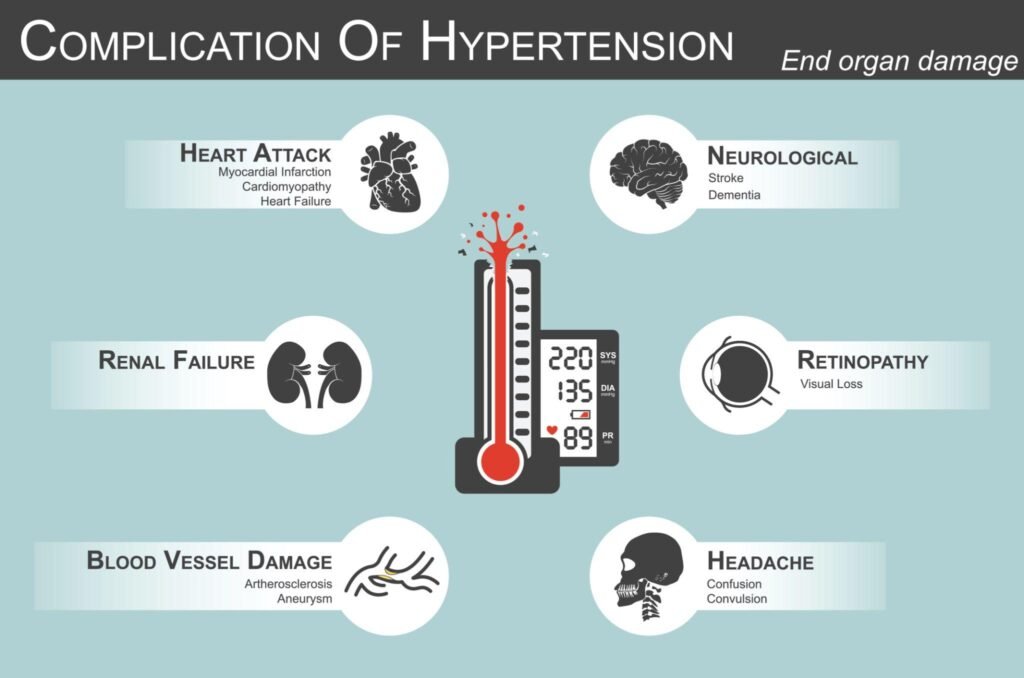
- Target organs include heart, brain, kidneys, eyes, and arteries.
- Prevention is a major community medicine priority.
🔬 CONCEPT EXPLAINED
Hypertension develops when normal regulatory mechanisms reset or fail to maintain pressure within normal limits. In many patients, arteriolar resistance remains chronically increased. In others, renal sodium retention expands blood volume. Sympathetic and RAAS overactivity may also maintain high pressure.
Long-standing hypertension increases afterload on the left ventricle. The heart must pump against higher pressure, causing left ventricular hypertrophy. Blood vessels also become thickened and damaged. Endothelial injury promotes atherosclerosis and thrombosis.
⚠️ CLINICAL IMPORTANCE
Hypertension is clinically dangerous because it may remain silent for years while damaging organs. It increases the risk of stroke, myocardial infarction, heart failure, chronic kidney disease, retinopathy, and peripheral vascular disease.
7 — Community Medicine: Prevention of Hypertension
🧠 CORE
- Prevention focuses on lifestyle, screening, and risk reduction.
- Regular blood pressure checking is essential.
- Healthy diet reduces hypertension risk.
- Salt restriction helps control blood pressure.
- Regular physical activity lowers cardiovascular risk.
- Weight control reduces blood pressure.
- Smoking cessation reduces vascular damage.
- Limiting alcohol reduces hypertension risk.
- Stress management and adequate sleep support cardiovascular health.
- Community awareness improves early detection.
🔬 CONCEPT EXPLAINED
Hypertension prevention works by reducing the factors that increase blood volume, peripheral resistance, and vascular injury. Reduced salt intake decreases sodium and water retention. Physical activity improves vascular function and helps maintain healthy body weight. Weight reduction decreases cardiac workload and insulin resistance. Avoiding tobacco protects endothelium and reduces cardiovascular risk.
Community medicine focuses not only on treating patients but also on preventing disease in the population. Screening programs, health education, lifestyle counseling, and early referral help reduce complications. Current public health sources emphasize regular BP monitoring, healthy diet, physical activity, weight control, smoking avoidance, and reduced alcohol intake as key prevention strategies.
⚠️ CLINICAL IMPORTANCE
Prevention reduces the burden of stroke, ischemic heart disease, kidney failure, and premature death. Since hypertension is often silent, community-level screening is important for early diagnosis and treatment.
⚙️ 4️⃣ Functional Flow
Structure → Function → Outcome
- Heart → Pumping action → Cardiac output maintains arterial pressure
- Arterioles → Smooth muscle contraction → Peripheral resistance controls BP
- Large arteries → Elastic recoil → Maintains diastolic pressure
- Veins → Blood reservoir → Venous return supports stroke volume
- Baroreceptors → Detect stretch → Rapid BP correction
- Medulla → Autonomic control → Adjusts heart and vessels
- Kidneys → Sodium and water balance → Long-term BP control
- RAAS → Hormonal activation → Restores BP during low perfusion
- Endothelium → Vascular regulation → Maintains vascular tone
🩺 5️⃣ Clinical Correlation
Hypertension
- Persistent elevation of arterial blood pressure.
- Often asymptomatic.
- Causes increased cardiac workload.
- Leads to left ventricular hypertrophy.
- Damages blood vessels and target organs.
- Major risk factor for stroke, myocardial infarction, heart failure, renal failure, and retinopathy.
Hypotension
- Low arterial pressure causing poor tissue perfusion.
- May occur due to dehydration, hemorrhage, shock, heart failure, or autonomic failure.
- Symptoms include dizziness, fainting, weakness, confusion, and cold clammy skin.
Orthostatic Hypotension
- Fall in blood pressure on standing.
- Due to failure of baroreceptor-mediated sympathetic response.
- Causes dizziness or syncope.
Renal Hypertension
- Occurs when renal perfusion is reduced.
- RAAS becomes activated.
- Angiotensin II and aldosterone raise blood pressure.
- Important example of secondary hypertension.
Cardiovascular Risk
- Chronic hypertension injures endothelium.
- Promotes atherosclerosis.
- Increases risk of stroke, ischemic heart disease, kidney disease, and heart failure.
📌 6️⃣ Summary Points
- Blood pressure is mainly determined by cardiac output and peripheral resistance.
- Arterioles are the main resistance vessels.
- Baroreceptor reflex is the most important rapid BP control mechanism.
- Carotid sinus and aortic arch contain baroreceptors.
- Sympathetic stimulation increases heart rate, contractility, venous return, and vasoconstriction.
- Parasympathetic stimulation mainly decreases heart rate.
- Kidneys are the main organs for long-term BP control.
- RAAS increases blood pressure by vasoconstriction and fluid retention.
- Angiotensin II is a powerful vasoconstrictor.
- Aldosterone increases sodium and water reabsorption.
- Hypertension is often silent but causes serious target organ damage.
- Prevention depends on screening, salt reduction, exercise, weight control, and healthy lifestyle.