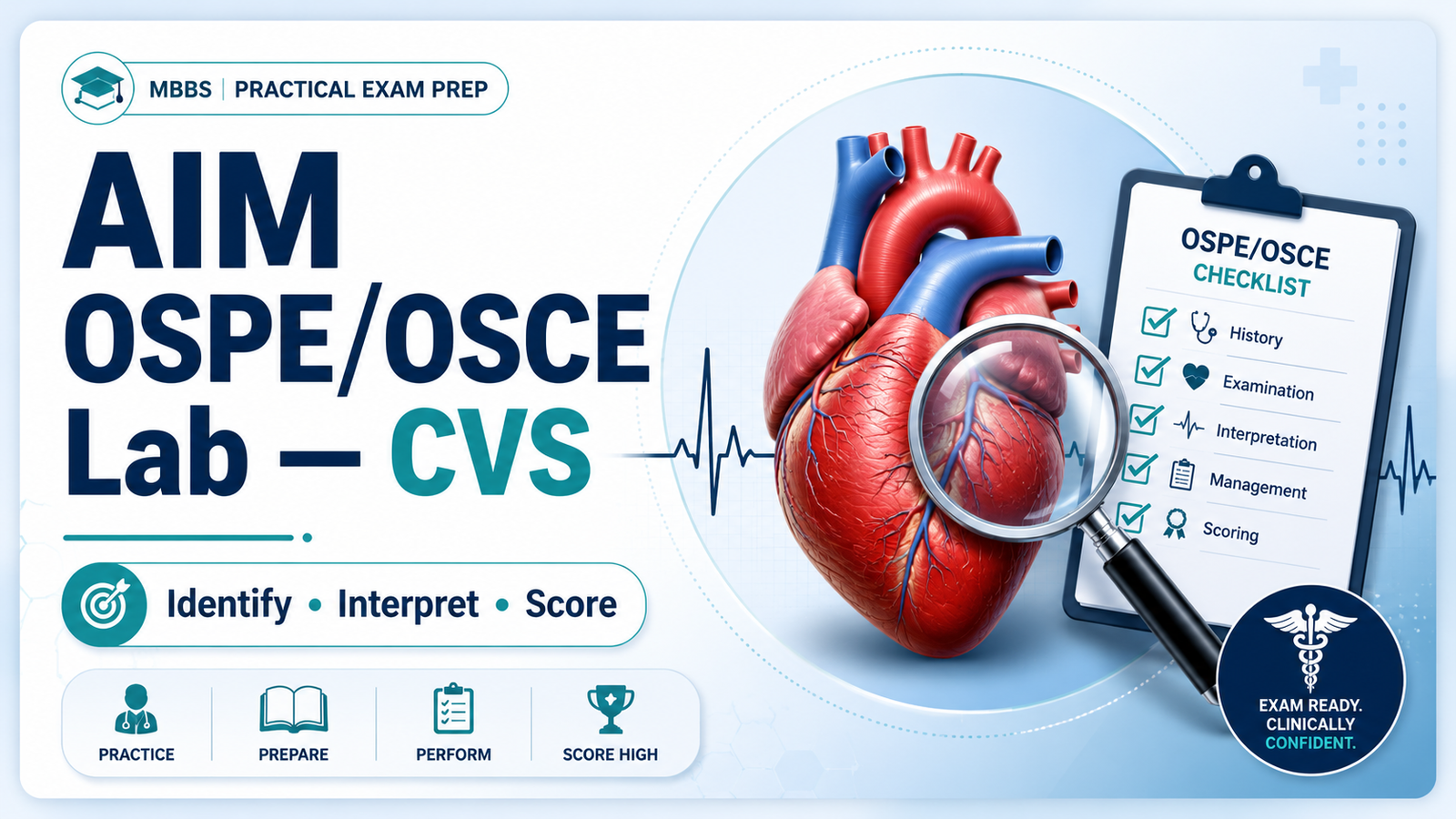
🫀🔍 AIM OSPE/OSCE Lab — CVS

About Course

AIM OSPE/OSCE Lab — CVS is a practical exam-focused course designed to help MBBS students master cardiovascular stations through identification, interpretation, clinical correlation, and structured marking checklists.

Students will practice heart models, vessels, histology slides, ECG basics, cardiac cycle graphs, heart sounds, embryology diagrams, and clinically integrated CVS scenarios in KMU-style OSPE/OSCE format.

Course Content

🫀🔬 Station 1 — Heart and Its Coverings
Identify heart Identify pericardium / coverings Identify heart in model or dissected specimen

🫀🩸 Station 2 — Heart and Major Blood Vessels
Covers: Aorta Pulmonary trunk Superior vena cava Inferior vena cava Pulmonary veins

🫀🏠 Station 3 — Chambers of the Heart
Covers: Right atrium Right ventricle Left atrium Left ventricle

🫀🔎 Station 4 — Internal Structures of Heart Chambers
Covers: Papillary muscles Chordae tendineae Trabeculae carneae Pectinate muscles Interventricular septum Valves

🔬🫀 Station 5 — Cardiac Muscle Slide
Covers: Cardiac muscle fibers Branching pattern Central nuclei Intercalated discs

🔬🩸 Station 6 — Medium-Sized Artery and Vein
Covers: Identify artery and vein in cross-section Compare wall thickness Compare lumen shape Compare tunica media

🔬🩸 Station 7 — Large Artery and Large Vein
Covers: Describe histological differences Link structure with function

🩻🫀 Station 8 — Cardiac Shadow on Chest X-Ray
Covers: Normal cardiac shadow Heart borders Cardiomegaly

📍🫀 Station 9 — Surface Marking of Heart Borders and Valves
Covers: Surface marking of borders Surface marking of valve areas on model/simulator

🎧🫀 Station 10 — Apex Beat and Auscultatory Areas
Covers: Locate apex beat Identify mitral, tricuspid, pulmonary, and aortic auscultatory areas State clinical significance

📍🩺 Station 11 — Normal vs Displaced Apex Beat
Covers: Normal apex beat position Displaced apex beat Clinical significance of displacement

🩺📊 Station 12 — Blood Pressure Measurement
Covers: Correct cuff placement Palpatory method Auscultatory method Systolic and diastolic BP

🏃‍♂️🩺 Station 13 — Effect of Posture and Exercise on Blood Pressure
Covers: BP before and after posture/exercise Physiological interpretation

✋🩸 Station 14 — Examination of Arterial Pulse
Covers: Rate Rhythm Volume Character Radio-radial delay if needed

🎧💓 Station 15 — Auscultation of Heart Sounds
Covers: Use of stethoscope S1 and S2 Auscultatory areas Basic interpretation

🎧🩺 Station 16 — Use of Stethoscope
Covers: Diaphragm Bell Proper placement Practical handling

🚑❤️ Station 17 — Basic Life Support
Covers: Check response Call for help Airway Breathing Circulation Chest compression basics

📈💓 Station 18 — Systematic Analysis of ECG
Covers: Rate Rhythm Axis basic idea P wave PR interval QRS complex ST segment T wave Calibration

🗣️❤️ Station 19 — Counseling for Cardiovascular Risk Factors
Covers: Lifestyle modification Diet Exercise Smoking cessation BP control Respectful communication

🎯📚 Section 7 — CVS Most Important Viva Questions

Want to receive push notifications for all major on-site activities?

Scroll to Top
Enable Notifications OK No thanks