🩺 Station 5 — Cardiac Muscle Slide
AIM OSPE/OSCE Lab — Practical Station | KMU Style | MBBS Practical + Viva
📌 Station Overview
Module: Cardiovascular System
Year: 1st Year MBBS
Focus: Identification • Procedure • Interpretation • Viva
Total Marks: 5
📋 Complete OSPE Station Content
Learning Target
By the end of this station, the student should be able to:
- Identify cardiac muscle on a histology slide.
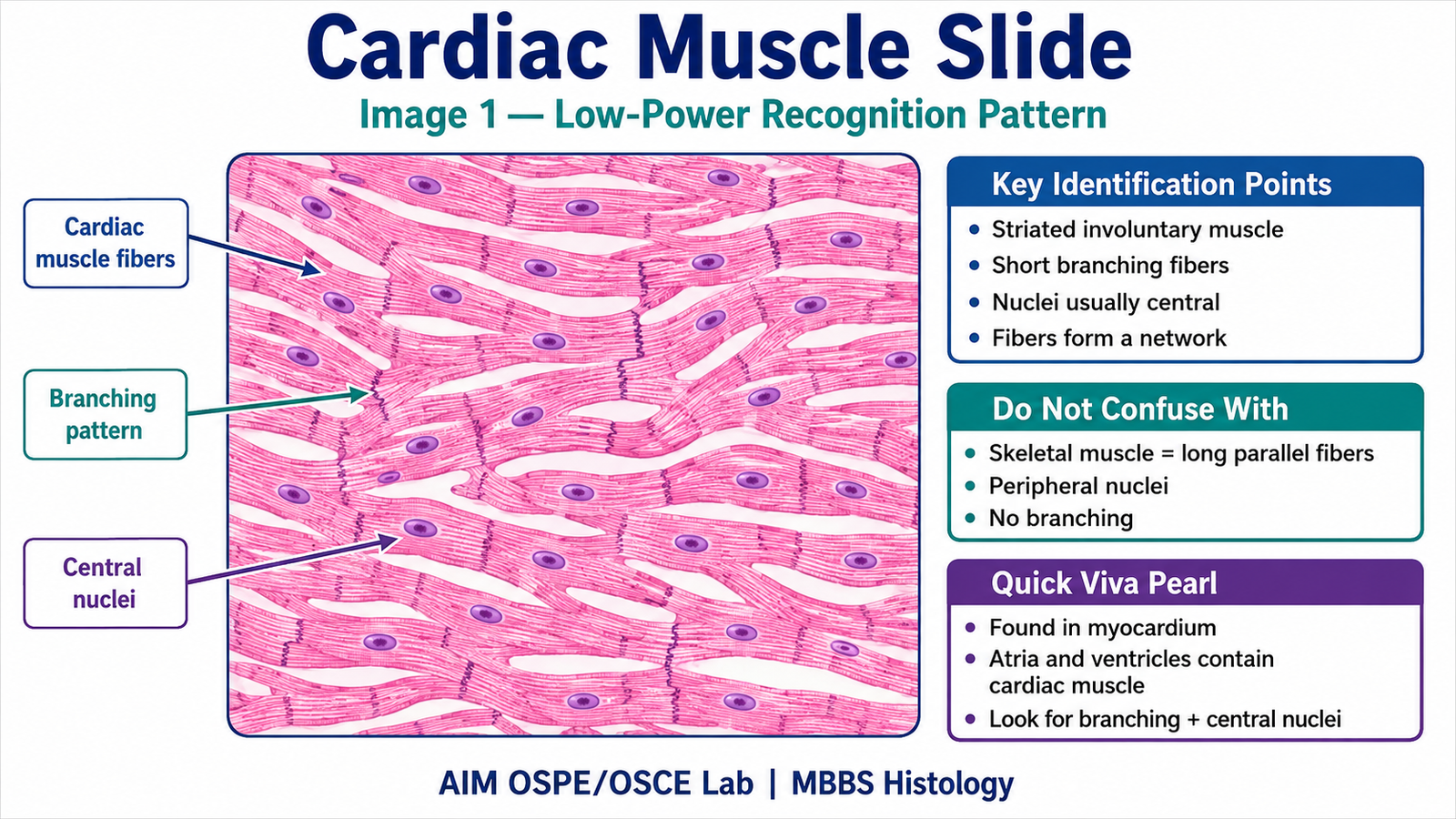
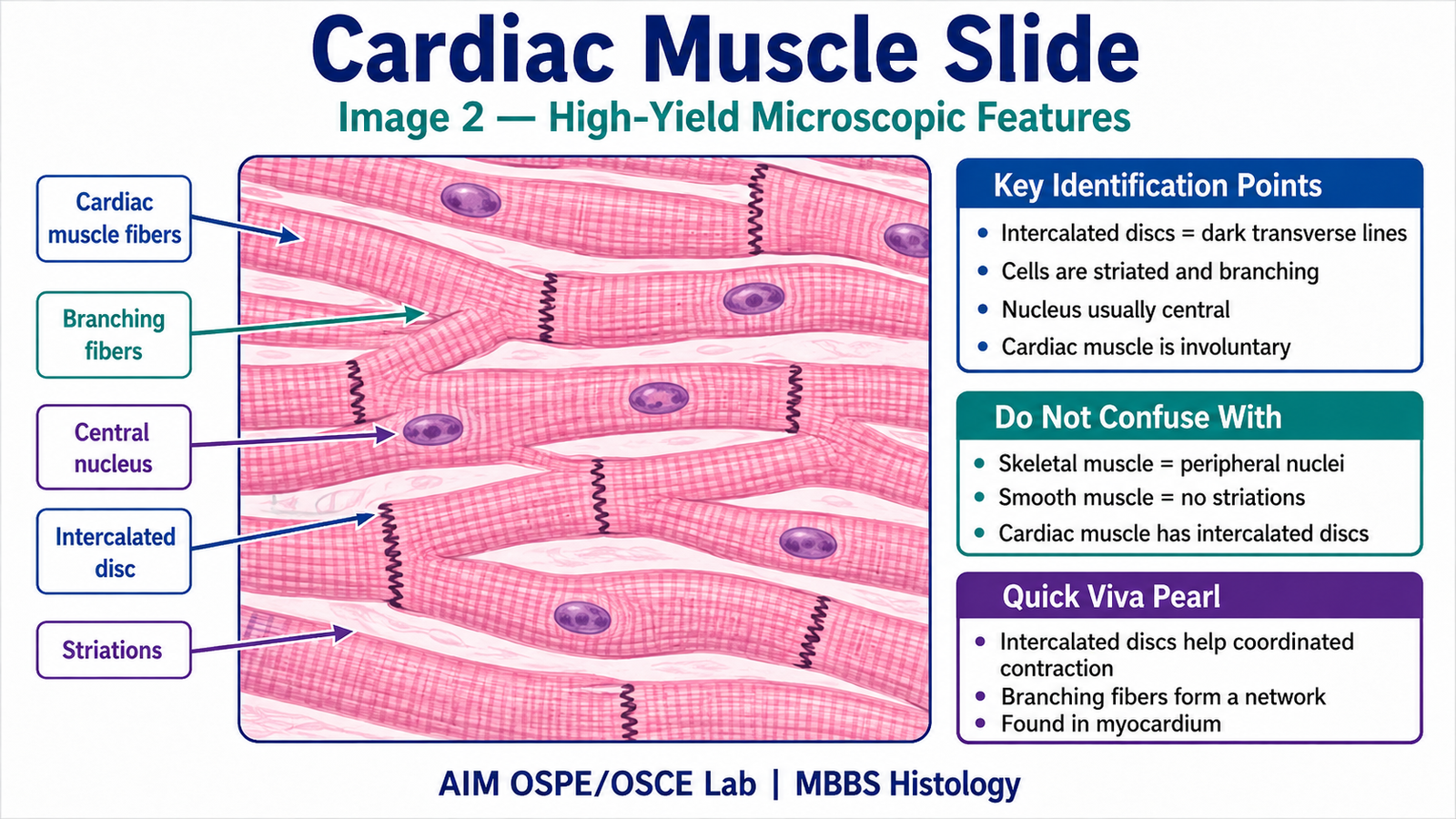
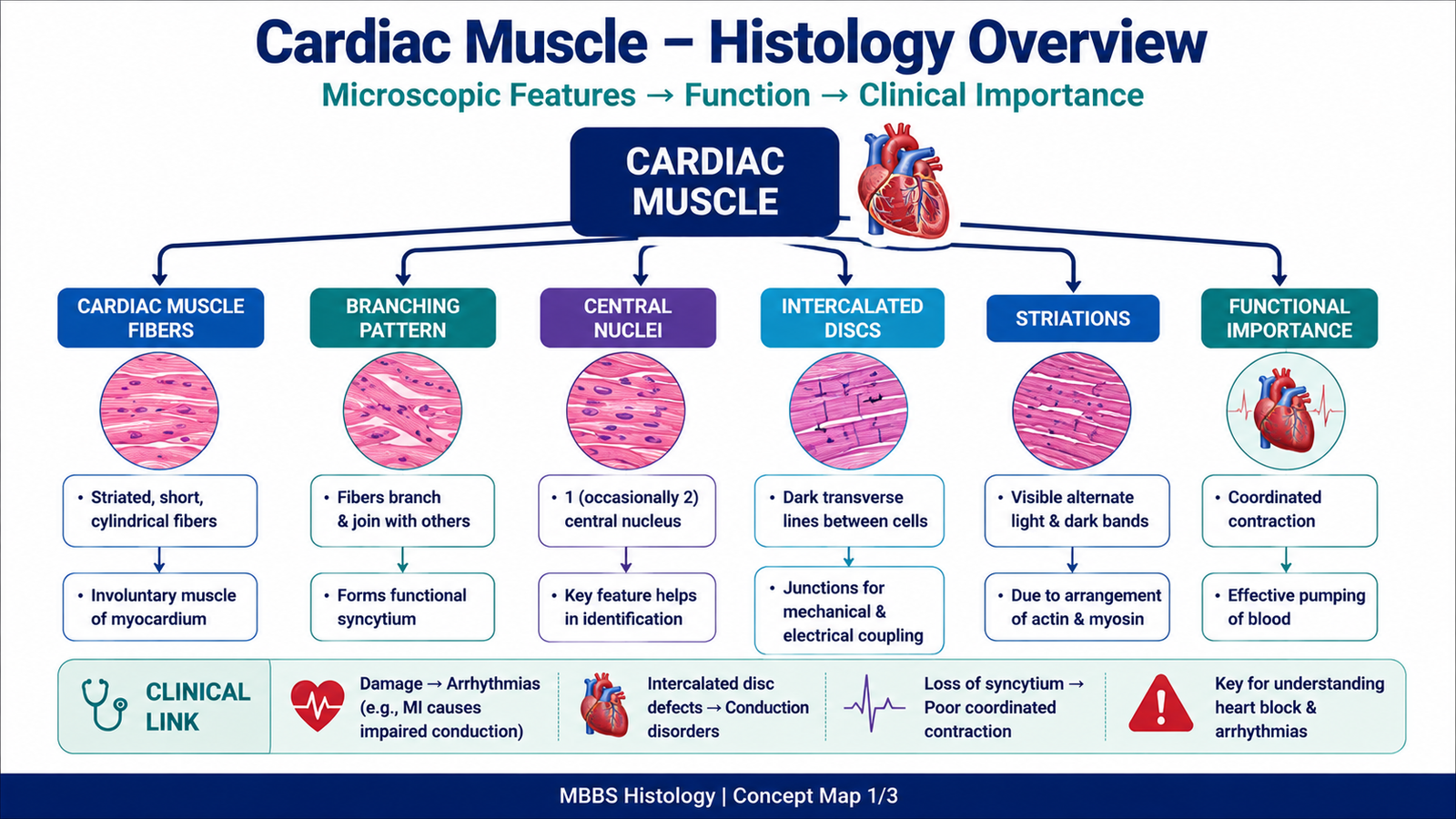
- Recognize key microscopic features: branching fibers, central nuclei, striations, and intercalated discs.
Required Material
- Prepared histology slide of cardiac muscle
- Light microscope
- Pointer / digital slide image
- Unlabelled histology image
- Answer sheet
- Station instruction card
Student Task / Procedure
- Observe the given histology slide/image carefully.
- Identify the tissue shown.
- Point out the following features:
- Cardiac muscle fibers
- Branching pattern
- Central nuclei
- Intercalated discs
- Mention one functional importance of intercalated discs.
- Differentiate cardiac muscle from skeletal muscle using one microscopic feature.
Observation / Identification Points
Students should identify or demonstrate:
- Cardiac muscle fibers are striated and arranged in short fibers
- Fibers show branching pattern
- Cells usually contain one centrally placed nucleus
- Intercalated discs appear as dark transverse lines between cardiac muscle cells
- Fibers are joined end-to-end and side-to-side
- Cardiac muscle is involuntary and found in the myocardium
- Intercalated discs help in mechanical and electrical connection between cells
Result / Interpretation
The slide shows cardiac muscle, a specialized involuntary striated muscle found in the myocardium.
Its branching fibers, central nuclei, and intercalated discs allow coordinated contraction of the heart.
Intercalated discs are important because they help cardiac muscle cells act as a functional syncytium.
Viva Questions
1. How do you identify cardiac muscle under the microscope?
Answer: By striated branching fibers, central nuclei, and intercalated discs.
2. Where is cardiac muscle found?
Answer: In the myocardium of the heart.
3. What are intercalated discs?
Answer: Specialized junctions between cardiac muscle cells.
4. What is the function of intercalated discs?
Answer: They provide mechanical attachment and allow electrical conduction between cardiac muscle cells.
5. How is cardiac muscle different from skeletal muscle?
Answer: Cardiac muscle has branching fibers, central nuclei, and intercalated discs, while skeletal muscle has long unbranched fibers with peripheral nuclei.
Marking Scheme
Total Marks: 5
| Component | Marks |
|---|---|
| Correct identification / performance | 2 |
| Key observation / procedure steps | 1 |
| Interpretation / principle | 1 |
| Viva answer | 1 |
Common Student Mistakes
- Confusing cardiac muscle with skeletal muscle because both are striated.
- Forgetting that cardiac muscle usually has central nuclei.
- Not recognizing intercalated discs as dark transverse lines.
AIM Feedback
Revise cardiac muscle by focusing on three high-yield microscopic clues: branching fibers, central nuclei, and intercalated discs. In OSPE, do not identify the slide only by striations, because skeletal muscle is also striated. The presence of intercalated discs and branching fibers confirms cardiac muscle.
Short Caption
Identify cardiac muscle by three key features: branching striated fibers, central nuclei, and intercalated discs.
🖼️ Visual / Image Support