
Transportation Trauma, Road-Traffic Injury Prevention and Spinal Injuries
Topic Introduction
Transportation trauma includes injuries caused by road vehicles, railways and aircraft, as well as the spinal, limb and soft-tissue injuries that may result from these events. The severity of injury depends on the amount of energy transferred to the body, the direction of force, the structures involved and whether protective measures were used. Understanding the mechanism of an accident helps the doctor anticipate hidden injuries, provide safe emergency care and interpret important forensic findings. This chapter explains accident prevention through Haddon’s model, road-traffic risk factors, characteristic injuries of vehicle occupants, railway and air-crash injuries, emergency limb and spinal immobilization, cast principles, and the initial management of ligament, tendon and spinal injuries.
A. Accidents: Types, Mechanisms and Injury Production
An accident is an unplanned event that causes, or has the potential to cause, injury, death or damage. The word “accident” does not mean that the event was completely unpredictable or unavoidable. Most accidents develop through identifiable human, environmental and mechanical factors, which means that many can be prevented.
Types of accidents
Accidents may be classified according to where they occur, the activity involved or the source of injury. This classification helps public-health workers identify the population at risk and choose appropriate preventive measures.
- Road-traffic accidents: Events involving vehicles, motorcyclists, cyclists, pedestrians or roadside structures.
- Domestic accidents: Falls, burns, poisoning, electrical injury and other injuries occurring in or around the home.
- Occupational accidents: Injuries related to machinery, construction, chemicals, electricity or unsafe workplace practices.
- Sports and recreational accidents: Injuries occurring during exercise, games or leisure activities.
- Railway accidents: Collisions, derailments, falls from trains and injuries caused by passing railway vehicles.
- Air-transport accidents: Injuries caused by aircraft crashes, rapid deceleration, fire, smoke or structural collapse.
Mechanisms of injury
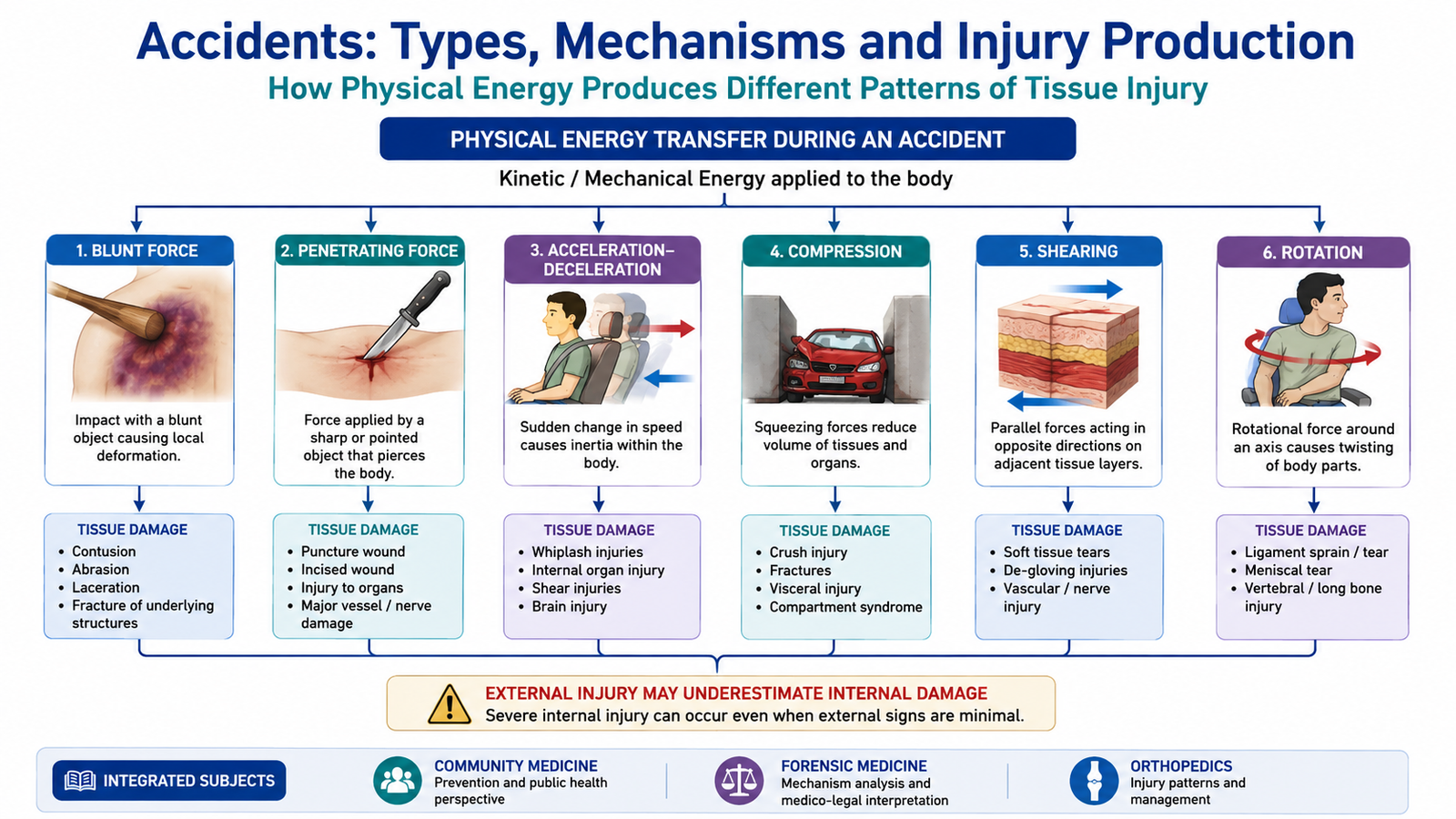
Injury occurs when physical energy is transferred to the body in an amount greater than the tissues can tolerate. The type of damage depends on the force, duration, direction and area over which the force acts.
- Blunt force: Produces abrasions, bruises, lacerations, fractures and internal organ damage without necessarily breaking the skin.
- Penetrating force: Concentrates energy over a small area and enters the body, damaging tissues along its path.
- Acceleration and deceleration: Cause the body or internal organs to continue moving after the vehicle suddenly stops or changes direction.
- Compression: Occurs when the body is trapped between two surfaces, producing crush injuries and possible tissue ischemia.
- Shearing: Develops when adjacent structures move in different directions, potentially tearing blood vessels, ligaments or organs.
- Rotation and twisting: May produce spiral fractures, ligament injury or spinal instability.
- Thermal and chemical energy: May cause burns, smoke inhalation or toxic exposure during vehicle, railway or aircraft fires.
Greater speed produces greater kinetic energy. When a moving vehicle stops suddenly, this energy is transferred to the vehicle, its occupants and surrounding objects. The body may strike the interior of the vehicle, while internal organs continue moving and become stretched, torn or compressed.
B. Accident Prevention Through Haddon’s Model
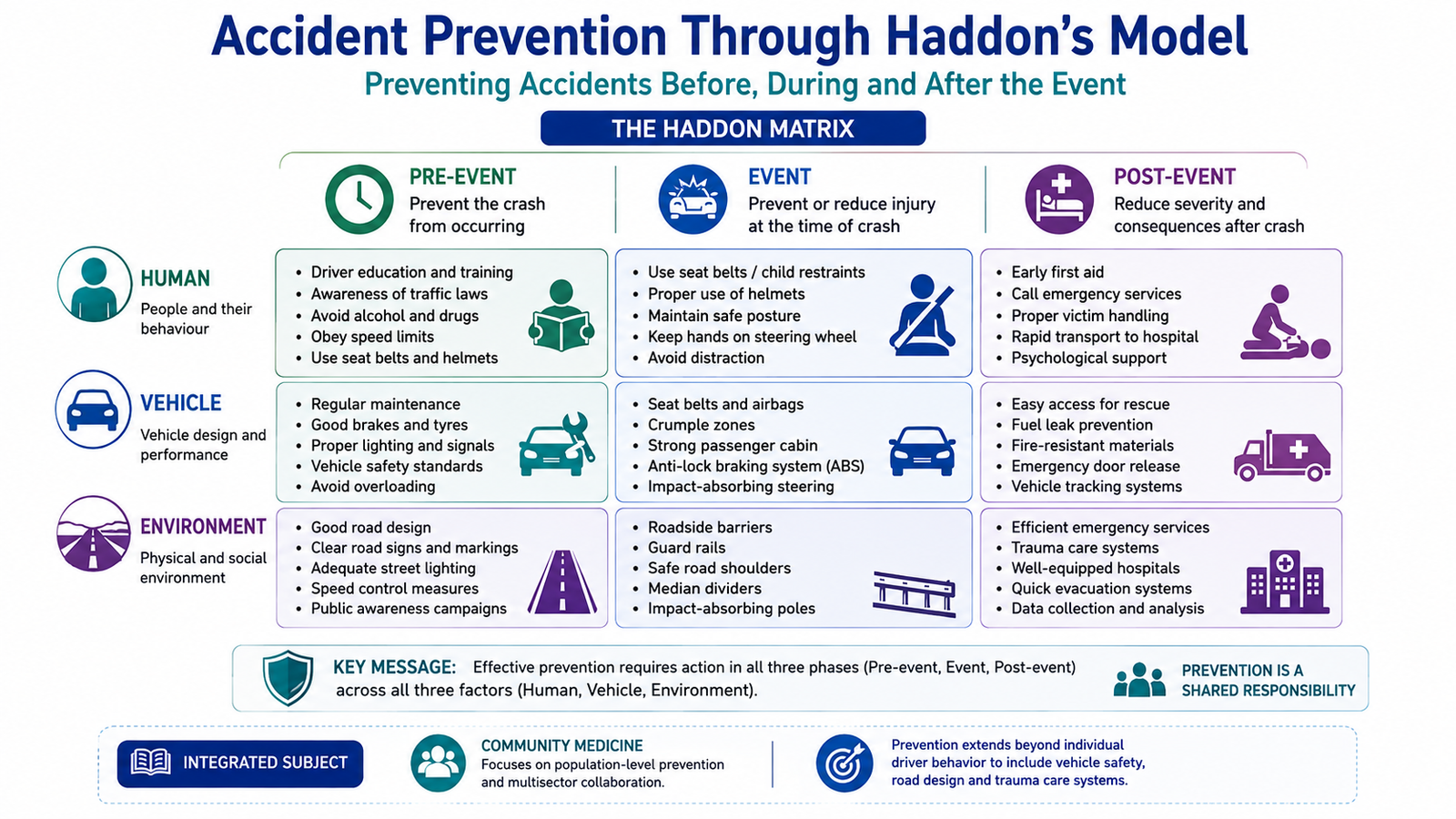
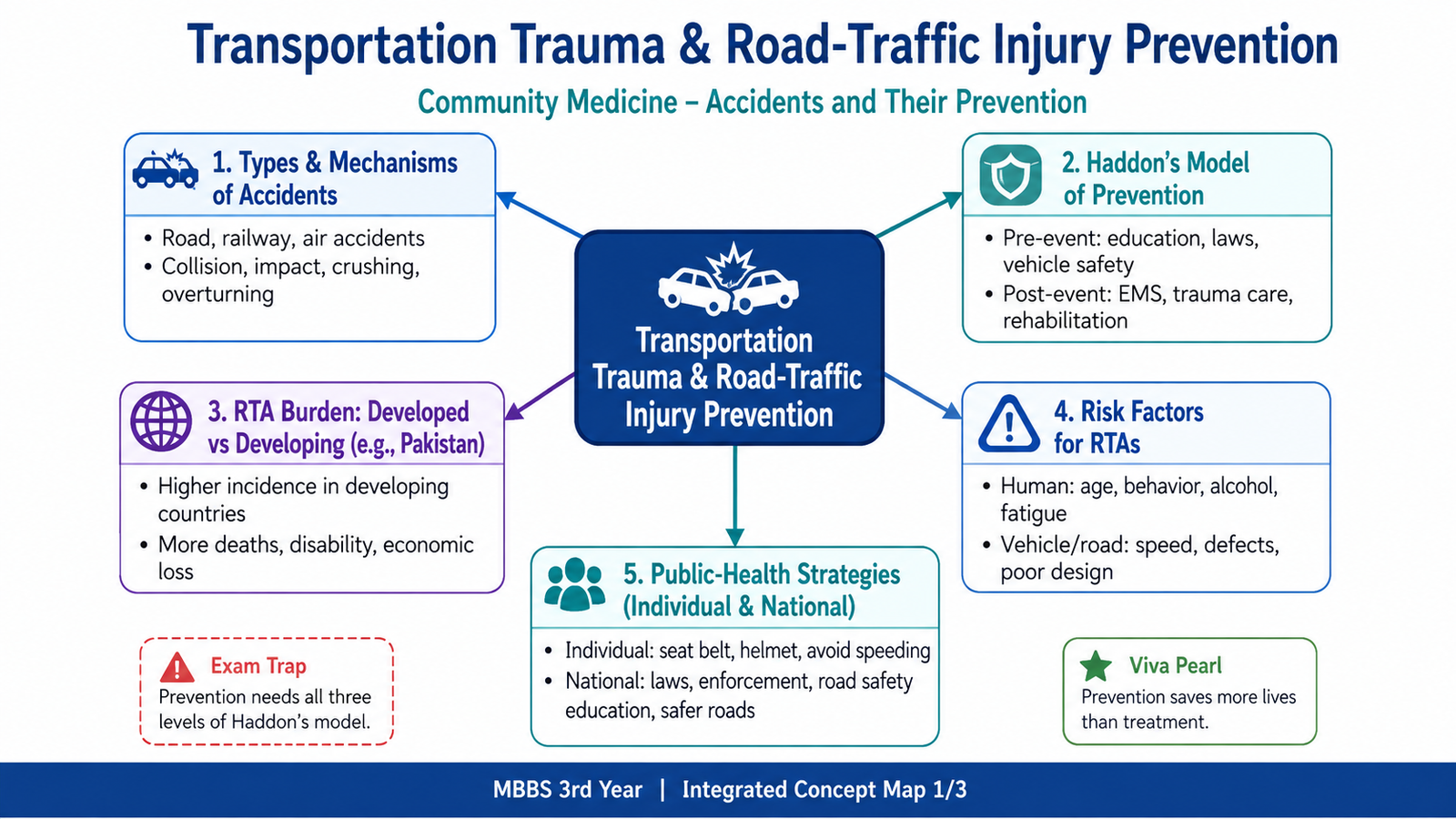
Haddon’s model explains that an injury event is not produced by one factor alone. It develops through interaction between the human being, the vehicle or agent, and the physical or social environment. These factors can be addressed before, during and after the event.
The three phases
- Pre-event phase: Actions taken before a crash to prevent the event from occurring.
- Event phase: Measures that reduce the transfer of energy and limit injury while the crash is occurring.
- Post-event phase: Measures that reduce death, disability and complications after injury has occurred.
The three factors
- Human factors: Driver behavior, knowledge, physical condition, use of restraints and response after injury.
- Vehicle or agent factors: Vehicle design, braking, lights, tires, airbags and structural protection.
- Environmental factors: Roads, traffic systems, lighting, weather, enforcement and emergency-care access.
| Phase | Human | Vehicle or Agent | Environment |
|---|---|---|---|
| Pre-event | Driver training, avoiding alcohol, fatigue control | Reliable brakes, lights, tires and warning systems | Safe road design, signs, lighting and traffic regulation |
| Event | Seat-belt and helmet use | Airbags, crumple zones and protected passenger compartment | Median barriers, roadside protection and forgiving road edges |
| Post-event | First-aid knowledge and early help-seeking | Easy vehicle exit and reduced fire risk | Rescue services, trauma transport and hospital access |
The model is useful because it prevents narrow thinking. For example, road safety cannot depend only on telling drivers to “be careful.” Safer vehicles, better roads, effective enforcement and rapid emergency care are also necessary.
C. Road-Traffic Accidents: Types and Associated Injury Patterns
A road-traffic accident is an event occurring on a road or public traffic area in which a moving vehicle is involved and injury, death or property damage results. The mechanism of collision provides important clues about the injuries that may be present, including injuries that are not immediately visible.
Main types of road-traffic events
- Vehicle-to-vehicle collision: May be frontal, side-impact, rear-impact or rotational.
- Vehicle-to-pedestrian collision: Commonly produces impact injuries to the lower limbs followed by injury from the bonnet, windscreen or road surface.
- Motorcycle collision: Exposes the rider directly to impact, sliding, crushing and head injury.
- Vehicle rollover: Produces repeated impacts and may cause ejection, crushing or severe spinal injury.
- Collision with a fixed object: Produces rapid deceleration and a high transfer of energy to occupants.
- Run-over injury: The wheel passes over part of the body, causing crushing, degloving and internal injury.
Frontal collision
In a frontal collision, the vehicle stops suddenly but the occupant continues moving forward. The body may move upward and forward or downward beneath the dashboard.
- Head and face may strike the windscreen, steering wheel or dashboard.
- Chest may strike the steering wheel, causing rib, sternal, cardiac or pulmonary injury.
- Knees may strike the dashboard, transferring force through the femur to the hip.
- The lower limb may sustain patellar, femoral, tibial or ankle injury.
- Rapid deceleration may injure the aorta or internal organs.
Side-impact collision
In a side-impact collision, there is less space between the occupant and the striking vehicle. Energy is therefore transferred more directly to the side of the body.
- Head and neck injury from lateral movement.
- Rib fractures and lung injury.
- Abdominal organ injury on the struck side.
- Pelvic and proximal femoral injury.
Rear-impact collision
When a stationary or slow-moving vehicle is struck from behind, the seat pushes the torso forward while the head initially lags behind. This may produce rapid extension followed by flexion of the cervical spine, resulting in whiplash injury.
Pedestrian injuries
A pedestrian may experience several stages of injury. The exact pattern depends on vehicle height, speed, body position and whether the person is thrown or run over.
- Primary impact injury: Produced at the point where the vehicle first strikes the pedestrian, often the lower limb.
- Secondary impact injury: Produced when the body strikes another part of the vehicle, such as the bonnet or windscreen.
- Secondary injuries from the ground: Produced when the person falls or is thrown onto the road.
- Run-over injuries: Produced when a wheel passes over the body.
A small external mark does not exclude major internal injury. Rapid deceleration may tear deep structures even when the skin appears relatively intact.

D. Burden, Risk Factors and Public-Health Prevention of Road-Traffic Injuries
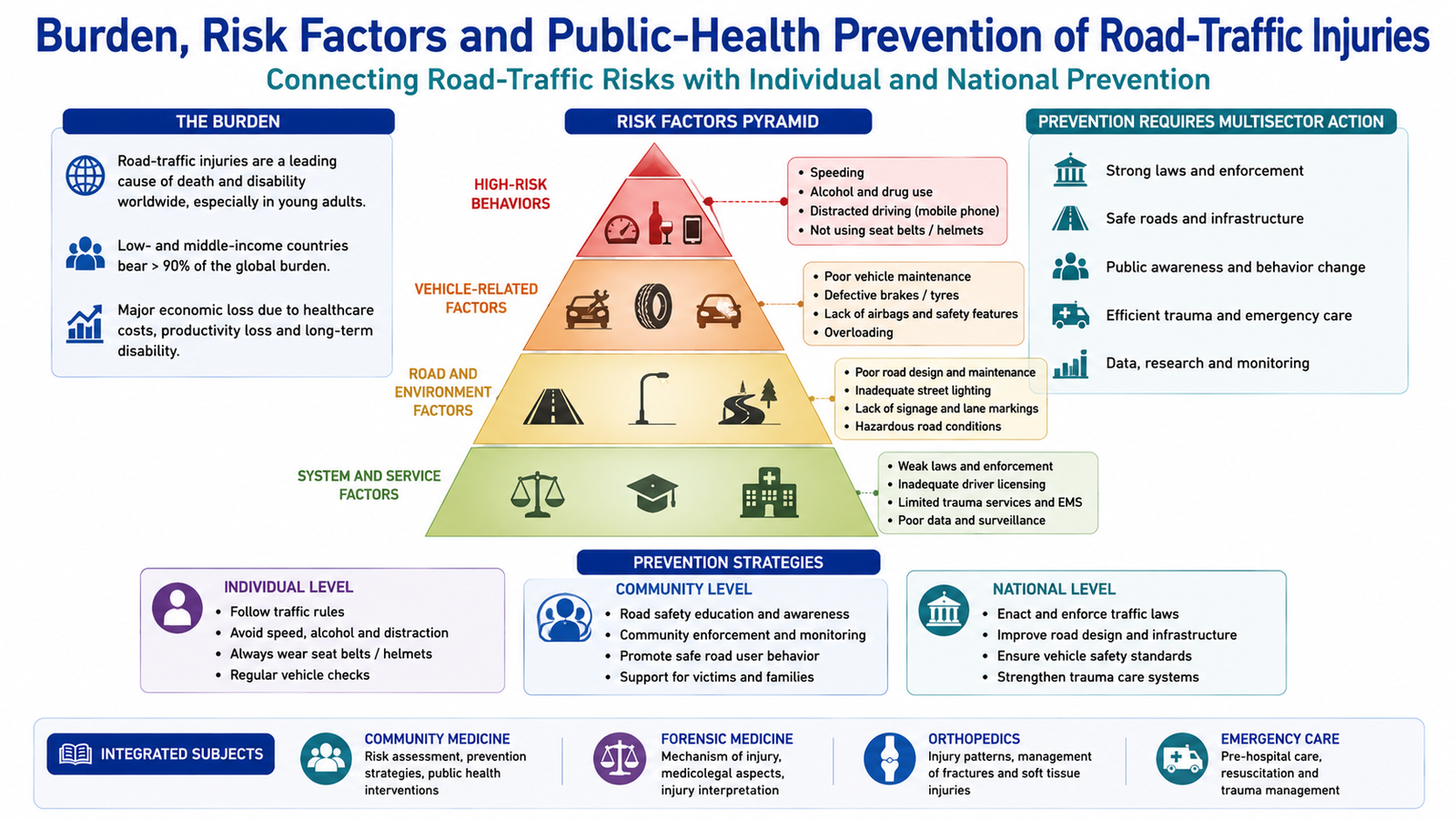
Road-traffic injuries are an important public-health problem because they affect people who are otherwise healthy, frequently cause long-term disability and require emergency, surgical and rehabilitation services. Their effects extend beyond the injured person to the family, health system and national economy.
Developed and developing-country patterns
Developed countries generally have higher levels of motorization, but many have reduced deaths through safer roads, safer vehicles, stronger enforcement, organized emergency care and consistent use of protective devices. Developing countries, including Pakistan, may experience a heavier injury burden because growth in traffic and vehicle use may occur faster than improvement in roads, regulation, public awareness and trauma services.
- Mixed traffic involving cars, motorcycles, rickshaws, bicycles, pedestrians and heavy vehicles increases conflict on the road.
- Motorcyclists and pedestrians are physically exposed and therefore vulnerable.
- Poor road maintenance, limited lighting and unsafe crossing areas increase risk.
- Inconsistent helmet, seat-belt and child-restraint use increases injury severity.
- Delayed rescue, transport and definitive care may worsen outcomes.
Important risk factors
Risk factors may increase the probability of a crash, the severity of injury during the crash or the risk of death after injury.
- Excessive or inappropriate speed: Reduces reaction time and increases collision energy.
- Alcohol or psychoactive substances: Impair judgment, coordination and reaction.
- Driver fatigue: Reduces alertness and may cause delayed response or sleep at the wheel.
- Distraction: Mobile-phone use, conversation and in-vehicle activities divert attention.
- Young or inexperienced drivers: May have limited hazard recognition and greater risk-taking behavior.
- Poor vision or illness: May reduce the ability to detect hazards or control the vehicle.
- Unsafe vehicles: Faulty brakes, worn tires, poor lights and inadequate maintenance increase crash risk.
- Unsafe roads: Poor design, damaged surfaces, missing signs and inadequate lighting increase danger.
- Non-use of helmets and restraints: Does not necessarily cause the crash but greatly increases injury severity.
- Weak enforcement: Reduces compliance with speed, helmet, licensing and vehicle-safety rules.
Individual-level prevention
- Obey speed limits and adapt speed to road, weather and traffic conditions.
- Use a properly fitted helmet on motorcycles.
- Use seat belts in front and rear seats.
- Use age-appropriate child restraints.
- Avoid alcohol, sedating drugs and driving while fatigued.
- Avoid mobile-phone use and other distractions while driving.
- Maintain brakes, lights, tires and other essential vehicle systems.
- Use safe pedestrian crossings and improve visibility at night.
National and population-level prevention
- Safe road design, pedestrian pathways, crossings, barriers and lighting.
- Effective driver licensing and training.
- Enforcement of speed, helmet, seat-belt and impaired-driving laws.
- Vehicle fitness inspection and safety standards.
- Public education directed at high-risk road users.
- Organized ambulance, trauma referral and emergency-care systems.
- Collection and analysis of road-injury data to guide preventive action.
E. Characteristic Injuries of Drivers and Vehicle Occupants
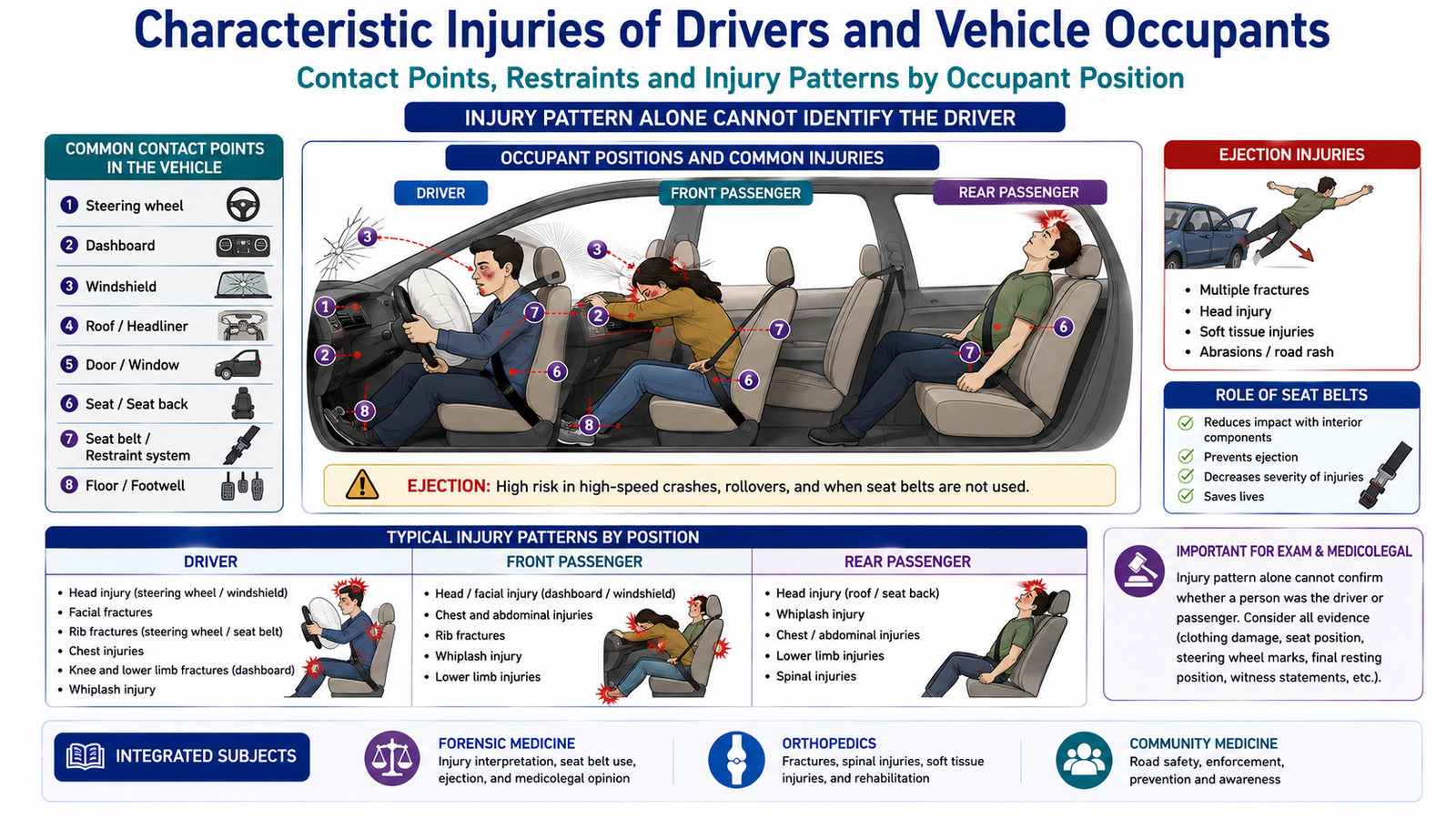
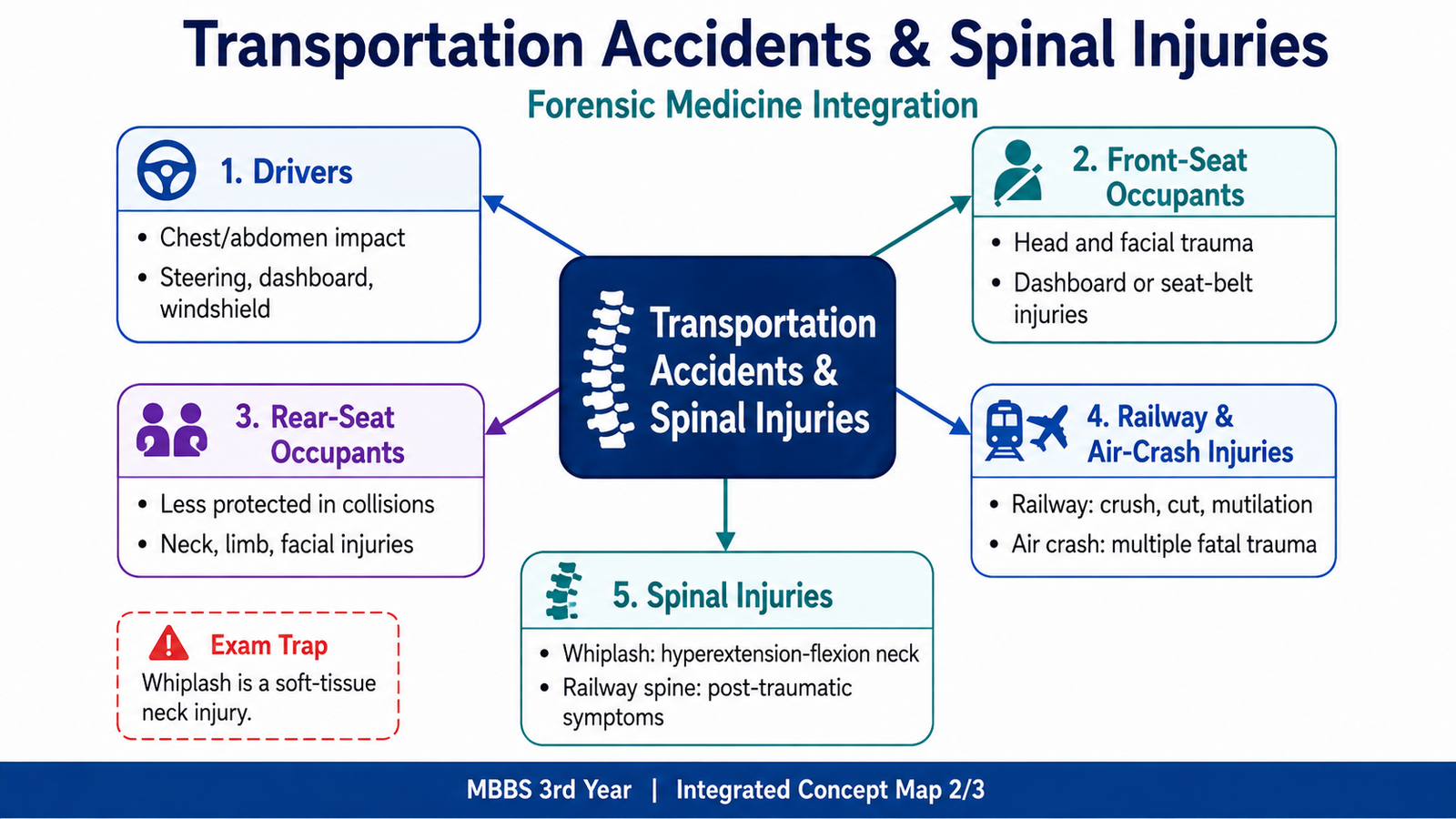
The position of a person inside a vehicle influences which objects the body may strike and which forces act on it. Injury patterns are not absolutely specific, but they can support reconstruction of the event when interpreted together with vehicle damage, seat-belt use, witness statements and scene findings.
Driver injuries
The driver is positioned close to the steering wheel, pedals, dashboard, windscreen and side structures. In a frontal collision, forward movement may produce several characteristic injuries.
- Facial injuries from the windscreen, steering wheel or dashboard.
- Chest bruising, rib or sternal fractures from steering-wheel impact.
- Cardiac or lung injury after severe anterior chest impact.
- Abdominal injury from steering-wheel or seat-belt force.
- Knee injuries from dashboard impact.
- Hip dislocation or femoral injury when force travels from the knee along the femur.
- Ankle and foot injury related to pedals or floor deformation.
- Upper-limb injuries from gripping the steering wheel or bracing during impact.
Front-seat occupant injuries
The front-seat passenger may strike the dashboard, windscreen or side structures. Unlike the driver, steering-wheel and pedal injuries are absent, but severe facial, head, chest and lower-limb injuries may still occur.
- Head and facial injuries from the windscreen or dashboard.
- Chest and abdominal injury from direct impact or the seat belt.
- Knee, femoral, hip and pelvic injuries from dashboard impact.
- Side-impact injuries depending on which side is struck.
- Ejection through the windscreen when restraints are not used.
Rear-seat occupant injuries
Rear-seat occupants may be thrown forward against the front seats, other passengers or the vehicle interior. An unrestrained rear passenger may also strike and injure front-seat occupants.
- Head, facial and chest injuries after striking the front seat.
- Lower-limb injury from contact with seat structures.
- Neck injury from sudden acceleration or deceleration.
- Ejection through doors or windows in severe crashes.
- Serious injury when a rear seat belt is not used.
Seat-belt injuries
Seat belts reduce the risk of ejection and distribute deceleration forces over stronger parts of the body. However, severe collisions or incorrect belt positioning may produce bruising or internal injury along the belt path.
- Linear bruising over the chest or abdomen may indicate belt loading.
- A poorly positioned lap belt may compress abdominal organs.
- Severe flexion around the belt may contribute to spinal or abdominal injury.
| Occupant | Likely Contact Points | Important Injury Patterns |
|---|---|---|
| Driver | Steering wheel, pedals, dashboard, windscreen | Chest, face, knee, hip, ankle and upper-limb injuries |
| Front passenger | Dashboard, windscreen, side interior | Face, head, chest, abdomen, knee and hip injuries |
| Rear passenger | Front seat, other occupants, doors and windows | Head, face, chest, neck and ejection injuries |
No single injury pattern proves who was driving. Findings must be correlated with the entire scene, vehicle examination and other evidence.
F. Railway Injuries, Railway Spine and Air-Crash Accidents
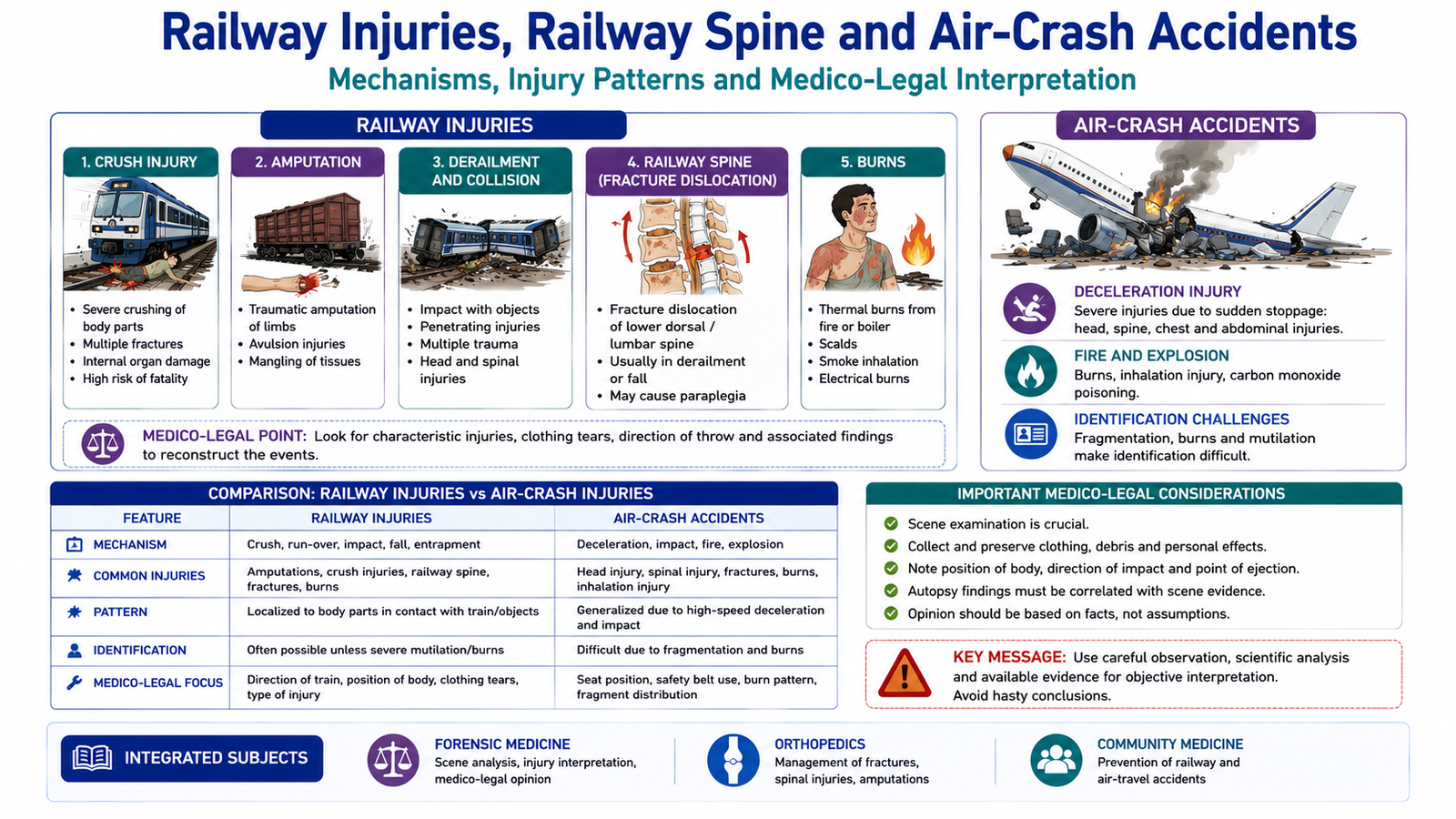
Railway and air-transport accidents can produce multiple severe injuries because large masses, high speeds, crushing forces, fire and difficult rescue conditions may be involved. These events often require careful identification, documentation and reconstruction.
Types of railway injuries
- Collision between trains or between a train and another vehicle.
- Derailment with overturning, crushing and multiple impacts.
- Fall from a moving train.
- Impact while standing near or crossing railway tracks.
- Run-over injuries caused by wheels.
- Crushing between railway vehicles or fixed structures.
- Electrical burns from railway power systems.
Characteristic railway trauma
Railway wheels and heavy structures can produce extensive crushing, amputation, tissue destruction and contamination. Injuries may be multiple and distributed over different body regions.
- Traumatic amputation or near-amputation.
- Crush injuries with muscle necrosis and vascular damage.
- Open fractures and severe soft-tissue loss.
- Head, chest, abdominal and spinal injuries.
- Burns and smoke inhalation when fire occurs.
- Contamination with grease, soil, debris or railway material.
Railway spine
Railway spine is a historical term used for persistent pain, weakness, sensory symptoms or other nervous complaints reported after railway trauma when obvious structural injury may not be demonstrated. The term should be used cautiously because symptoms may arise from soft-tissue injury, neurological injury, psychological response or a combination of factors.
A careful assessment should document the mechanism, symptoms, examination findings, investigations and functional limitations. The absence of a visible fracture does not automatically prove that symptoms are false, but symptoms should not be attributed to structural spinal damage without supporting evidence.
Medico-legal significance of railway injuries
- Determine whether the event was accidental, suicidal or homicidal where possible.
- Correlate injuries with the railway scene and damage pattern.
- Distinguish injuries produced before death from postmortem damage where possible.
- Document identity, clothing, personal belongings and distinguishing features.
- Use cautious interpretation because severe mutilation may obscure the original injury pattern.
Air-crash accidents
Aircraft crashes may involve rapid deceleration, blunt trauma, penetrating debris, crushing, fire, smoke inhalation and toxic gases. High-energy impact may cause fragmentation and multiple fatal injuries.
- Blunt-force injuries from impact with the aircraft interior.
- Deceleration injury to internal organs and major vessels.
- Fractures and spinal injuries.
- Burns and inhalational injury.
- Crush and fragmentation injuries.
- Difficulty in identification because of fire or severe body disruption.
Medico-legal priorities in an air crash
- Systematic recovery and labeling of human remains.
- Accurate documentation of the location where remains and belongings were found.
- Identification through available physical, dental, fingerprint or genetic evidence.
- Correlation of medical findings with crash investigation.
- Respectful handling of remains and preservation of evidentiary continuity.
G. Emergency Treatment of an Injured Limb
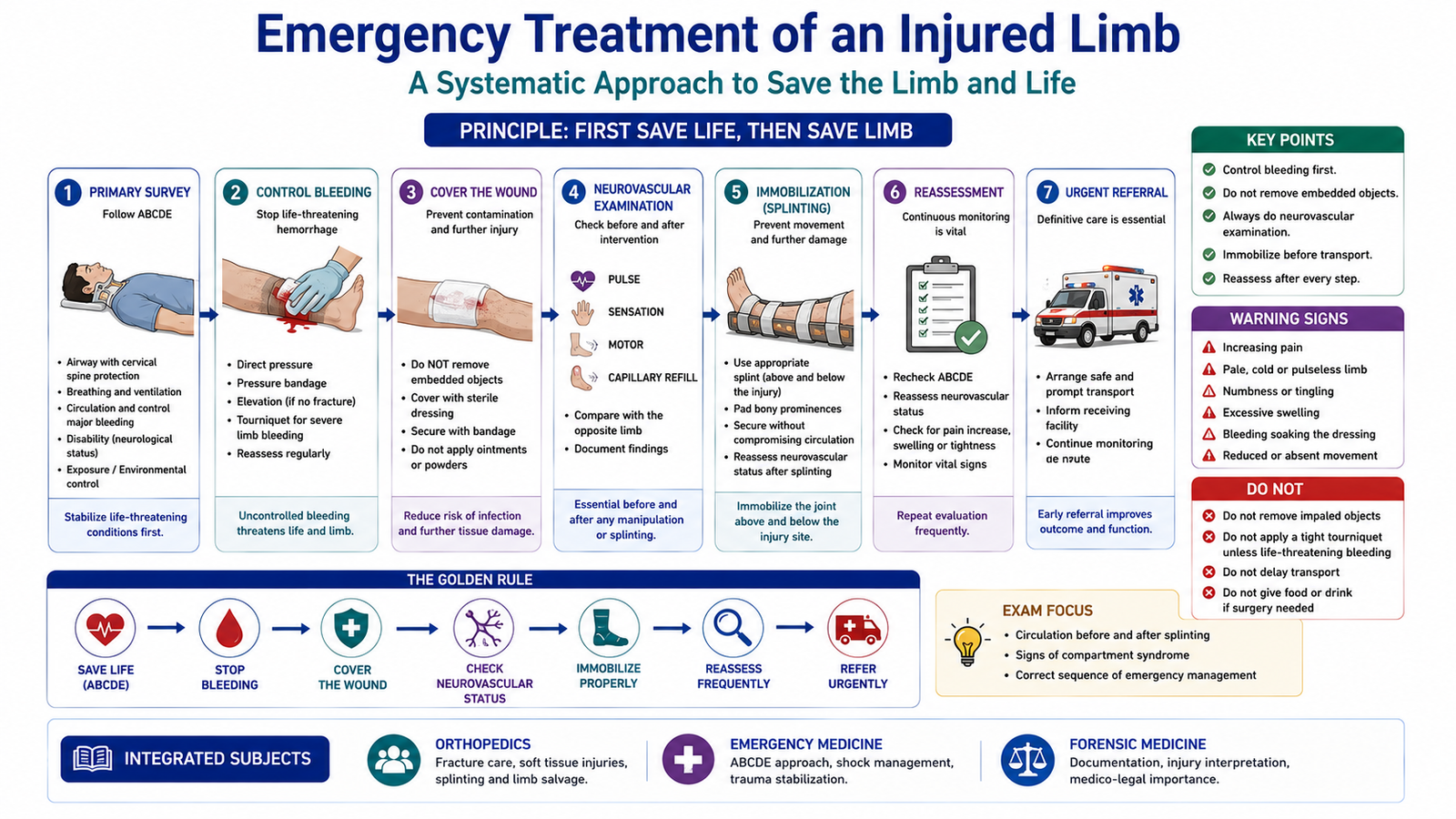
The immediate aim in limb trauma is to preserve life, control bleeding, protect the injured tissues, maintain circulation and prevent further damage. A visibly deformed limb can attract attention, but life-threatening airway, breathing or circulatory problems must always be managed first.
Initial priorities
- Ensure personal and scene safety.
- Assess airway, breathing and circulation.
- Control severe external bleeding.
- Look for shock and other major injuries.
- Expose and inspect the injured limb carefully.
Assessment of the injured limb
Examination should identify deformity, wounds, swelling, tenderness and possible damage to blood vessels or nerves. The findings should be recorded before and after immobilization.
- Look: Deformity, swelling, bruising, wounds, bleeding and abnormal limb position.
- Feel: Tenderness and temperature, while avoiding unnecessary movement.
- Assess circulation: Pulse, capillary refill, skin color and temperature.
- Assess nerve function: Distal sensation and movement where safe.
Control of bleeding and wound protection
Direct pressure is the first measure for most external bleeding. Open wounds should be covered with a clean dressing. Protruding bone should not be pushed back into the wound because this may introduce contamination and further damage tissues.
Immobilization
Immobilization reduces pain, limits bleeding, prevents further soft-tissue injury and decreases the risk of damage to vessels and nerves. The joint above and the joint below a suspected long-bone fracture should usually be supported.
- Support the limb in the position found unless circulation is critically impaired.
- Use padded splints and avoid excessive pressure over bony prominences.
- Recheck distal circulation and nerve function after splinting.
- Elevate the limb when appropriate to reduce swelling, while maintaining safe alignment.
Red flags requiring urgent referral
- Absent or reduced distal pulse.
- Pale, cool or poorly perfused limb.
- Open fracture.
- Severe crush injury.
- Progressive pain, tense swelling or suspected compartment syndrome.
- Loss of movement or sensation.
- Major joint dislocation with vascular or nerve compromise.
Severe pain out of proportion to the visible injury, increasing pain on passive stretch, tense swelling and neurological changes suggest compartment syndrome and require urgent surgical assessment.
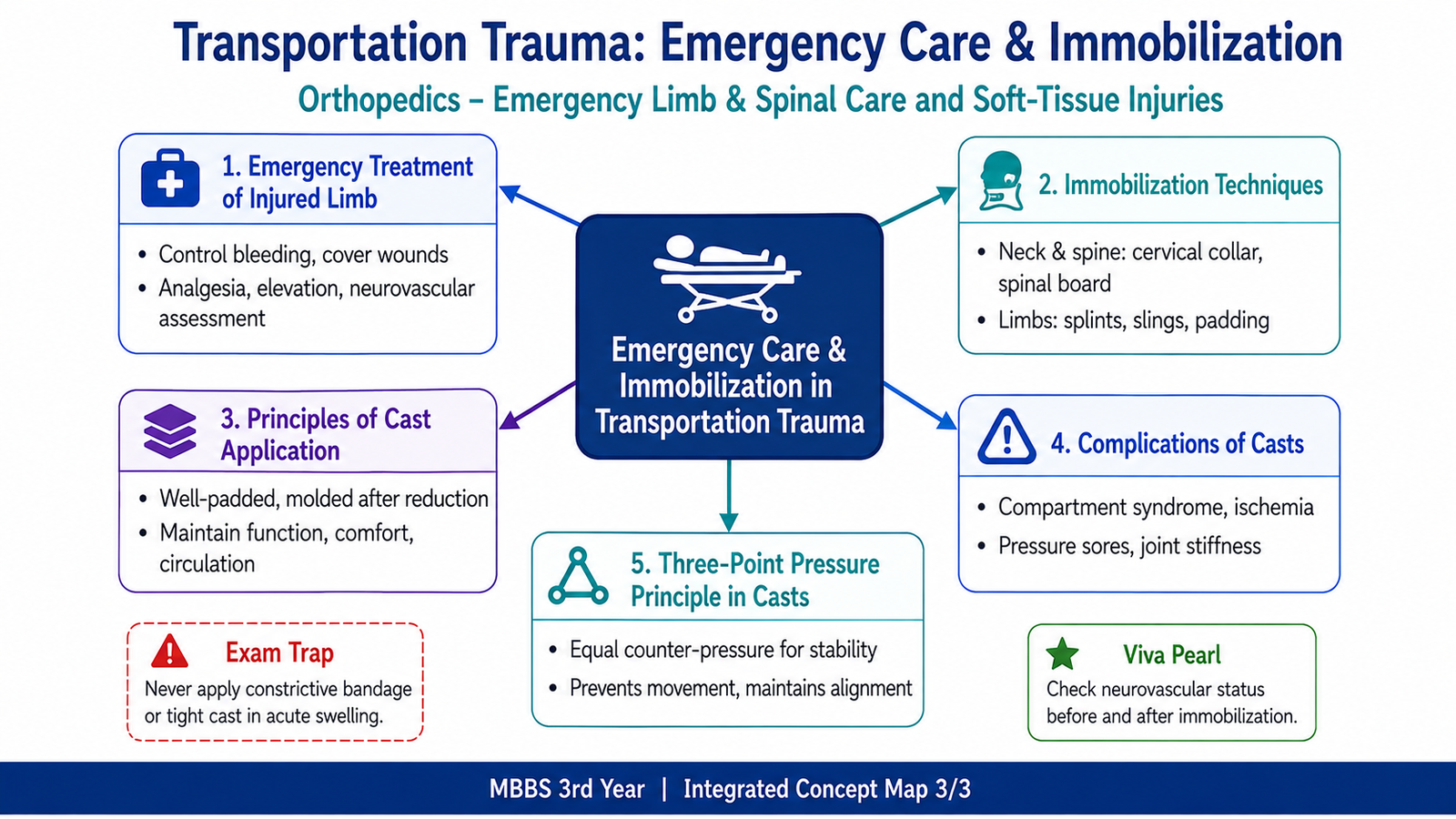
H. Emergency Immobilization and Initial Management of Spinal Injuries
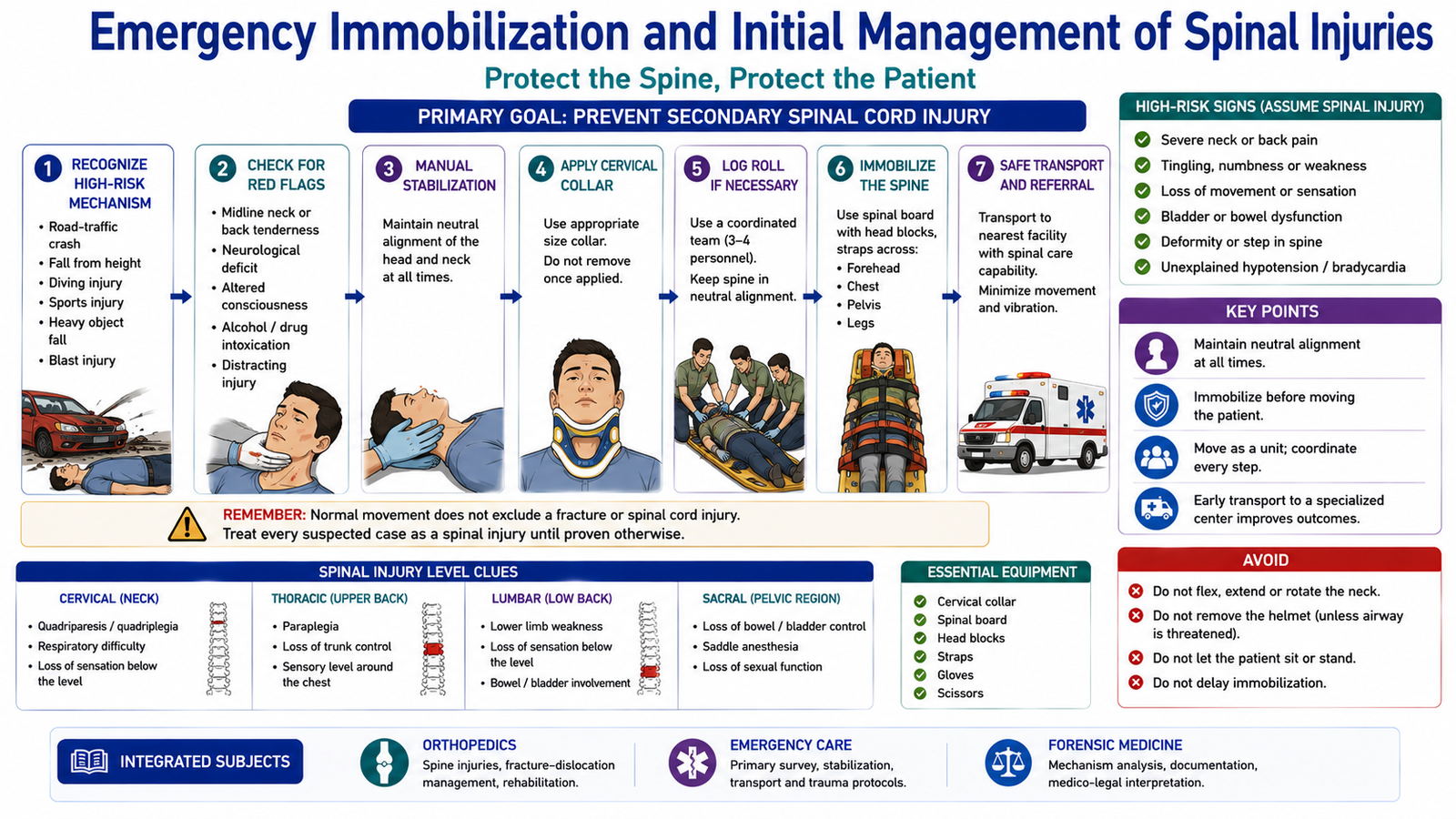
A spinal injury should be suspected after a high-energy collision, fall, direct spinal impact, severe head injury or any event associated with neck or back pain, neurological symptoms or reduced consciousness. Movement of an unstable spine may worsen damage to the spinal cord or nerve roots.
When to suspect spinal injury
- Neck or back pain after trauma.
- Midline spinal tenderness or deformity.
- Numbness, weakness or paralysis.
- Loss of bladder or bowel control.
- Altered consciousness or distracting major injury.
- High-risk mechanism such as rollover, ejection, fall from height or axial loading.
Basic immobilization principles
The head, neck and trunk should be kept aligned while airway and breathing are managed. Immobilization should reduce unnecessary movement without delaying essential life-saving care.
- Manually stabilize the head and neck in a neutral position when possible.
- Apply an appropriately fitted cervical collar when indicated.
- Move the patient using coordinated assistance so the head, shoulders, trunk and pelvis move together.
- Avoid twisting, uncontrolled flexion or extension of the spine.
- Secure the patient during transport while continuing respiratory and neurological observation.
Common spinal fracture mechanisms
Spinal fractures may result from flexion, extension, compression, rotation or a combination of forces. The mechanism helps predict stability and possible neurological injury.
- Compression injury: Axial force compresses the vertebral body and may produce wedge collapse.
- Burst injury: Greater axial compression breaks the vertebral body into fragments that may enter the spinal canal.
- Flexion-distraction injury: The spine is pulled apart around a point of restraint and may damage posterior structures.
- Fracture-dislocation: Severe translation or rotation disrupts bone and supporting ligaments, producing marked instability.
- Cervical hyperextension or hyperflexion injury: May damage vertebrae, discs, ligaments or the spinal cord.
Initial management
- Manage airway while maintaining spinal alignment.
- Assess breathing and circulation.
- Perform a brief neurological examination.
- Document motor power, sensation and any sphincter symptoms.
- Maintain immobilization and obtain appropriate imaging through the trauma team.
- Arrange urgent specialist referral when instability or neurological injury is suspected.
A patient who can move the limbs may still have an unstable spinal fracture. Neurological function does not by itself exclude important spinal injury.
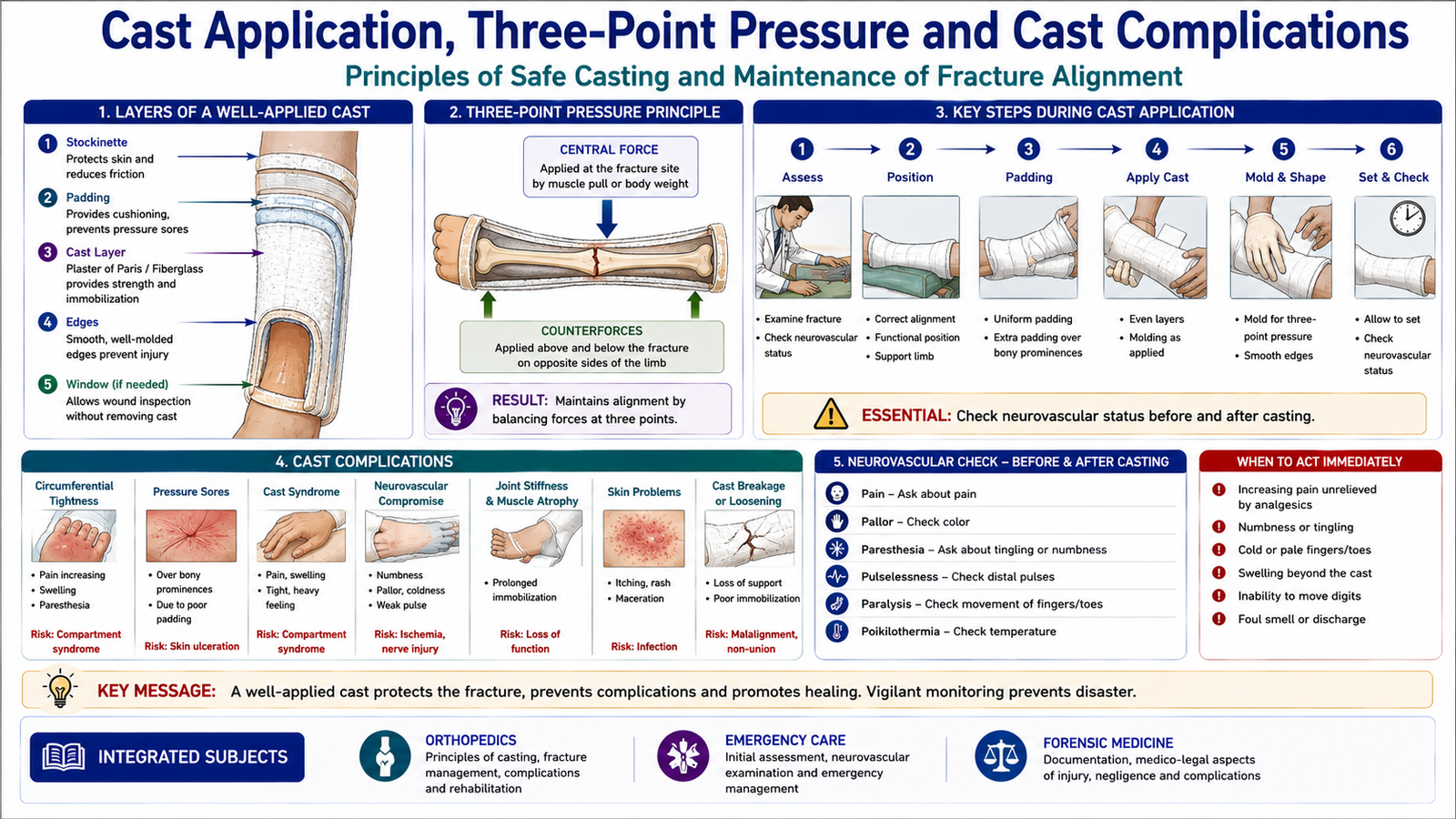
I. Cast Application, Three-Point Pressure and Cast Complications
A cast is a rigid external support used to maintain alignment, restrict movement and protect an injured bone or joint during healing. A cast must support the injury without interfering with circulation, nerve function or skin integrity.
Basic principles of cast application
- Assess and document distal circulation, sensation and movement before application.
- Position the limb in the required alignment.
- Apply a protective stockinette and adequate padding.
- Provide extra protection over bony prominences.
- Apply cast material evenly without excessive tightness.
- Mold the cast with the palms rather than fingertips to avoid pressure points.
- Leave digits visible when possible for circulation and swelling assessment.
- Reassess distal neurovascular status after application.
- Give clear advice about elevation, cast care and warning symptoms.
Three-point pressure system
The three-point pressure system is used to maintain or correct angulation in a fracture. One force is applied at the apex of the deformity, while two opposing forces are applied above and below it. Together, these forces prevent the bone from returning to the deformed position.
Central corrective force at the deformity
↔ two counterforces above and below
→ maintenance of alignment inside the cast
Early cast complications
- Excessive swelling and tight cast: May reduce venous return and later compromise arterial flow.
- Nerve compression: Produces numbness, tingling or weakness.
- Pressure injury: Develops over bony prominences when padding is inadequate or molding is uneven.
- Compartment syndrome: Increasing tissue pressure threatens muscle and nerve viability.
- Loss of reduction: May occur as swelling decreases and the cast becomes loose.
- Thermal injury: May occur if excessive heat develops while cast material sets.
Late cast complications
- Joint stiffness.
- Muscle wasting.
- Skin irritation or infection.
- Delayed recognition of pressure sores.
- Persistent swelling and reduced function.
Warning symptoms after cast application
- Increasing or severe pain.
- Numbness, tingling or weakness.
- Cold, pale, blue or markedly swollen digits.
- Inability to move exposed fingers or toes.
- Burning pain, foul smell, discharge or fever.
- A cast that becomes cracked, wet, soft or excessively loose.
Increasing pain with neurovascular changes after casting must not be dismissed as normal discomfort. The cast and limb require immediate reassessment.
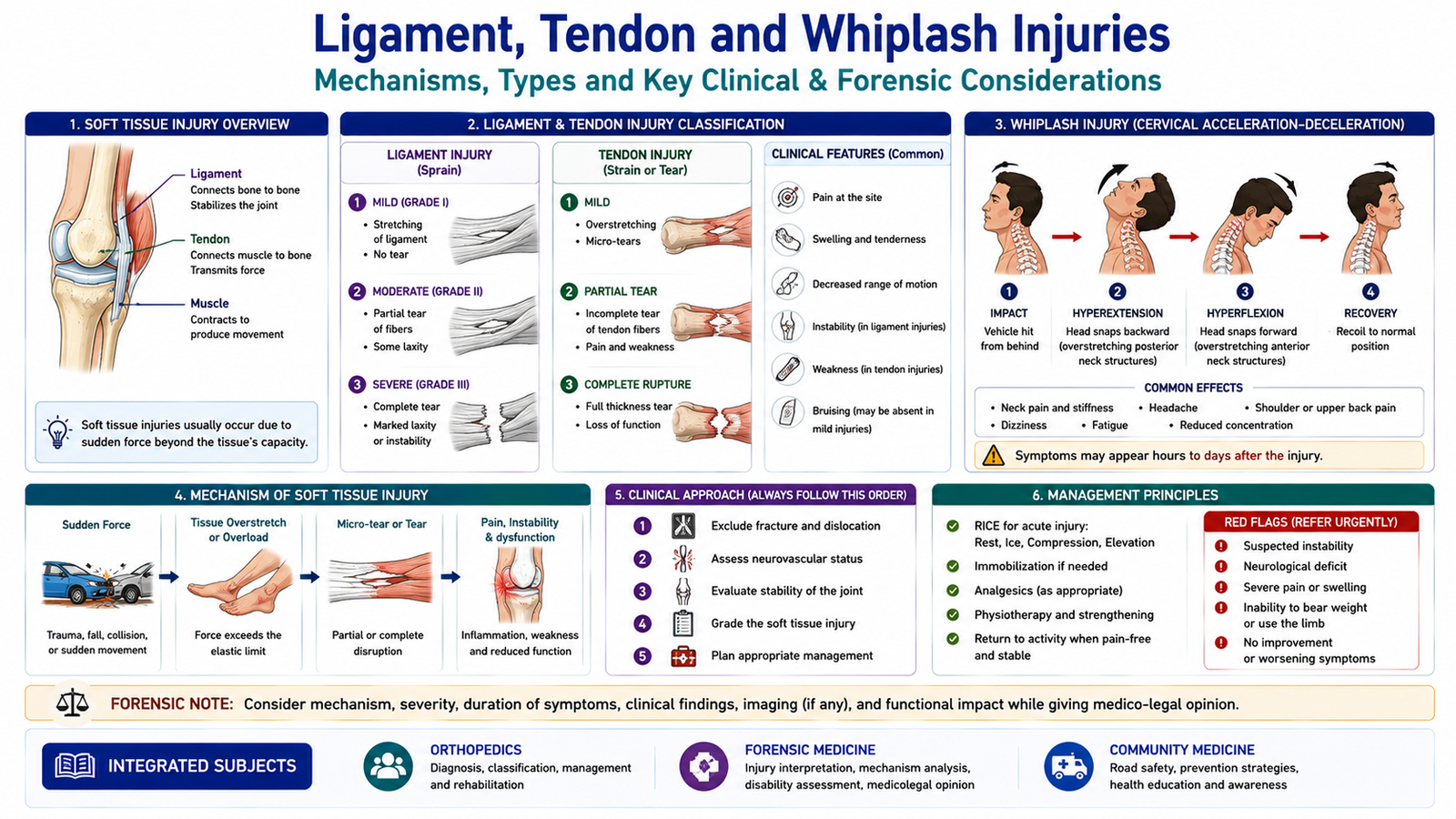
J. Ligament, Tendon and Whiplash Injuries
Ligaments connect bone to bone and stabilize joints, while tendons connect muscle to bone and transmit muscular force. Trauma may stretch, partially tear or completely rupture these structures. Management depends on the injured structure, severity, joint stability and functional loss.
Ligament injuries
A ligament injury is commonly called a sprain. It usually occurs when a joint is forced beyond its normal range, producing stretching or tearing of ligament fibers.
- Mild injury: Stretching with microscopic fiber damage and little instability.
- Partial tear: Greater pain and swelling with some loss of stability.
- Complete tear: Major structural disruption with marked instability or functional loss.
Common findings include pain, swelling, bruising, tenderness and difficulty using the joint. Instability testing should be performed carefully because forceful examination during the acute painful phase may worsen discomfort or injury.
Tendon injuries
Tendon injury may occur through sudden excessive loading, direct trauma or degeneration followed by rupture. A complete rupture may produce a sudden loss of the movement normally performed by the affected muscle.
- Pain and localized tenderness.
- Swelling or a palpable gap.
- Weakness or inability to perform a specific movement.
- Abnormal tendon contour.
Basic management principles
Initial treatment aims to protect the damaged structure, reduce pain and swelling, and prevent further injury. Serious tears, instability, open wounds or loss of function require specialist assessment.
- Protect the injured part and stop the activity.
- Use appropriate short-term support or immobilization.
- Apply cold therapy during the early phase when suitable.
- Elevate the limb to reduce swelling.
- Assess circulation, sensation and movement.
- Begin graded rehabilitation after serious injury has been excluded and pain allows.
- Refer suspected complete rupture, major instability or associated fracture.
Whiplash injury
Whiplash is an acceleration-deceleration injury of the neck, commonly associated with a rear-impact vehicle collision. The torso is pushed forward by the seat while the head initially lags behind, producing extension. The head then moves forward, producing flexion. This rapid movement may injure cervical muscles, ligaments, facet joints and other soft tissues.
- Neck pain and stiffness.
- Reduced neck movement.
- Headache, often arising from the neck.
- Shoulder or upper-back discomfort.
- Occasional dizziness or sensory symptoms.
Initial assessment must first exclude fracture, dislocation or neurological injury. The diagnosis should not be made solely from the history of a rear-impact collision. Persistent or severe symptoms, neurological deficit, midline tenderness or high-risk mechanisms require further evaluation.
Medico-legal interpretation
Whiplash symptoms may be genuine even when routine imaging does not show a fracture. At the same time, pain and stiffness are not specific to one mechanism. The examiner should document the history, time of symptom onset, physical findings, investigations, treatment and functional effects without exaggerating or dismissing the complaint.
A sprain affects a ligament, while a strain usually affects a muscle or tendon.
Integrated Mechanism Flow
Speed, distraction, poor road, unsafe vehicle or environmental danger.
Vehicle, occupant or pedestrian undergoes sudden impact or deceleration.
Compression, bending, shearing, rotation or acceleration forces act on tissues.
Fracture, ligament tear, tendon rupture, organ injury or spinal damage.
Bleeding, airway compromise, shock, neurovascular injury or cord damage.
Rescue, hemorrhage control, immobilization, transport and definitive care.
⭐ AIM High-Yield Review
- Accidents are often predictable and preventable because they arise from identifiable human, vehicle and environmental factors.
- Injury occurs when energy transferred to the body exceeds tissue tolerance.
- Haddon’s model analyzes human, vehicle and environmental factors during pre-event, event and post-event phases.
- Speed increases both crash risk and the energy transferred during impact.
- Frontal collisions commonly produce head, chest, knee, hip and lower-limb injuries.
- Rear-impact collisions may produce acceleration-deceleration injury of the cervical spine known as whiplash.
- Primary pedestrian injuries occur at first vehicle contact; secondary injuries occur against the vehicle or road.
- Seat belts reduce ejection and severe injury, although belt-related bruising or internal injury may occur in major collisions.
- Driver injuries may involve the steering wheel and pedals, but no single injury pattern proves who was driving.
- Railway accidents may cause crushing, traumatic amputation, open fractures and extensive contamination.
- Railway spine is a historical term and should not be interpreted as proof of structural spinal injury without supporting evidence.
- In limb trauma, document distal circulation and nerve function before and after splinting or casting.
- Suspected spinal injury requires controlled movement and maintenance of head, neck and trunk alignment.
- The three-point pressure system uses one corrective force at the deformity and two counterforces above and below it.
- Increasing pain, tense swelling and neurovascular changes after injury or casting may indicate compartment syndrome and require urgent assessment.
Transportation Trauma, Road-Traffic Injury Prevention and Spinal Injuries
Use these videos after reading the AIM Learning Material. Focus on accident prevention, safe spinal handling, emergency limb immobilization and the basic principles of cast application.
Video 1 — Accidents and Road-Traffic Accidents
Review the types of accidents, road-traffic accidents, major risk factors and important preventive principles.
Video 2 — Cervical-Spine Immobilization in Trauma
Observe the basic steps used to stabilize the cervical spine and reduce unnecessary movement during trauma management.
Video 3 — Emergency Splinting of a Fracture
Learn how temporary splinting limits movement, reduces pain and protects injured tissues before definitive treatment.
- Explain how accident mechanisms transfer energy to the body.
- Apply Haddon’s model to road-traffic injury prevention.
- Describe safe cervical-spine stabilization.
- State the basic principles of emergency limb splinting.
- Recognize neurovascular warning signs after splint or cast application.