
Firearm, Explosive, Thermal and Electrical Injuries
Forensic Medicine principles for understanding wound ballistics, firearm wounds, blast trauma, burns, electrocution and lightning injuries.
Topic Introduction
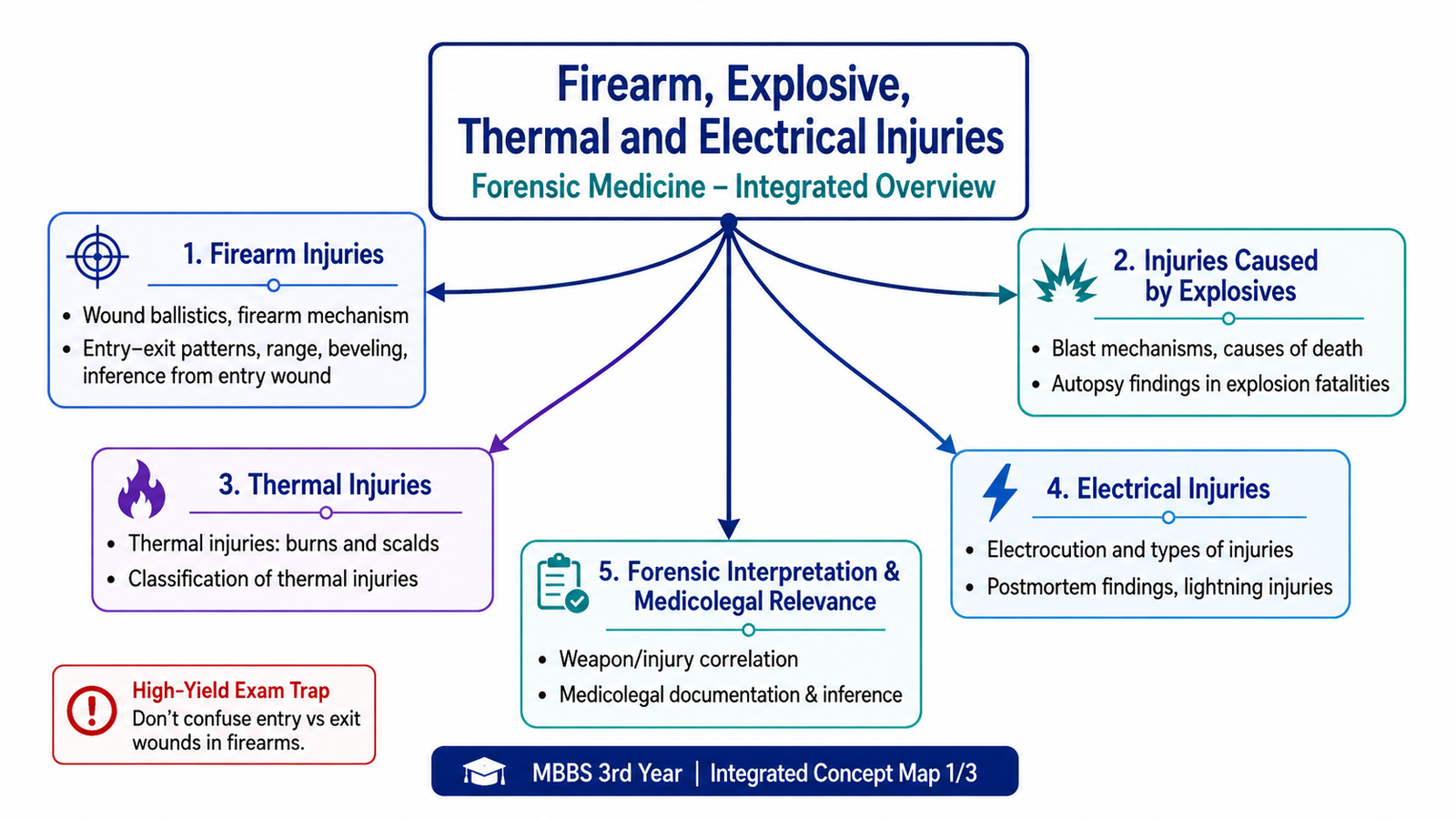
Firearms, explosions, heat and electricity injure the body by transferring energy to tissues. The appearance and severity of the injury depend on the type of energy, the amount transferred, the distance from the source and the tissue involved. In forensic practice, these injuries are examined not only to determine the medical cause of death but also to answer questions about the weapon, range of fire, direction of injury and possible circumstances of the incident. This chapter explains firearm terminology, wound ballistics, ammunition, entry and exit wounds, blast mechanisms, burns, scalds, electrocution and lightning injuries. The emphasis is on understanding why characteristic findings develop and how they should be interpreted cautiously.
A. Firearms, Ammunition and Wound Ballistics
Firearm injury begins when rapidly expanding gases propel a projectile through the barrel of a weapon. The projectile carries kinetic energy, and injury occurs when part or all of that energy is transferred to the body. Therefore, the wound cannot be understood by looking at the bullet alone. Its velocity, shape, stability, range and interaction with tissue are also important.
Basic firearm mechanism
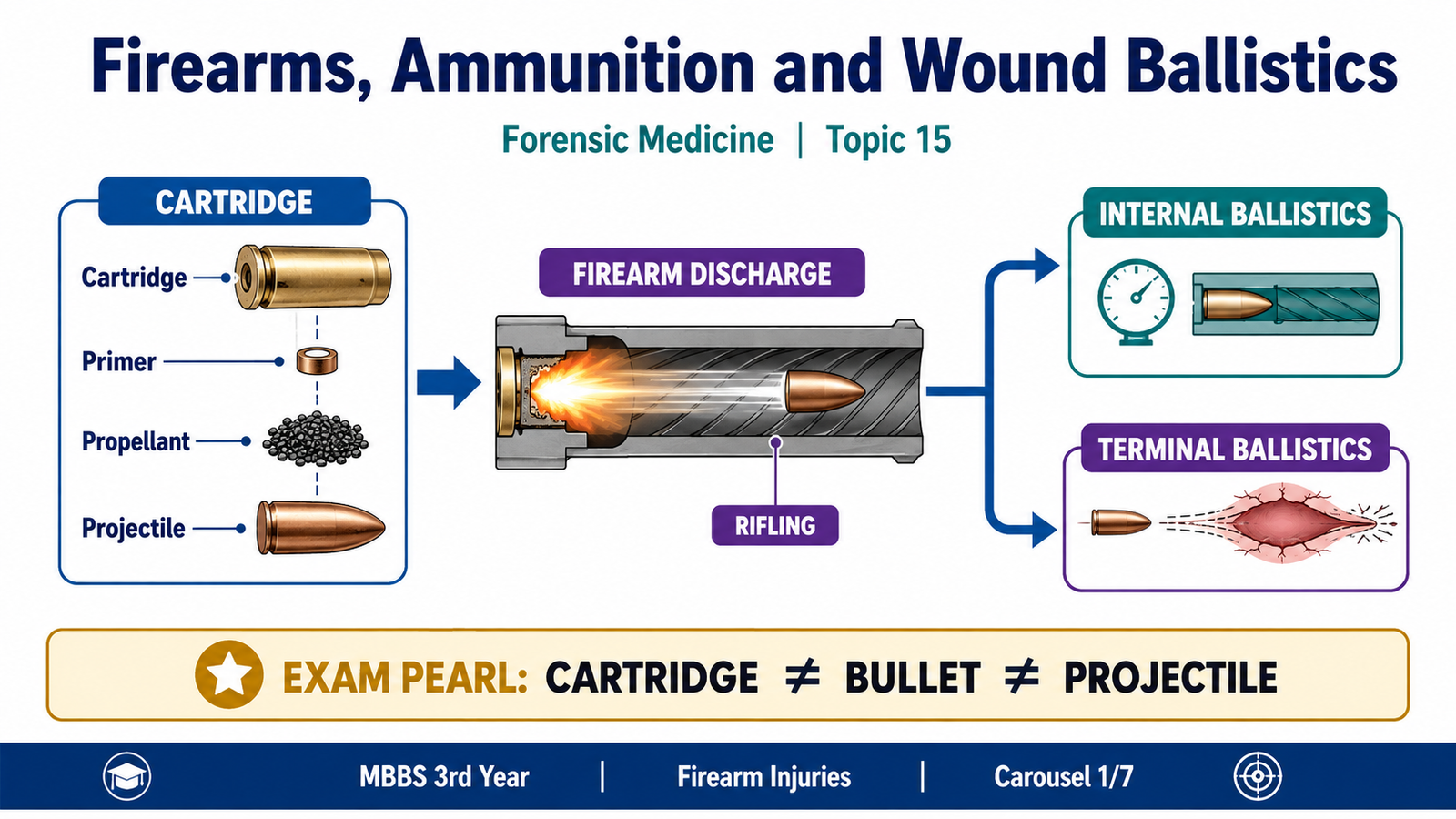
A firearm cartridge contains the components required to produce a shot. When the trigger is pressed, the firing mechanism strikes the primer. The primer ignites the propellant or gunpowder. Rapid combustion produces high-pressure gases, which expand and drive the projectile through the barrel and towards the target.
Trigger pressed → primer ignited → propellant burns → gases expand → projectile accelerates through barrel → projectile leaves muzzle → energy is transferred to tissue
Important terms
- Firearm: A weapon that discharges a projectile by the force of expanding gases produced by burning propellant.
- Projectile: The object expelled from the firearm, such as a bullet or shotgun pellets.
- Bullet: The projectile component of a rifled-firearm cartridge. The complete cartridge should not be called a bullet.
- Cartridge: A complete unit containing the cartridge case, primer, propellant and projectile.
- Calibre: The approximate internal diameter of the barrel or diameter of the projectile, depending on the system used.
- Muzzle: The open end of the barrel from which the projectile emerges.
- Rifling: Spiral grooves inside a rifled barrel that make the bullet spin and improve stability.
- Lands and grooves: Raised and depressed portions of rifling that may leave characteristic marks on a bullet.
- Trajectory: The path followed by a projectile after leaving the weapon.
- Recoil: The backward movement of a firearm produced by the forward discharge of the projectile and gases.
- Ricochet: Deflection of a projectile after it strikes another surface before reaching the body.
- Yaw: Deviation of the long axis of a bullet from the direction of its movement.
- Tumbling: End-over-end rotation of an unstable projectile.
Types of firearms
Firearms may be broadly divided according to whether the barrel is rifled or smooth. This distinction affects the projectile, its flight and the wound pattern.
- Rifled firearms: Pistols, revolvers and rifles. They usually discharge a single bullet through a barrel containing spiral rifling.
- Smooth-bore firearms: Shotguns. They usually discharge multiple pellets, although a single slug may also be used.
Types of bullets
Bullet design changes the way a projectile behaves in flight and after entering tissue. A bullet that deforms, fragments or tumbles may transfer more energy and produce greater tissue disruption.
- Lead bullet: Made mainly of lead and more likely to deform.
- Jacketed bullet: Lead core partly or completely covered by a harder metal jacket, reducing deformation.
- Full metal jacket bullet: Almost completely covered by a metal jacket and usually retains its shape better.
- Hollow-point bullet: Has a cavity at its tip that encourages expansion after entering tissue.
- Soft-point bullet: Has an exposed soft lead tip that promotes deformation.
- Armour-piercing bullet: Contains a hard core designed to penetrate resistant material.
- Tracer bullet: Contains a composition that produces visible light during flight.
- Incendiary bullet: Designed to ignite combustible material after impact.
Gunpowder and ammunition
Older black powder produces a larger volume of smoke and solid residue. Modern smokeless powder produces less visible smoke and burns more efficiently. However, the term “smokeless” does not mean that no gases or residue are produced.
- Black powder: Traditionally contains charcoal, sulfur and potassium nitrate.
- Smokeless powder: Commonly based on nitrocellulose, sometimes combined with other energetic compounds.
- Shotgun cartridge: Usually contains a primer, propellant, wad and multiple pellets within a cartridge case.
- Wad: Material that separates the propellant from the pellets and helps transmit gas pressure to the shot charge.
Wound ballistics
Wound ballistics is the study of the behaviour of projectiles and the injuries they produce in the body. It is commonly considered in three parts:
- Internal ballistics: Events inside the firearm from ignition until the projectile leaves the muzzle.
- External ballistics: Behaviour of the projectile during flight.
- Terminal or wound ballistics: Interaction of the projectile with the body or another target.
AIM VISUAL 01 — Firearm Discharge and Ballistics Overview
B. Mechanisms of Firearm Wound Production
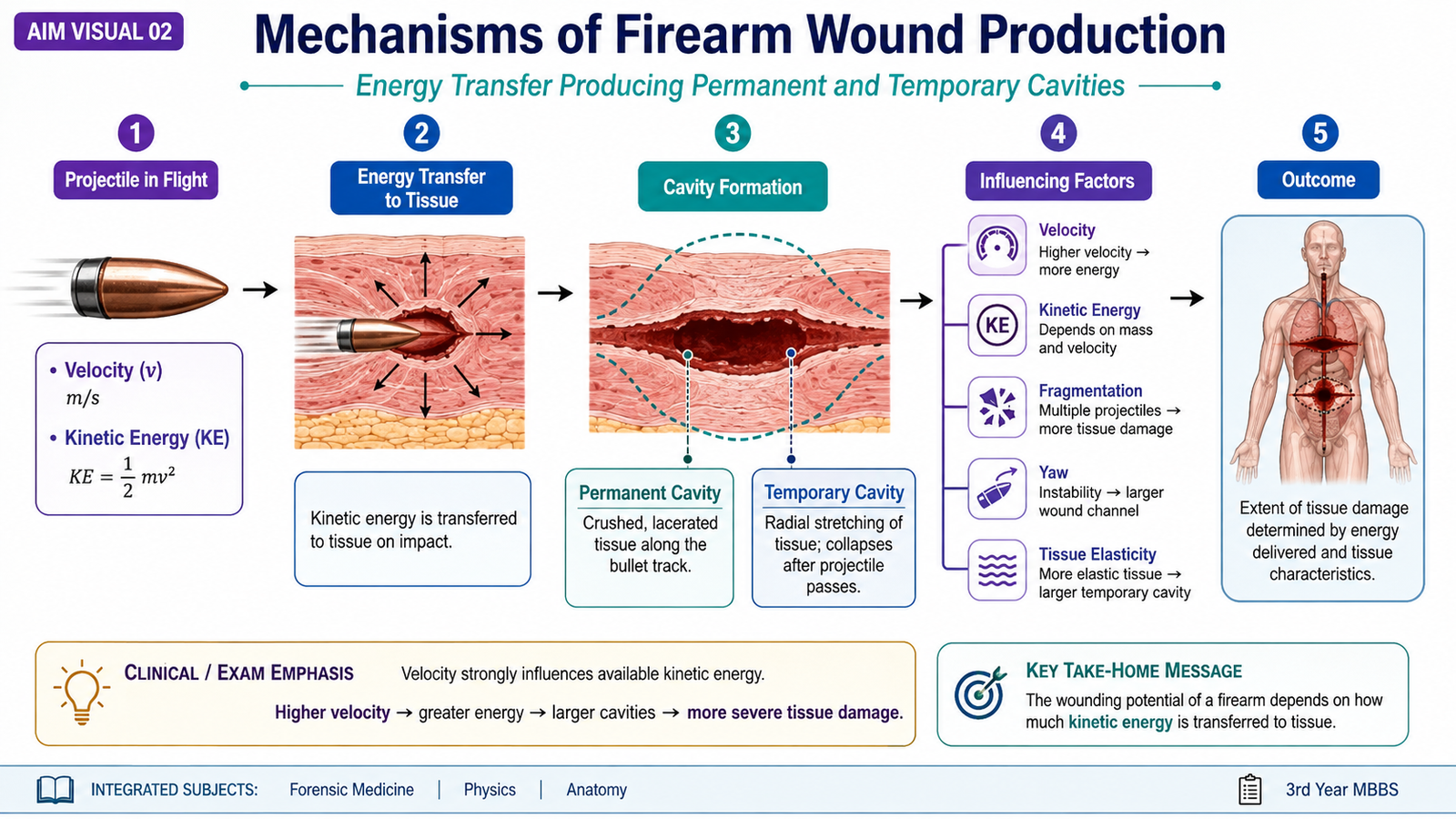
A firearm projectile does not injure tissue simply by making a narrow hole. It crushes structures in its direct path, stretches nearby tissues and may transfer enough energy to fragment bone or damage organs away from the visible track. The degree of damage depends on both projectile factors and tissue factors.
Kinetic energy and energy transfer
The kinetic energy of a moving projectile increases with its mass and, more importantly, with the square of its velocity. Therefore, a marked rise in velocity can greatly increase the energy available for transfer to tissue. However, injury depends on how much of this energy is actually deposited in the body. A projectile that passes through without much slowing may retain a significant amount of energy.
Projectile velocity and mass → available kinetic energy → energy transferred to tissue → crushing, stretching and organ disruption
Permanent cavity
The permanent cavity is the lasting track formed by tissues that are directly crushed, cut or destroyed by the projectile. Its size is influenced by the projectile diameter, deformation, fragmentation, yaw and the tissues encountered.
Temporary cavity
The temporary cavity is produced when tissues are rapidly pushed away from the projectile path and then recoil. Elastic tissues may tolerate stretching better, while relatively fixed or fragile organs may tear. The temporary cavity may therefore be much more important in solid organs than in highly elastic tissue.
Direct crushing, stretching and secondary missiles
- Direct crushing: Tissue lying directly in the projectile path is disrupted.
- Radial stretching: Tissue surrounding the track is temporarily displaced.
- Projectile deformation: An expanding or flattened projectile presents a larger surface and may transfer more energy.
- Fragmentation: Pieces of the projectile may produce multiple secondary tracks.
- Secondary missiles: Bone fragments, teeth, clothing or other material may be driven into adjacent tissues.
- Yaw and tumbling: A sideways or tumbling bullet presents a larger surface area and can produce a wider track.
Influence of tissue type
Tissue structure strongly influences the resulting injury. Dense or relatively inelastic organs are less able to accommodate rapid stretching and may split or burst. More elastic tissues may deform and then return towards their original position.
- Bone: May fracture and produce secondary bone fragments.
- Liver and spleen: Relatively fragile solid organs that may show extensive disruption.
- Brain: Enclosed within the skull and vulnerable to pressure changes and cavitation.
- Lung: Contains air and has greater elasticity, although major vessels and bronchi may still be severely damaged.
- Muscle: Can stretch to some extent but may still undergo crushing, bleeding and necrosis.
C. Range of Fire and Firearm Wound Interpretation
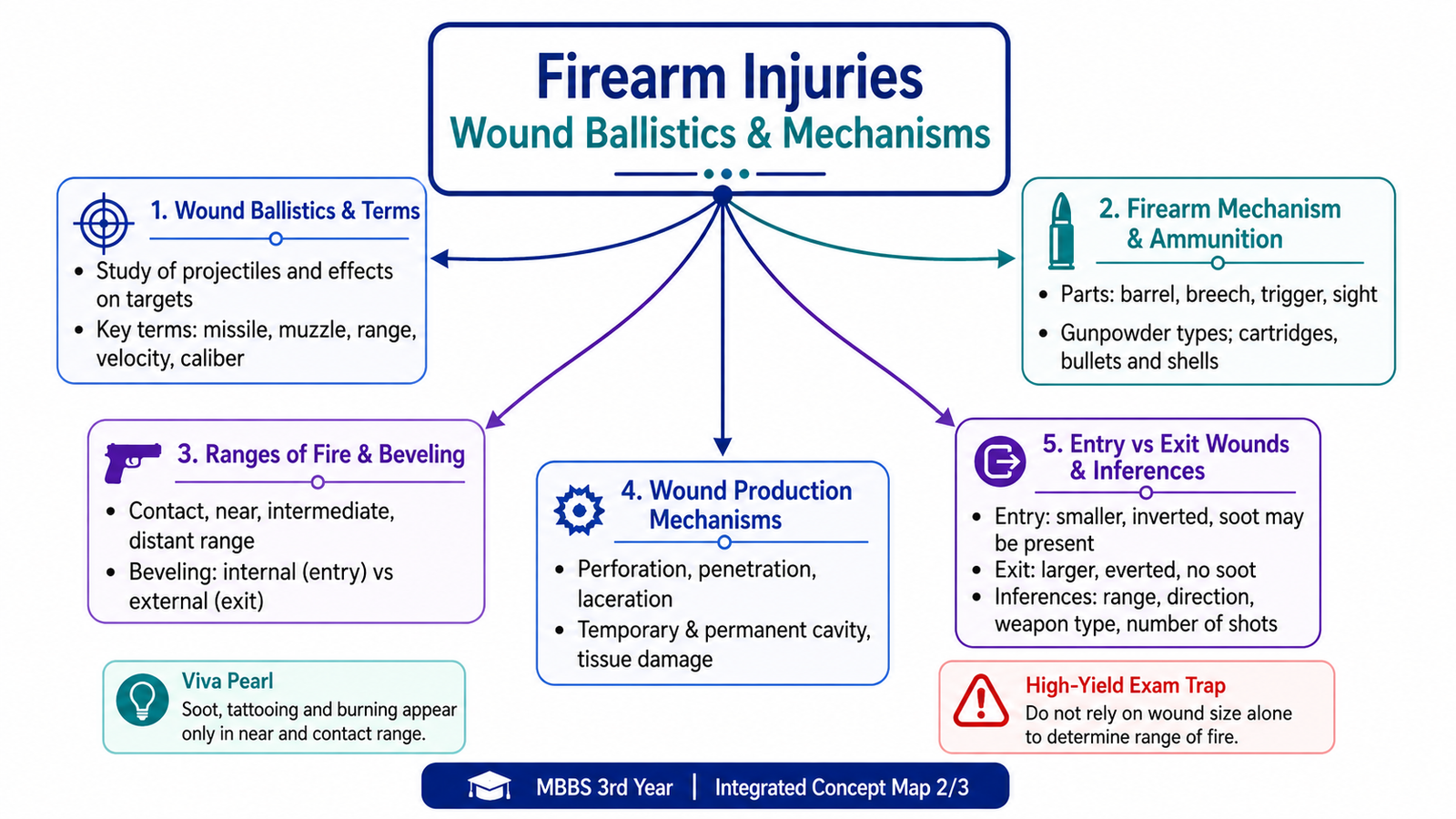
The range of fire describes the approximate distance between the muzzle and the body when the weapon was discharged. Range assessment mainly depends on the distribution of flame, soot, unburnt powder and gases around the entry wound. These findings vary with the weapon, ammunition, intervening clothing and anatomical site, so they should be interpreted together rather than in isolation.
Contact discharge
In a contact shot, the muzzle is pressed against the skin or is extremely close to it. Hot gases, soot and powder are driven into the wound. The appearance depends on whether firm tissue or a bony surface lies beneath the skin.
- Soot may be present within the wound track.
- Burning and blackening may be concentrated inside or around the wound.
- Gas expansion beneath the skin may cause tearing.
- Over the skull, gas entering beneath the skin may produce a stellate or irregular wound.
- A muzzle imprint may be produced when the weapon is pressed firmly against the skin.
Close-range discharge
At close range, flame, hot gases, soot and powder particles may reach the skin. The entry wound may therefore show burning, singeing of hair, blackening and powder effects. The exact combination depends on distance and firearm characteristics.
- Burning or scorching: Produced by flame and hot gases.
- Singeing: Heat damage to hair.
- Blackening or smudging: Deposition of soot that may be wiped away.
- Tattooing or stippling: Punctate abrasions caused by powder particles striking and embedding in the skin; it cannot simply be wiped away.
Intermediate-range discharge
At an intermediate range, soot and flame may no longer reach the body, but powder particles may still strike the skin. Tattooing may therefore remain even when blackening and burning are absent.
Distant discharge
In a distant shot, the projectile reaches the body but flame, soot and powder do not. The entry wound usually lacks burning, blackening and tattooing. However, absence of these findings should not be used alone to calculate an exact distance.
| Range | Typical additional effects | Interpretive point |
|---|---|---|
| Contact | Gases and soot may enter wound; tearing or muzzle imprint may occur | Appearance varies with underlying tissue and firmness of contact |
| Close | Burning, singeing, blackening and tattooing may be present | Exact pattern depends on firearm and ammunition |
| Intermediate | Tattooing may persist without soot or scorching | Powder particles have reached skin |
| Distant | No burning, blackening or tattooing | Exact distance cannot be inferred from absence alone |
Shotgun range patterns
After leaving a shotgun barrel, the pellets initially travel as a compact mass and then gradually spread. At very close range, they may produce a single large defect. As distance increases, separate pellet holes appear around the main injury. The wad may also strike or enter the body at shorter ranges.
- Contact or very close range: A large central wound with effects of gas, soot and possible wad entry.
- Increasing distance: Progressive pellet dispersion or spread.
- Distant range: Multiple separate pellet wounds over a wider area.
Range should preferably be assessed by test firing the suspected weapon with comparable ammunition. Clothing, intermediate objects, weathering, treatment and decomposition may alter the visible findings.
AIM VISUAL 03 — Range-of-Fire Pattern Map

D. Entry Wounds, Exit Wounds and Beveling
An entry wound marks the point where a projectile enters the body, while an exit wound marks the point where it leaves. Their appearance depends on the projectile, velocity, angle of impact, tissue support and events occurring inside the body. Although typical patterns are useful, no single feature is absolutely reliable in every case.
Typical entry wound
As a bullet strikes the skin, it first stretches and indents it before perforation occurs. Friction between the projectile and the margins produces a narrow abrasion around the defect.
- Usually round when the projectile strikes at approximately a right angle.
- May be oval when the projectile strikes obliquely.
- Often shows an abrasion collar around the margin.
- May show a grease or wipe ring formed by material wiped from the projectile.
- Margins are commonly inverted, although this is not an absolute rule.
- Close-range effects may include burning, blackening and tattooing.
Abrasion collar and direction
When a bullet enters at an angle, the abrasion collar may be wider on the side from which the projectile approached because the skin is rubbed over a greater surface on that side. This may help estimate direction, but the conclusion should be supported by the wound track and internal findings.
Typical exit wound
An exit wound is produced when the projectile pushes outward through the skin. By this stage, the projectile may have deformed, fragmented, tumbled or carried bone fragments with it. Therefore, the exit wound is often less regular than the entry wound.
- Often irregular, slit-like or stellate.
- Usually lacks an abrasion collar.
- Usually lacks soot, burning and powder tattooing.
- Margins are commonly everted, but this is not constant.
- May be larger than the entry wound, although size alone is unreliable.
Atypical and supported exit wounds
An exit wound may develop an abrasion around its margin when the skin is supported by a firm surface such as tight clothing, a wall, a floor or another body part. This is called a shored or supported exit wound. It can resemble an entry wound, so internal examination and wound-track assessment become especially important.
Beveling of skull bone
When a projectile perforates flat skull bone, it usually creates a smaller defect at the surface where it enters the bone and a wider defect at the surface where it leaves. This produces a cone-shaped loss of bone called beveling.
- Entry through skull: Internal beveling is typical because the inner table has a wider defect.
- Exit through skull: External beveling is typical because the outer table has a wider defect.
Information that may be inferred from an entry wound
Careful examination may provide useful information, but the findings should be expressed as compatible with or suggestive of a conclusion rather than as absolute proof.
- Approximate site of projectile entry.
- Possible angle and direction of fire.
- Approximate range category.
- Whether the injury is compatible with a rifled firearm or shotgun.
- Whether an intermediate object or ricochet may have altered the projectile.
- Whether more than one projectile entered the body.
- Whether the wound was produced during life, when supported by tissue reaction and associated findings.
| Feature | Typical entry wound | Typical exit wound |
|---|---|---|
| Shape | Often round or oval | Often irregular or slit-like |
| Abrasion collar | Usually present | Usually absent; may occur if supported |
| Margins | Commonly inverted | Commonly everted |
| Soot or tattooing | May occur according to range | Absent |
| Skull beveling | Usually internal | Usually external |
| Reliability | Typical pattern may be modified | Typical pattern may be modified |
AIM VISUAL 04 — Entry, Exit and Skull Beveling Comparison

E. Injuries Caused by Explosions
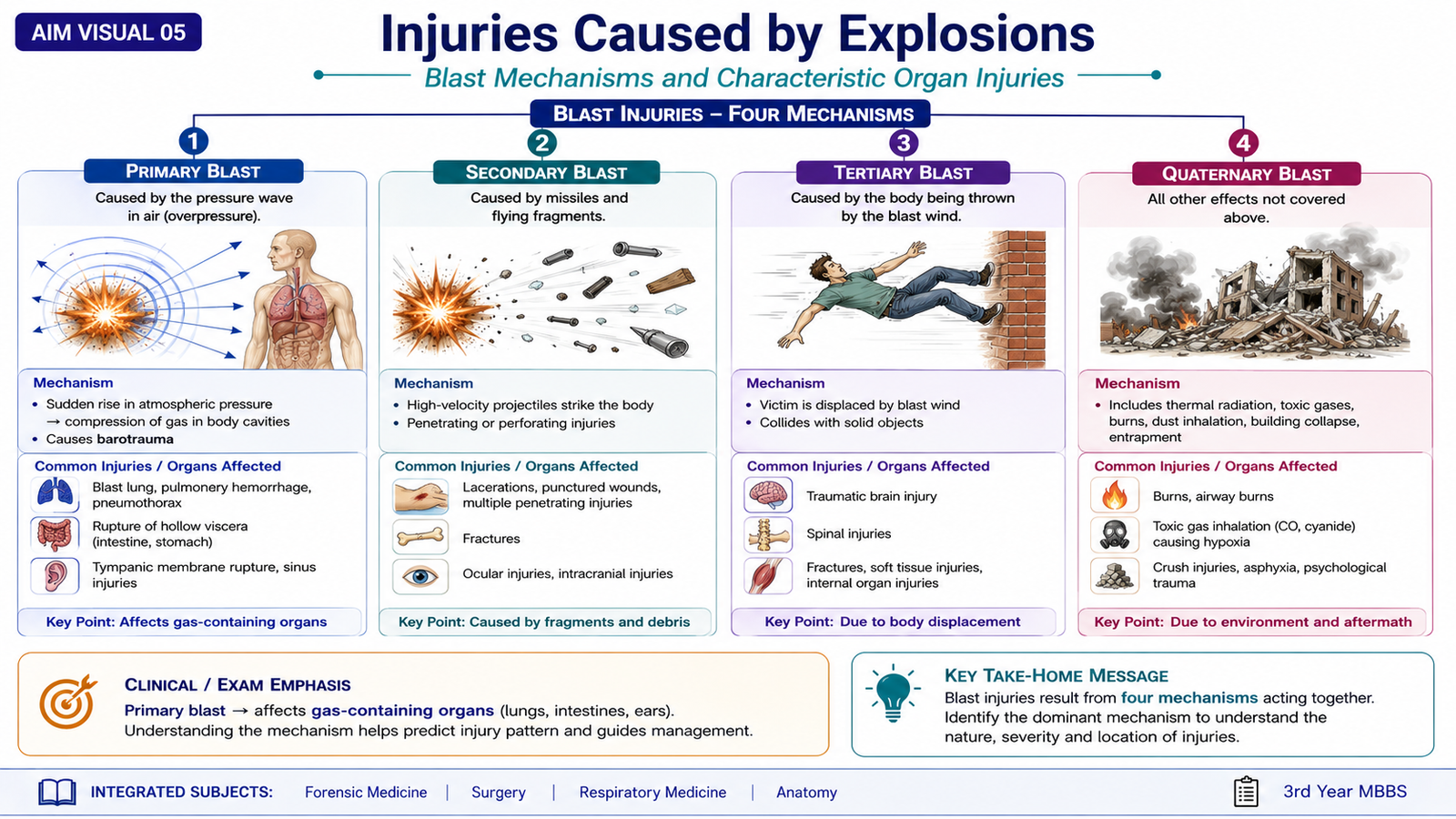
An explosion is a sudden release of energy that produces rapidly expanding gases, intense pressure, heat, fragments and movement of surrounding objects. Blast victims commonly suffer several mechanisms of injury at the same time. The external wounds may appear limited even when serious internal damage is present.
Primary blast injury
Primary blast injury is caused directly by the blast pressure wave. It mainly affects gas-containing organs because the pressure wave causes rapid compression and expansion at air–tissue interfaces.
- Ear: Tympanic membrane rupture and middle-ear injury.
- Lung: Pulmonary contusion, haemorrhage, oedema and possible air embolism.
- Gastrointestinal tract: Haemorrhage or perforation, particularly in gas-containing bowel.
Secondary blast injury
Secondary blast injury is produced by fragments propelled by the explosion. These may include parts of the explosive device, glass, metal, stones or other environmental debris. They produce penetrating wounds, lacerations and fractures.
Tertiary blast injury
Tertiary injury occurs when the blast wind throws the person against a surface or causes structural collapse. The resulting injuries include blunt trauma, fractures, crush injuries and traumatic amputations.
Quaternary and additional effects
Other explosion-related effects are often grouped as quaternary injuries. They include burns, inhalation of smoke or toxic substances, asphyxia and worsening of pre-existing disease. Some descriptions also identify contamination-related and psychological consequences separately, but the essential undergraduate principle is that blast injury is commonly multi-mechanistic.
Causes of death in explosions
- Severe blast lung with respiratory failure.
- Massive haemorrhage from penetrating or blunt trauma.
- Head injury and traumatic brain damage.
- Crush injury from structural collapse.
- Burns and inhalation injury.
- Traumatic amputation.
- Air embolism related to pulmonary blast injury.
- Asphyxia due to smoke, dust, entrapment or oxygen displacement.
Autopsy findings in explosion fatalities
The autopsy should document the complete pattern of injury and search for evidence of each blast mechanism. Clothing, foreign material and radiological findings may help locate fragments before dissection.
- Multiple abrasions, lacerations and penetrating fragment wounds.
- Burning, singeing and soot contamination.
- Traumatic amputations or severe tissue disruption.
- Fractures, crush injuries and internal haemorrhage.
- Tympanic membrane rupture.
- Pulmonary haemorrhage, contusion and oedema.
- Gastrointestinal haemorrhage or perforation.
- Foreign bodies embedded in skin, soft tissue or internal organs.
Fragment location and wound distribution may help reconstruct the event, but the pattern can be altered by shielding, body position, distance, structural collapse and movement after the explosion.
AIM VISUAL 05 — Blast Injury Classification
F. Thermal Injuries: Burns and Scalds
Thermal injury occurs when heat or cold damages body tissues. In routine forensic practice, the main concern is injury caused by excessive heat. A burn is commonly produced by dry heat, while a scald is caused by hot liquid or steam. Tissue damage depends on temperature, duration of contact, body area involved and the victim’s ability to escape.
Classification by source
- Flame burns: Produced by direct exposure to fire.
- Contact burns: Produced by contact with a heated solid object.
- Radiant-heat burns: Produced without direct contact with the heat source.
- Scalds: Produced by hot liquid or steam.
- Chemical burns: Produced by corrosive substances; these are not true thermal burns but may resemble them.
- Electrical burns: Produced by conversion of electrical energy into heat within tissues.
Classification by depth
Burn depth reflects how far tissue damage extends through the skin. Modern clinical terminology often describes burns as superficial, partial-thickness or full-thickness. Traditional degree-based terminology may also be encountered.
- Superficial burn: Involves the epidermis. The skin is red and painful because sensory endings remain intact.
- Partial-thickness burn: Extends into the dermis. Blisters are common because fluid separates damaged skin layers.
- Full-thickness burn: Destroys the entire epidermis and dermis. The surface may appear pale, brown or charred, and sensation may be reduced because nerve endings are destroyed.
- Deep burn: May extend into subcutaneous tissue, muscle or bone.
Burns caused by dry heat
Flame burns often show irregular areas of injury, singeing of hair, charring of clothing and soot deposition. When the body is exposed to intense heat after death, the skin may split and muscles may contract. Such heat-related changes must not automatically be mistaken for injuries sustained during life.
- Heat ruptures: Splits in heated skin produced by shrinkage and tension; they may resemble lacerations but lack true vital tissue reaction.
- Pugilistic attitude: Flexion of elbows, hips and knees due to heat-induced contraction of muscles. It does not indicate that the person was fighting.
- Heat fractures: Cracks or fractures produced by severe heating, particularly in the skull.
- Heat haematoma: A heat-related collection within the skull that can resemble an extradural haemorrhage but is not necessarily due to blunt trauma.
Scalds
Scalds usually produce moist, sharply demarcated areas of injury. Hot liquid may flow downwards and produce streaming marks. Clothing may retain hot fluid against the skin and deepen the injury. Immersion may produce a clear upper level corresponding to the depth of the liquid.
- Hair is generally not singed unless another heat source is present.
- Charring is absent in ordinary hot-liquid scalds.
- Splash marks may occur around the main area.
- Flowing liquid may produce downward “drip” or streaming patterns.
- Immersion may create a relatively clear line of demarcation.
Antemortem indicators
Determining whether a person was alive during a fire requires the combined interpretation of external, internal and laboratory findings. No single sign should be considered conclusive in every case.
- Vital inflammatory reaction around burns.
- True vesicles containing protein-rich fluid with a red, inflamed base.
- Soot in the larynx, trachea or deeper airways, suggesting breathing in a smoky environment.
- Signs of smoke inhalation and airway injury.
- Carboxyhaemoglobin formation after inhalation of carbon monoxide.
Causes of death in thermal injury
- Smoke inhalation and toxic gas exposure.
- Airway oedema and respiratory obstruction.
- Extensive tissue damage with fluid loss and shock.
- Direct thermal injury to the respiratory tract.
- Trauma sustained during escape or structural collapse.
- Later infection and organ complications in survivors.
Severe internal inhalation injury may be present even when external burns appear limited.
AIM VISUAL 06 — Thermal Injury Patterns

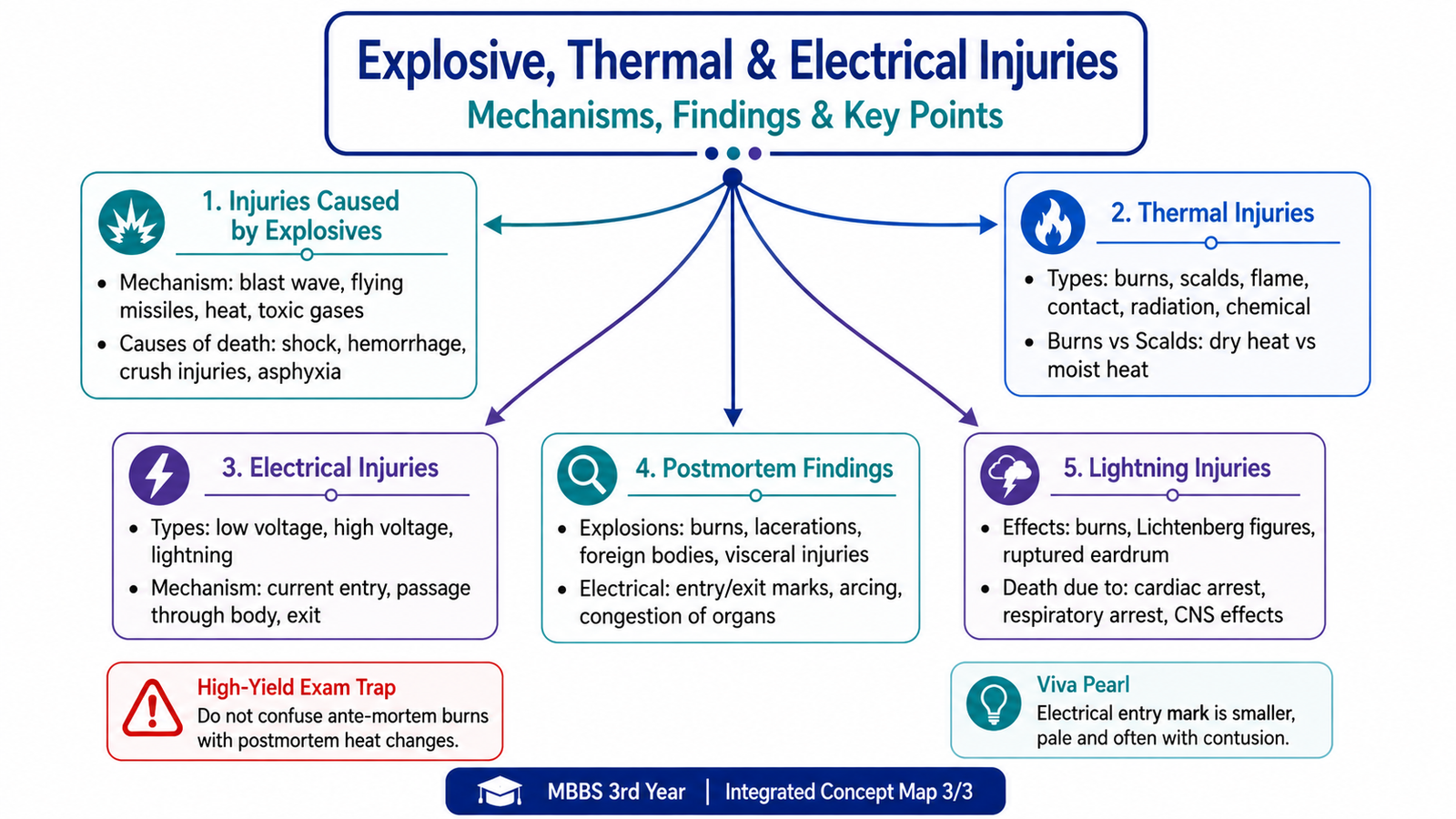
G. Electrical Injuries, Electrocution and Lightning
Electrical injury occurs when electric current passes through or acts upon the body. Electrocution means death caused by electricity, although the term is sometimes used loosely for non-fatal electrical injury. The severity depends on current strength, voltage, resistance, current pathway, duration of contact and the type of current.
How electricity damages the body
Electricity can disturb the normal electrical activity of the heart, cause sustained muscle contraction, interfere with breathing and generate heat within tissues. Therefore, death may occur with little visible external damage.
Factors affecting severity
- Current strength: Greater current generally produces more severe physiological effects.
- Voltage: Higher voltage can drive current through greater resistance and produce deeper tissue injury.
- Resistance: Dry skin offers greater resistance than wet or damaged skin.
- Duration: Prolonged contact increases energy transfer and tissue damage.
- Pathway: A current passing across the chest may affect the heart or respiratory muscles.
- Type of current: Alternating and direct currents may differ in their physiological effects.
- Contact area: A small contact area may concentrate heat and produce a localized mark.
Electrical contact mark
A characteristic electrical mark may develop at the point where current enters or leaves the body. It is often a small, pale, dry, firm and depressed lesion with a raised margin. However, an electrical mark may be absent, especially when the skin is wet or the contact area is broad.
- Pale or grey-white centre.
- Dry, firm or parchment-like surface.
- Crater-like depression with an elevated margin.
- Possible reproduction of the shape of the conductor.
- Possible metallization due to deposition of metal from the conductor.
Types of electrical injury
- Direct contact injury: Current enters through contact with an energized conductor.
- Arc injury: Electricity crosses an air gap and produces intense heat.
- Flash burn: Heat from an electrical flash burns the skin without necessarily passing significant current through the body.
- Flame burn: Electricity ignites clothing or nearby material, causing ordinary thermal burns.
- Secondary trauma: Muscle contraction or shock causes a fall, fracture or other blunt injury.
Mechanisms of death
- Fatal cardiac arrhythmia, particularly ventricular fibrillation.
- Respiratory arrest due to paralysis of respiratory muscles or central respiratory disturbance.
- Severe burns and tissue destruction.
- Trauma caused by falls or forceful muscle contraction.
Postmortem findings in electrical fatalities
There may be a typical contact mark, extensive burns or very little visible injury. The diagnosis therefore depends on scene information, examination of the electrical source, autopsy findings and exclusion of competing causes.
- Electrical contact mark at a possible point of contact.
- Exit or secondary burns in some cases.
- Deep tissue damage that may exceed the surface appearance.
- Associated fractures, dislocations or head injury after a fall.
- Internal findings that may be non-specific.
The absence of a typical electrical mark does not exclude electrocution. Scene findings and examination of the suspected electrical source are essential.
Lightning injuries
Lightning is a natural high-voltage electrical discharge of extremely short duration. It may affect a person by a direct strike, contact with a struck object, side flash from a nearby object or current travelling through the ground.
- Direct strike: Lightning directly contacts the person.
- Side flash: Current jumps from a nearby struck object to the person.
- Contact injury: The person is touching an object through which lightning passes.
- Ground current: Current travels through the ground and enters the body through points of contact.
Characteristic lightning findings
- Lichtenberg figures: Transient branching, fern-like skin markings caused by lightning. They are not ordinary burns.
- Burns, often superficial but occasionally severe.
- Singeing of hair and damage to clothing.
- Rupture or perforation of tympanic membranes.
- Cardiac or respiratory arrest.
- Blunt injury caused by falls, explosive force or being thrown.
- Neurological injury in survivors.
Lichtenberg figures strongly support lightning exposure, but their absence does not exclude it.
AIM VISUAL 07 — Electrical and Lightning Injury Pathway

Integrated Mechanism Flow
Projectile, blast, heat or electricity
Mechanical force, pressure, temperature or current
Crushing, stretching, heating or electrical disturbance
Wound track, rupture, burn or tissue necrosis
Haemorrhage, respiratory failure or arrhythmia
Mechanism, range, direction and cause of death
⭐ AIM High-Yield Review
- Wound ballistics includes internal, external and terminal or wound ballistics.
- Projectile injury depends on energy transfer, deformation, fragmentation, yaw, tumbling and tissue characteristics.
- The permanent cavity is the lasting crushed track; the temporary cavity results from rapid tissue stretching.
- Blackening is caused by soot and may be wiped away; tattooing is caused by impacting powder particles and cannot simply be wiped away.
- A typical entry wound has an abrasion collar, while a typical exit wound does not.
- A supported or shored exit wound may develop marginal abrasion and resemble an entry wound.
- Skull entry usually shows internal beveling; skull exit usually shows external beveling.
- Primary blast injury mainly affects gas-containing organs, especially the ear, lungs and bowel.
- Secondary blast injury is caused by fragments; tertiary injury results from body displacement or structural collapse.
- Pugilistic attitude is caused by heat contraction of muscles and does not prove that the victim fought before death.
- Soot in the lower respiratory passages supports breathing during a fire, but all findings must be interpreted together.
- Electrocution may occur without a typical external electrical mark.
- Fatal electrical injury may result from ventricular fibrillation, respiratory arrest, burns or secondary trauma.
- Lichtenberg figures are branching skin markings associated with lightning and are not ordinary thermal burns.
- Forensic conclusions about weapon type, range, direction and circumstances should be expressed cautiously because wound appearances may be altered by clothing, intermediate objects, tissue support and post-injury changes.
3rd Year MBBS
Forensic Medicine
AIM Learning Cycle
Firearm, Explosive, Thermal and Electrical Injuries
Watch this video after completing the AIM learning material. Focus on wound ballistics, entry and exit wounds, range of fire, blast injuries, burns, electrocution and lightning injuries.
Keep the written learning material open while watching. Pause at difficult concepts and compare the visual explanation with the AIM High-Yield Review.
Key Concepts Covered
- Basic firearm mechanism, ammunition and bullet types
- Internal, external and terminal ballistics
- Permanent and temporary cavity formation
- Contact, close, intermediate and distant ranges
- Firearm entry and exit wound differences
- Internal and external beveling of skull bone
- Primary, secondary, tertiary and quaternary blast injuries
- Burns, scalds and important postmortem heat changes
- Electrical contact injuries and mechanisms of electrocution
- Lightning injuries and Lichtenberg figures
After Watching
Revise the AIM High-Yield Review and attempt the Post-Test MCQs to check your understanding and application of the forensic findings.