
Topic 13 — Exhumation and Examination of Skeletonized Remains
Topic Introduction
Exhumation means lawful removal of a buried dead body from its grave for medico-legal examination. It may become necessary when important questions about identity, injury, poisoning or cause of death arise after burial. In some cases, the body may be markedly decomposed or reduced largely to skeletal remains. The forensic examination must then depend on the bones, teeth, preserved tissues, clothing and associated material that remain available. This chapter explains who authorizes exhumation, how the procedure is performed safely and systematically, how specimens are collected, and what limitations may affect interpretation. It also explains how a skeletonized body is examined to estimate ancestry, sex, age and stature, recognize injuries, consider the type of weapon involved, assess cause of death and form a cautious opinion about time since death.
A. Exhumation: Definition, Purpose and Scope
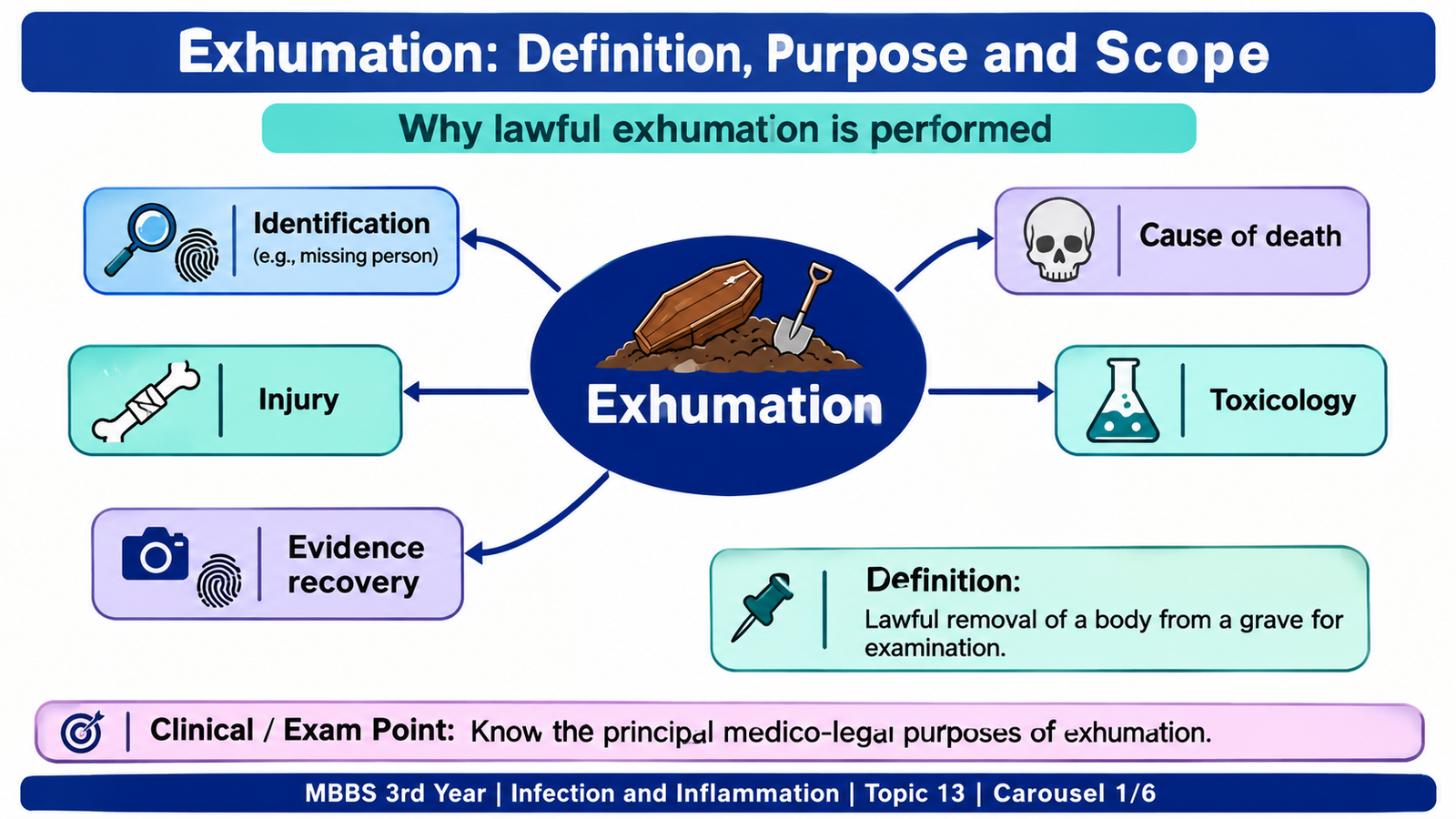
Exhumation is a medico-legal procedure in which a buried body is disinterred under lawful authority so that it can be examined. It is not performed merely because relatives wish to see the body again. Its purpose is to obtain evidence that may help answer a legally important question that could not be answered before burial, was overlooked initially, or arose later during investigation.
Why may exhumation be required?
Burial does not necessarily end a medico-legal investigation. New allegations, new witness statements or new investigative findings may make examination of the buried body necessary. The usefulness of exhumation depends on what evidence has survived after burial.
- To establish or reconsider identity: particularly when the identity of the deceased is disputed or was uncertain at burial.
- To determine or reconsider cause of death: when the original cause was unknown, inadequately investigated or subsequently questioned.
- To detect injuries: fractures, firearm defects or other skeletal injuries may remain demonstrable even after soft tissues have decomposed.
- To obtain material for toxicological examination: where suitable biological material or associated samples remain available.
- To recover evidentiary material: clothing, projectiles, foreign material or other objects associated with the body may assist investigation.
- To investigate suspected criminal conduct: particularly when information obtained after burial raises suspicion about the circumstances of death.
Scope of exhumation
Exhumation can contribute to identification, injury analysis, toxicology, reconstruction of events and determination of cause of death. Its scope is nevertheless limited by decomposition and environmental damage. A forensic examiner should therefore distinguish between findings that are directly demonstrable and conclusions that are only probable.
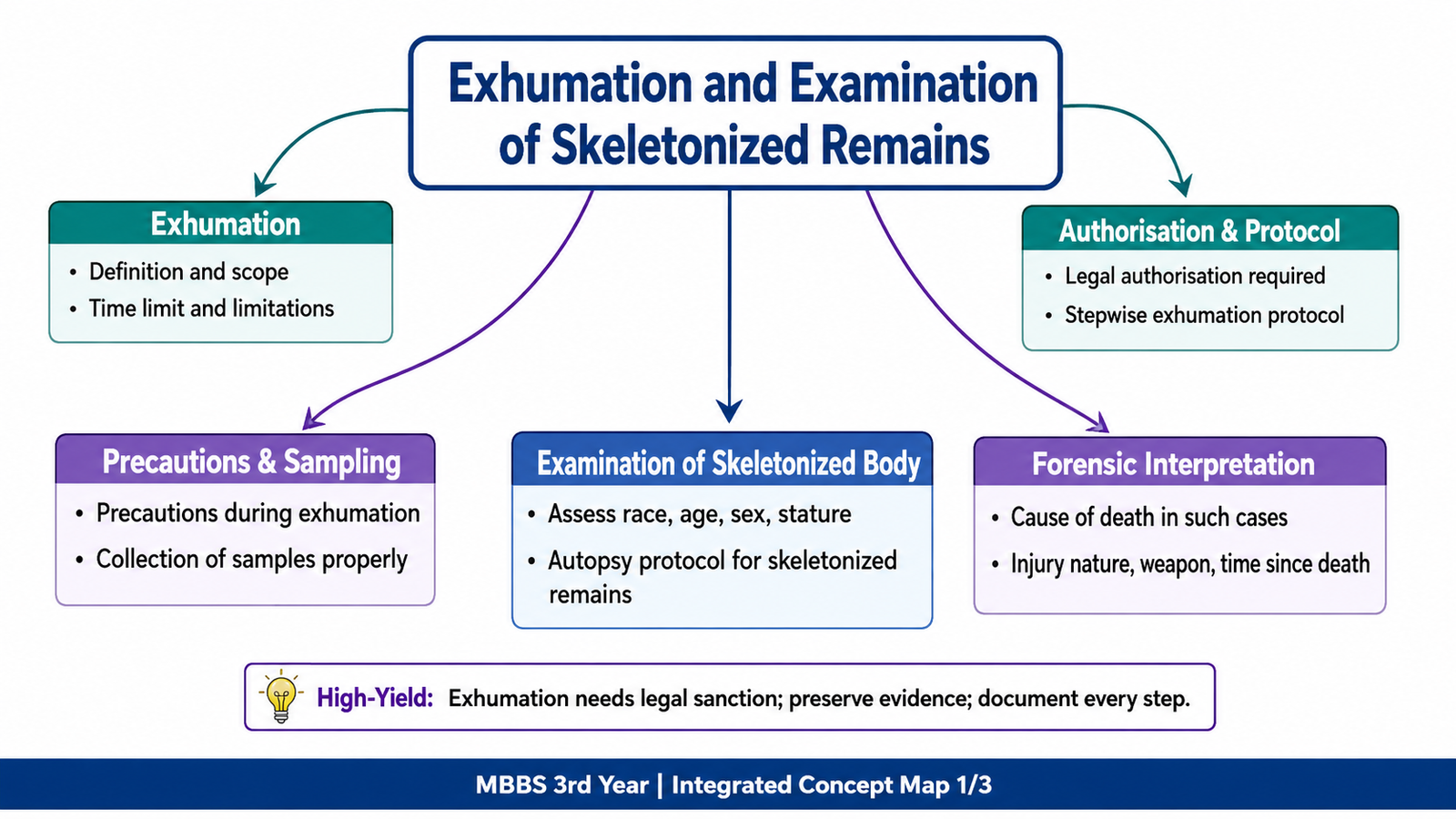
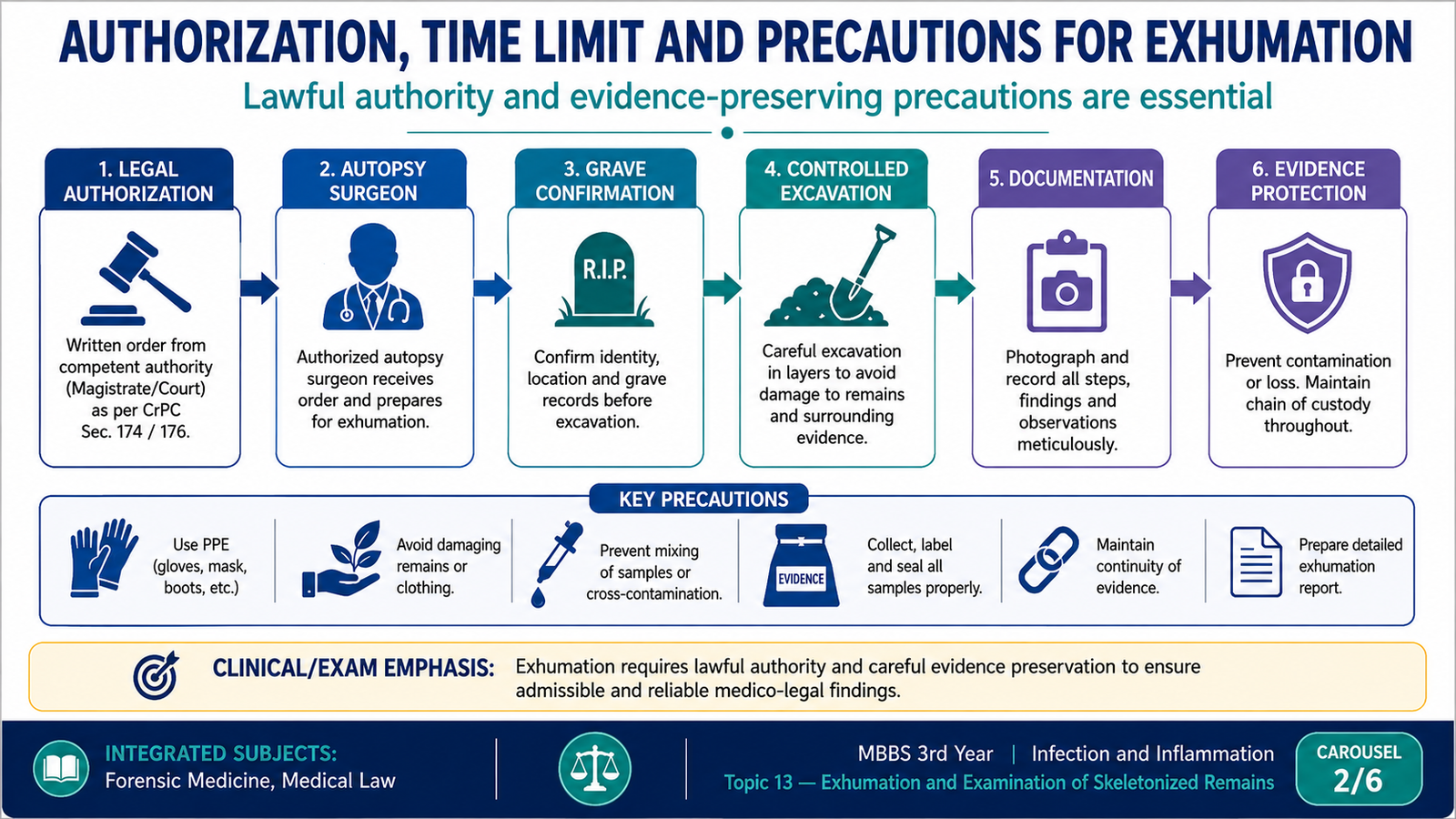
B. Authorization, Time Limit and Precautions for Exhumation
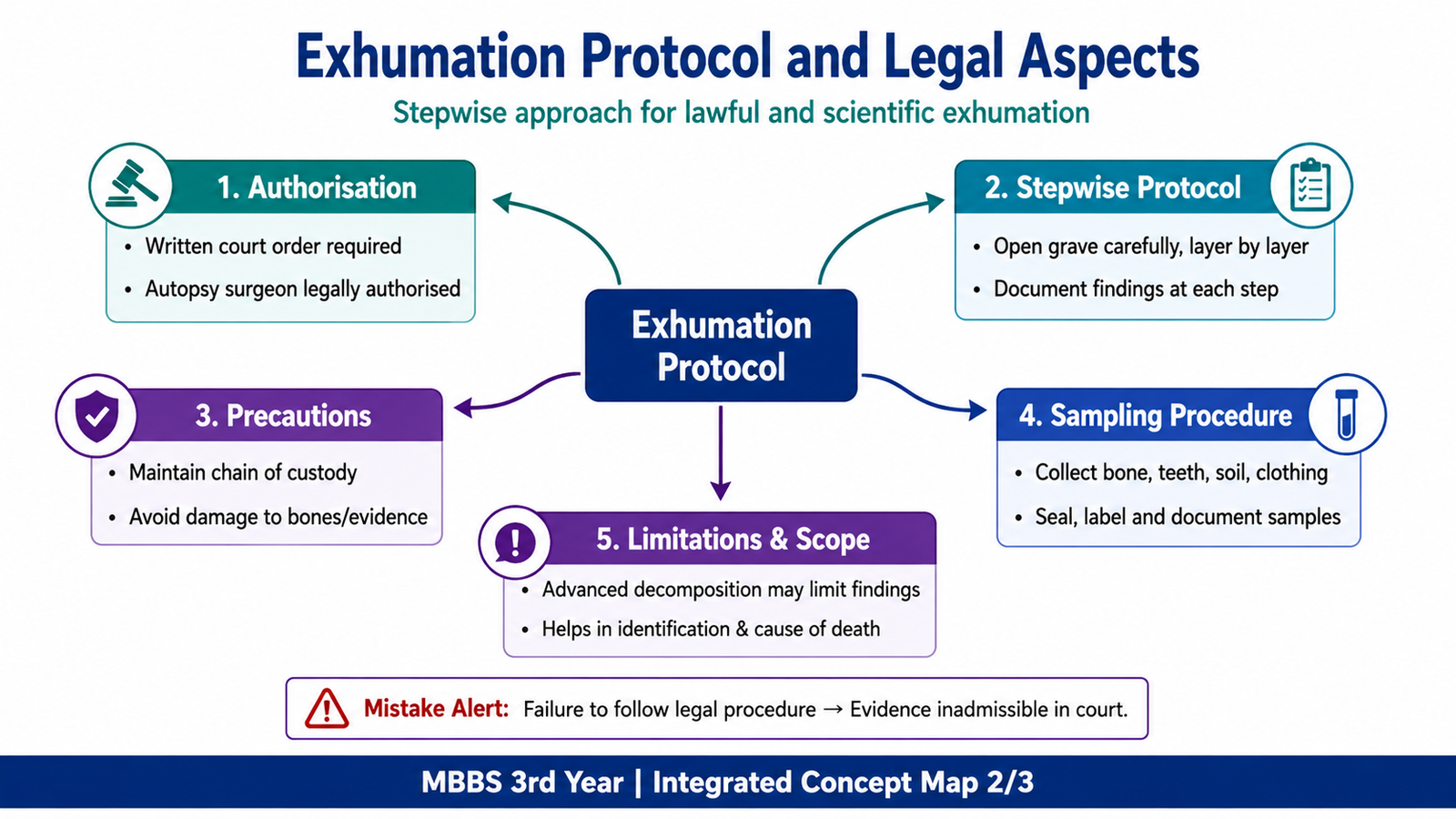
Because exhumation interferes with a legally buried body and may affect important evidence, it must be performed under competent legal authority. The autopsy surgeon does not independently decide to open a grave. The surgeon participates after the appropriate authority orders or authorizes the procedure and should work within the scope of that authorization.
Authorization of the autopsy surgeon
The medical officer or autopsy surgeon acts as the forensic medical expert during the examination. The legal authority is responsible for ordering the exhumation according to the applicable medico-legal procedure. Once authorized, the medical examiner should ensure that the body recovered from the grave is correctly identified and that all relevant findings and specimens are documented.
The examiner should not assume that the grave, coffin or remains are correct merely because they have been indicated by another person. Identification of the grave and continuity of evidence should be documented carefully.
Time limit
From a forensic point of view, the passage of time does not automatically make exhumation useless. There is no universal biological time after which exhumation can no longer provide evidence. Its evidentiary value progressively depends on decomposition, burial conditions and the particular question being investigated. Bones, teeth, metallic foreign bodies and some other forms of evidence may persist long after soft tissues have disappeared.
Therefore, the practical principle is that exhumation should be undertaken when legally authorized and medically relevant, while recognizing that increasing postmortem change may reduce the certainty of some conclusions.
Important precautions
The purpose of precautions is to prevent loss, contamination, mixing or incorrect interpretation of evidence. The excavation should therefore proceed in a controlled manner rather than as an ordinary grave opening.
- Confirm the identity and location of the grave before excavation.
- Record relevant grave markers, surrounding features and the condition of the burial site.
- Excavate carefully to avoid producing new damage to the coffin, body or bones.
- Use appropriate protective clothing because decomposed remains and contaminated soil may present biological hazards.
- Document the position and condition of the coffin or burial covering before disturbing it further.
- Recover small bones, teeth, foreign bodies and associated objects carefully.
- Avoid mixing soil, clothing or biological material from different locations without proper labeling.
- Maintain correct identification, labeling, sealing and continuity of specimens.
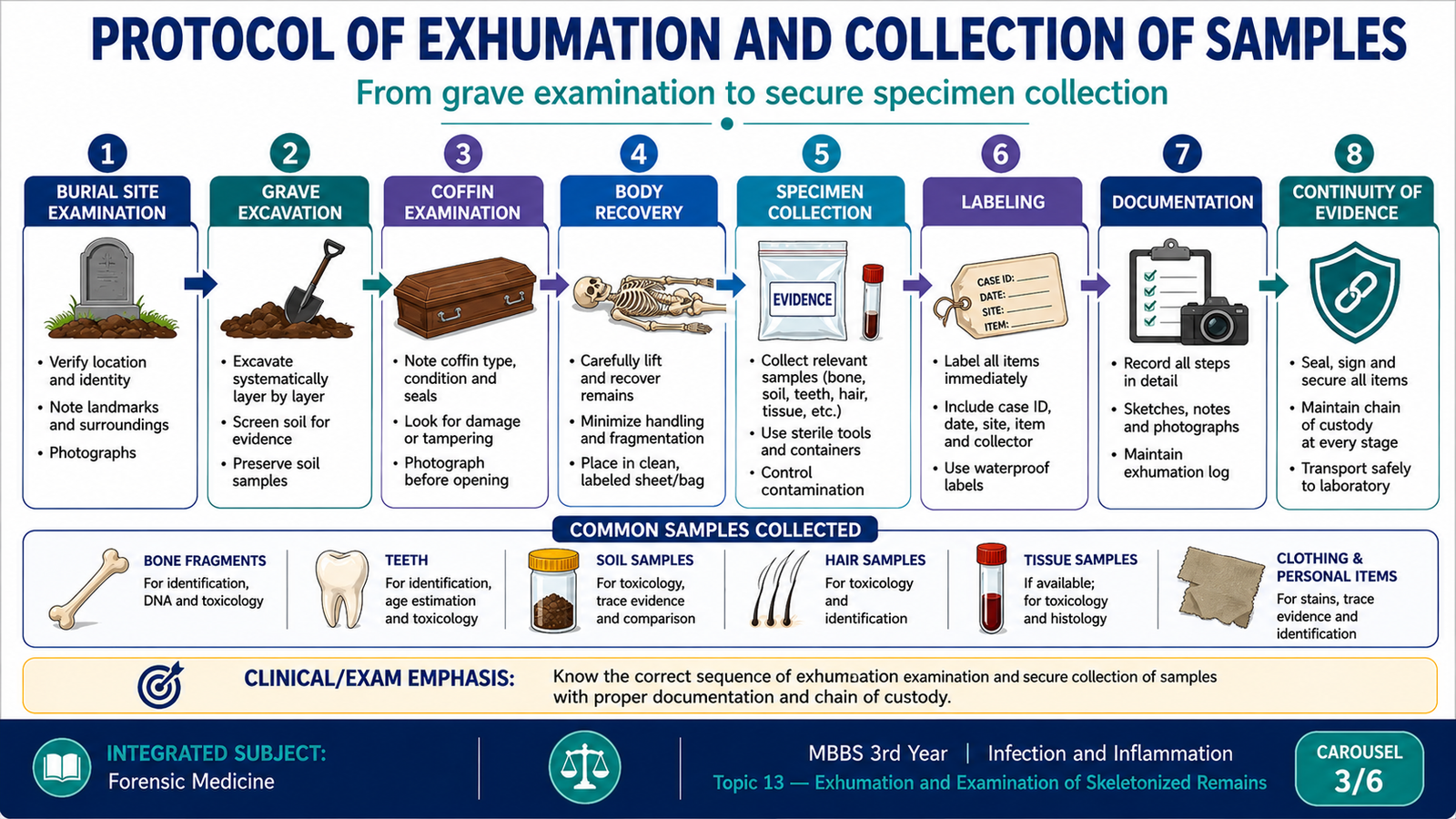
C. Protocol of Exhumation and Collection of Samples
Exhumation should be approached as a continuous medico-legal examination beginning at the burial site rather than starting only when the body reaches the mortuary. The position of the grave, coffin, remains and associated material may itself contain useful information. For this reason, observations should be made before, during and after removal of the body.
1. Examination of the burial site
The grave should first be identified by the responsible persons and its external features documented. Disturbance, abnormal soil changes or other relevant findings should be recorded before excavation begins.
2. Controlled opening of the grave
Soil is removed carefully. The excavation should minimize accidental damage to skeletal structures and prevent loss of small items. The level and orientation of significant findings should be noted where relevant.
3. Examination of the coffin or burial covering
When a coffin is present, its condition should be recorded before opening. Damage, deterioration, position and relevant associated objects may provide context for later interpretation.
4. Examination and recovery of the body
The body is inspected in relation to its position and state of preservation. Clothing and external material are documented. The remains are then removed carefully for a more detailed medico-legal examination.
5. Sample collection
The type of sample collected depends on the question under investigation and on what material has survived. Decomposition may destroy some tissues while leaving others available. The examiner should therefore collect relevant surviving material rather than following a rigid routine that ignores the condition of the remains.
- Preserved soft tissues or organs, when present and relevant.
- Hair, nails or teeth when required for identification or other forensic examination.
- Bones when skeletal examination or identification requires them.
- Relevant body fluids if any suitable material remains.
- Clothing and foreign material associated with the remains.
- Projectiles or other objects recovered from or near the body.
- Representative environmental material when its comparison is relevant to the investigation.
6. Documentation and continuity of evidence
Each specimen must remain traceable to its source. Correct labeling, documentation and secure handling are therefore essential. A scientifically useful specimen loses much of its medico-legal value if its origin cannot be established reliably.
D. Limitations of Exhumation and Examination of Decomposed Remains
Exhumation may reveal important evidence, but it cannot restore information that has already been destroyed. The longer a body remains buried, the more its appearance is influenced by decomposition and by the burial environment. Conclusions must therefore be based on the surviving evidence and expressed with an appropriate level of certainty.
Why does exhumation become difficult?
Soft tissues undergo progressive decomposition. This can destroy wounds, disease changes and other findings that might have been obvious during an early autopsy. Environmental factors can also modify both soft tissues and bones.
- Loss of soft tissues: may obscure bruises, superficial wounds and internal organ disease.
- Decomposition: may alter normal anatomy and simulate pathological changes.
- Environmental alteration: moisture, soil conditions, temperature and biological activity may modify the remains.
- Loss or displacement of small structures: small bones, teeth or foreign material may be missed during burial or excavation.
- Contamination: soil and environmental material can complicate laboratory interpretation.
- Incomplete previous information: absence of reliable medical or investigative records limits comparison.
- Reduced certainty: an examiner may identify an injury without being able to determine precisely when or how it occurred.
How should findings be interpreted?
Findings should be described first and interpreted second. For example, a defect in a bone may be clearly visible, but the examiner must decide whether its features are compatible with trauma occurring around the time of death or whether it represents postmortem damage. If the evidence does not permit a definite conclusion, the correct forensic approach is to state the limitation rather than force a diagnosis.

E. Examination of a Skeletonized Body: Ancestry, Sex, Age and Stature
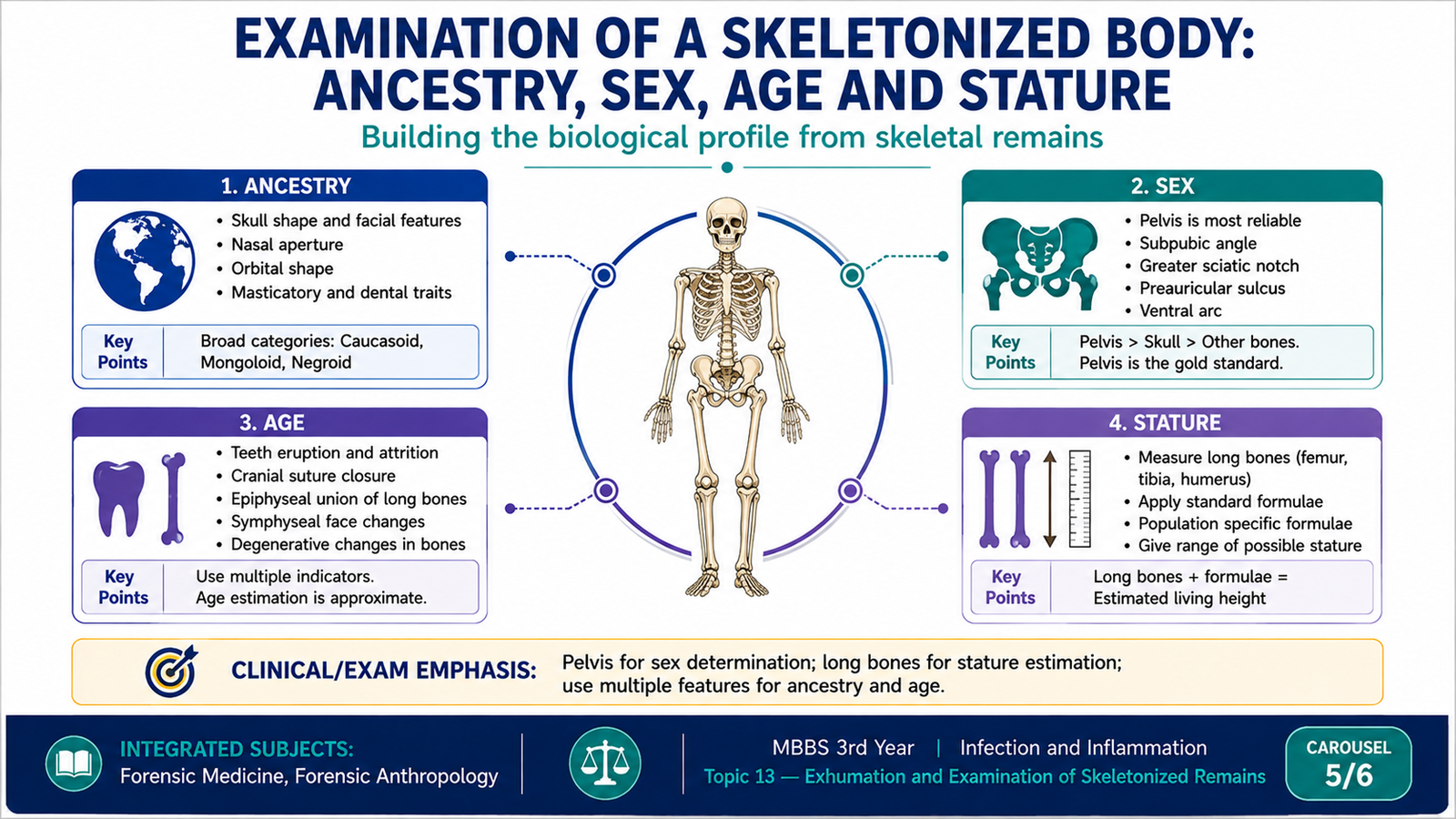
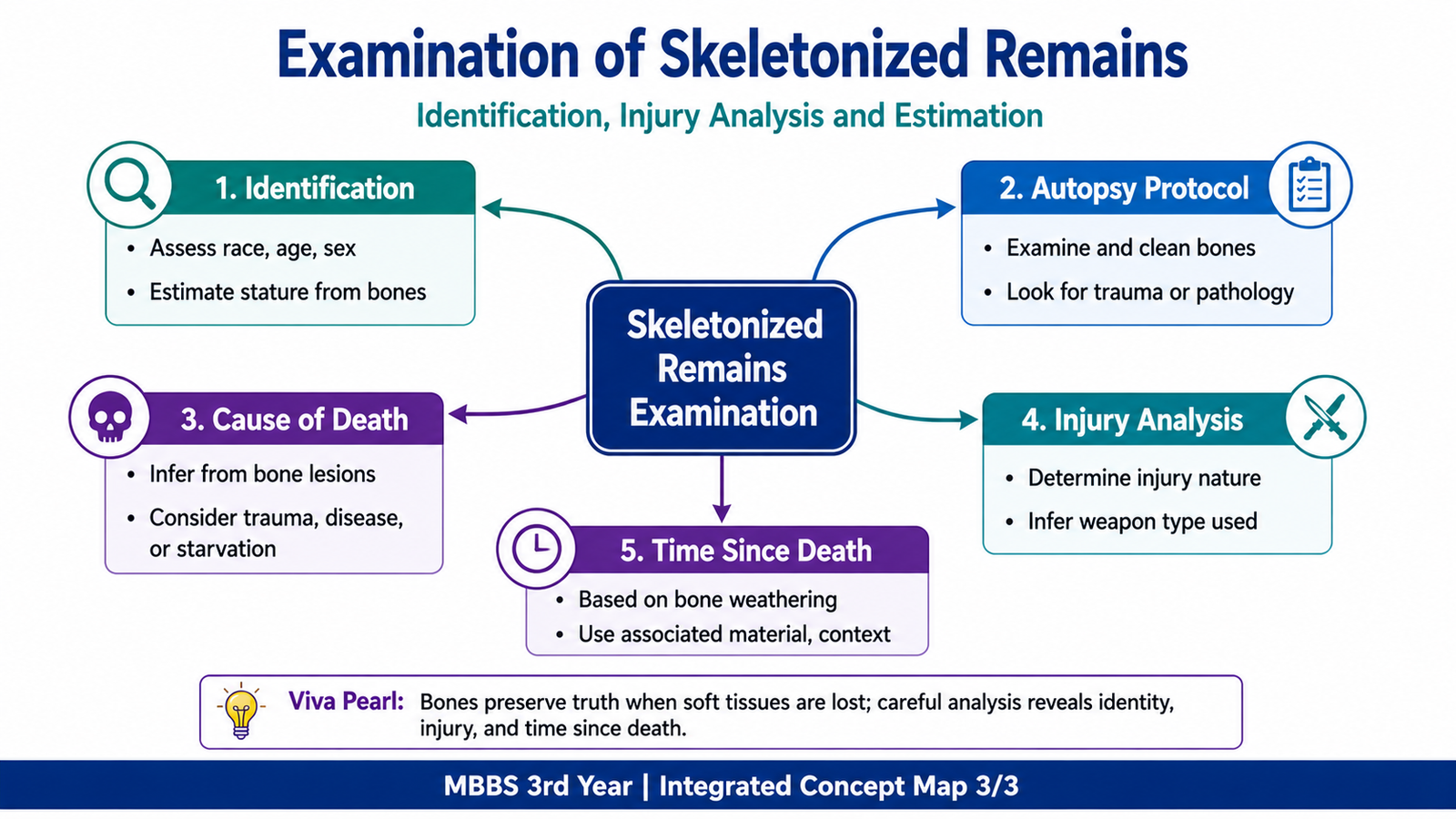
A skeletonized body is one in which most or all soft tissues have disappeared and the examination depends mainly on bones and teeth. The forensic examiner first establishes whether the recovered material is human and then develops a biological profile. This profile can help narrow the possible identity of the deceased.
The major components requested in the skeletal examination are ancestry, sex, age and stature. These findings should be considered together. No single skeletal feature should automatically be treated as absolute proof of identity.
Initial organization of the skeleton
Before estimating identity-related characteristics, the remains should be systematically arranged and inventoried. The examiner determines which bones are present, whether they belong to one individual, whether any bones are duplicated, and whether there is evidence of trauma, disease or postmortem alteration.
Assessment of ancestry
The KMU learning outcome refers to assessment of race. In modern forensic anthropology, the more cautious term is ancestry estimation. Certain cranial and other skeletal characteristics may suggest broad ancestral affinity, but human variation overlaps considerably. Therefore, this assessment is probabilistic and should not be treated as an exact biological classification.
Assessment of sex
Sex estimation is more reliable in the adult skeleton than in children because sexually dimorphic features become clearer after puberty. The pelvis is generally the most informative region because female pelvic anatomy is adapted for childbirth. The skull provides useful supportive features.
| Feature | Typically more female | Typically more male |
|---|---|---|
| Pelvis | Broader and adapted to childbirth | Generally narrower and more robust |
| Subpubic region | Generally wider | Generally narrower |
| Skull | Usually smoother and less robust | Usually more robust with stronger muscular markings |
| Overall skeleton | Usually more gracile | Usually more robust |
Assessment of age
Different indicators are useful at different ages. In children and adolescents, growth and development provide relatively useful age markers. In adults, estimation becomes broader because skeletal aging varies considerably between individuals.
- Teeth: eruption and development are particularly useful in younger individuals.
- Long bones: the appearance and fusion of epiphyses help estimate age during growth.
- Pelvic changes: adult age estimation may use progressive morphological changes in pelvic structures.
- Cranial sutures: closure may contribute supportive information but should not be used alone as an exact age marker.
- Degenerative skeletal changes: may support estimation in older adults but show considerable individual variation.
Assessment of stature
Stature can be estimated from the dimensions of long bones because their length has a predictable relationship with overall body height. Bones such as the femur, tibia and humerus may therefore contribute to stature estimation. The appropriate estimation method depends on the available bones and relevant population characteristics.
The result is an estimated range, not an exact reconstructed height. Accuracy is reduced when only incomplete or damaged bones are available.
F. Skeletal Autopsy: Injury, Weapon, Cause of Death and Time Since Death
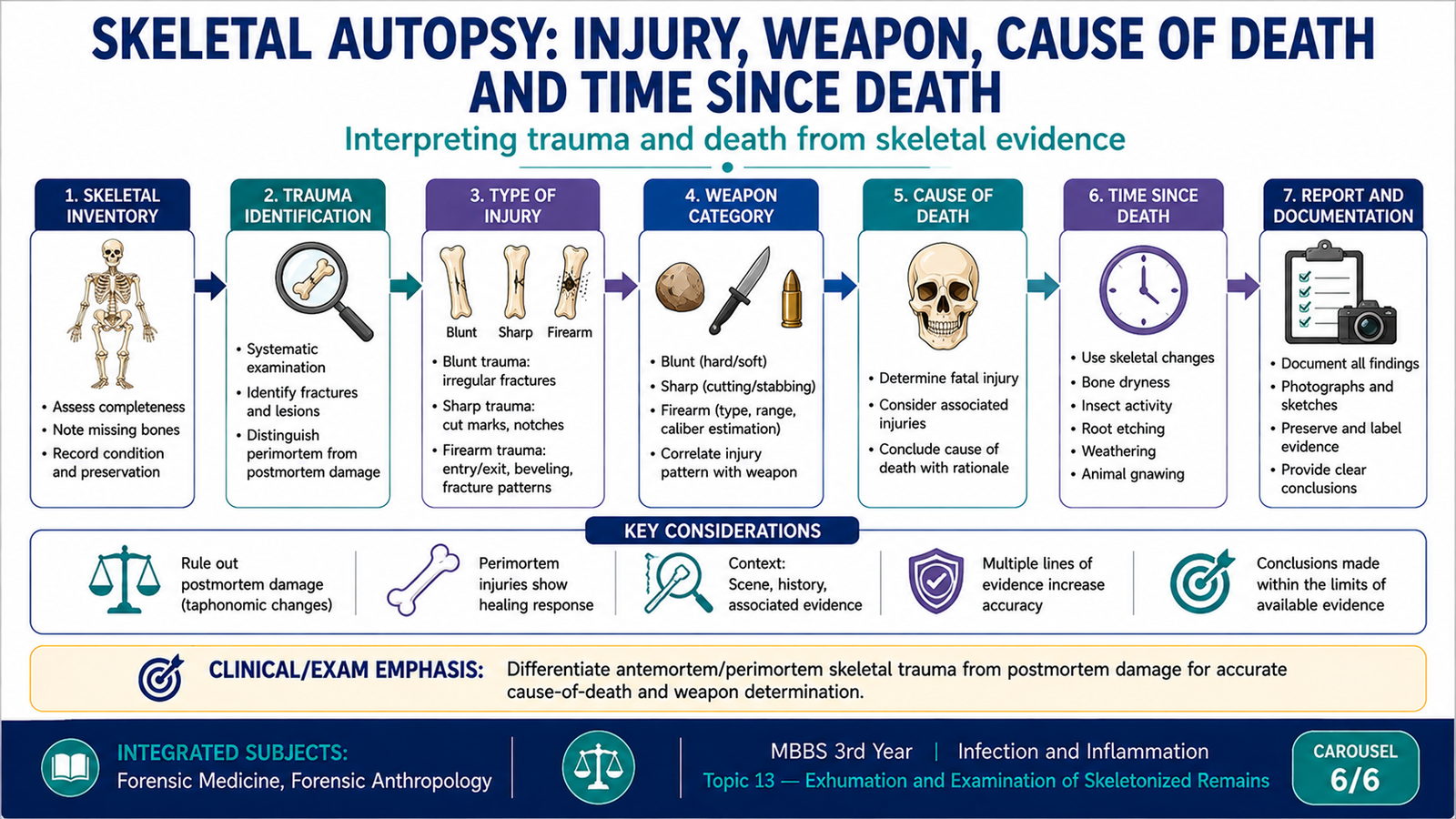
Examination of skeletonized remains is not limited to identification. The bones are also examined for injury, disease and changes occurring after death. Because the soft tissues and organs may no longer be available, conclusions about cause of death must often be more cautious than in a fresh body.
Protocol for examination of a skeletonized body
A systematic examination prevents important evidence from being overlooked. The recovered skeletal material should first be inventoried and arranged anatomically. Each bone is then inspected for anatomical variation, disease, trauma, heat effects, animal activity, weathering and other postmortem alterations.
The examiner should determine whether the skeletal remains are consistent with one individual and document missing, duplicated or fragmented bones. Teeth and jaws should be examined carefully because they may contribute substantially to identification.
Assessment of injuries
Injuries involving bone may survive long after soft-tissue wounds disappear. Fractures, cut marks, penetrating defects and projectile-related defects may therefore provide important evidence. The examiner must first distinguish true trauma from damage caused during excavation, decomposition, animal activity or later handling.
A major forensic question is whether an injury occurred around the time of death or after death. Fresh bone behaves differently from dry bone because fresh bone still contains moisture and organic material. Injury patterns may therefore provide clues, but interpretation must remain cautious when preservation is poor.
Nature of injury and possible weapon
The morphology of a skeletal injury can suggest the broad type of force or weapon involved. However, a bone defect does not normally identify one unique weapon by itself.
- Blunt-force trauma: may produce fractures, depression or crushing depending on the force and anatomical site.
- Sharp-force trauma: may produce cuts, incisions, chopping defects or characteristic kerf-like marks on bone.
- Firearm trauma: may produce penetrating or perforating defects and characteristic fracture patterns, especially in the skull.
The forensic conclusion should therefore usually describe compatibility with a category of force or weapon rather than claiming that one particular object definitely produced the injury unless additional evidence supports that conclusion.
Cause of death in skeletonized remains
Cause of death can sometimes be established when the skeleton preserves a lethal injury. For example, major destructive trauma involving the skull may strongly support fatal cranial injury. In many other cases, however, the disease or injury responsible for death affected only soft tissues and has disappeared completely.
Therefore, skeletal examination may lead to one of three broad situations:
- A skeletal injury provides strong evidence for a potentially fatal cause.
- Skeletal findings contribute to the cause of death but require correlation with circumstantial evidence.
- No sufficient skeletal evidence remains, so the cause of death cannot be determined from the skeleton alone.
Estimation of time since death
In skeletonized remains, estimation of time since death is usually much less precise than in a recently deceased body. The examiner considers the overall state of decomposition and skeletal preservation together with environmental and burial information.
Relevant observations may include the degree of skeletonization, weathering, soil effects, preservation of clothing or associated materials and changes caused by plants, insects or animals. These processes are strongly influenced by environment, so a single skeletal feature cannot usually provide an exact postmortem interval.
The appropriate medico-legal approach is therefore to provide a cautious estimated interval or broad assessment when the evidence permits it rather than an artificially precise time of death.
Integrated Medico-Legal Examination Flow
↓
Confirm grave and preserve scene information
↓
Controlled excavation and recovery of remains
↓
Document body, skeleton, clothing and associated evidence
↓
Collect and securely identify relevant specimens
↓
Construct biological profile and examine skeletal trauma
↓
Form cautious opinions on identity, injury, cause of death and time since death
⭐ AIM High-Yield Review
- Exhumation is the lawful disinterment of a buried body for medico-legal examination.
- The autopsy surgeon performs the medical examination under appropriate legal authorization; the surgeon does not independently order grave opening.
- Important reasons for exhumation include questions of identity, cause of death, injury, toxicology and evidentiary recovery.
- There is no universal biological point after which exhumation becomes automatically useless; its value depends on what evidence has survived.
- Controlled excavation is essential because careless digging may destroy or create apparent injuries and may cause loss of small evidence.
- Specimens and associated material must be correctly identified, documented and kept traceable to their source.
- Decomposition may destroy soft-tissue evidence, so the exact cause of death may sometimes remain undetermined.
- In skeletonized remains, the biological profile includes ancestry, sex, age and stature.
- ⭐ The pelvis is especially important for estimation of sex in the adult skeleton; skull features provide supportive evidence.
- Teeth and skeletal development are particularly useful for age estimation in younger individuals, while adult age estimates are generally broader.
- Long-bone measurements can be used to estimate stature, but the result represents an estimate rather than exact height.
- Skeletal injury patterns may suggest blunt, sharp or firearm trauma, but a bone lesion alone does not usually identify one unique weapon.
- Absence of skeletal trauma does not exclude violent or unnatural death because many fatal injuries affect only soft tissues.
- Time since death in skeletonized remains is generally estimated from several findings together and should not be stated with unjustified precision.
- The strongest forensic opinion is one that clearly separates observed findings from interpretation and acknowledges limitations when evidence is incomplete.
Review the systematic examination of skeletal remains with emphasis on age, sex, stature, ancestry and medico-legal interpretation.