
This chapter follows the supplied KMU learning outcomes and moves from basic medico-legal concepts to professional identity, patient safety and trust. First understand the principles and their relationships; then use the AIM High-Yield Review for rapid revision.
Topic 8 — Forensic Medicine, Medical Law, Professionalism and Patient Safety
A structured introduction to the doctor’s medico-legal responsibilities, evidence and court processes, ethical duties, professional identity, patient safety, clinical governance, quality improvement and professional trust.
Topic Introduction
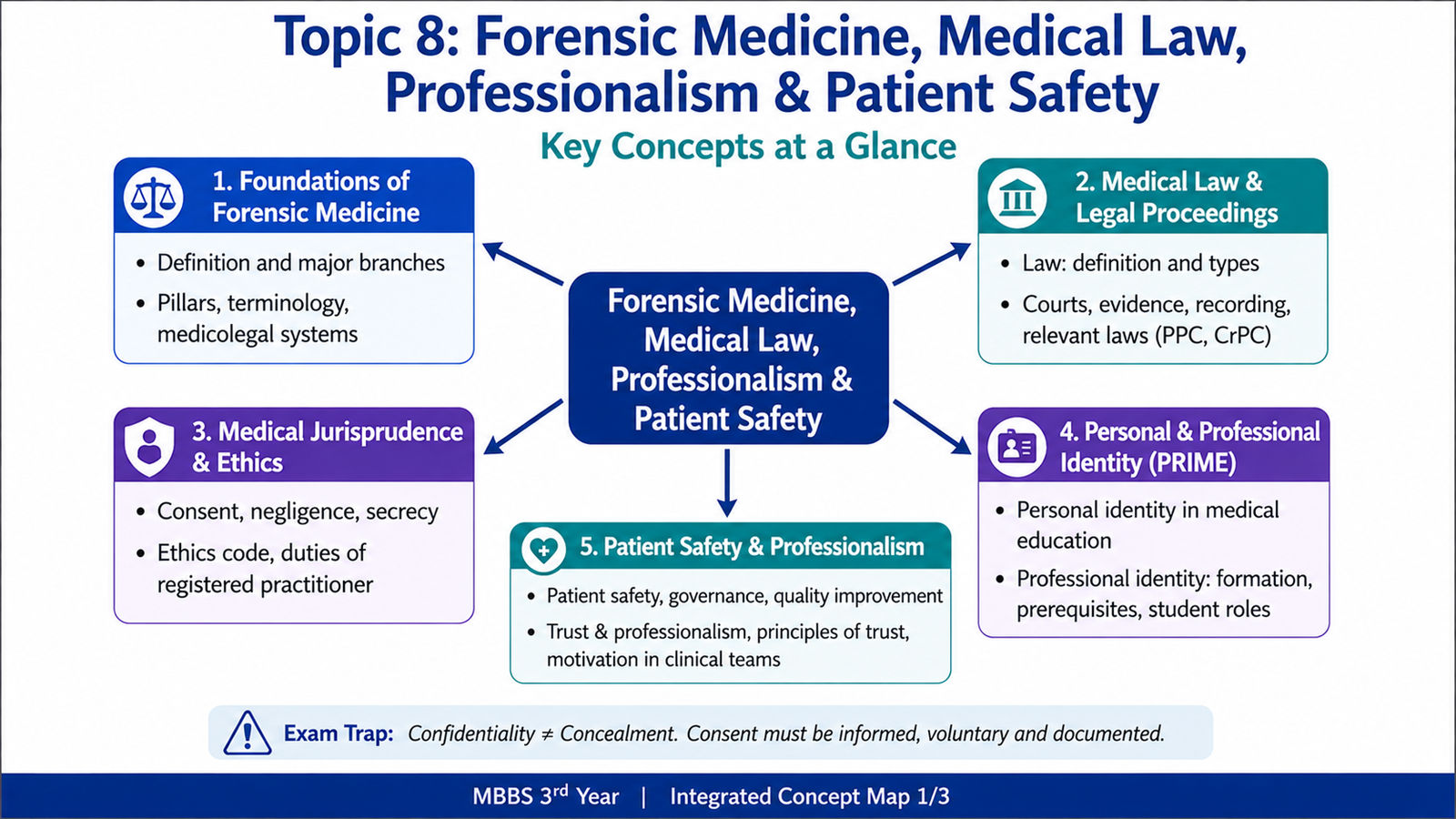
Forensic medicine connects medical knowledge with the requirements of law and justice. A doctor may therefore work not only as a healer, but also as a professional who documents injuries, preserves important evidence, provides medical opinions and may explain those opinions before a court. At the same time, every doctor has ethical and professional duties involving consent, confidentiality, competent care, patient safety and trustworthy behaviour. This topic also introduces professional identity formation: the gradual process by which a medical student learns to think, act and accept responsibility as a member of the medical profession. The final part connects professionalism with patient safety, clinical governance, quality improvement, teamwork and trust. The supplied KMU outcomes specifically require these areas. :contentReference[oaicite:0]{index=0}
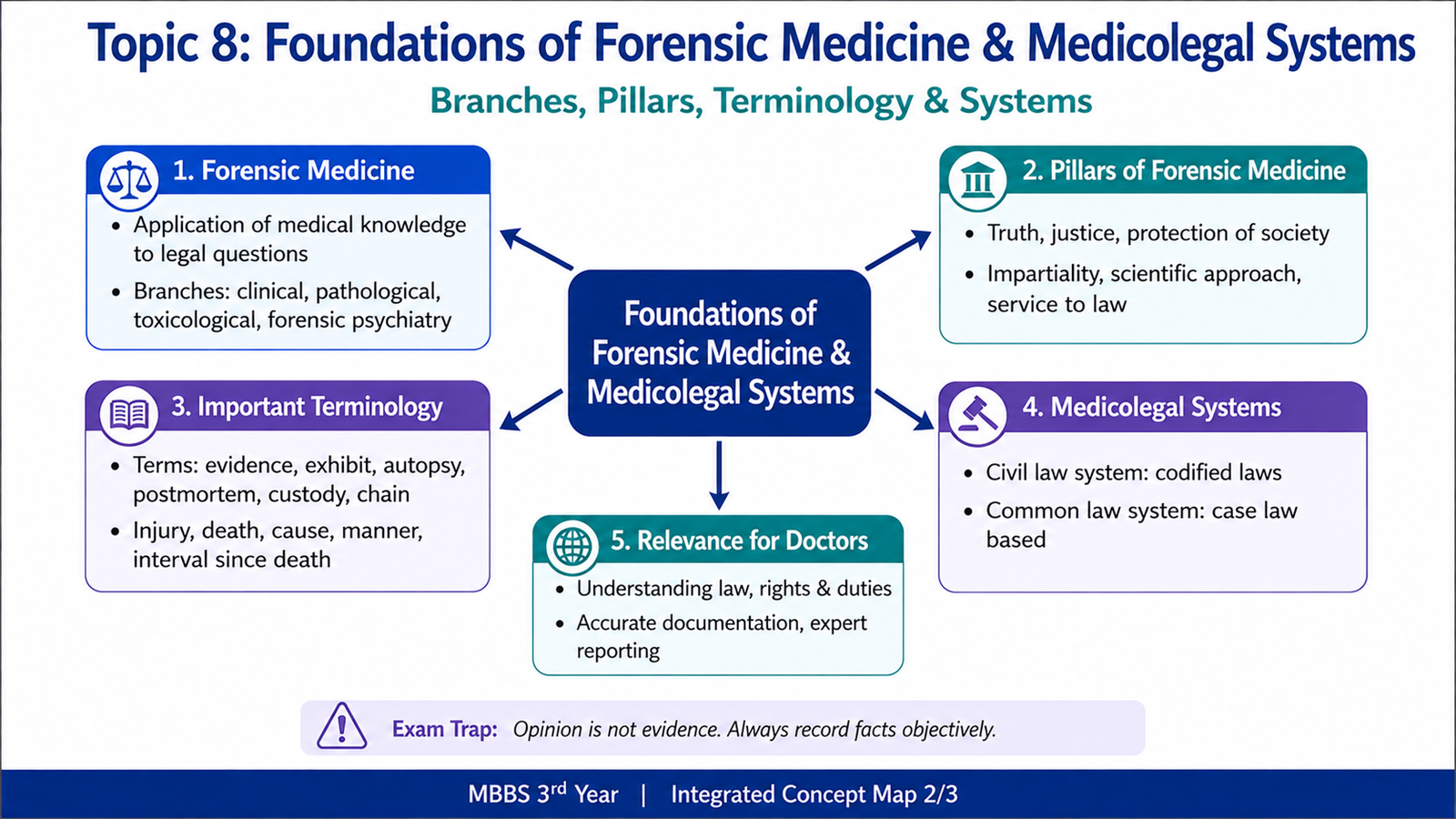
A. Foundations of Forensic Medicine and Medico-Legal Systems
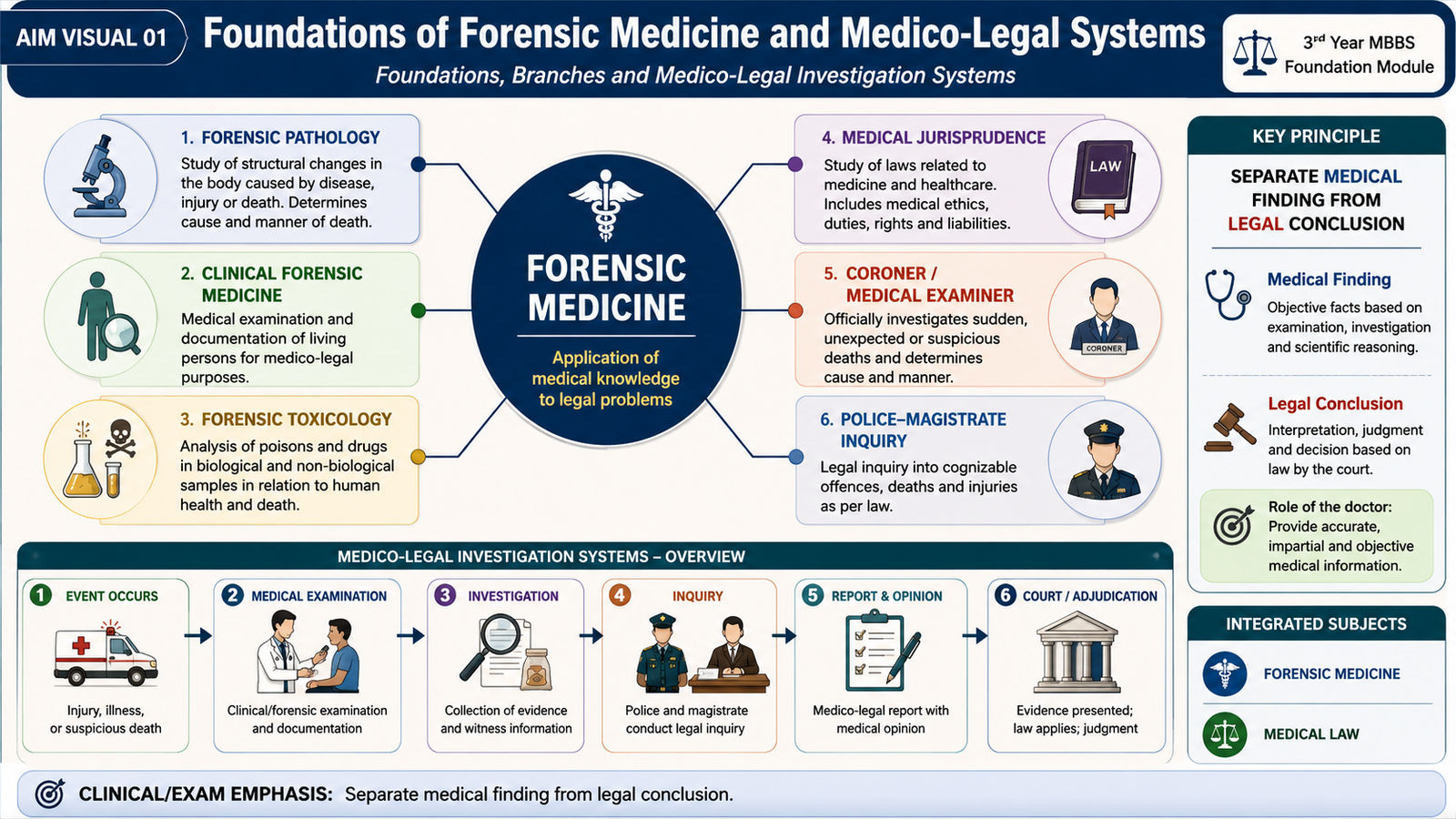
Forensic medicine is the application of medical knowledge and scientific principles to questions arising in law and the administration of justice. It becomes relevant whenever a medical finding has legal significance—for example, an injury, suspicious death, poisoning, sexual offence examination, age estimation or professional dispute. The doctor must separate a medical finding from the legal conclusion. The doctor describes and interprets the medical evidence within the limits of medical expertise; the final legal judgment belongs to the appropriate legal authority.
Major branches
The field is broad, but the most important undergraduate branches can be understood according to the type of medico-legal question being answered.
- Forensic pathology: application of pathology to injury and death, particularly the determination and interpretation of cause of death.
- Clinical forensic medicine: medico-legal examination of living persons, such as assessment and documentation of injuries.
- Forensic toxicology: study and detection of poisons, drugs and toxic substances in medico-legal situations.
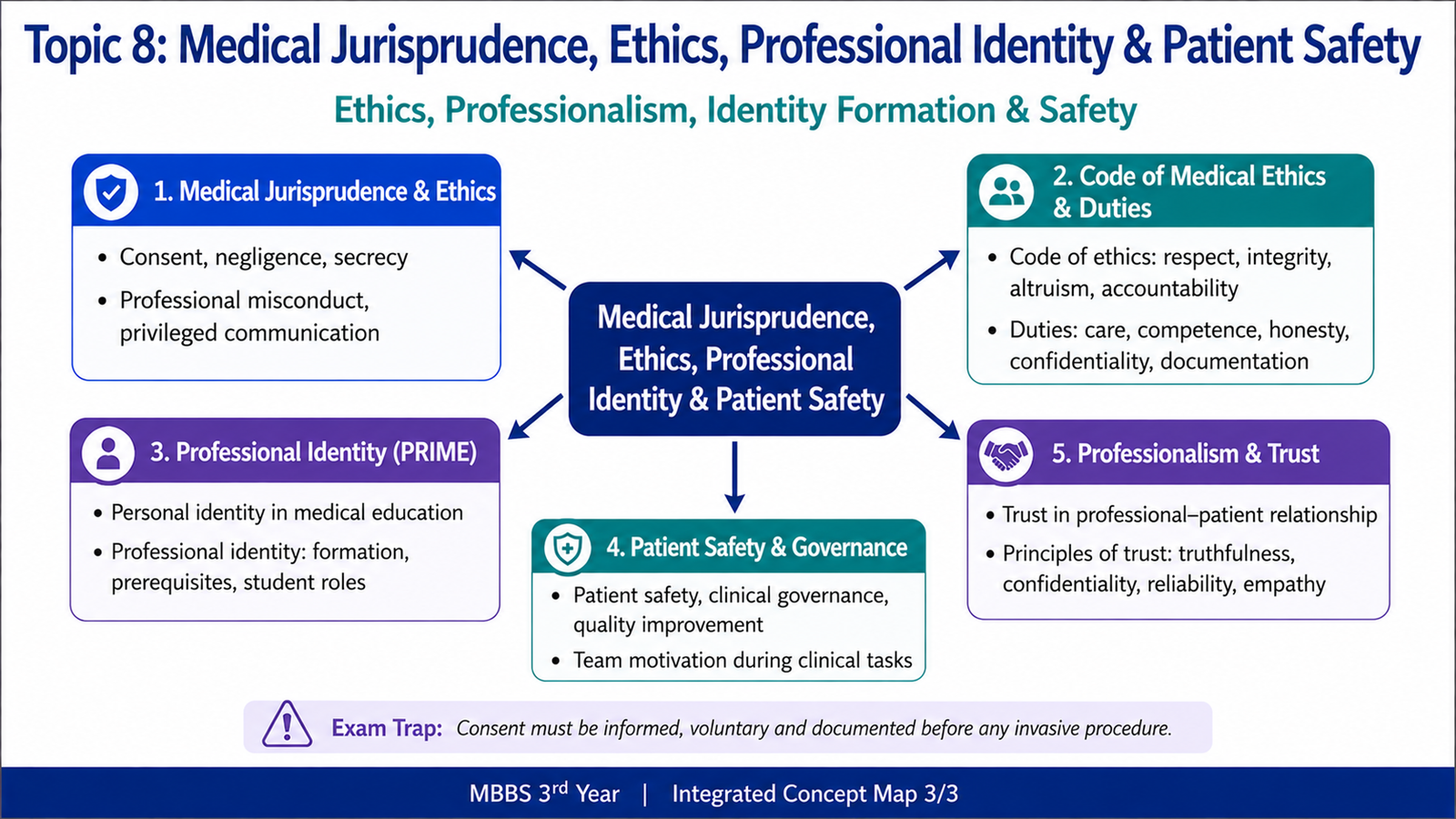
- Medical jurisprudence: legal and ethical principles governing medical practice, including consent, negligence, confidentiality and professional conduct.
- Forensic identification sciences: medical and biological methods that assist identification, such as examination of physical characteristics and biological material.
The practical pillars of forensic medical work
Different textbooks may group the field differently, so the word pillars should be understood as the major foundations on which medico-legal medical work rests. These include accurate medical examination, objective documentation, preservation and interpretation of evidence, and communication of an independent medical opinion to the legal system. Forensic pathology, clinical forensic medicine, toxicology and medical jurisprudence represent the major working domains through which these foundations are applied.
Important terminology
- Medico-legal case: a medical case in which legal investigation or legal responsibility may arise.
- Evidence: information or material placed before a competent legal authority to help establish or disprove a fact.
- Expert witness: a person with specialized knowledge who assists the court by giving an expert opinion within that field.
- Cause of death: the disease or injury responsible for initiating the sequence leading to death.
- Mechanism of death: the physiological or biochemical disturbance through which the cause produces death.
- Manner of death: the circumstances in which death occurred, such as natural, accidental, suicidal, homicidal or undetermined, depending on the legal system and available evidence.
- Chain of custody: documented continuity showing who collected, handled, transferred and received an evidentiary specimen or item.
Prevailing medico-legal systems
Systems for investigating sudden, suspicious or unnatural deaths differ between countries. The important principle for an undergraduate student is to recognize that responsibility may lie primarily with a coroner, a medical examiner or an investigating judicial/police authority working with medical experts.
| System | Basic idea | Main emphasis |
|---|---|---|
| Coroner system | A legally authorized coroner conducts or supervises investigation of specified deaths. | Judicial/legal inquiry supported by medical evidence. |
| Medical examiner system | A medically qualified forensic authority leads the medical investigation. | Specialist medical investigation of death. |
| Police / magistrate-based inquiry | Investigating legal authorities initiate inquiry and obtain medical examination or opinion when required. | Legal investigation with medical assistance. |
B. Medical Law, Courts and Medical Evidence
Medical practice takes place within a legal framework. Law is a body of enforceable rules recognized by the state for regulating conduct, protecting rights and resolving disputes. A doctor does not need to function as a lawyer, but must understand the legal principles that affect medical care, documentation, evidence and courtroom participation.
Types of law relevant to doctors
- Criminal law: deals with acts considered offences against the state or society. Medical evidence may be required in cases involving injury, poisoning, sexual offences or suspicious death.
- Civil law: deals with disputes between persons or organizations, including claims involving professional negligence or compensation.
- Administrative and professional regulation: governs registration, standards of professional conduct and disciplinary responsibility.
- Law of evidence and procedure: determines how facts, testimony, documents and expert opinions are presented and assessed in legal proceedings.
The doctor and court procedure
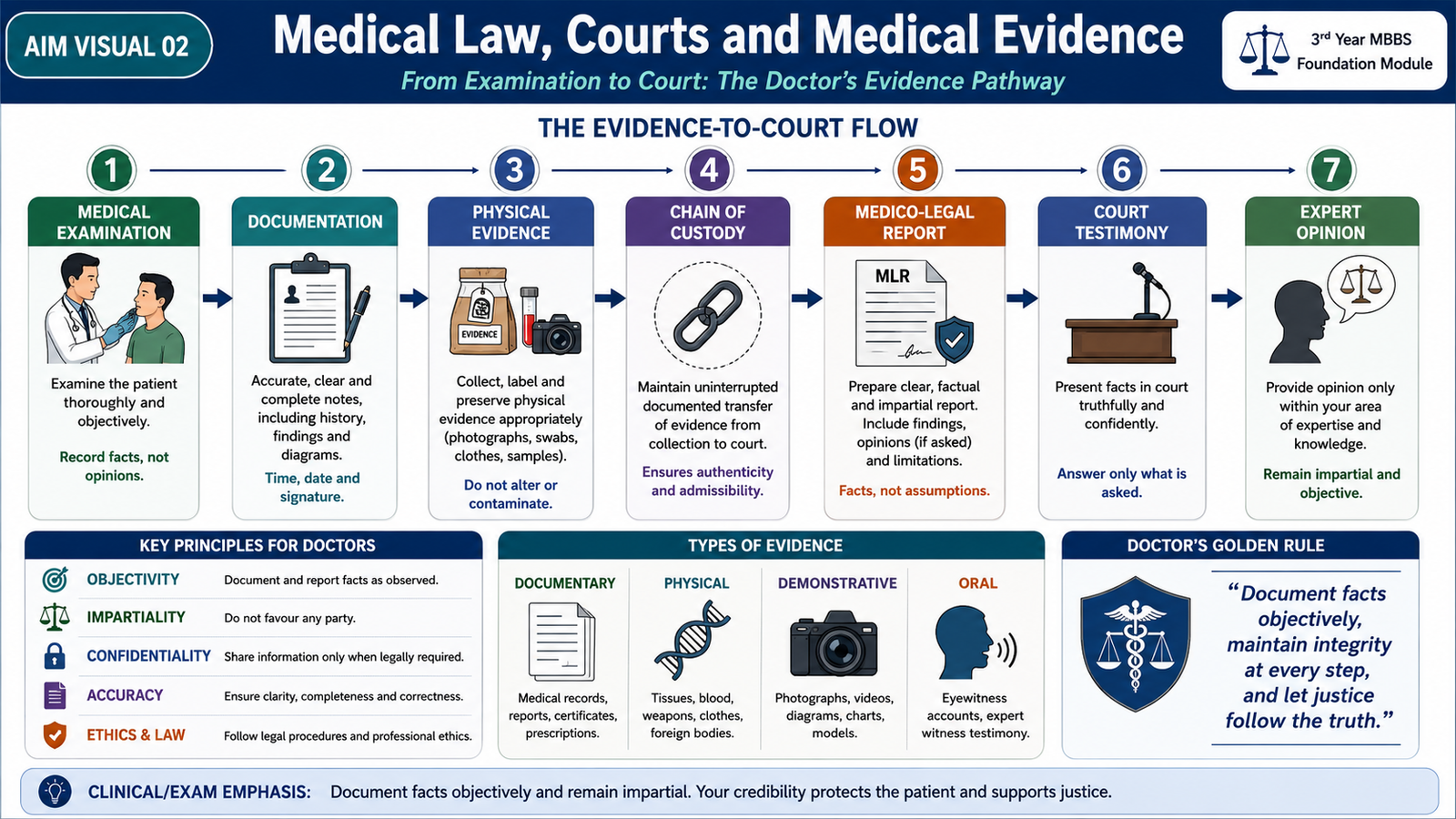
A doctor may appear before a court as an ordinary witness who reports personally observed facts, or as an expert witness who interprets medical findings using specialized knowledge. The doctor should remain impartial. The responsibility is not to secure conviction or acquittal, but to assist the court with accurate medical evidence.
A typical sequence is:
Evidence and its important forms
Medical evidence becomes useful only when it is reliable, relevant and properly communicated. Evidence may include oral testimony, written records, physical material, laboratory findings and expert opinion.
- Oral evidence: statements made by a witness before the court.
- Documentary evidence: written or recorded material such as medical records and medico-legal reports.
- Real or physical evidence: tangible material relevant to the investigation.
- Expert evidence: an informed opinion given by a person with specialized knowledge.
Principles of recording medical evidence
The strength of a medical opinion depends greatly on the quality of the original examination and records. Important principles are:
- record findings accurately and objectively;
- distinguish what the patient or another person reported from what the doctor observed;
- use clear medical terminology and avoid ambiguous statements;
- record negative findings when they are important to interpretation;
- avoid alteration or retrospective fabrication of records;
- identify and label specimens correctly;
- maintain appropriate continuity of possession when evidence is transferred;
- state conclusions only to the degree supported by the findings.
Pakistan Penal Code, criminal procedure and evidence law
For undergraduate medico-legal practice, students should understand the areas in which the Pakistan Penal Code and criminal procedural law become relevant to doctors: offences involving bodily injury, grievous injury, homicide, poisoning, sexual offences, false information or false evidence, and medico-legal investigation of suspicious or unnatural deaths. Criminal procedure governs how criminal cases are investigated and brought before the courts, while evidence law governs the admissibility and evaluation of testimony and expert opinion.
Pakistan’s official legal database lists the Qanun-e-Shahadat Order, 1984 as the federal law governing evidence. Because statutory text and amendments must be checked against the current official version, a student should not rely on an unverified section number when completing a legal document or medico-legal report. :contentReference[oaicite:1]{index=1}
C. Consent, Negligence, Confidentiality and Professional Misconduct
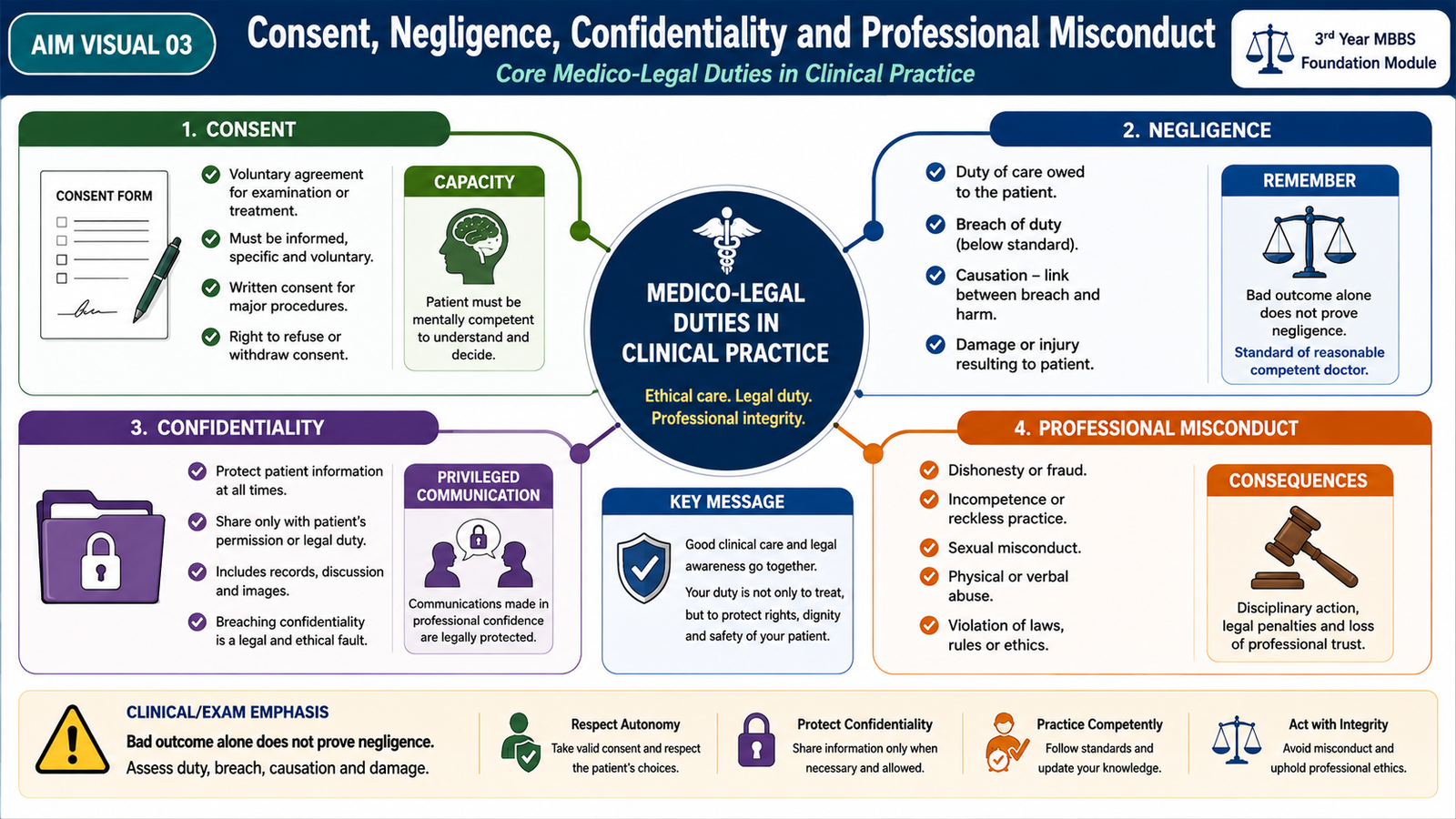
Medical jurisprudence deals with the duties, rights and responsibilities created by the doctor–patient relationship. Four particularly important concepts are consent, negligence, confidentiality and professional conduct. They are connected by one central principle: a doctor has professional power and specialized knowledge, and must use them in a way that respects the patient and meets accepted standards of practice.
Consent
Consent is a voluntary agreement by a competent person to undergo an examination, investigation, procedure or treatment. Valid consent is more than obtaining a signature. The patient must have sufficient information to make a meaningful decision and must be free from improper pressure.
The essential elements are:
- Capacity: the person must be capable of understanding and deciding.
- Information: sufficient relevant information should be provided in understandable language.
- Voluntariness: the decision should be made without coercion.
- Specificity: consent should relate to the examination or intervention being proposed.
- Communication: the patient should have an opportunity to ask questions and express a decision.
Consent may be implied from conduct in simple routine situations or express verbally or in writing. The more invasive or consequential the intervention, the greater the need for clear and appropriately documented consent. Emergency situations may create special legal and ethical considerations when immediate action is required and valid consent cannot be obtained; the doctor must act according to applicable professional and legal principles rather than treating emergency status as unlimited permission.
Medical negligence
Negligence means a failure to exercise the degree of reasonable care expected in the circumstances, resulting in legally relevant harm. An undesirable outcome alone does not prove negligence. Medicine has uncertainty, and complications may occur even when appropriate care is provided.
Examples of conduct that may raise a negligence question include failure to take an important history, failure to recognize a significant abnormal finding, unsafe prescribing, failure to communicate a serious result or performing an intervention without appropriate competence. Whether negligence is legally established depends on the facts and applicable legal standard, not merely on the presence of an error.
Professional secrecy and confidentiality
Information obtained during medical care is confidential. Maintaining confidentiality encourages patients to provide accurate information and therefore supports both trust and safe care. The doctor should not disclose identifiable patient information merely because another person is curious or because the information is interesting.
Confidential information may sometimes need to be disclosed when disclosure is properly authorized, required by law or justified by an overriding professional duty. When disclosure is necessary, the doctor should ordinarily disclose only what is relevant to the legitimate purpose.
Privileged communication
In forensic medicine teaching, privileged communication commonly describes disclosure of otherwise confidential information to an appropriate person or authority when the doctor has a recognized legal or professional justification for doing so. It is not a general permission to disclose patient information. The justification, recipient and extent of disclosure matter.
Professional misconduct
Professional misconduct is behaviour incompatible with the ethical and professional standards expected of a registered practitioner. Examples include dishonesty, exploitation of patients, serious breaches of confidentiality, falsification of medical documents, inappropriate relationships, practicing beyond competence without appropriate support and conduct that seriously undermines public trust in the profession.
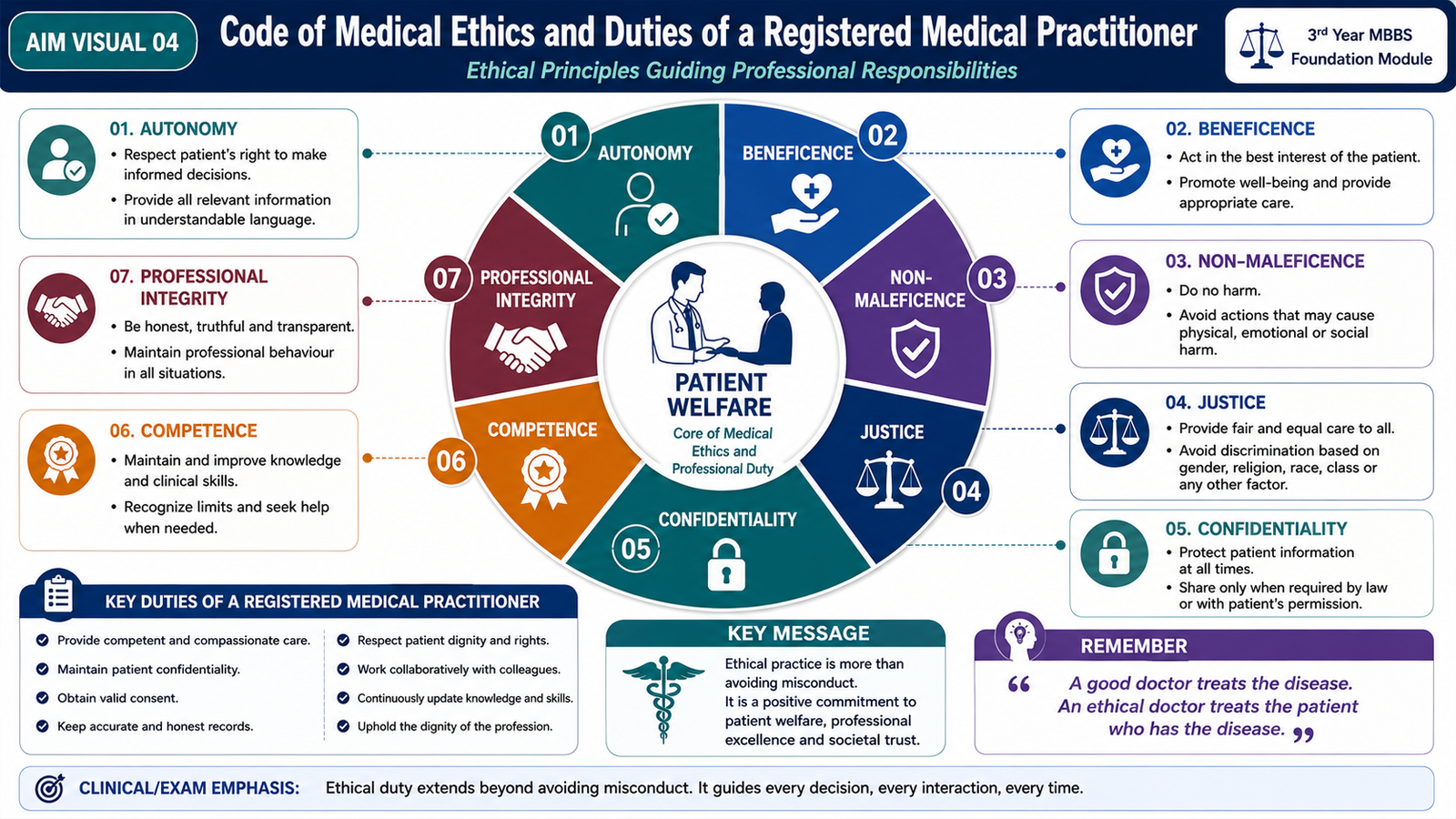
D. Code of Medical Ethics and Duties of a Registered Medical Practitioner
A code of medical ethics translates the values of medicine into standards of professional behaviour. Ethical practice is not limited to avoiding misconduct. It requires the doctor to place the patient’s legitimate interests at the centre of care while maintaining competence, honesty, respect and accountability.
Core ethical principles
- Respect for autonomy: respect the patient’s informed choices.
- Beneficence: act for the patient’s benefit.
- Non-maleficence: avoid unnecessary or preventable harm.
- Justice: treat people fairly and use healthcare resources responsibly.
- Confidentiality: protect information entrusted through professional care.
- Professional integrity: remain truthful, transparent and accountable.
Duties toward patients
The registered practitioner must provide care within personal competence and seek appropriate help when a patient’s needs exceed that competence. Respect should be maintained regardless of the patient’s background, status or behaviour.
- provide competent and compassionate care;
- obtain appropriate consent;
- maintain confidentiality;
- keep accurate clinical records;
- communicate honestly and clearly;
- recognize personal limitations and refer or seek senior help when appropriate;
- avoid exploitation of the doctor–patient relationship;
- respond appropriately to emergencies within professional capability.
Duties toward colleagues and the profession
Doctors work within teams, so professional behaviour toward colleagues also affects patient care. Respectful communication, appropriate referral, responsible handover and willingness to raise genuine safety concerns are professional duties rather than optional courtesies.
- communicate respectfully;
- share clinically relevant information during referral and handover;
- avoid dishonest criticism or misrepresentation of colleagues;
- support safe teamwork;
- maintain competence through continued learning;
- protect the integrity and reputation of the profession through ethical behaviour.
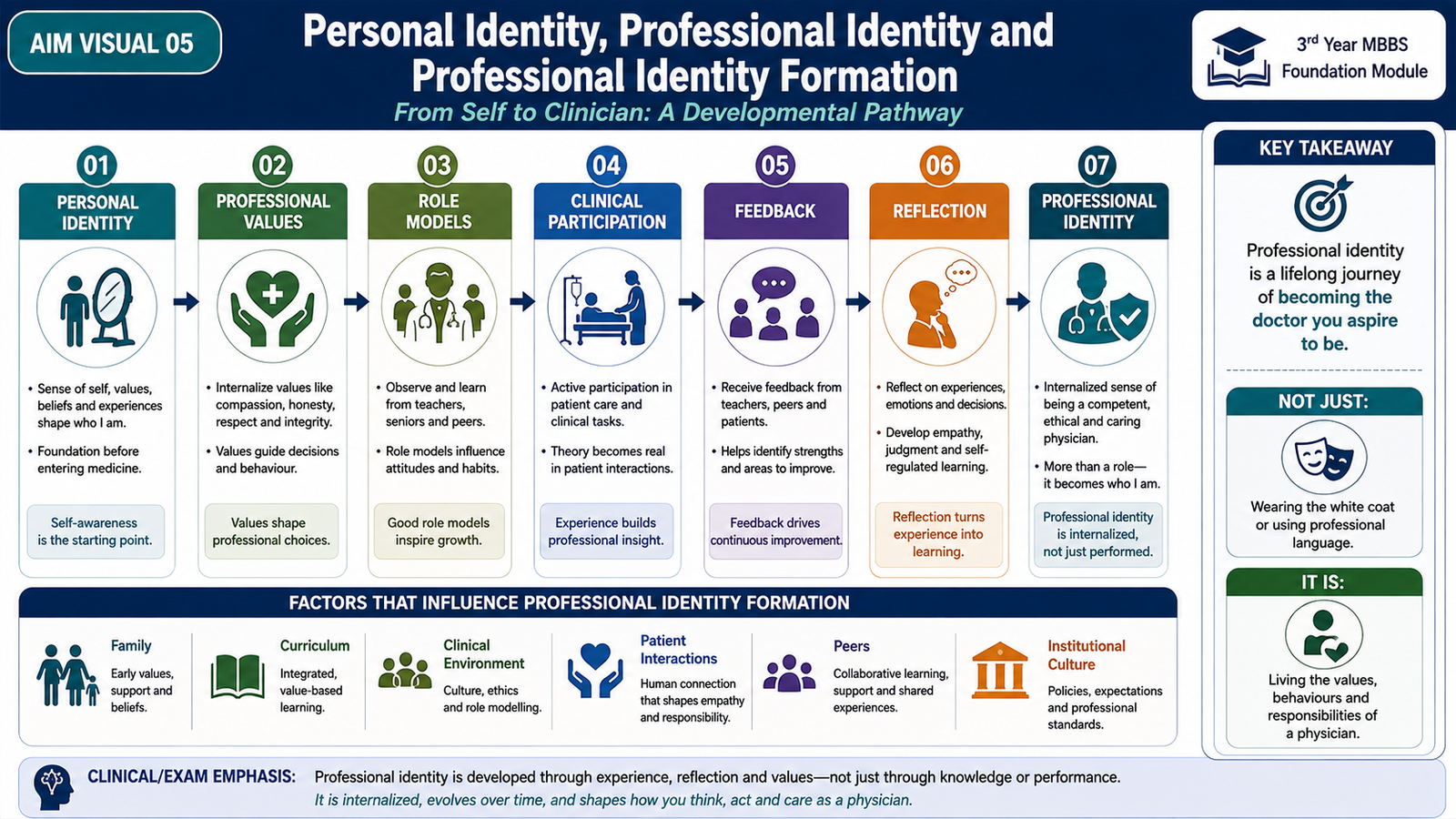
E. Personal Identity, Professional Identity and Professional Identity Formation
A medical student enters training with an existing personal identity—a developing understanding of who the person is, what values are important and how the person relates to others. Medical education adds another layer: professional identity. This is the internalized understanding of oneself as a doctor who belongs to a profession with specific knowledge, responsibilities, ethical values and social expectations.
Personal identity in medical education
Personal identity includes the student’s values, beliefs, strengths, responsibilities, communication style and previous experiences. Medical education does not simply erase this identity and replace it with a professional role. Instead, students gradually integrate professional expectations with their existing personal values.
Professional identity
Professional identity is more than wearing a white coat or performing clinical tasks. It means beginning to think and behave as a responsible member of the medical profession. A learner with developing professional identity increasingly asks not only, “What am I allowed to do?” but also, “What should a trustworthy doctor do in this situation?”
Prerequisites for professional identity formation
Professional identity develops when students are exposed repeatedly to the values and responsibilities of medicine and are given opportunities to practice them.
- understanding professional values and ethical standards;
- appropriate role models;
- meaningful participation in clinical and educational teams;
- reflection on experiences and feedback;
- progressive responsibility appropriate to competence;
- respectful learning environments;
- accountability for behaviour and decisions.
Professional identity formation
Professional identity formation (PIF) is the continuing developmental process through which a learner gradually internalizes the values, behaviours and responsibilities of the medical profession. It is therefore different from simply memorizing a list of professionalism rules.
The student’s role
Students are active participants in their own professional development. They should observe professional behaviour critically, seek feedback, reflect on mistakes, accept responsibility, respect patients and colleagues, and recognize when an action conflicts with the standards expected of a future doctor.
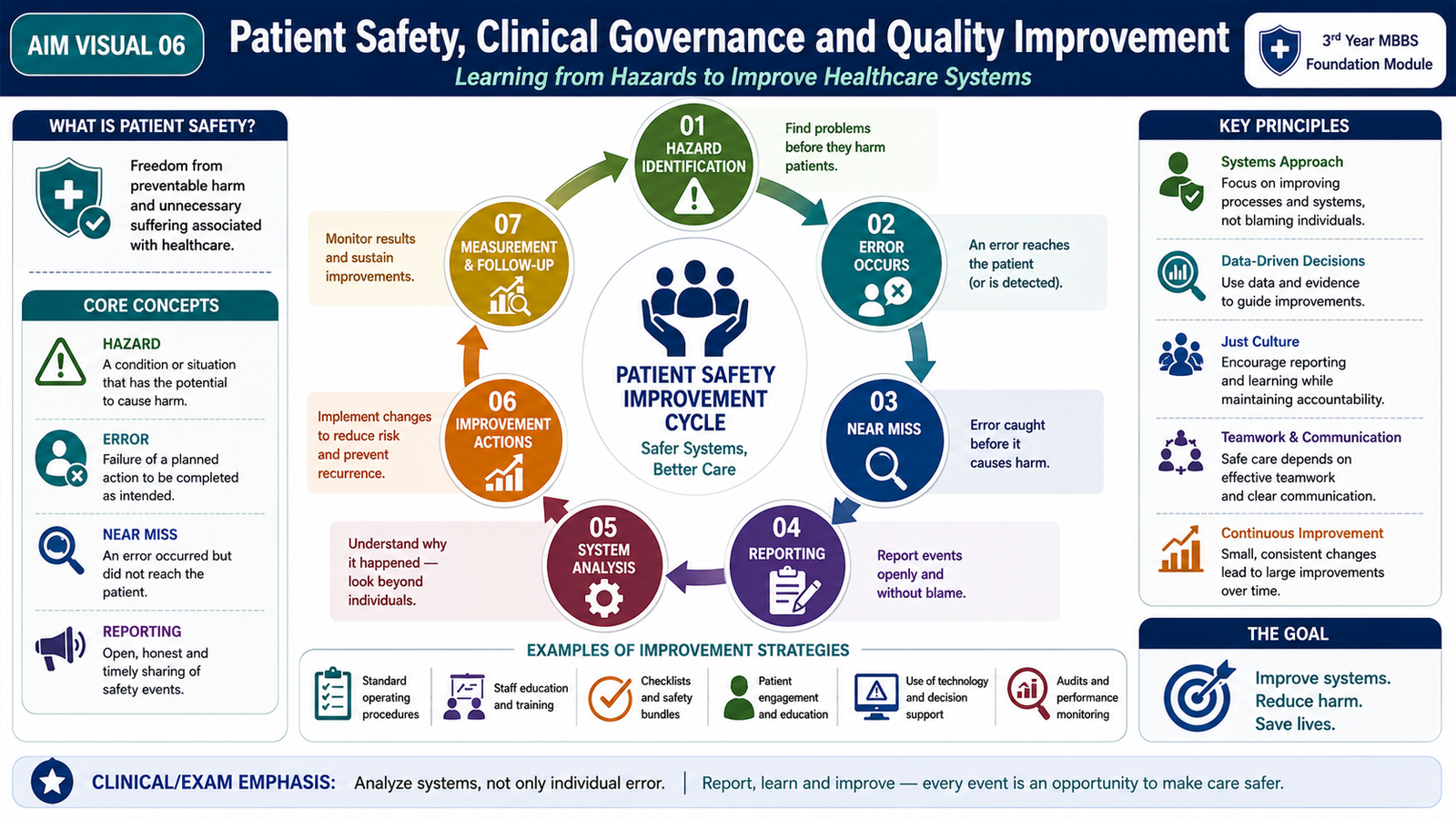
F. Patient Safety, Clinical Governance and Quality Improvement
Patient safety is the organized effort to reduce preventable harm associated with healthcare. Safe care depends not only on an individual doctor’s knowledge but also on communication, teamwork, reliable systems, appropriate supervision and the ability to learn from mistakes and near misses.
Understanding patient safety
An error may occur when the intended plan is not carried out correctly or when the wrong plan is chosen. Not every error produces harm. A near miss is an event that could have caused harm but did not, either by chance or because it was detected in time. Near misses are valuable because they reveal weaknesses before a patient is injured.
Common areas in which safety problems may arise include:
- patient identification;
- medication prescribing and administration;
- communication and handover;
- failure to act on investigation results;
- infection prevention;
- procedural errors;
- inadequate supervision or escalation of a deteriorating patient.
Systems approach to safety
Patient harm often results from several contributing factors rather than one isolated act. For example, a medication error may involve an unclear prescription, similar packaging, an interruption during administration and failure of an independent check. A systems approach asks what conditions allowed the error to occur and how the system can be made safer.
Clinical governance
Clinical governance is the framework through which healthcare organizations and professionals are accountable for maintaining and continuously improving the quality and safety of care. It links individual professional responsibility with organizational systems.
Its practical components include:
- evidence-informed clinical practice;
- clinical audit;
- risk management and patient safety;
- education and professional development;
- effective use of information;
- clear accountability;
- involvement of patients in improving care.
Quality improvement in primary healthcare
Quality improvement (QI) is a structured process of identifying a gap in care, introducing a change and examining whether the change produces improvement. In primary healthcare, QI may involve better follow-up systems, safer prescribing, improved documentation, improved communication of test results or more reliable preventive care processes.
A simple improvement cycle can be understood as:
Quality improvement is different from blaming an individual. Accountability remains important, especially for deliberate unsafe behaviour, but a mature safety culture also examines system weaknesses that make error more likely.
G. Professionalism, Trust and Motivation within Healthcare Teams
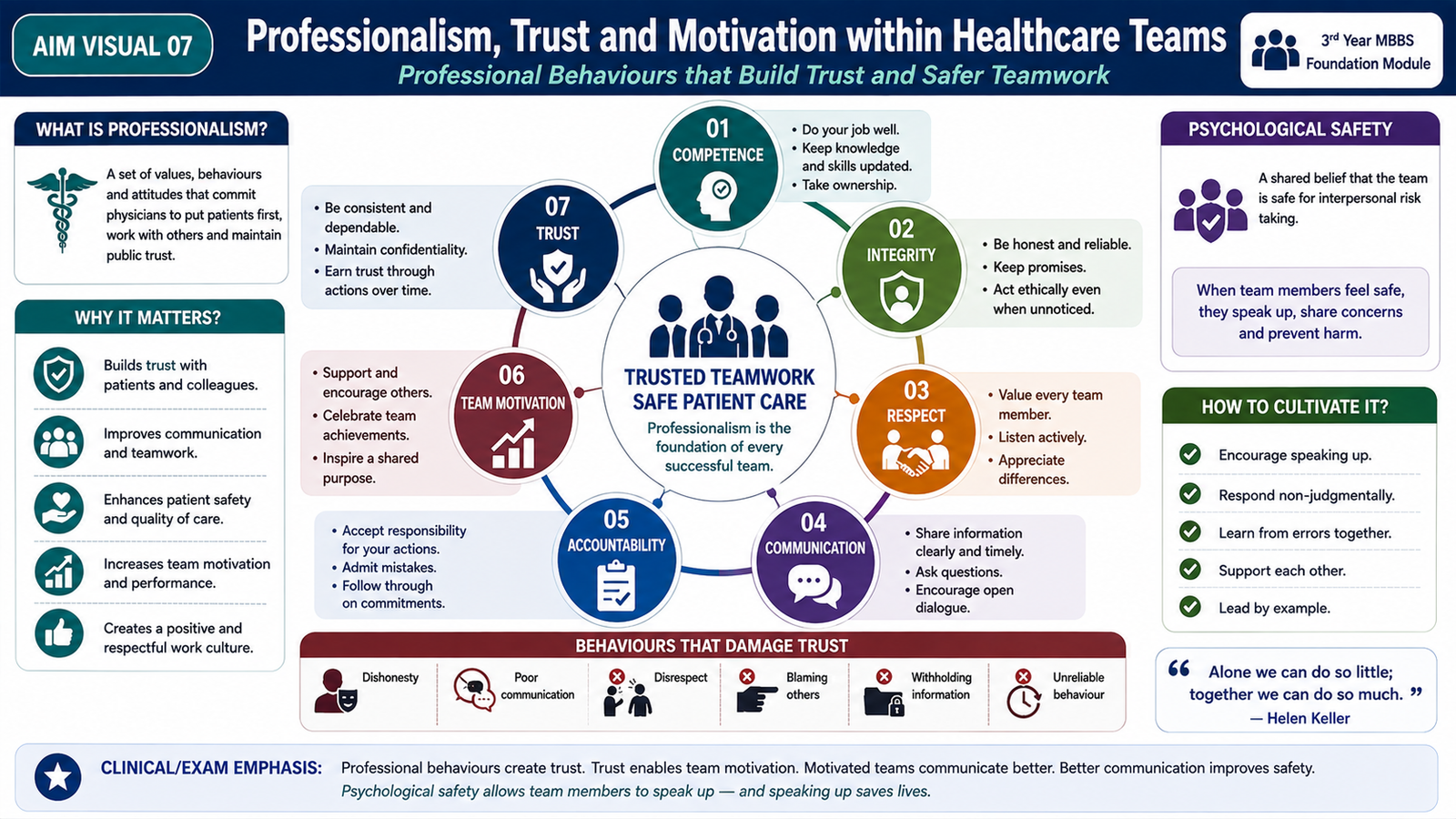
Professionalism is the consistent expression of medical knowledge, ethical values, accountability and respectful behaviour in the service of patients and society. One of its most important outcomes is trust. Patients often reveal highly personal information and permit doctors to examine or treat them because they believe that the professional will use medical knowledge responsibly.
Dynamics of professionalism and trust
Trust is not created by qualifications alone. It develops through repeated professional behaviour. Competence without honesty is not enough, and kindness without competence is not enough. Patients need both technical reliability and ethical reliability.
Trust can be weakened by misleading information, disrespect, failure to maintain confidentiality, unexplained delays, poor communication, avoidance of responsibility or behaviour suggesting that the professional’s personal interest is being placed above the patient’s welfare.
Principles underlying trust in professional interactions
- Competence: perform responsibilities within the limits of knowledge and skill.
- Integrity: behave consistently with ethical standards even when behaviour is not being observed.
- Honesty: communicate truthfully and avoid deception.
- Respect: recognize the dignity, rights and perspectives of others.
- Confidentiality: handle private information responsibly.
- Reliability: carry out agreed responsibilities and communicate when this is not possible.
- Accountability: accept responsibility for actions and participate in correcting problems.
Motivating team members during clinical tasks
Clinical teams function better when members understand the shared goal, know their responsibilities and feel that their contribution is valued. Motivation in healthcare should therefore be linked to patient care rather than simply to personal reward.
Useful motivational skills include:
- Clarify the goal: explain what the team must achieve for the patient.
- Define roles: ensure each member knows what is expected.
- Communicate respectfully: instructions should be clear without humiliation or unnecessary aggression.
- Recognize contribution: appropriate appreciation reinforces effective behaviour.
- Invite participation: team members should be able to raise relevant concerns and information.
- Provide constructive feedback: address what can be improved and how it can be improved.
- Model professionalism: leaders influence behaviour through their own conduct.
- Maintain psychological safety: team members should be able to speak up about genuine safety concerns.
Integrated Professional Responsibility Flow
↓
Competent examination, communication and decision-making
↓
Valid consent + confidentiality + accurate documentation
↓
Safe care and responsible teamwork
↓
Recognition and improvement of system weaknesses
↓
Accountability to patients, profession and law
↓
Professional trust and safer healthcare
Important Comparison — Ordinary Witness vs Expert Witness
| Feature | Ordinary / Fact Witness | Expert Witness |
|---|---|---|
| Main role | States facts personally observed. | Uses specialized knowledge to interpret relevant facts. |
| Opinion | Generally limited to factual observations. | May give an expert opinion within established expertise. |
| Doctor example | Describes an injury seen during examination. | Explains the medical significance or likely mechanism of that injury. |
| Core duty | Accuracy. | Accuracy, impartiality and opinion within expertise. |
⭐ AIM High-Yield Review
- Forensic medicine applies medical knowledge to legal questions and the administration of justice.
- A forensic doctor must distinguish medical findings from the final legal conclusion.
- Major forensic domains include forensic pathology, clinical forensic medicine, toxicology and medical jurisprudence.
- Cause of death, mechanism of death and manner of death are different concepts.
- ⭐ Accurate contemporary documentation is one of the strongest foundations of reliable medical evidence.
- An expert witness should remain independent and impartial and stay within the limits of expertise.
- Valid consent requires appropriate capacity, information and voluntariness.
- ⭐ A poor outcome or recognized complication does not automatically prove negligence.
- Confidentiality supports both patient autonomy and professional trust; disclosure requires proper justification.
- Professional identity formation is a developmental process involving role models, participation, reflection, feedback and increasing responsibility.
- Patient safety focuses on reducing preventable harm and learning from both adverse events and near misses.
- Clinical governance links individual professional practice with organizational accountability for quality and safety.
- Quality improvement follows a cycle of identifying a problem, changing the process and measuring whether care improves.
- ⭐ Professional trust depends on competence together with honesty, integrity, respect, confidentiality and accountability.
- Effective team motivation requires clear goals, defined roles, respectful communication, constructive feedback and the ability to speak up about safety concerns.
Forensic Medicine, Medical Law, Professionalism & Patient Safety
Use these videos with the AIM Learning Material. Multiple videos are provided because the topic combines forensic medicine, medical ethics, professional identity and patient safety.
Legal Procedure — MBBS 3rd Year
Covers important legal procedures relevant to forensic medicine, including the doctor’s medico-legal role and documentation.
Medical Evidence & Witness — Documentary vs Oral Evidence
Useful for understanding medical evidence, documentary and oral evidence, witnesses and the doctor’s role when medical findings enter legal proceedings.
Medical Ethics — MBBS 3rd Year
Covers core medical-ethics concepts including informed consent and confidentiality, complementing the AIM sections on professional duties and medical jurisprudence.
Defining & Understanding Professional Identity Formation
Supports the PRIME learning outcomes on professional identity and the process through which medical learners develop their identity as physicians.
Clinical Governance in Healthcare
Explains clinical governance as a framework for maintaining and improving healthcare quality and patient safety.
Start with Videos 01–02 for forensic medicine and legal procedure, then Video 03 for medical ethics, Video 04 for professional identity formation, and finish with Video 05 for patient safety and clinical governance.