
Topic 14 — Thanatology, Diagnosis of Death and Death Certification
Topic Introduction
Thanatology is the study of death and the changes and circumstances associated with it. For a doctor, death is not simply the moment when a person stops moving or breathing. The diagnosis must be made carefully because declaring death has major medical, social and medico-legal consequences. Students must also understand that the cause, mechanism, mode and manner of death describe different aspects of the same event. Finally, an accurate death certificate provides a medically meaningful sequence explaining why the person died and also contributes to mortality statistics and public-health planning. This chapter develops these concepts step by step without extending beyond the required undergraduate scope.
A. Death, Thanatology and the Phases of Death
Death is best understood as a process rather than as a single isolated instant. During dying, vital functions fail progressively until the organism can no longer maintain integrated life. This distinction is important because some functions may temporarily disappear while resuscitation is still possible, whereas irreversible loss of vital functions represents established death.
Definition of Death
In practical medical terms, death is the irreversible cessation of the functions necessary to maintain the life of the individual as an integrated organism. Traditionally this was recognized by permanent cessation of circulation and respiration. Modern medicine also recognizes irreversible loss of brain-stem function in the appropriate clinical setting.
Phases in the Process of Death
The terminology used in textbooks may vary slightly, but the central principle is that loss of life occurs progressively. The important undergraduate phases are clinical or somatic death followed by cellular or molecular death.
| Phase | Meaning | Key Point |
|---|---|---|
| Clinical / somatic death | The individual no longer shows integrated vital functions such as effective circulation, respiration and consciousness. | This concerns death of the person as a whole. |
| Cellular / molecular death | Individual cells and tissues progressively lose viability after circulation has stopped. | Different tissues do not die simultaneously. |
The fact that cellular death occurs progressively explains why some tissues remain biologically active for a period after somatic death. Therefore, the death of the individual should not be confused with instantaneous death of every cell in the body.


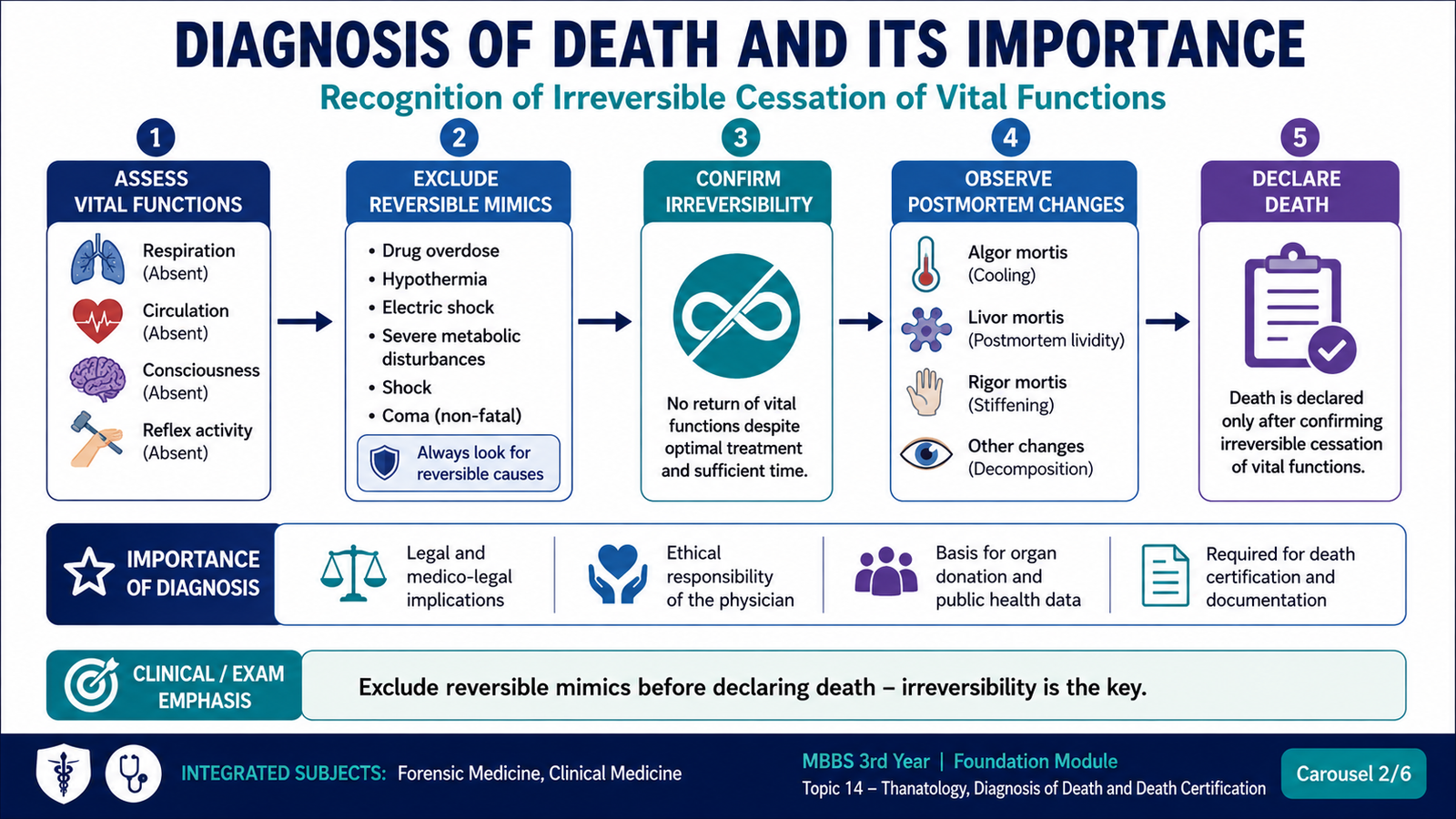
B. Diagnosis of Death and Its Importance
The diagnosis of death must establish that vital functions have ceased irreversibly. A doctor should not rely on one superficial observation, such as apparent absence of breathing. The findings are assessed together and interpreted in the clinical circumstances.
Criteria Used in the Diagnosis of Death
In ordinary cardiopulmonary death, the doctor looks for a consistent combination of findings indicating permanent cessation of circulation, respiration and neurological responsiveness. Important observations include:
- absence of spontaneous respiration;
- absence of effective circulation and cardiac activity;
- absence of consciousness and purposeful response;
- absence of relevant reflex activity in a person in whom death is established;
- subsequent development of postmortem changes, which provides additional confirmation when present.
No single finding should be interpreted blindly. Severe hypothermia, poisoning, metabolic depression and certain neurological conditions may markedly suppress vital functions and can sometimes imitate death. This is one reason why the circumstances of the patient must always be considered.
Why Establishing Death Correctly Is Important
Declaring death changes the legal and medical status of the individual. It ends active treatment directed toward preserving the patient’s life and begins responsibilities related to documentation, communication, examination of the body and, where relevant, medico-legal procedures. Correct diagnosis is therefore important because it:
- prevents premature declaration of death;
- provides a clear medical endpoint for treatment;
- allows appropriate completion of medical documentation;
- supports correct reporting of the cause of death;
- may determine whether a death requires medico-legal investigation;
- allows appropriate handling and disposal of the body;
- provides reliable information for mortality statistics and public-health analysis.
C. Brain-Stem Death and Suspended Animation


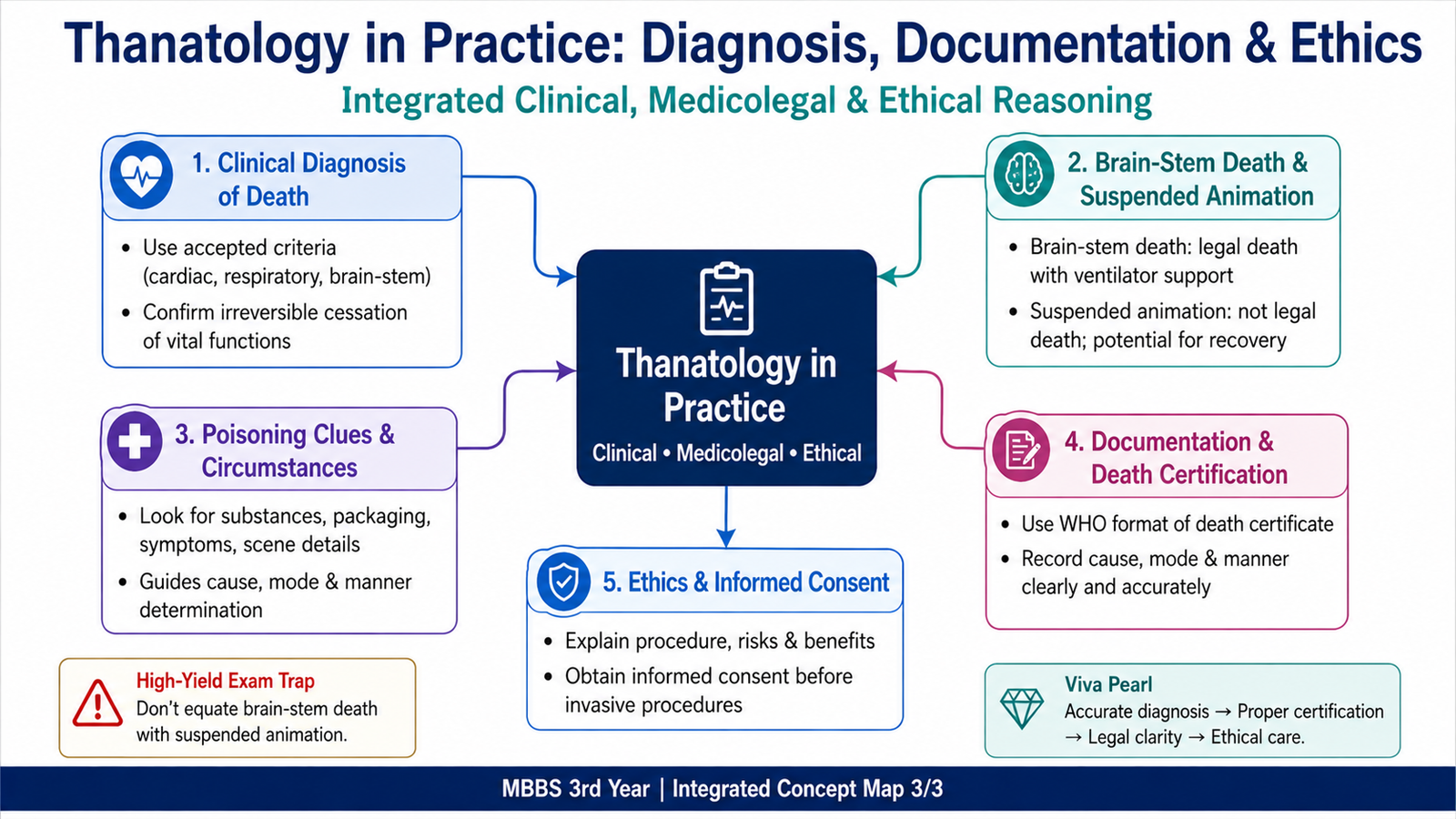
Brain-stem death and suspended animation are important because both involve situations in which ordinary bedside appearances may create confusion. However, they represent fundamentally different states. Brain-stem death is irreversible, whereas suspended animation refers to profound suppression of vital functions in which life may still be present.
Brain-Stem Death
The brain stem contains centres necessary for spontaneous respiration and important cranial nerve reflexes. Brain-stem death means irreversible loss of brain-stem function. A patient may still have circulation for some time because mechanical ventilation and intensive care can maintain oxygenation and cardiac activity even though the brain stem has irreversibly ceased to function. The diagnosis therefore depends on a formal clinical assessment performed under appropriate conditions. Before testing brain-stem function, the clinical team must be satisfied that there is a sufficient explanation for the severe brain injury and that potentially reversible causes of profound neurological depression have been excluded. Important principles include:
- the neurological condition responsible for the loss of brain function must be established;
- reversible factors capable of suppressing neurological responses must be excluded;
- brain-stem reflexes are assessed systematically;
- absence of the drive to breathe is assessed according to the applicable clinical protocol;
- findings must be properly documented;
- the assessment must follow the professional and legal requirements applicable to the institution and jurisdiction.
Medico-Legal Importance of Brain-Stem Death
Brain-stem death has major medico-legal importance because mechanical ventilation can maintain heartbeat and circulation despite irreversible loss of brain-stem function. The diagnosis may affect decisions concerning continuation of artificial support, certification of death and possible organ donation where such donation is medically and legally appropriate. Because of these consequences, brain-stem death should never be diagnosed casually. The criteria, examinations, timing and documentation must follow the accepted professional and legal framework rather than personal judgment alone.
Suspended Animation
Suspended animation, sometimes described as apparent death, is a state in which vital functions are so greatly depressed that signs of life may be extremely difficult to detect, although the person is not truly dead. The crucial feature is that the suppression may be reversible. Situations capable of producing profound physiological depression must therefore be approached cautiously. Examples include severe hypothermic states, certain poisonings, severe metabolic depression and some forms of profound unconsciousness. Its medico-legal importance lies primarily in the danger of wrongly certifying a living person as dead. When the circumstances raise doubt, careful clinical assessment and appropriate attempts to identify reversible causes are essential.
| Feature | Brain-Stem Death | Suspended Animation |
|---|---|---|
| Basic state |
D. Cause, Mechanism, Mode and Manner of Death
These four terms answer different questions about a death. They are frequently confused in examinations and in medical documentation. The easiest way to separate them is to ask: What produced the fatal sequence? How did the body fail? What broad physiological pathway occurred? Under what circumstances did the death happen?
Cause of Death
The cause of death is the disease, injury or pathological condition responsible for initiating the sequence that resulted in death. It identifies the medical condition that produced the fatal process. For example, if a person develops massive intracranial hemorrhage after a traumatic head injury and dies, the relevant cause should identify the injury or pathological condition responsible for the fatal sequence rather than merely state that the heart stopped.
Mechanism of Death
The mechanism of death is the physiological or biochemical disturbance produced by the cause of death. It explains how the disease or injury actually causes the vital functions to fail. Examples of mechanisms include severe hemorrhage producing circulatory collapse or extensive lung disease producing profound respiratory failure. A mechanism usually does not identify the underlying disease sufficiently by itself.
Mode of Death
Mode of death is a broader physiological description of the way vital functions finally fail. Classical descriptions include failure primarily involving the cardiovascular, respiratory or central nervous system. Such terms may help describe the terminal process, but they should not replace a meaningful etiological cause on a death certificate.
Manner of Death
The manner of death describes the circumstances in which the cause of death arose. Common medico-legal categories include:
- Natural — death due to disease without an external injury being responsible for the fatal event.
- Accidental — death resulting from an unintended external event.
- Suicidal — death resulting from an intentional act directed by a person toward himself or herself.
- Homicidal — death resulting from the act of another person under circumstances classified as homicide.
- Undetermined — used when available information is insufficient to assign another manner confidently.
The exact medico-legal classification and authority responsible for determining manner can vary according to local law and investigative systems. Therefore, uncertain circumstances should not be converted into an unsupported conclusion by the treating doctor.
| Term | Question It Answers | Example |
|---|---|---|
| Cause | What disease or injury produced death? | Acute myocardial infarction |
| Mechanism | What physiological disturbance caused vital failure? | Fatal arrhythmia or circulatory failure |
| Mode | What broad type of vital-system failure occurred? | Cardiovascular failure |
| Manner | Under what circumstances did death occur? | Natural, accidental, suicidal or homicidal |

E. Disposal of a Dead Body
Disposal of the dead body means the final method by which human remains are dealt with after death, following the necessary medical, administrative and medico-legal requirements. The method used is influenced by cultural, religious, social and legal considerations.
Recognized methods include:
- Burial — placement of the body in the ground according to accepted social, religious and legal practice.
- Cremation — reduction of the body by burning in an appropriate facility or according to accepted practice.
- Burial at sea — used in particular circumstances and subject to relevant regulations.
- Other legally and culturally accepted methods — practices may vary between societies and jurisdictions.
From the medico-legal perspective, the important principle is that disposal should not interfere with a required investigation. When a death is suspicious, unnatural or otherwise subject to medico-legal examination, the necessary authorization and investigative process must be completed before final disposal according to the applicable system.

F. Death Certification and the WHO Cause-of-Death Format
A medical certificate of cause of death should explain the sequence of diseases or injuries that led to death. Its purpose is not simply to record that circulation or respiration stopped, because these events occur in all deaths. Instead, the certificate should identify the medically meaningful condition that initiated and produced the fatal sequence.
Why Accurate Death Certification Matters
Death certification has both individual and population-level importance. It provides an official medical account of why a person died and contributes to mortality data used to understand patterns of disease in the community. Accurate certification therefore helps:
- document the medical cause of an individual death;
- distinguish the immediate cause from the condition that started the fatal sequence;
- produce reliable mortality statistics;
- identify important causes of death in populations;
- support public-health planning and evaluation;
- avoid misleading records based only on terminal events.
Basic WHO Structure
The standard international medical certificate separates the causal sequence in Part I from other significant contributing conditions in Part II.
The upper line records the immediate cause of death: the disease, injury or complication directly resulting in death.
If that condition resulted from another disease or condition, the antecedent cause is entered on the next line. The sequence continues downward until the condition that began the fatal chain is reached.
The condition entered on the lowest completed line of Part I is generally the underlying cause of death: the disease or injury that initiated the chain of events leading directly to death.
Part II records other important diseases or conditions that contributed to the death but were not part of the direct causal sequence written in Part I.
Immediate, Antecedent and Underlying Cause
The relationship between these terms can be understood as a chain:
For example, suppose a patient with a serious underlying disease develops a recognized complication that directly produces death. The immediate complication is written above the disease that produced it, preserving the biological sequence from the underlying cause upward toward death.
Principles of Correct Certification
Good certification requires the doctor to think causally. Each condition in Part I should reasonably explain the condition written above it.
- Use a specific disease, injury or pathological condition whenever it is known.
- Arrange conditions in a logical causal sequence.
- Place the immediate cause first and trace backward to the underlying cause.
- Record unrelated but significant contributing conditions in Part II.

Integrated Mechanism Flow — From Death to Certification
Important Comparison — Cause vs Mechanism vs Mode vs Manner
| Concept | Core Meaning | Think | Typical Example |
|---|---|---|---|
| Cause | Disease or injury responsible for the fatal sequence | “What started it?” | Myocardial infarction |
| Mechanism | Physiological disturbance by which the cause produces death | “How did it kill?” | Fatal arrhythmia |
| Mode | Broad type of failure of vital function | “Which vital system failed?” | Cardiovascular failure |
| Manner | Circumstances surrounding the death | “Under what circumstances?” | Natural or accidental |
⭐ AIM High-Yield Review
- Death is a process: death of the individual occurs before every cell and tissue has necessarily lost viability.
- Diagnosis of death requires irreversibility. Apparent absence of breathing or response alone is not sufficient when a reversible mimic is possible.
- Brain-stem death is irreversible loss of brain-stem function and must be determined according to an accepted formal clinical and legal framework.
- Suspended animation is apparent death due to profound depression of detectable vital functions; the condition may still be reversible.
- Cause of death = the disease or injury responsible for initiating the fatal sequence.
- Mechanism of death = the physiological or biochemical disturbance through which the cause produces death.
- Mode of death describes the broad pattern of vital-system failure and should not replace the etiological cause on certification.
- Manner of death concerns the circumstances of death, such as natural, accidental, suicidal, homicidal or undetermined.
- ⭐ Cardiac arrest is not usually an adequate etiological cause of death because it merely describes a terminal event.
- Part I of the WHO medical certificate records the direct causal sequence leading to death.
- The immediate cause appears first in Part I; antecedent conditions are entered below it.
- ⭐ The underlying cause is the disease or injury that initiated the sequence leading directly to death and is generally entered on the lowest completed line of Part I.
- Part II contains significant conditions that contributed to death but were not part of the direct sequence in Part I.
- Accurate death certification matters beyond the individual patient because mortality data contribute to understanding disease burden and public-health planning.
- Final exam distinction: cause tells you what produced death; mechanism tells you how it killed; manner tells you the circumstances in which it happened.