
Topic 22 — Forensic Sexual Medicine: Virginity, Sexual Offences, Sexual Perversions and Abortion
Topic Introduction
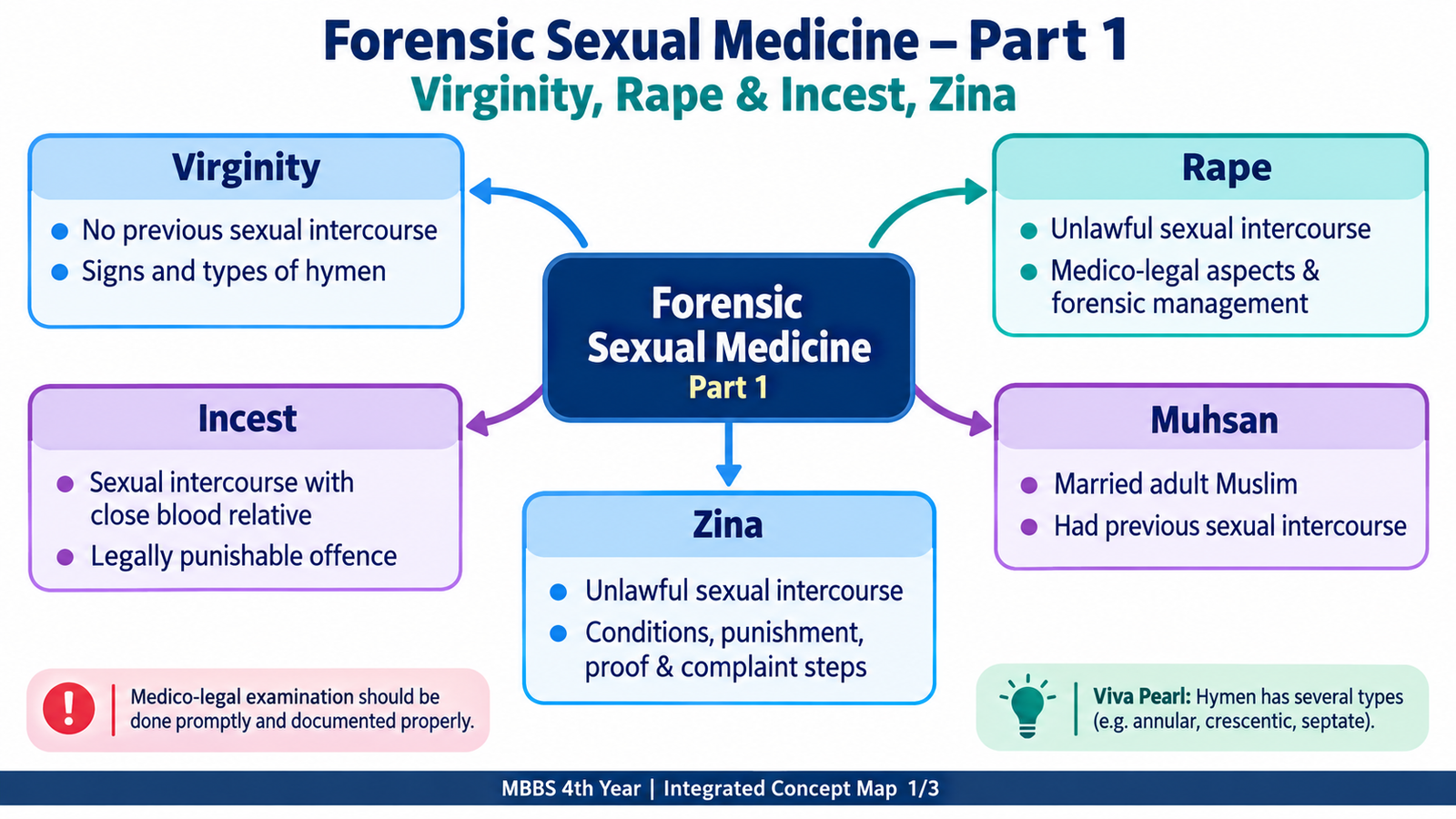
Forensic sexual medicine deals with medical findings that may have legal importance in matters involving sexual activity, alleged sexual offences and reproductive events. The doctor’s role is not to decide whether an offence occurred. Instead, the doctor obtains consent, records the history, performs an appropriate examination, documents findings objectively, collects relevant specimens and explains the medical significance and limitations of those findings. In this chapter, you will learn how virginity and hymenal appearances should be interpreted cautiously, how rape and other sexual offences are approached forensically, the basic legal concepts of zina and Muhsan required by the curriculum, important historical and modern terminology related to sexual behaviours, and the forensic distinction between natural and unlawful induced abortion.
A. Virginity and Hymenal Variations
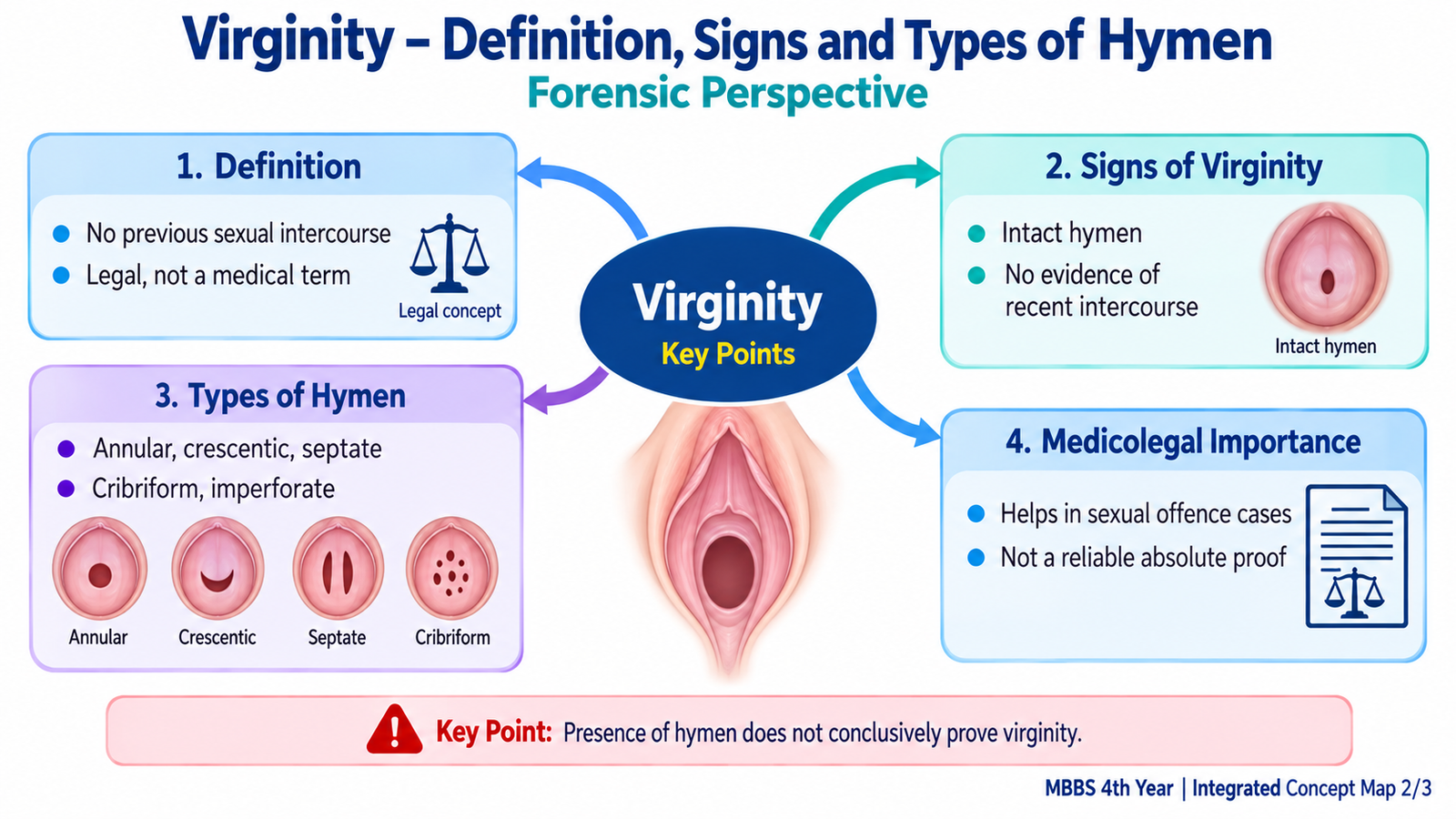
Virginity is traditionally described in forensic medicine as the state of a person who has not experienced sexual intercourse. However, virginity is a social and sexual-history concept rather than a diagnosis that can be established by physical examination alone. This distinction is essential because the appearance of the hymen and external genitalia varies considerably between individuals.
Signs traditionally described in forensic examination
Older forensic descriptions list several genital findings as being compatible with absence of previous vaginal penetration. These findings may be recorded during examination, but none is sufficiently specific to prove virginity.
- Labia majora may lie in close apposition.
- Labia minora may be relatively covered by the labia majora.
- The posterior fourchette may be intact.
- The vaginal introitus may appear relatively narrow.
- The hymen may be intact and show one of several normal anatomical forms.
Common Types of Hymen
The hymen is a variable fold of mucosal tissue surrounding part of the vaginal opening. Several normal configurations are described.
| Type | Basic Appearance |
|---|---|
| Annular | Ring-like hymenal tissue surrounding a central opening. |
| Crescentic / Semilunar | Crescent-shaped rim, usually more prominent posteriorly. |
| Septate | A band of hymenal tissue divides the opening. |
| Cribriform | Several small openings are present in the hymenal membrane. |
| Fimbriated | The free margin has an irregular or fringed appearance. |
| Imperforate | No opening is present; this represents a developmental abnormality rather than evidence related to sexual activity. |

B. Rape: Legal Definition and Medico-Legal Meaning
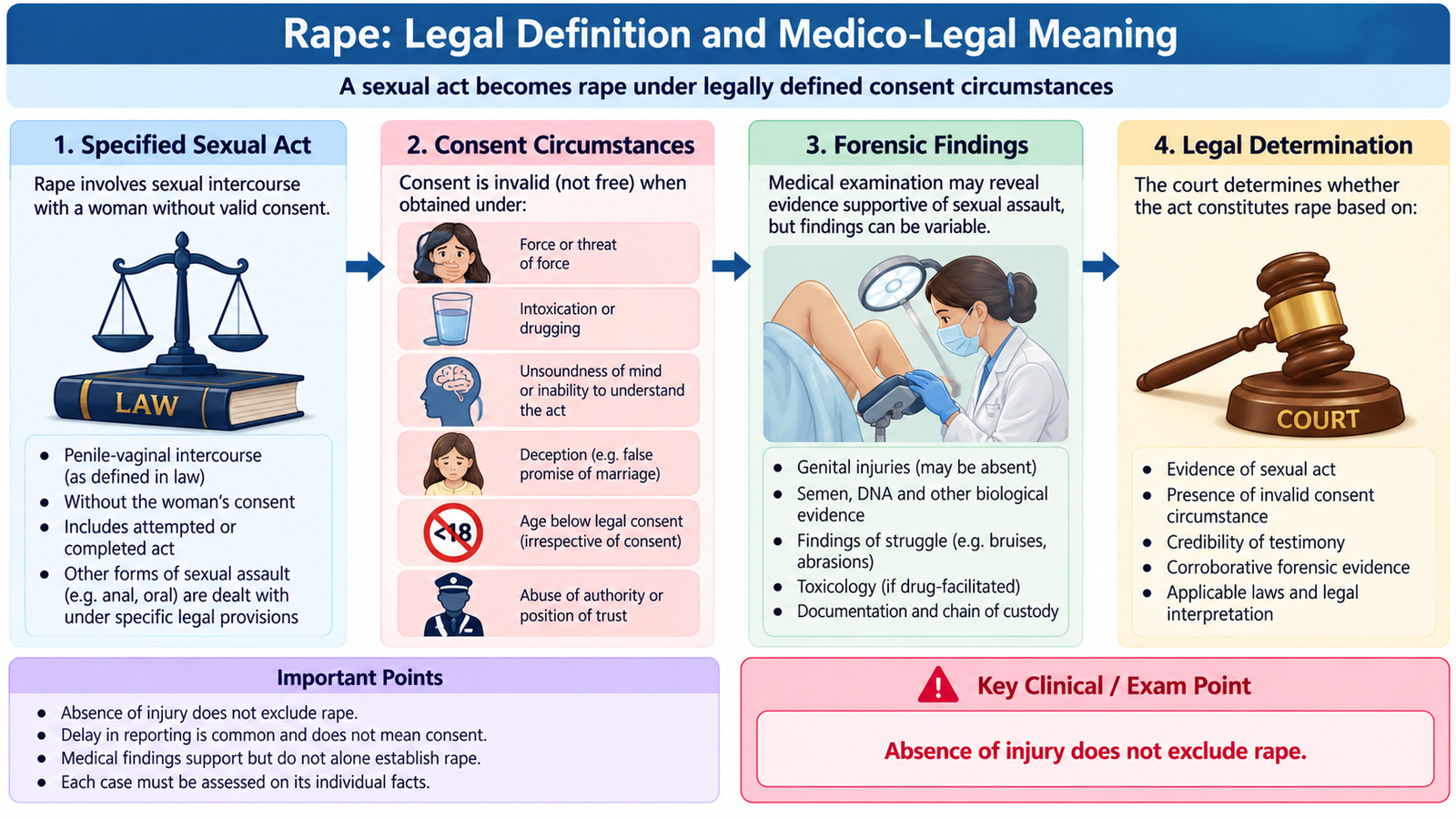
Rape is both a serious criminal offence and an important medico-legal emergency. Forensic examination can document injuries, identify biological evidence and provide objective medical information, but the final determination of whether the legal offence of rape has been proved belongs to the court rather than the examining doctor.
Legal Concept
Under the current Pakistan Penal Code formulation of section 375, rape includes specified forms of penile penetration, penetration by an object or another body part, manipulation causing penetration, and specified oral-genital or oral-anal contact when the act occurs under legally defined circumstances. These include acts against the person’s will, without consent, with consent obtained through fear, through specified mistaken belief, when the person cannot understand the nature and consequences because of mental incapacity, intoxication or a stupefying substance, when the person is below the statutory age, or when the person is unable to communicate consent. The provision also defines consent as an unequivocal voluntary agreement and makes clear that absence of physical resistance alone does not establish consent. :contentReference[oaicite:1]{index=1}
Medico-Legal Importance
The medical evidence may support or clarify part of the history, identify recent trauma, detect biological material and document the person’s physical condition. However, individual findings are rarely specific enough to prove the entire allegation on their own.
- Absence of injury does not exclude rape. Penetration may occur without visible trauma.
- Presence of injury does not independently prove rape. The injury must be interpreted in its clinical and historical context.
- Absence of semen does not exclude sexual assault. Ejaculation is not required for penetration to occur.
- Hymenal appearance cannot establish consent or previous sexual history.
- The doctor should describe findings rather than give a legal verdict.
C. Forensic Management of Sexual-Offence Cases
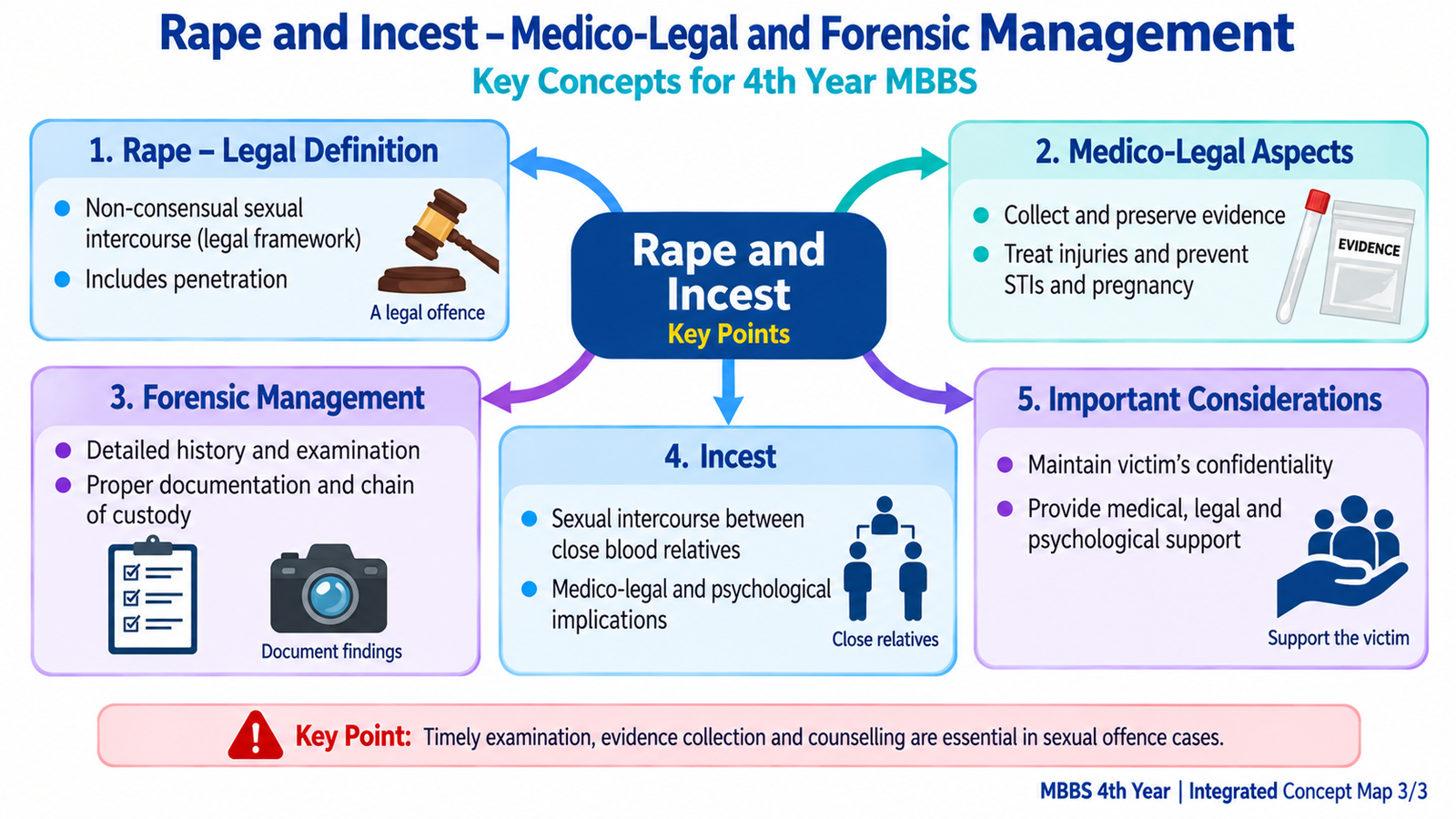
Forensic management should be patient-centred, respectful and evidence-conscious. Medical care and safety take priority, while forensic documentation and specimen collection should follow the history, examination findings and applicable medico-legal protocol. The process should avoid unnecessary, humiliating or scientifically unsupported examination practices.
1. Consent, Privacy and Immediate Care
Explain the purpose and components of the examination in understandable language and obtain appropriate informed consent. Consent for medical examination does not automatically mean consent for every specimen or procedure. Privacy, dignity and confidentiality should be maintained according to applicable law and institutional procedure.
Any urgent injury, bleeding, intoxication, altered consciousness or other medical problem should be treated first. Forensic requirements must never delay essential clinical care.
2. Relevant History
The history provides the framework for deciding what to examine and which specimens may be relevant. Record the account carefully and objectively, preferably using the person’s own words for important statements.
- Nature of the alleged sexual contact.
- Sites of penetration or contact described.
- Use of force, threats, restraint or weapons.
- Loss of consciousness or suspected intoxication.
- Bleeding, pain or other symptoms after the event.
- Washing, bathing or changing clothing after the event where relevant to evidence interpretation.
- Relevant menstrual, pregnancy and recent sexual history when necessary for interpretation.
3. Physical Examination
Perform a systematic general examination and then examine relevant anatomical areas according to the history. Describe the site, type, size and appearance of injuries objectively. Genital, anal or oral examination should be performed only when clinically and forensically indicated and with appropriate consent.
4. Specimen Collection and Documentation
Specimen collection is guided by the alleged contact and local protocol. Possible evidence may include clothing, relevant swabs, biological material, trace material and toxicology specimens when drug-facilitated assault is suspected. Exact specimen type, timing and preservation requirements should follow the applicable forensic protocol rather than being assumed.
Every specimen must be correctly identified, packaged and sealed according to protocol. Documentation should allow the specimen to be traced from collection to transfer and laboratory examination. This continuous record is the chain of custody.
Clinical care after the forensic examination should also address injury treatment, pregnancy-related assessment when relevant, sexually transmitted infection concerns, psychological support and appropriate referral.

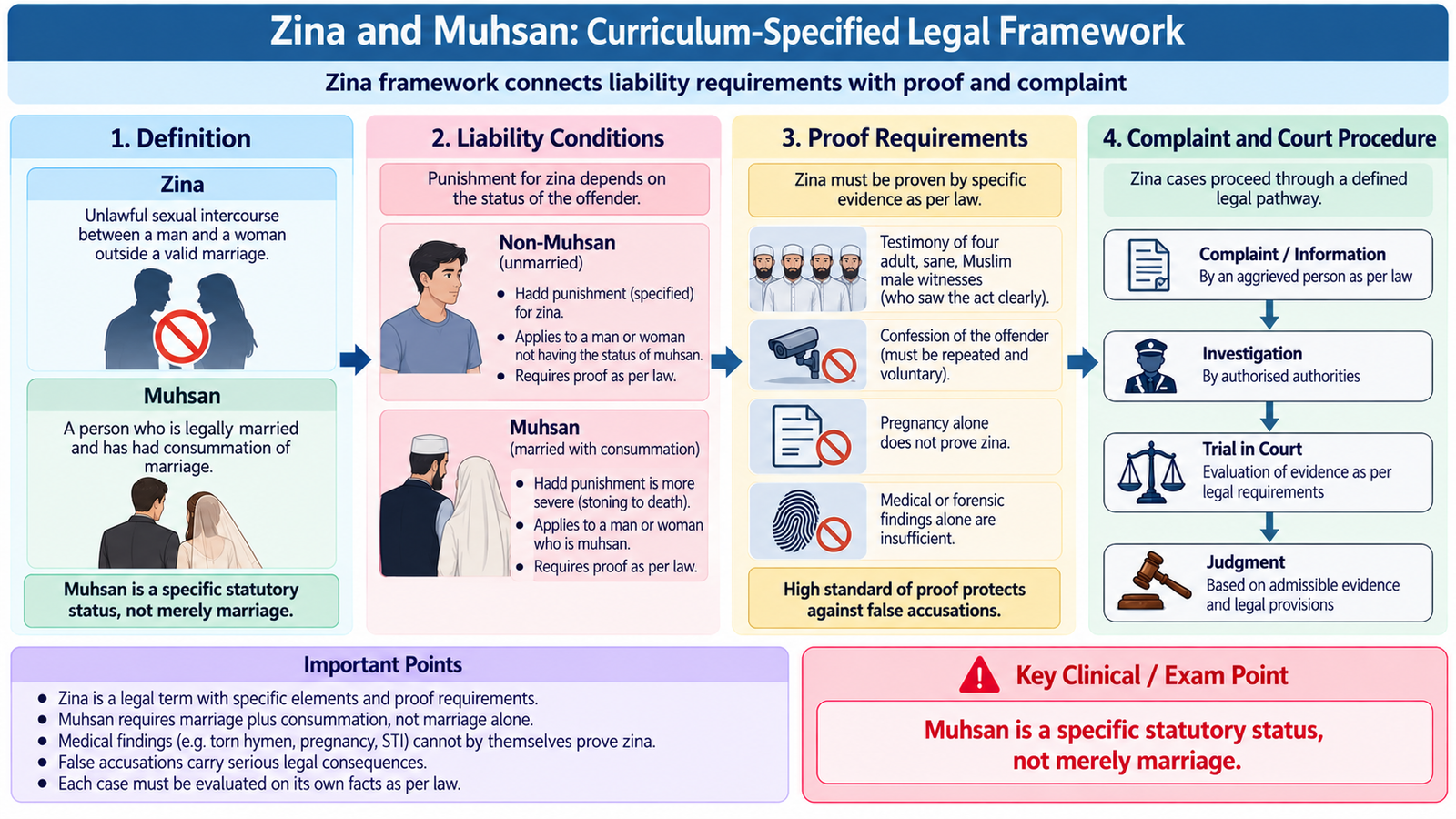
D. Zina and Muhsan: Curriculum-Specified Legal Framework
The KMU curriculum specifically requires the concepts of Muhsan, zina, conditions of liability, punishment, proof and the complaint procedure. These terms arise from the Offence of Zina (Enforcement of Hudood) Ordinance, 1979 and related procedural provisions. They should therefore be learned as legal definitions rather than as medical diagnoses.
Definition of Muhsan
In the Zina Ordinance, a Muhsan is essentially a Muslim adult man or woman who is not insane and who has previously had sexual intercourse with a Muslim adult spouse while the valid marital relationship existed and both spouses fulfilled the conditions specified in the Ordinance. :contentReference[oaicite:2]{index=2}
Definition of Zina
The Ordinance describes zina as wilful sexual intercourse between a man and a woman who are not married to each other. The statutory framework treats penetration as sufficient for the sexual intercourse necessary to the offence. :contentReference[oaicite:3]{index=3}
Conditions for Zina Liable to Hadd
For zina to fall within the Ordinance’s category of zina liable to hadd, the statutory requirements concerning adulthood, mental capacity and absence of marriage or a genuine belief of marriage must be satisfied.
- The person is an adult for the purpose of the Ordinance.
- The person is not insane.
- Sexual intercourse is with a person to whom he or she is not married.
- The person does not believe or suspect that a valid marital relationship exists with the other person.
Punishment Specified in the Statutory Text
The statutory text provides that a person convicted of zina liable to hadd who is Muhsan is subject to stoning to death at a public place, whereas a person who is not Muhsan is subject to one hundred stripes at a public place. The same statutory text requires confirmation by the appellate court before execution of the punishment. This describes the wording of the legal framework taught by the curriculum and should not be confused with a statement about how frequently such punishment is applied in practice. :contentReference[oaicite:4]{index=4}
Proof in Court
Zina liable to hadd may be proved under the Ordinance through one of two principal routes:
- Confession: the accused makes the required confession before a court of competent jurisdiction.
- Eyewitness testimony: at least four Muslim adult male eyewitnesses satisfying the court regarding credibility give evidence of the act of penetration. Where the accused is non-Muslim, the statutory proviso allows non-Muslim eyewitnesses.
The court’s inquiry into the credibility of witnesses is referred to as tazkiyah al-shuhood. The Ordinance also provides circumstances in which hadd is not enforced, such as retraction of a confession before enforcement or reduction of the qualifying eyewitnesses below four because a witness withdraws testimony. :contentReference[oaicite:5]{index=5}
Complaint Procedure
Section 203A of the Code of Criminal Procedure provides the complaint pathway for an allegation under section 5 of the Zina Ordinance. The major undergraduate steps are:
- The complaint is lodged before a court of competent jurisdiction.
- The presiding officer examines the complainant and the required eyewitnesses on oath.
- The substance of their examination is reduced to writing and signed by the relevant persons and the presiding officer.
- If sufficient grounds for proceeding exist, the court issues summons for the personal attendance of the accused.
- If sufficient grounds do not exist, the complaint may be dismissed and reasons are recorded.
Amendments introduced through the Protection of Women legislation also state that a rape allegation is not to be converted into a zina or fornication complaint merely because the rape allegation has not been established. :contentReference[oaicite:6]{index=6}
E. Other Sexual Offences
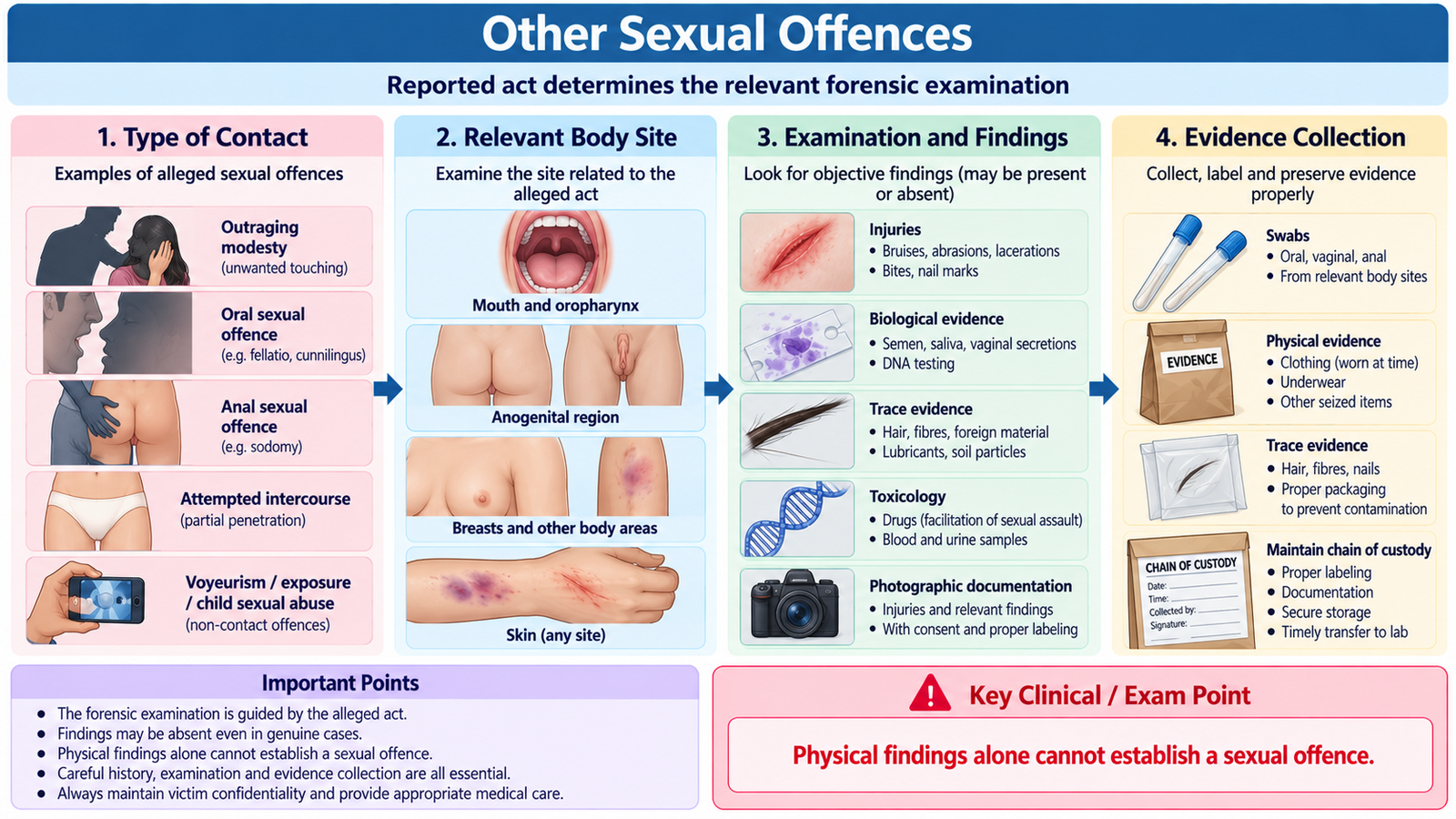
Forensic textbooks use several terms to describe particular sexual acts that may become medico-legally important when they involve lack of consent, prohibited relationships, children, coercion or other circumstances covered by law. The doctor’s responsibility remains the same: describe the history and findings objectively and avoid assuming that a physical finding alone establishes the offence.
Incest
Incest refers to sexual intercourse or sexual activity between persons who are so closely related by blood or legally recognized family relationship that sexual relations or marriage between them are prohibited under the applicable legal framework.
Sodomy
In traditional forensic terminology, sodomy commonly refers to anal intercourse. The terms passive agent and active agent have historically been used for the receptive and penetrating participants respectively. These terms describe the alleged act and do not determine consent or criminal liability.
Conceptual Examination of the Passive / Receptive Agent
After consent and history, perform a general examination for injuries and examine the perianal region when indicated. Relevant findings may include recent abrasions, bruising, fissures, bleeding or other trauma. Appropriate biological specimens may be collected according to the history and forensic protocol.
Chronic anatomical variations, anal tone or absence of injury must not be interpreted as proof of repeated anal intercourse. Recent anal penetration may occur without visible injury.
Conceptual Examination of the Active / Penetrating Agent
Examine the body and genital region for injuries or relevant trace material when legally and medically appropriate. Clothing, biological specimens and DNA-related evidence may be collected according to the alleged contact and applicable protocol. Findings should be described rather than labelled as proof of sodomy.
Buccal Coitus
Buccal coitus refers to oral-genital sexual contact, traditionally particularly the introduction of the penis into the mouth. In a forensic case, examination of the mouth, lips and surrounding areas and collection of relevant specimens may be considered according to the history.
Tribadism
Tribadism is a historical term describing sexual activity between women involving rubbing of the external genital regions against each other or against another part of the partner’s body.
Bestiality
Bestiality refers to sexual activity between a human and an animal. If examined medico-legally, attention is directed to injuries, possible biological or trace evidence and objective documentation.
F. Sexual Perversions and Modern Clinical Terminology
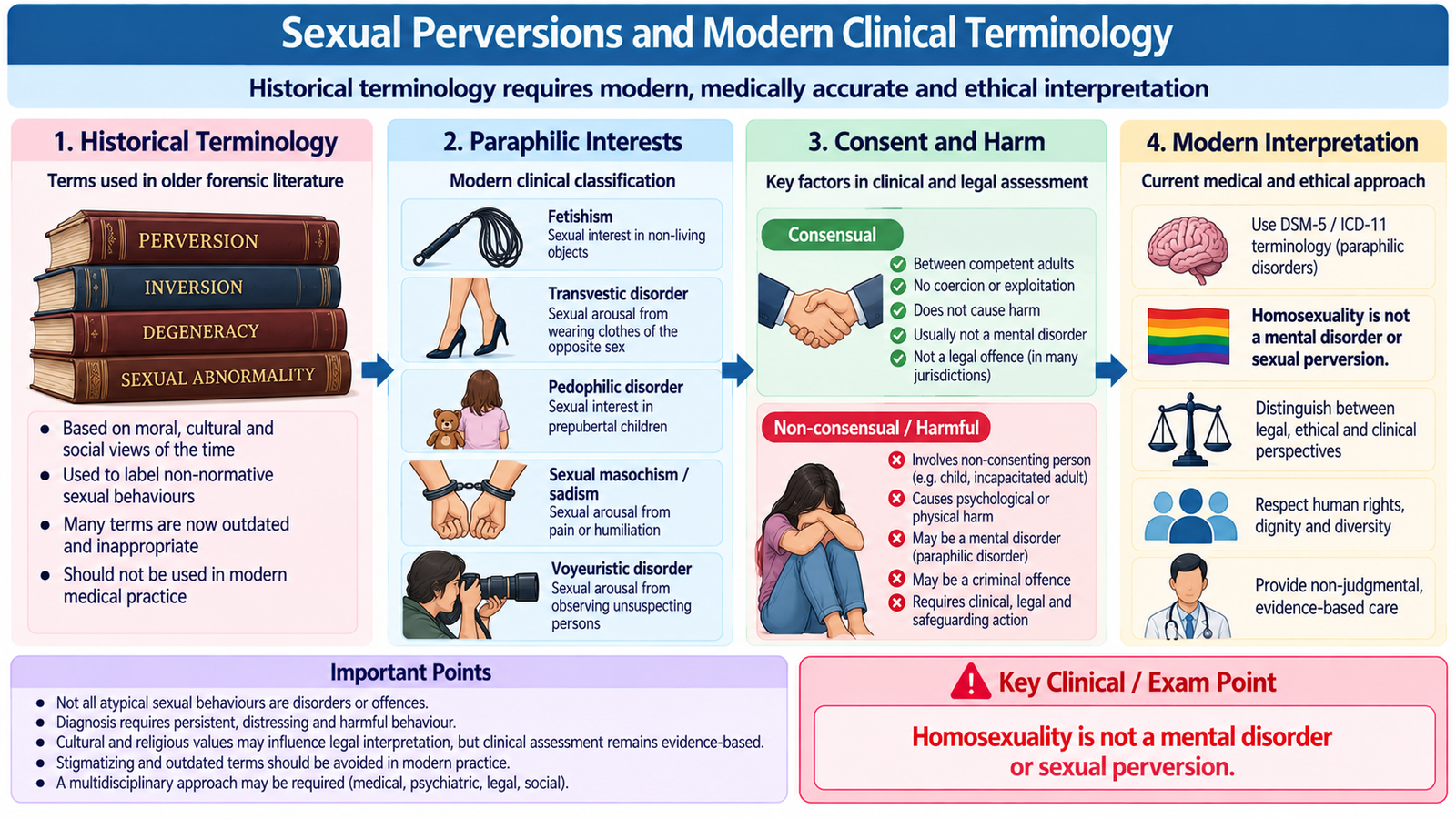
The curriculum uses the traditional forensic expression sexual perversions. Modern psychiatry generally prefers terms such as paraphilia or paraphilic disorder. A paraphilia is an atypical pattern of sexual interest; an atypical interest becomes a disorder only in appropriate clinical circumstances, particularly when it causes significant distress or impairment or involves harm or non-consenting persons. Therefore, historical terminology should not automatically be treated as a psychiatric diagnosis.
| Term | Core Meaning | Important Interpretation |
|---|---|---|
| Sexual sadism | Sexual arousal associated with another person’s suffering, humiliation or pain. | Especially important when acted upon with a non-consenting person or associated with harm. |
| Sexual masochism | Sexual arousal associated with one’s own humiliation, restraint, pain or suffering. | Clinical disorder requires appropriate diagnostic context rather than the preference alone. |
| Fetishism | Sexual interest focused strongly on particular non-living objects or specific non-genital body parts. | Modern diagnosis depends on distress, impairment and context. |
| Exhibitionism | Sexual arousal associated with exposing the genitals to an unsuspecting person. | The non-consenting nature of the target gives important medico-legal significance. |
| Voyeurism | Sexual arousal from observing an unsuspecting person who is naked, undressing or engaged in sexual activity. | Privacy and absence of consent are central medico-legal considerations. |
| Frotteurism | Sexual arousal from touching or rubbing against a non-consenting person. | Usually occurs in situations where physical proximity permits such contact. |
| Urolagnia | Sexual arousal associated with urine or urination. | The behaviour itself should not automatically be labelled a disorder without clinical criteria. |
| Transvestism | Historical term involving wearing clothing conventionally associated with another gender. | Cross-dressing itself is not automatically a psychiatric disorder. |
| Uranism | Obsolete historical term used for homosexuality, especially male homosexuality. | Homosexuality is not classified by modern medicine as a sexual perversion or mental disorder. |
G. Abortion: Forensic Classification, Differentiation and Legal Relevance
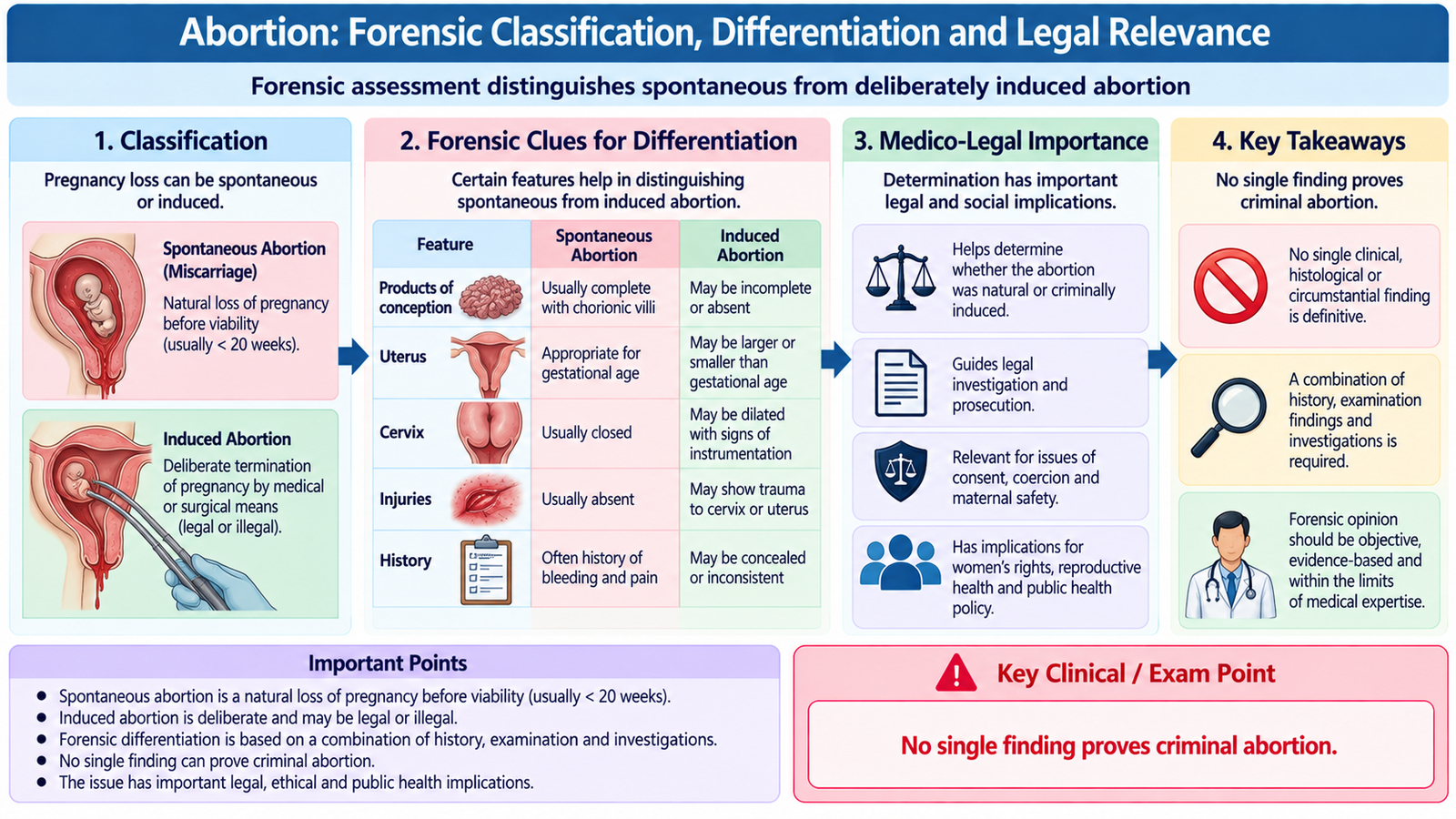
In the forensic context, abortion refers to termination of pregnancy with expulsion or removal of the products of conception before fetal viability. Its medico-legal importance arises mainly when it is necessary to determine whether the pregnancy ended naturally or was deliberately interrupted and, when interruption occurred, whether it was performed within or outside the applicable legal framework.
Types of Abortion
For forensic learning, abortion can first be divided according to whether it occurs spontaneously or is deliberately induced.
- Natural / spontaneous abortion: pregnancy ends without deliberate external induction.
- Artificial / induced abortion: pregnancy is intentionally interrupted.
- Induced abortion may be performed for a legally permitted therapeutic purpose or may fall outside the lawful framework, traditionally described in forensic texts as criminal abortion.
Natural Abortion
Natural abortion results from an obstetric or medical process rather than deliberate interference. Bleeding, uterine contractions, cervical change and passage of products of conception may occur as part of the natural process. Forensic assessment therefore depends on the clinical history, examination and available medical evidence rather than on a single physical sign.
Artificial or Criminal Abortion
Deliberate abortion may involve medication, mechanical instrumentation or other interventions. When unsafe or unlawful methods are used, trauma, haemorrhage, infection, uterine or cervical injury, retained foreign material or systemic toxicity may occur. These findings may raise suspicion of induced abortion but are not individually diagnostic because some complications can also occur during spontaneous miscarriage or legitimate medical treatment.
Important Comparison — Natural versus Criminal Abortion
| Feature | Natural / Spontaneous | Suspected Criminal / Unlawfully Induced |
|---|---|---|
| History | No deliberate interference; obstetric or medical cause may be present. | History may suggest deliberate medication, instrumentation or other interference. |
| Genital trauma | Usually no trauma attributable to instrumentation. | Cervical, vaginal or uterine trauma may be present after instrumentation. |
| Foreign material | Not expected as part of the natural process. | May occasionally be detected when unsafe mechanical methods have been attempted. |
| Infection | Can occur, especially with retained products. | May be severe after unsterile instrumentation, but infection alone does not prove criminal abortion. |
| Interpretation | Diagnosis supported by compatible clinical course and absence of evidence of deliberate interference. | Requires correlation of history, injuries, specimens and circumstantial evidence. |
Legal Framework in Pakistan
The Pakistan Penal Code uses the terms isqat-i-haml and isqat-i-janin. Section 338 describes isqat-i-haml where the fetal organs have not formed and excludes miscarriage caused in good faith for saving the woman’s life or providing necessary treatment to her. Section 338B addresses a later stage where some limbs or organs have formed and provides an exception when the act is done in good faith to save the woman’s life. :contentReference[oaicite:7]{index=7}
Medico-Legal Formalities and Doctor’s Responsibilities
When pregnancy termination is being considered or when an unlawful abortion is suspected, the doctor should work within the applicable law and professional standards. The important undergraduate principles are:
- Establish and document the medical indication and relevant pregnancy findings.
- Ensure that any intervention is undertaken in good faith within the applicable legal framework.
- Obtain appropriate informed consent when the patient is capable of giving it.
- Maintain clear contemporaneous medical documentation.
- If complications of a suspected unlawful abortion are present, provide necessary emergency treatment without allowing forensic considerations to delay care.
- Document injuries and relevant findings objectively.
- Collect and preserve medico-legal specimens only when indicated and according to applicable protocol.
- Maintain chain of custody for material collected as forensic evidence.
- Avoid declaring an abortion “criminal” purely from one medical finding; criminal liability is ultimately a legal determination.
⭐ AIM High-Yield Review
- Virginity cannot be proved or disproved solely by examination of the hymen.
- Common hymenal forms include annular, crescentic, septate, cribriform, fimbriated and imperforate types.
- In rape examination, absence of genital or bodily injury does not exclude the allegation.
- Absence of semen also does not exclude penetration or sexual assault.
- The forensic doctor’s role is objective examination, documentation, specimen collection and interpretation—not deciding guilt.
- Chain of custody provides a traceable record of forensic evidence from collection onward.
- Muhsan is a specific statutory status and must not be confused simply with “a married person.”
- Zina liable to hadd may be proved by the required judicial confession or qualifying eyewitness testimony under the statutory framework.
- A rape allegation is not automatically converted into a zina allegation when rape is not proved.
- Sodomy is traditionally used in forensic medicine for anal intercourse; physical findings alone cannot prove that it occurred.
- Exhibitionism, voyeurism and frotteurism are especially important medico-legally because they commonly involve non-consenting persons.
- “Uranism” is an obsolete historical term; homosexuality is not a mental disorder or sexual perversion in modern medicine.
- Natural and unlawfully induced abortion may share bleeding and infection; trauma or instrumentation findings must therefore be interpreted cautiously.
- Pakistan law distinguishes isqat-i-haml and isqat-i-janin, with legally important good-faith exceptions specified in the Penal Code. :contentReference[oaicite:8]{index=8}
Forensic Sexual Medicine
Supplement your AIM learning material with these undergraduate Forensic Medicine lectures on sexual offences, virginity and abortion.
Sexual Offences — Part 1
Forensic Medicine lecture by Prof. Mukkaram Ali. Use it to reinforce the basic concepts and medico-legal approach to sexual offences.
Sexual Offences — Part 2
Continue the topic with further forensic discussion of sexual offences and their medico-legal interpretation.
Virginity and Abortion — Forensic Medicine
A complementary lecture covering virginity, pregnancy-related forensic concepts and abortion.