
Topic 15 — Macrolides, Linezolid, Clindamycin, Streptogramins and Chloramphenicol
Topic Introduction
Macrolides, linezolid, clindamycin, streptogramins and chloramphenicol are antibacterial drugs that mainly act by interfering with bacterial protein synthesis. Although several of them act on the bacterial 50S ribosomal subunit, they differ greatly in antibacterial spectrum, pharmacokinetics, clinical usefulness and toxicity. Macrolides are especially important for respiratory infections and atypical organisms. Linezolid is valuable against resistant gram-positive bacteria, while clindamycin is important against anaerobic infections but may cause pseudomembranous colitis. Streptogramins have a specialized role in resistant infections. Chloramphenicol has broad activity but severe toxicity has greatly restricted its systemic use. Understanding these differences allows rational selection of the appropriate drug.
A. Macrolides: Classification, Spectrum and Mechanism of Action
Macrolides are antibacterial drugs characterized by a large macrocyclic lactone ring. The most important members are erythromycin, clarithromycin and azithromycin. Their usefulness comes mainly from activity against many gram-positive organisms and several important respiratory and atypical pathogens. They are generally bacteriostatic, although bactericidal activity may occur against particularly susceptible organisms at sufficient concentrations.
Important macrolides
- Erythromycin — the traditional prototype.
- Clarithromycin — a semisynthetic derivative with improved oral properties and useful activity against selected respiratory organisms.
- Azithromycin — an azalide closely related to macrolides, with excellent tissue penetration and a long tissue half-life.
Antimicrobial spectrum
Macrolides are particularly useful when the infecting organism is susceptible but a beta-lactam drug is unsuitable, or when the pathogen is located intracellularly or lacks a conventional cell wall target.
- Many gram-positive cocci, including susceptible streptococci.
- Important respiratory pathogens.
- Atypical organisms such as Mycoplasma, Chlamydia and Legionella.
- Selected additional organisms depending on the individual macrolide.
Mechanism of action
Macrolides enter susceptible bacteria and bind mainly to the 23S ribosomal RNA of the 50S ribosomal subunit. This interferes with movement of the growing peptide chain during translation, particularly the translocation step. The bacterium therefore cannot efficiently continue protein synthesis.
Macrolide enters susceptible bacterium → binds 23S rRNA on 50S ribosomal subunit → interferes with translocation of the growing peptide chain → bacterial protein synthesis decreases → bacterial growth is inhibited.
This mechanism explains why macrolides are usually bacteriostatic: they primarily stop bacterial growth rather than immediately destroying the organism.


B. Macrolides: Pharmacokinetics, Resistance and Clinical Uses
The clinical differences between erythromycin, clarithromycin and azithromycin are strongly influenced by their pharmacokinetics. Oral absorption, tissue penetration, metabolism and duration of persistence determine how often they are given and which infections they are particularly convenient for treating.
Pharmacokinetics
Erythromycin is acid-labile, so formulations are designed to protect it from gastric acid. It distributes well into many tissues but has relatively limited penetration into cerebrospinal fluid. It is concentrated in the liver and is eliminated mainly through bile. Its comparatively shorter persistence means that it generally requires more frequent administration than azithromycin.
Clarithromycin is more acid-stable and has good oral absorption. It is metabolized in the liver and forms an active metabolite. Renal elimination is clinically relevant, so reduced renal function may influence drug handling. Its pharmacokinetic properties permit less frequent administration than traditional erythromycin in many settings.
Azithromycin achieves high concentrations inside tissues and phagocytic cells. It is released slowly from tissues and therefore has a prolonged tissue half-life. This explains why it can usually be administered less frequently and for shorter courses than erythromycin in appropriate infections.
Principal mechanism of resistance
A major mechanism of macrolide resistance is alteration of the ribosomal target. Bacteria may methylate the 23S rRNA binding site on the 50S subunit. This reduces binding of the antibiotic and therefore prevents effective inhibition of protein synthesis.
Resistance may also occur through increased drug efflux or enzymatic inactivation, but target-site modification is particularly important and may produce cross-resistance with other drugs that bind related sites on the 50S ribosome.
Clinical uses
Macrolides are especially valuable in respiratory and atypical infections because they penetrate tissues well and act against organisms such as Mycoplasma, Chlamydia and Legionella.
- Respiratory tract infections caused by susceptible organisms.
- Atypical pneumonia.
- Selected infections caused by Chlamydia.
- Selected infections caused by Mycoplasma and Legionella.
- Erythromycin may be used as an alternative in some patients when a suitable beta-lactam cannot be used.
- Clarithromycin has a role in multidrug regimens against Helicobacter pylori and selected mycobacterial infections.
- Azithromycin is particularly useful when prolonged tissue persistence and simplified dosing are advantageous.

C. Macrolides: Adverse Effects, Drug Interactions and Important Differences
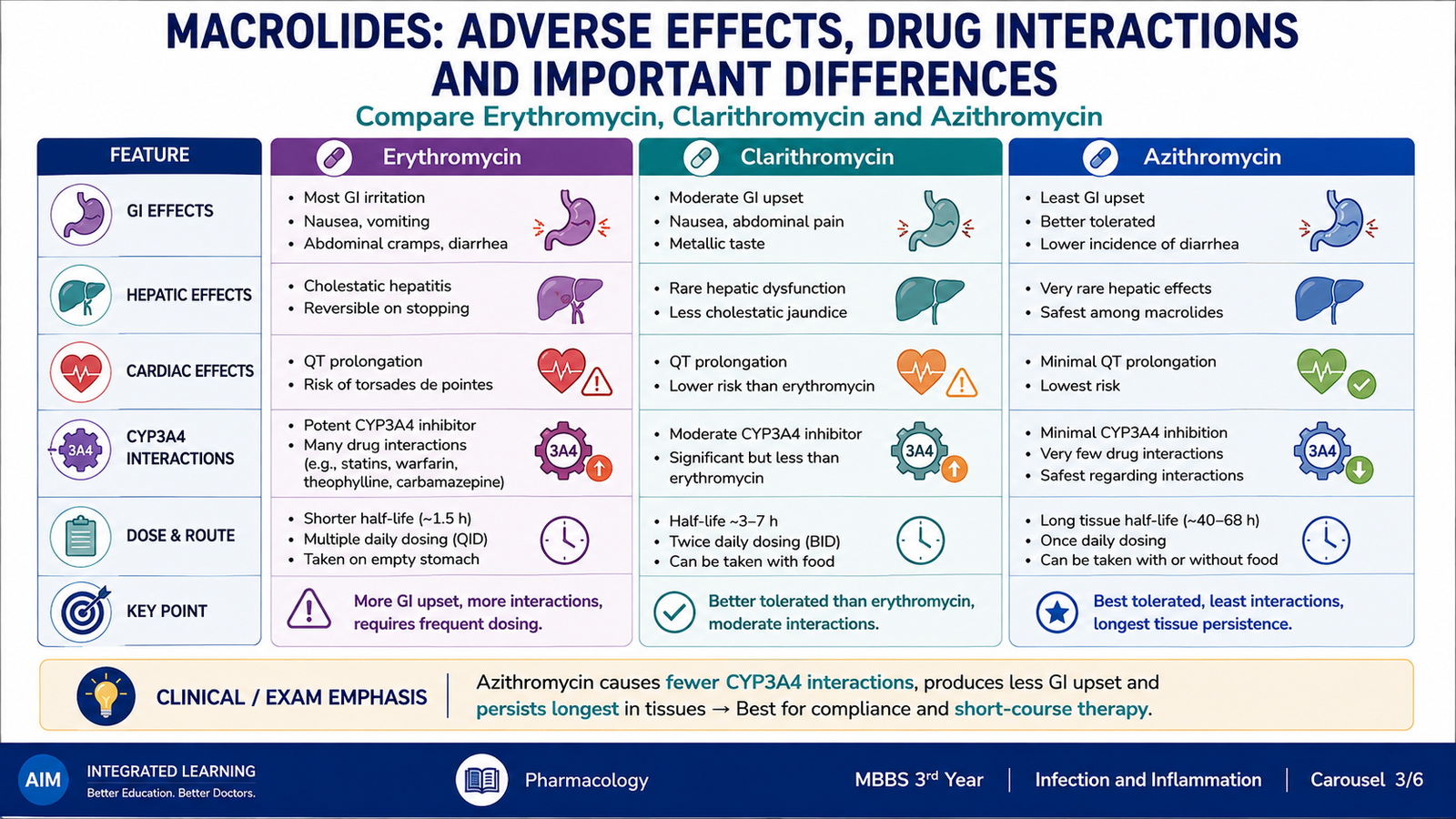
Macrolides are generally well tolerated, but several adverse effects are clinically and examination-relevant. The risk is not identical for all members of the group. Erythromycin and clarithromycin are particularly important for drug interactions because they can inhibit hepatic drug metabolism, whereas azithromycin has much less effect on cytochrome P450 enzymes.
Adverse effects
- Gastrointestinal upset: nausea, abdominal discomfort and diarrhea are particularly associated with erythromycin. Erythromycin can stimulate gastrointestinal motility, helping explain these symptoms.
- Cholestatic hepatitis: classically associated with certain erythromycin preparations.
- QT interval prolongation: may predispose susceptible patients to serious ventricular arrhythmias.
- Reversible hearing impairment: may occur particularly with high exposure to some macrolides.
Drug interactions
Erythromycin and clarithromycin inhibit hepatic CYP3A4. Drugs normally metabolized by this pathway may therefore accumulate and produce exaggerated or toxic effects. This is an important reason to review concurrent medication before prescribing these agents.
Azithromycin causes much less CYP3A4 inhibition and therefore has fewer clinically important metabolic interactions than erythromycin or clarithromycin.
Important comparison of the major macrolides
| Feature | Erythromycin | Clarithromycin | Azithromycin |
|---|---|---|---|
| Acid stability / oral use | Acid-labile; protected formulations used | More acid-stable | Good oral usefulness |
| Persistence | Relatively short | Intermediate | Very prolonged tissue persistence |
| Dosing pattern | Generally more frequent | Less frequent than erythromycin | Usually least frequent because of long tissue half-life |
| CYP3A4 inhibition | Important | Important | Minimal compared with the other two |
D. Linezolid: Mechanism and Role in Resistant Gram-Positive Infections
Linezolid is an oxazolidinone antibacterial drug with an important role against resistant gram-positive organisms. Its main undergraduate importance is its activity against methicillin-resistant Staphylococcus aureus (MRSA) and vancomycin-resistant enterococci (VRE).
Mechanism of action
Linezolid acts at an early stage of bacterial protein synthesis. It binds to the 50S ribosomal subunit near the interface with the 30S subunit and prevents formation of the functional 70S initiation complex. Without this initiation complex, translation cannot begin normally.
Linezolid binds 50S ribosomal subunit → prevents formation of functional 70S initiation complex → initiation of protein synthesis is blocked → bacterial growth is inhibited.
Clinical uses
Linezolid is reserved mainly for important gram-positive infections in which resistance limits the usefulness of more conventional drugs.
- Infections caused by MRSA, when linezolid is clinically appropriate.
- Infections caused by vancomycin-resistant enterococci.
- Other serious susceptible gram-positive infections when resistance or clinical circumstances justify its use.

E. Clindamycin and Streptogramins
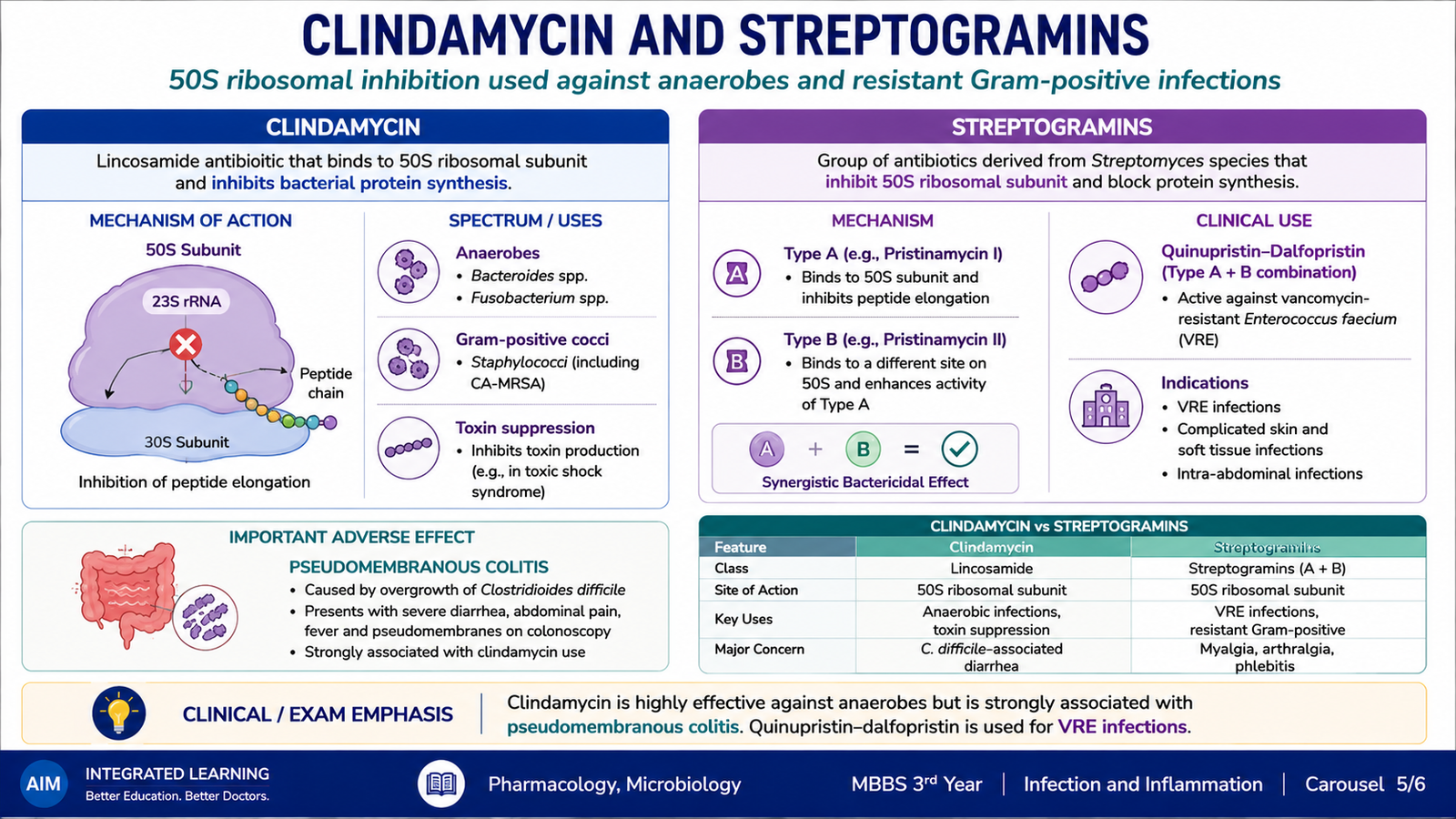
Clindamycin and streptogramins also inhibit bacterial protein synthesis through effects on the 50S ribosomal subunit, but their clinical roles are different. Clindamycin is particularly useful for susceptible anaerobic and gram-positive infections, whereas the streptogramin combination quinupristin-dalfopristin is reserved for selected resistant gram-positive infections.
Clindamycin: mechanism of action
Clindamycin binds to the 50S ribosomal subunit and inhibits bacterial protein synthesis. Its binding site overlaps functionally with that used by macrolides, helping explain why resistance mechanisms may sometimes affect both groups.
Clinical uses of clindamycin
- Infections caused by susceptible anaerobic bacteria, particularly in appropriate infections originating from oral or abdominal sites.
- Selected infections caused by susceptible gram-positive cocci.
- Clinical situations in which good tissue penetration and anti-anaerobic activity are advantageous.
Antibiotic-associated pseudomembranous colitis
The most important adverse effect associated with clindamycin is antibiotic-associated pseudomembranous colitis. Clindamycin suppresses part of the normal intestinal bacterial flora. This loss of normal microbial competition permits overgrowth of toxin-producing Clostridioides difficile.
The toxins injure colonic epithelial cells and produce inflammation. The damaged mucosa becomes covered by characteristic inflammatory pseudomembranes composed of inflammatory cells, necrotic debris, mucus and fibrin.
Clindamycin → suppression of normal intestinal flora → C. difficile overgrowth → toxin production → colonic mucosal injury and inflammation → pseudomembranous colitis.
Streptogramins
The clinically important streptogramin preparation is the combination quinupristin-dalfopristin. The two components act on the bacterial 50S ribosomal subunit at closely related sites and work synergistically to inhibit protein synthesis.
Clinical use of quinupristin-dalfopristin
Its main curricular importance is treatment of selected serious infections caused by resistant gram-positive organisms. It has activity against vancomycin-resistant Enterococcus faecium, but it is not reliably active against Enterococcus faecalis.

F. Chloramphenicol: Spectrum, Mechanism, Uses and Toxicity
Chloramphenicol is a broad-spectrum antibacterial drug that inhibits bacterial protein synthesis. Its antibacterial activity is useful, but severe and sometimes unpredictable toxicity has made routine systemic use largely obsolete where safer alternatives are available.
Antimicrobial spectrum
Chloramphenicol has a broad spectrum that includes many gram-positive and gram-negative organisms as well as several other susceptible pathogens. It also penetrates tissues well, including the central nervous system. Despite these advantages, its toxicity prevents routine use for infections that can be treated with safer drugs.
Mechanism of action
Chloramphenicol binds to the 50S ribosomal subunit and inhibits the enzyme activity responsible for peptide-bond formation. In practical terms, it inhibits peptidyl transferase activity, preventing elongation of the bacterial protein chain.
Clinical uses
Systemic chloramphenicol is generally reserved for situations in which its antibacterial activity is valuable and safer drugs are unsuitable or unavailable. Its historic and selected clinical uses include serious susceptible infections, particularly when tissue or central nervous system penetration is important.
Topical ophthalmic preparations may still be used in appropriate settings because local administration produces much lower systemic exposure than routine systemic treatment.
Why systemic use became largely obsolete
The major reason is bone-marrow toxicity. Because effective and safer alternatives exist for many infections, exposing patients routinely to potentially severe hematological toxicity is usually unjustified.
Adverse effects
- Dose-related bone-marrow suppression: usually reversible when the drug is withdrawn.
- Aplastic anemia: rare, unpredictable and potentially fatal; it is not simply related to the administered dose.
- Gray Baby syndrome: occurs particularly in neonates because their capacity to metabolize and eliminate chloramphenicol is immature.
Gray Baby syndrome
Newborn infants have limited hepatic glucuronidation and immature renal elimination. Chloramphenicol may therefore accumulate to toxic concentrations. Mitochondrial and cardiovascular dysfunction can follow, producing a characteristic clinical syndrome.
Neonatal immature drug metabolism and elimination → chloramphenicol accumulation → toxicity → poor feeding, vomiting, abdominal distension and circulatory collapse → cyanosis with an ashen-gray appearance.
The possibility of serious marrow toxicity and neonatal toxicity explains why chloramphenicol is no longer considered a routine systemic antibacterial drug.


How These Drugs Differ at the 50S Ribosome
Several drugs in this chapter inhibit bacterial protein synthesis, but they interfere with different stages of translation. Recognizing the specific action helps separate otherwise similar drug classes.
| Drug/Class | Ribosomal action | Key curricular association |
|---|---|---|
| Macrolides | Bind 23S rRNA on 50S and interfere with translocation | Respiratory and atypical pathogens |
| Linezolid | Prevents formation of functional 70S initiation complex | MRSA and VRE |
| Clindamycin | Binds 50S and inhibits peptide-chain elongation | Anaerobic infections; pseudomembranous colitis risk |
| Streptogramins | Two components bind 50S and synergistically inhibit synthesis | VRE caused by E. faecium |
| Chloramphenicol | Inhibits peptidyl transferase on 50S | Bone-marrow toxicity and Gray Baby syndrome |
⭐ AIM High-Yield Review
- Macrolides include erythromycin, clarithromycin and azithromycin.
- Macrolides bind mainly to 23S rRNA of the 50S ribosomal subunit and interfere with translocation during bacterial protein synthesis.
- Macrolides are particularly useful against respiratory and atypical pathogens such as Mycoplasma, Chlamydia and Legionella.
- ⭐ A principal mechanism of macrolide resistance is methylation or alteration of the ribosomal binding site.
- Azithromycin has marked tissue penetration and a long tissue half-life, permitting less frequent dosing than erythromycin.
- Erythromycin and clarithromycin inhibit CYP3A4 more importantly than azithromycin and therefore cause more metabolic drug interactions.
- Macrolides may cause gastrointestinal symptoms, cholestatic hepatitis and QT prolongation.
- Linezolid prevents formation of the functional 70S initiation complex and is important against MRSA and VRE.
- Clindamycin inhibits the 50S ribosome and is useful against susceptible anaerobic and gram-positive organisms.
- ⭐ The classic serious complication of clindamycin is C. difficile-associated pseudomembranous colitis.
- Quinupristin-dalfopristin is a streptogramin combination used for selected resistant gram-positive infections, including vancomycin-resistant E. faecium.
- Chloramphenicol inhibits peptidyl transferase on the 50S ribosomal subunit.
- The major reason systemic chloramphenicol use became largely obsolete is its risk of severe bone-marrow toxicity, including rare aplastic anemia.
- ⭐ Gray Baby syndrome results from chloramphenicol accumulation in neonates because hepatic metabolism and renal elimination are immature.
🎥 Video Learning — Protein Synthesis Inhibitors
Review the mechanisms and important pharmacological features of macrolides, clindamycin, linezolid, streptogramins and chloramphenicol.