
This chapter follows the KMU learning outcomes in a logical sequence. First understand how each identification method works and what information it can provide; then use the High-Yield Review for rapid revision.
Personal Identification and Forensic Identification Methods
Forensic Medicine • Infection and Inflammation Module
A structured introduction to identification of living and deceased persons using physical characteristics, age and sex estimation, fingerprints, dental findings, DNA and other forensic techniques.
Topic Introduction
Personal identification means establishing the identity of an individual from available physical, biological or documentary evidence. It may be required in living persons who cannot or will not reveal their identity, and in dead bodies that are decomposed, mutilated, burnt or otherwise difficult to recognize. Identification is usually strongest when several independent parameters agree. Forensic medicine therefore uses a combination of general appearance, age, sex, skeletal and dental findings, fingerprints, scars, tattoos, hair, DNA and specialized methods such as superimposition. Some methods can establish identity with very high reliability, while others provide only supportive information. Understanding both the value and the limitations of each method is essential for correct medico-legal interpretation.
A. Principles, Methods and Parameters of Personal Identification
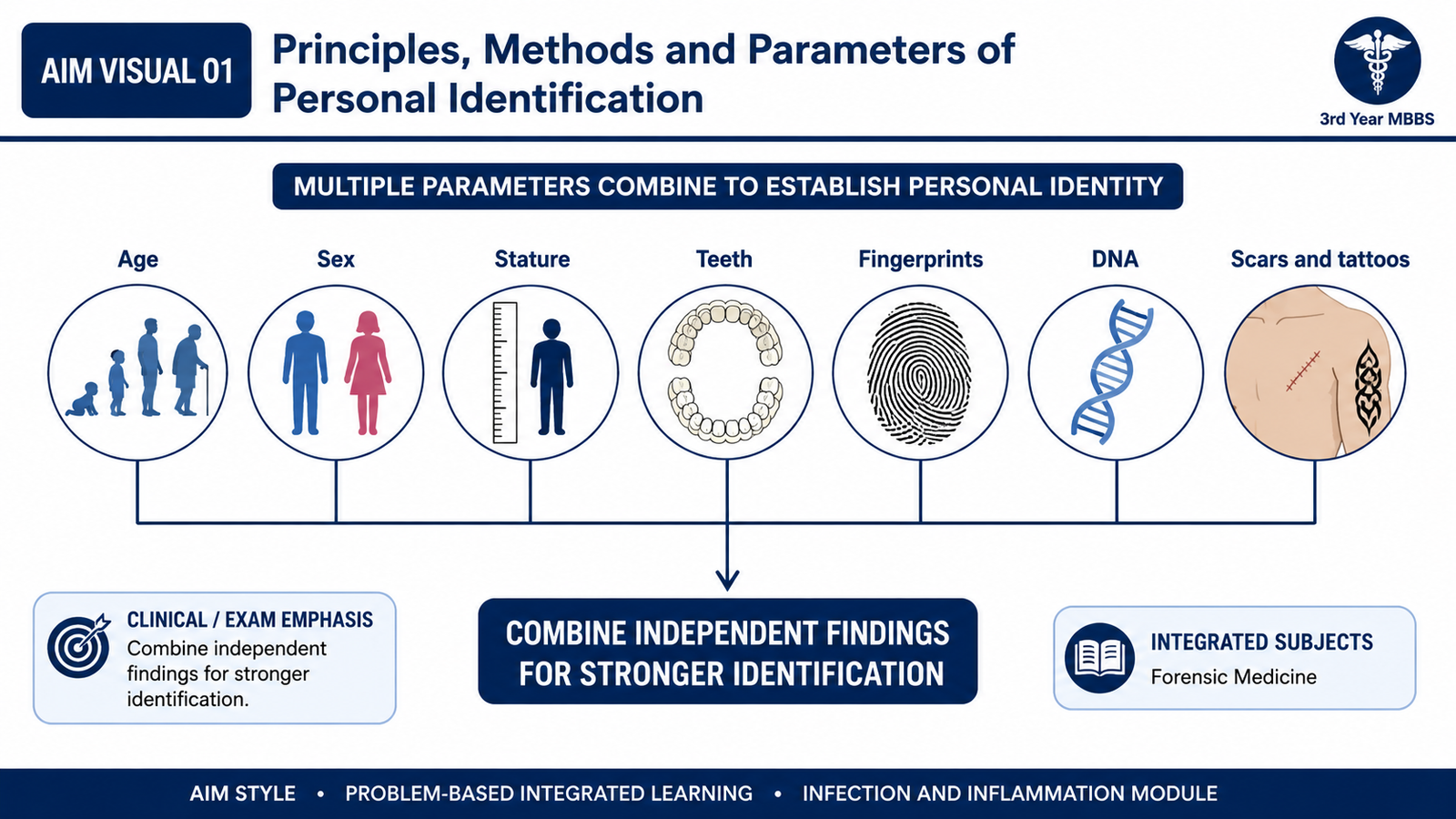
Identification is the process of determining who a person is. In forensic practice, no single general physical characteristic should automatically be considered conclusive. The examiner collects several independent features and interprets them together. The method selected depends on whether the person is alive or dead, the condition of the body, and whether previous records are available for comparison.
Important Parameters Used for Identification
- Age: estimated from physical development, teeth and skeletal maturation.
- Sex: assessed from external characteristics and, particularly in skeletal remains, from the pelvis and skull.
- Stature: measured directly in living persons or estimated from long bones in skeletal remains.
- Build and general appearance: may provide supporting descriptive information.
- Facial characteristics: useful when recognizable and when photographs are available.
- Hair: may provide information about body site and morphological characteristics and may serve as a source of DNA in suitable specimens.
- Scars, deformities and tattoo marks: may provide distinctive identifying features.
- Teeth: highly useful because dental structures resist decomposition and may be compared with previous dental records.
- Fingerprints: valuable because friction-ridge patterns are highly individual and remain stable throughout life except where destroyed by deep injury.
- DNA profile: provides highly discriminating biological identification when suitable samples and comparison material are available.
Methods of Identification
Methods may be considered broadly as descriptive, comparative and biological. Descriptive methods record characteristics such as stature, age, sex, scars and tattoos. Comparative methods match findings such as fingerprints or dental structures with previously recorded material. Biological identification uses inherited material, particularly DNA, to compare a questioned sample with a reference sample or biological relatives.

B. Age Determination: Fetal Development, Skeleton, Teeth and Medico-Legal Age
Age estimation is frequently required when a person’s documented age is unavailable, doubtful or disputed. No single physical sign gives an absolutely exact age. The examiner therefore combines developmental, dental and skeletal findings and usually expresses the result as an estimated age or age range.
Fetal Age Determination
Fetal age can be estimated from the overall size and physical development of the fetus. Development occurs progressively, so increasing body length, weight and maturation of external features provide useful clues.
- In early fetal life, body size and developmental appearance are particularly important.
- As gestation advances, the limbs, external genitalia, nails, hair and other surface features become progressively more developed.
- Appearance of ossification centers may provide additional evidence of fetal maturity.
- Near term, the fetus shows more mature skin, nails, hair and body proportions.
A classic undergraduate approximation relates fetal length to gestational age. During the earlier months, the square root of crown-to-heel length in centimeters approximately corresponds to fetal age in months; during later months, fetal age is approximately obtained by dividing the length in centimeters by five. These are approximate teaching rules and should not be treated as exact biological measurements.
Age Determination by Skeletal Study
The skeleton changes in a relatively predictable sequence from childhood to adulthood. In children and adolescents, the most useful information comes from the appearance and fusion of ossification centers. In adults, age estimation depends more on later skeletal changes and is generally less precise.
The basic sequence is:
Important skeletal regions used in age estimation include the:
- wrist and hand;
- elbow;
- shoulder;
- hip and pelvis;
- knee;
- ankle;
- medial end of the clavicle.
Radiographs are especially useful because they show whether an epiphysis is absent, present, partially fused or completely fused. Since the timing of fusion varies among individuals, populations and sexes, interpretation should be expressed cautiously.
Age Determination by Dental Study
Teeth provide valuable age information because their development and eruption follow a recognizable sequence. Dental age assessment is particularly useful during childhood and adolescence.
- Formation and calcification of teeth can be assessed radiologically before eruption.
- Eruption of deciduous teeth provides clues in infancy and early childhood.
- Eruption of permanent teeth assists age estimation during later childhood and adolescence.
- Third molars may provide supportive evidence in late adolescence and early adult life, although their development is variable.
- In adults, changes such as tooth wear and alterations in supporting tissues may support an estimate, but they are less precise than developmental features in children.
Important Ages of Medico-Legal Significance
Certain chronological ages have medico-legal importance because laws may attach rights, responsibilities or legal consequences to specific age thresholds. For undergraduate forensic practice, the important principle is to determine age carefully whenever a legal decision depends upon it.
18 years is an especially important general medico-legal threshold because it commonly marks attainment of legal adulthood or majority. Other age thresholds may be relevant to specific legal questions, but their interpretation must follow the currently applicable legislation.

C. Sex and Ancestry-Related Assessment from Human Remains
Determination of biological sex is an important step when an unknown body or skeleton is examined. The reliability of the assessment depends on what structures remain available. A complete body permits examination of external and internal sexual characteristics, while skeletal remains require evaluation of sexually dimorphic bones.
Sex Determination
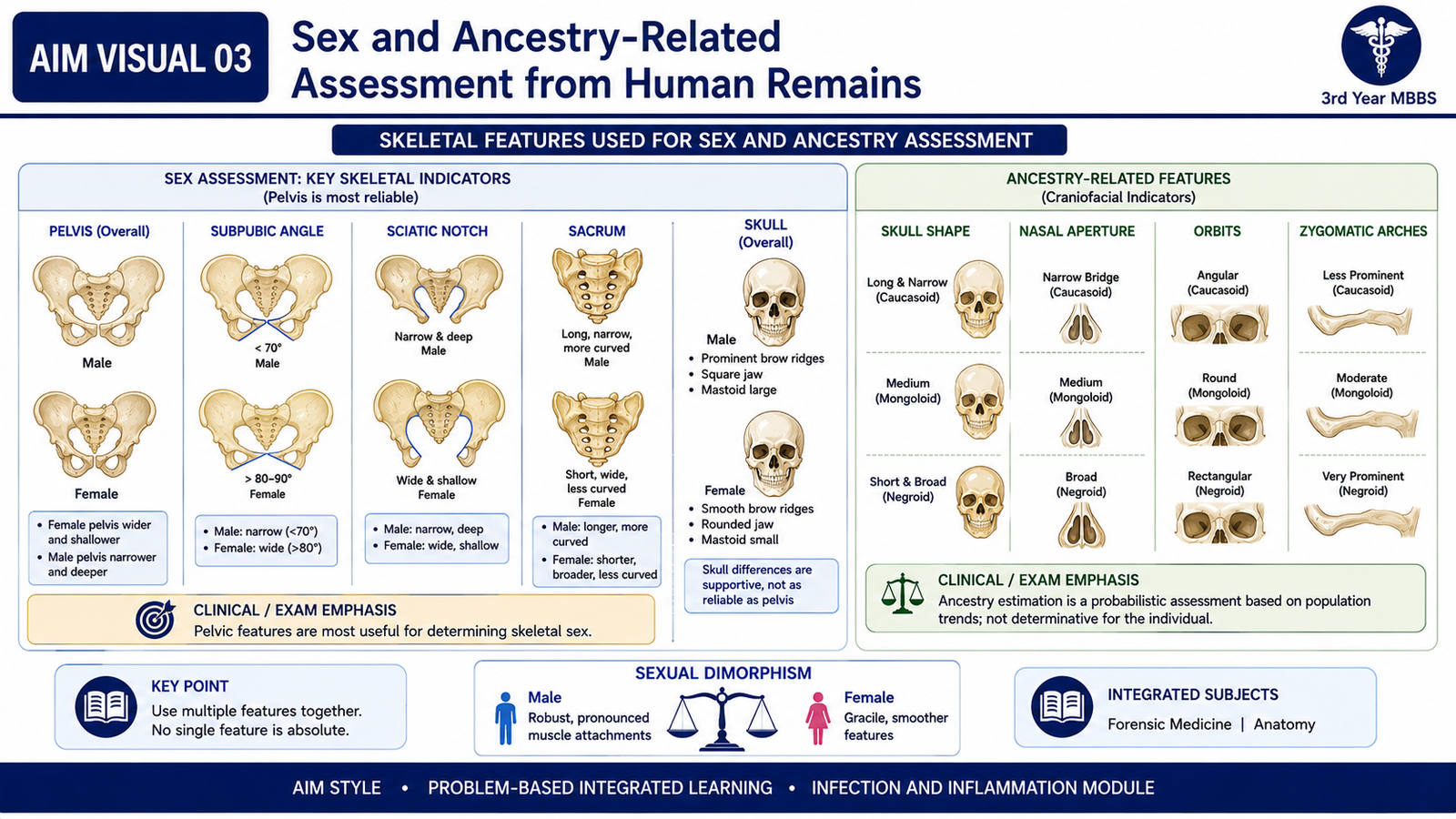
In an intact body, sex may be assessed from external genitalia, secondary sexual characteristics and internal reproductive organs. When only bones are available, the pelvis is generally the most informative skeletal region, while the skull provides additional supportive features.
Pelvic Parameters
The female pelvis is adapted for childbirth and therefore tends to be broader and more spacious. The male pelvis is generally narrower, heavier and more robust.
| Feature | Typical Male Pattern | Typical Female Pattern |
|---|---|---|
| General build | Heavier and more robust | Lighter and broader |
| Pelvic cavity | Relatively narrow | Relatively roomy |
| Subpubic angle | Narrower | Wider |
| Greater sciatic notch | Usually narrower | Usually wider |
| Sacrum | Longer and narrower | Shorter and broader |
Skull Parameters
Male skulls tend to show greater muscular markings and overall robustness. Features such as the supraorbital ridges, mastoid processes, mandible and occipital region may therefore support sex estimation. However, individual variation is considerable, so a skull feature should not be interpreted in isolation.
Assessment of Ancestry-Related Skeletal Features
Traditional forensic textbooks often use the term race determination. Modern forensic anthropology interprets these observations more cautiously as assessment of population or ancestry-related skeletal characteristics because human biological variation is continuous and does not fall into perfectly separate racial categories.
Features that may contribute to such an assessment include:
- overall cranial shape;
- facial proportions;
- nasal aperture characteristics;
- orbital shape;
- maxillary and dental characteristics;
- other cranial measurements considered together.
D. Hair, Tattoo Marks and Scar Marks
Hair, tattoos and scars are examples of physical evidence that may assist identification. Their value varies greatly. A highly distinctive tattoo or surgical scar may be strongly supportive when confirmed by previous records, while an isolated strand of hair usually requires careful laboratory interpretation before any conclusion can be drawn.
Examination of Hair
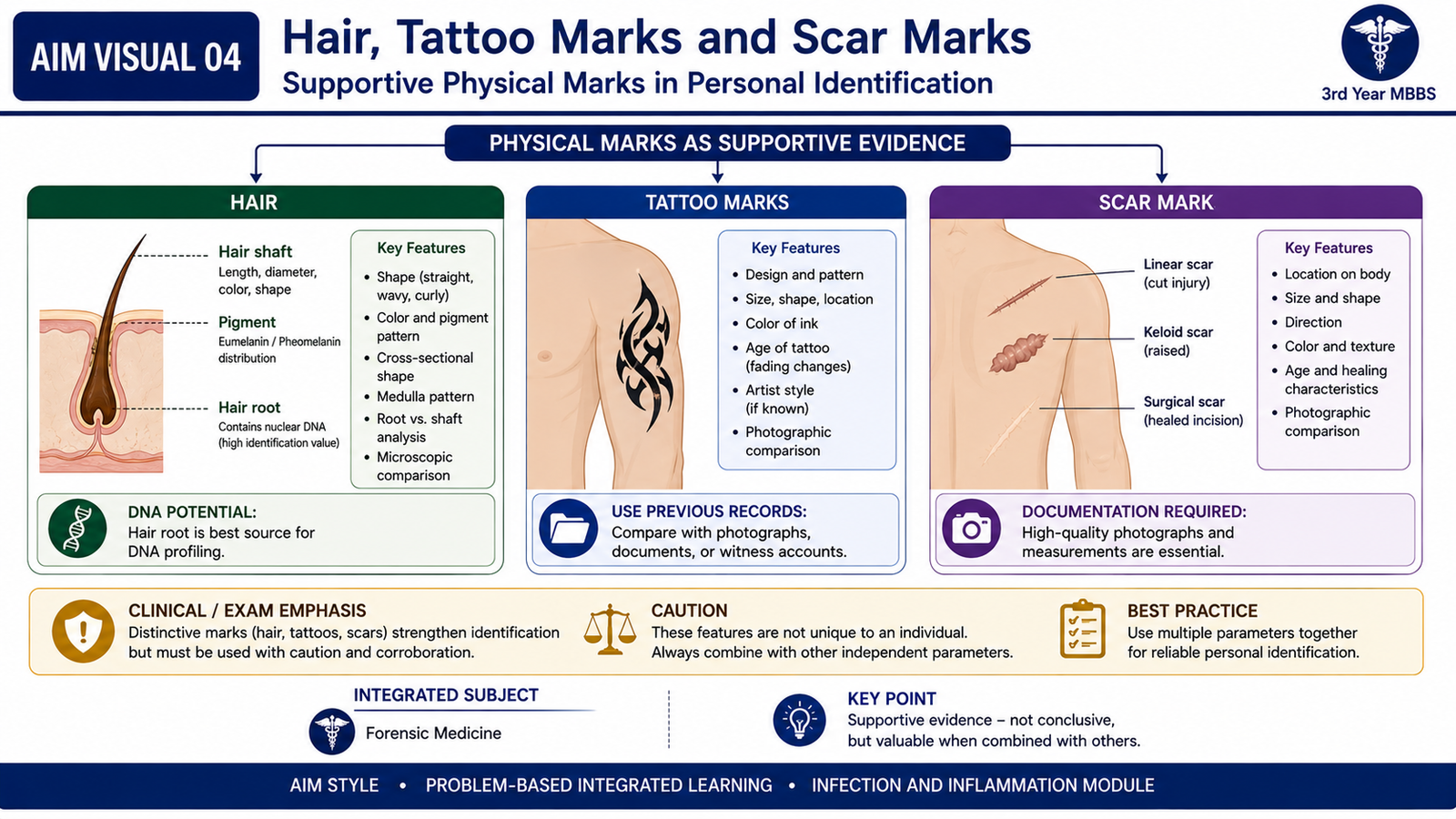
Hair may be recovered from a body, clothing, a scene or an object. Its forensic examination can help determine whether the material is hair, suggest its body origin and permit comparison with reference samples. Hair characteristics alone usually do not establish individual identity conclusively.
Important features examined include:
- length, color and diameter;
- cuticle;
- cortex and distribution of pigment;
- medulla and its pattern;
- appearance of the root;
- evidence of cutting, burning, artificial treatment or disease;
- features that may help distinguish human from animal hair.
The root may be especially important when tissue containing nucleated cells is attached because it may provide material for nuclear DNA testing. A hair shaft can also contain mitochondrial DNA, which may be useful when nuclear DNA is unavailable, although its discriminating power differs from a full nuclear DNA profile.
Tattoo Marks
A tattoo is produced by depositing pigment into the dermis. Because the pigment lies below the superficial epidermis, a tattoo usually persists for long periods and may therefore provide useful identifying information.
Medico-legal significance includes:
- supporting identification when the design and location correspond with records or descriptions;
- providing clues about personal associations or previous history, although these must be interpreted cautiously;
- remaining partially recognizable even when superficial skin changes occur;
- occasionally requiring examination of deeper skin when a tattoo has been deliberately altered or removed.
Scar Marks
A scar represents fibrous tissue formed after healing of an injury or surgical incision. Its identifying value depends on its site, shape, size and distinctive nature.
- Surgical scars may suggest a previous operation.
- Traumatic scars may indicate previous injury.
- Burn scars may have characteristic patterns.
- Scars may change in appearance with time and therefore cannot usually determine the exact age or cause of an old injury with certainty.
E. Forensic Odontology, Anthropometry and Dactylography
Some identification techniques rely on structures or measurements that are sufficiently stable to permit comparison with previous records. Teeth, body measurements and friction-ridge patterns are important examples. Their evidentiary value is greatest when a questioned finding can be directly compared with reliable ante-mortem records.
Forensic Odontology
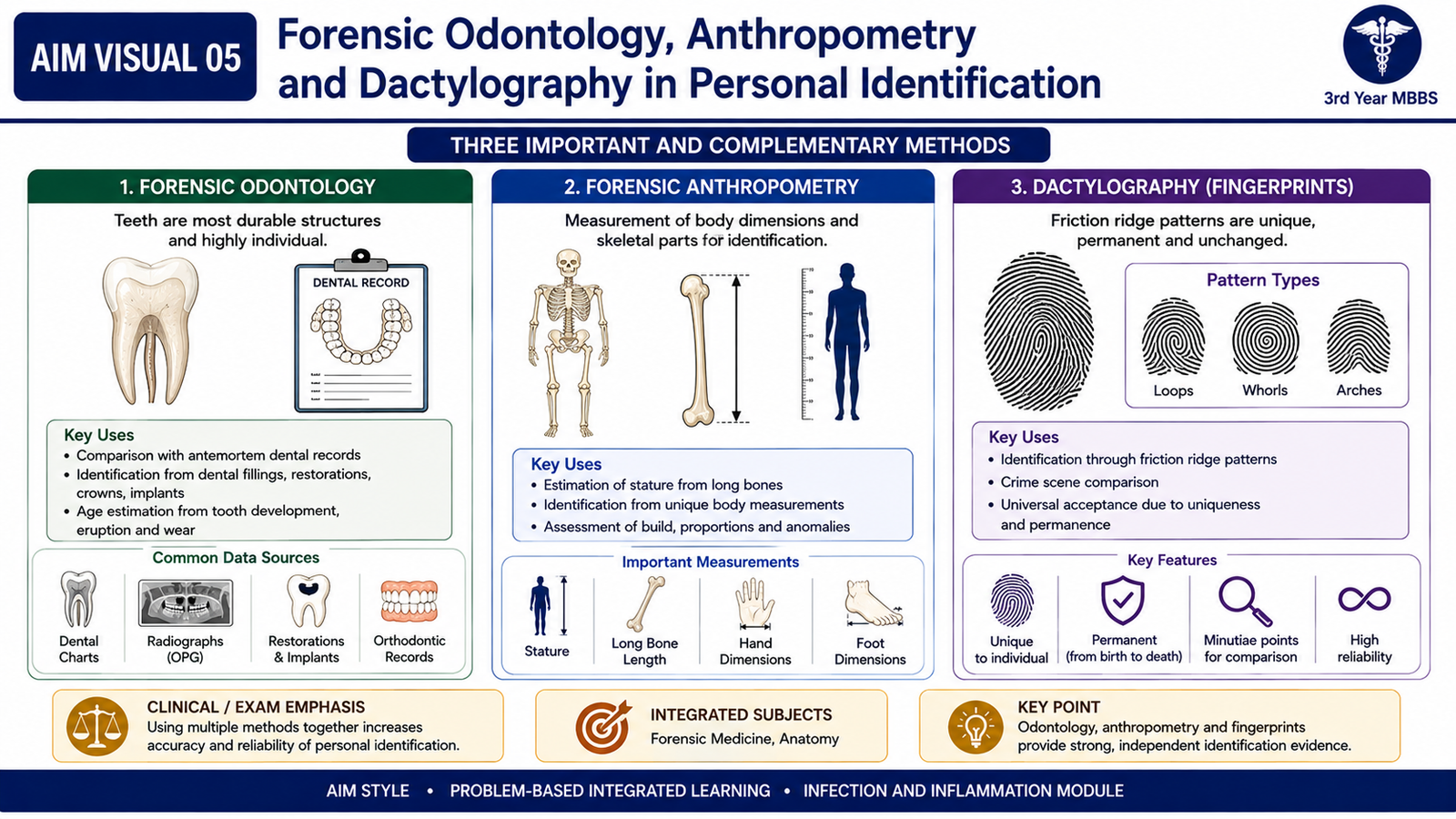
Forensic odontology is the application of dental knowledge to medico-legal investigation. Teeth are extremely useful because they are hard structures and can remain available even when soft tissues are damaged or decomposed.
Major applications include:
- identification of unknown deceased persons by comparison with dental records;
- age estimation from tooth development and eruption;
- assessment of dental restorations, missing teeth, prostheses and unusual dental features;
- assistance in mass-disaster identification;
- documentation and evaluation of injuries involving teeth and oral structures.
Identification becomes particularly strong when post-mortem findings correspond closely with previous dental charts, radiographs or treatment records.
Forensic Anthropometry
Anthropometry means systematic measurement of the human body or skeleton. Measurements can help describe a person and estimate characteristics such as stature from skeletal remains.
Examples include measurements of:
- overall body height;
- limb dimensions;
- long bones;
- cranial dimensions;
- other proportional measurements of the body.
When only skeletal remains are recovered, the length of long bones such as the femur, tibia or humerus can be entered into validated population-appropriate formulae to estimate stature. Because body proportions vary among populations and individuals, the result is an estimate rather than an exact reconstruction of height.
Dactylography
Dactylography is the study and use of fingerprints for identification. Fingerprints are produced by friction ridges on the palmar surfaces of the fingers. The arrangement of ridges and their fine details are highly individual.
Why Fingerprints Are Valuable
- Friction-ridge patterns develop before birth.
- The basic pattern remains stable throughout life.
- Superficial injury generally heals without changing the underlying pattern.
- Deep injury may produce a scar, which itself may become an additional identifying feature.
- Fingerprints can be directly compared with known records.
Basic Fingerprint Patterns
The major broad pattern groups taught at undergraduate level are:
- Loops
- Whorls
- Arches
Final individualization does not depend merely on calling a pattern a loop, whorl or arch. Detailed ridge characteristics are compared between the questioned and known prints.
F. DNA Fingerprinting: Principle, Applications, Sample Collection and Dispatch
DNA fingerprinting, also called DNA profiling, is a method of identifying or comparing individuals by examining variable regions of their DNA. Except for identical twins, the combination of genetic markers used in a forensic DNA profile is highly individual. The technique therefore provides much greater discriminating power than most general physical characteristics.
Basic Principle
Human beings share most of their DNA, but selected regions show substantial variation between individuals. A forensic laboratory examines a defined set of these variable genetic markers. The resulting pattern is compared with a reference sample or another biological specimen.
Applications of DNA Profiling
- identification of unknown bodies or human remains;
- comparison of biological material recovered during forensic investigation;
- establishing or excluding biological relationships such as parentage;
- identification of victims in mass disasters;
- comparison of separated body parts or tissue samples;
- assistance in investigations where biological material links a person with another person, object or location.
Biological Samples That May Provide DNA
Many human tissues and body fluids contain nucleated cells and can therefore provide DNA. Common forensic specimens include:
- blood;
- buccal epithelial cells obtained by oral swab;
- semen and other biological stains where relevant;
- soft tissue;
- hair with suitable root tissue;
- teeth;
- bone, particularly in decomposed or skeletonized remains.
Collection Principles
Good DNA analysis begins with correct collection. The purpose is not only to obtain biological material but also to prevent contamination, degradation and misidentification of the specimen.
- Use clean collection equipment and appropriate protective measures.
- Avoid touching biological material unnecessarily.
- Collect questioned and reference specimens separately.
- Package separate specimens separately to reduce cross-contamination.
- Clearly label each specimen with the necessary case identification information.
- Document who collected, handled and transferred the specimen.
- Where biological material is wet, appropriate drying and laboratory-approved handling principles are important to reduce degradation.
Dispatch to the Laboratory
The specimen should reach the forensic laboratory in a condition that preserves its integrity. Exact containers, preservatives, storage temperatures and transport procedures depend on the type of specimen and the protocol of the receiving forensic laboratory. Therefore, the examiner should follow the approved laboratory protocol rather than applying one preservation method to every sample.
Important general principles are:
- secure packaging;
- clear labeling;
- separate packaging of individual specimens;
- protection from contamination and inappropriate moisture;
- complete documentation;
- maintenance of chain of custody;
- timely dispatch according to laboratory instructions.


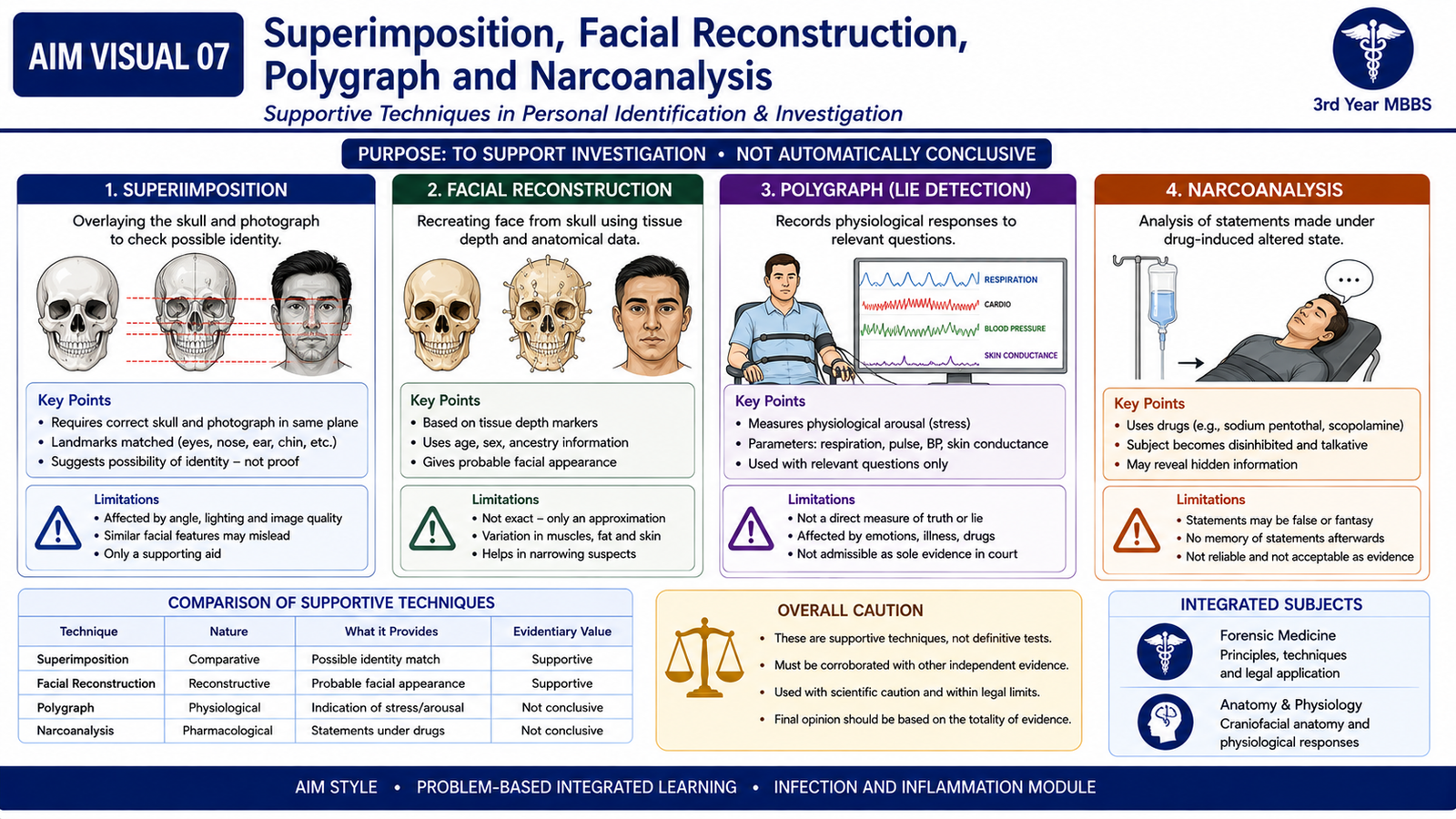
G. Superimposition, Facial Reconstruction, Polygraph and Narcoanalysis
Some forensic techniques are mainly supportive rather than independently conclusive. Their correct use requires understanding what question each method can answer and, equally importantly, what it cannot establish.
Superimposition
Superimposition is a comparison technique in which an image of a skull is aligned with an ante-mortem photograph of a suspected person. The examiner compares anatomical landmarks and proportions to determine whether the skull is compatible with the facial image.
The method may examine relationships involving:
- overall skull and facial dimensions;
- orbits and eyes;
- nasal region;
- mouth and teeth;
- chin and mandibular outline;
- other reproducible anatomical landmarks.
A clear mismatch can help exclude a proposed identity. A good match may support identification, but superimposition alone is usually not as individually discriminating as a reliable DNA profile, fingerprint comparison or distinctive dental comparison.
Facial Reconstruction
Facial reconstruction attempts to produce an approximation of a person’s facial appearance from the skull. Knowledge of skeletal anatomy and expected soft-tissue thickness is used to reconstruct the probable contour of the face.
Its main medico-legal role is investigative. A reconstructed face may help generate recognition or provide leads when no identity is initially known. It should not be regarded as an exact reproduction of the deceased person’s appearance.
Polygraph
A polygraph records physiological responses while a person answers questions. Recorded variables may include cardiovascular, respiratory and electrodermal responses. The underlying idea is that emotional arousal associated with certain answers may produce measurable physiological changes.
The important limitation is that physiological arousal is not specific to lying. Fear, anxiety, embarrassment, confusion and other emotional states can also produce similar responses. Therefore, a polygraph does not directly detect a lie and should not be interpreted as an infallible truth test.
Narcoanalysis
Narcoanalysis refers to questioning a person while consciousness and inhibition are altered by sedative or anesthetic drugs. Historically, it has been proposed that reduced inhibition might make a person more likely to disclose information.
However, reduced inhibition does not guarantee truth. A person may remain suggestible, confused or capable of producing inaccurate or mixed information. The technique also raises important ethical, medical and legal concerns.
Important Comparison: Major Identification Methods
| Method | Main Basis | Major Strength | Important Limitation |
|---|---|---|---|
| Fingerprints | Friction-ridge characteristics | Highly individual and permanent | Requires usable prints for comparison |
| Dental identification | Teeth, restorations and dental records | Teeth resist decomposition and damage | Best when reliable ante-mortem records exist |
| DNA profiling | Variable genetic markers | Very high discriminating power | Contamination and chain-of-custody problems can compromise interpretation |
| Scars and tattoos | Distinctive external marks | Rapid supportive recognition | May change, be altered or occur in more than one person |
| Superimposition | Skull-to-photograph anatomical correspondence | Useful for supporting or excluding a proposed identity | Usually supportive rather than independently conclusive |
⭐ AIM High-Yield Review
- Personal identification is strongest when several independent characteristics agree.
- Age estimation in children and adolescents relies mainly on dental development and skeletal ossification.
- Epiphyseal appearance and fusion are major skeletal indicators of age.
- ⭐ The pelvis is the most useful skeletal region for sex estimation.
- Traditional “race determination” from bones is better interpreted cautiously as assessment of ancestry-related skeletal characteristics.
- Hair microscopy can provide supportive information, while suitable hair material may also provide DNA.
- Tattoos and scars are useful identifying marks but become stronger evidence when matched with previous records.
- Forensic odontology is especially useful when decomposition or damage has destroyed soft tissues.
- ⭐ Fingerprints are valuable because friction-ridge patterns are highly individual and remain stable throughout life.
- Loops, whorls and arches are the basic broad fingerprint pattern groups.
- ⭐ DNA profiling provides highly discriminating biological identification when appropriate comparison material is available.
- Separate collection, proper labeling, contamination control and chain of custody are essential for forensic DNA evidence.
- Superimposition compares a skull with a possible ante-mortem facial photograph and is mainly supportive.
- Facial reconstruction is primarily an investigative aid and does not produce an exact portrait.
- ⭐ Polygraph responses are not specific for deception, and narcoanalysis does not guarantee truthful statements.
🎥 AIM Video Learning
Personal Identification and Forensic Identification Methods