
📖 Step 2 — Learning Material
1️⃣ Introduction
Gastric motility refers to the coordinated muscular activity of the stomach that stores, mixes, grinds, and gradually empties food into the duodenum. The stomach is located in the upper abdomen, mainly in the epigastric and left hypochondriac regions. Its motor functions are essential because food must be converted into chyme before intestinal digestion. Gastric emptying must be controlled carefully so that the duodenum receives chyme at a manageable rate. If gastric motility is abnormal, patients may develop vomiting, bloating, early satiety, reflux, or delayed gastric emptying. This topic is clinically important in conditions such as diabetic gastroparesis, pyloric stenosis, vomiting, and gastric outlet obstruction.
2️⃣ Foundation Basics
Key Definitions
- Gastric motility: Motor activity of the stomach muscles that helps in storage, mixing, grinding, and emptying.
- Gastric emptying: Movement of chyme from the stomach into the duodenum.
- Chyme: Semi-fluid mixture of partially digested food and gastric secretions.
- Basic electrical rhythm: Spontaneous rhythmic electrical activity generated by gastric smooth muscle.
- Pyloric pump: Strong peristaltic contractions of the distal stomach that push chyme toward the pylorus.
- Pylorus: Distal narrow part of the stomach that regulates passage of chyme into the duodenum.
- Retropulsion: Backward movement of chyme into the stomach when the pylorus closes.
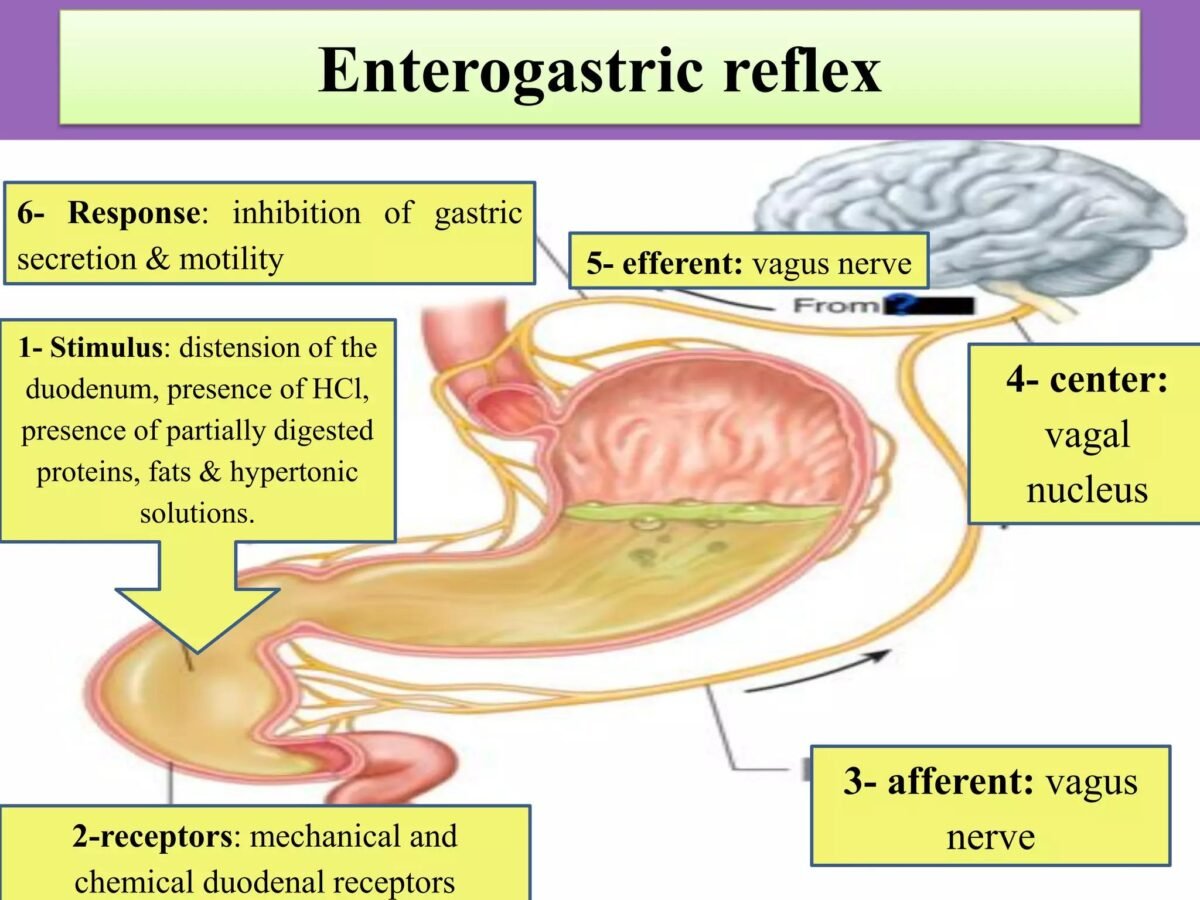
- Enterogastric reflex: Reflex from duodenum that slows gastric emptying.
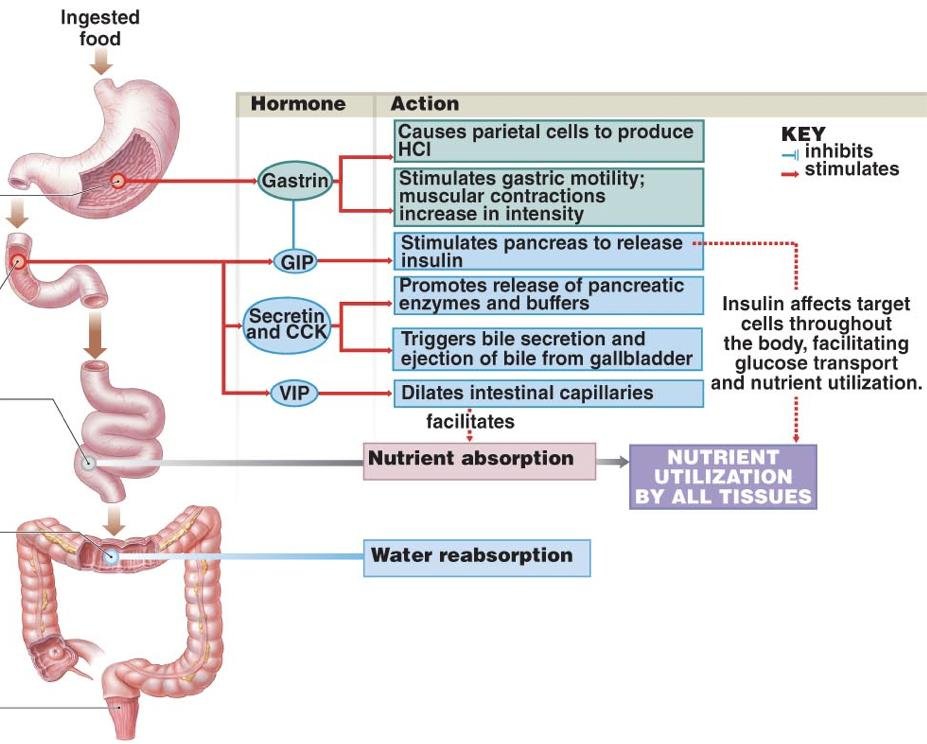
- Gastrin: Hormone that increases gastric motility and secretion.
- Cholecystokinin (CCK): Intestinal hormone that slows gastric emptying, especially when fats enter the duodenum.
3️⃣ Core Learning — Curriculum Coverage
Objective 1: Motor Function of Stomach
🧠 CORE
- The stomach performs storage, mixing, grinding, and controlled emptying.
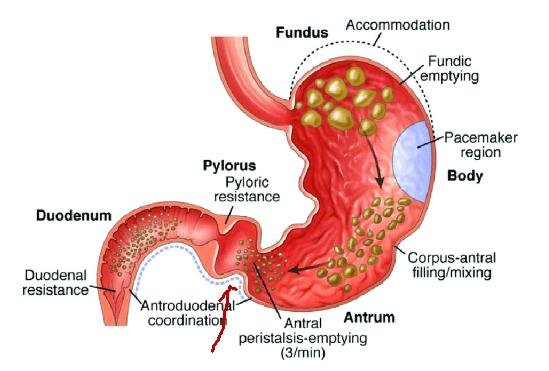
- The fundus and body mainly act as storage areas.
- The antrum is the main grinding and mixing region.
- Gastric smooth muscle produces peristaltic waves.
- Food is mixed with gastric juice to form chyme.
- Strong antral contractions break food into smaller particles.
- Only small particles and liquids pass easily through the pylorus.
- Gastric motility is controlled by neural, hormonal, and local mechanisms.
- Vagus nerve generally increases gastric motility.
- Sympathetic stimulation decreases gastric motility.
🔬 CONCEPT EXPLAINED
The stomach does not simply pass food forward. It first stores food, then mixes it with acid and enzymes, then grinds it into small particles before emptying it slowly.
The upper stomach relaxes after food enters. This is called receptive relaxation and allows the stomach to store food without a large rise in pressure.
The lower stomach, especially the antrum, produces stronger peristaltic contractions. These contractions move chyme toward the pylorus. When the pylorus is partly closed, much of the chyme moves backward into the stomach. This backward movement is called retropulsion, and it helps in grinding and mixing.
⚠️ IF DAMAGED
- Weak gastric contractions → poor mixing → delayed digestion.
- Loss of receptive relaxation → early satiety and discomfort after meals.
- Excessive motility → rapid emptying and intestinal discomfort.
- Reduced vagal activity → delayed gastric emptying.
- Diabetic autonomic neuropathy → gastroparesis → nausea, vomiting, bloating.
2: Basic Electrical Rhythm of Stomach
🧠 CORE
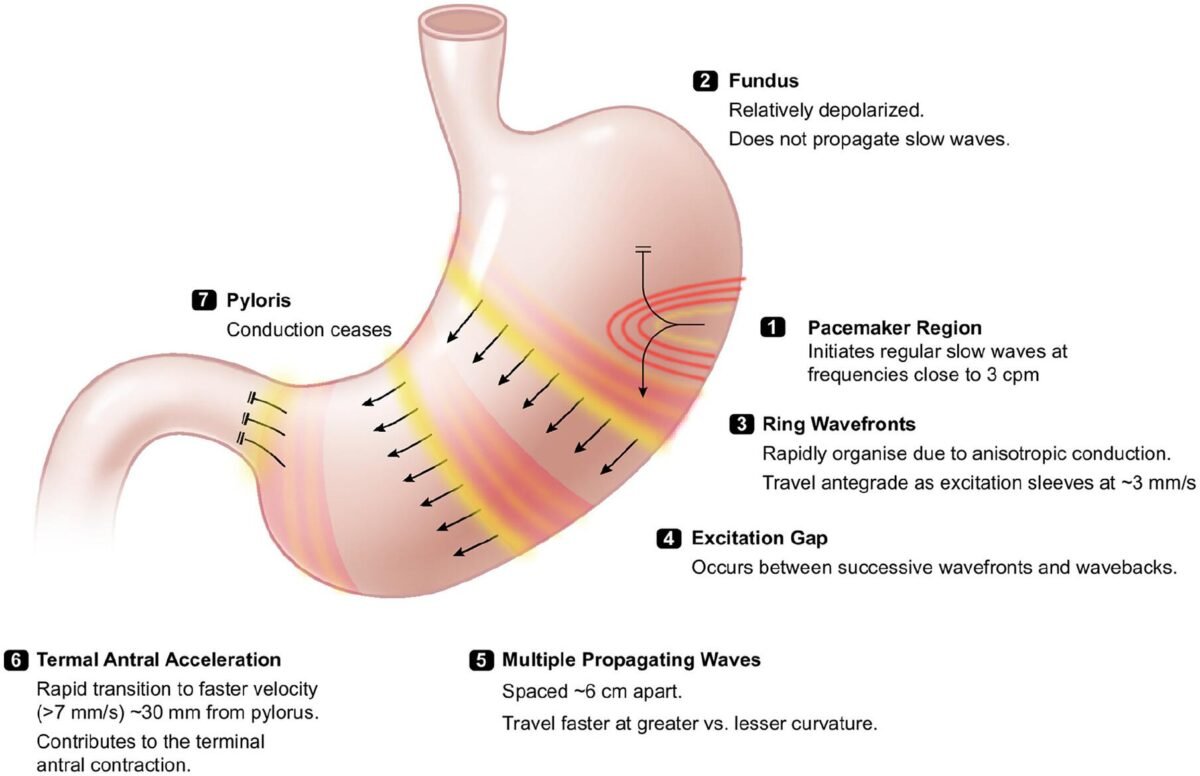
- Basic electrical rhythm is the rhythmic electrical activity of gastric smooth muscle.
- It is generated mainly by interstitial cells of Cajal.
- These cells act as pacemaker cells of the gut.
- In the stomach, the rhythm is about 3 waves per minute.
- Electrical waves begin in the upper body and spread toward the antrum.
- These waves do not always cause contraction.
- Contraction occurs when spike potentials are added.
- Stretch, gastrin, and vagal stimulation increase contractions.
- Sympathetic activity reduces contractions.
- Basic electrical rhythm coordinates gastric peristalsis.
🔬 CONCEPT EXPLAINED
The stomach has smooth muscle that can generate rhythmic electrical activity. This rhythm provides timing for contractions, like a pacemaker.
The basic electrical rhythm spreads from the body of the stomach toward the pylorus. By itself, it may produce weak contractions. Strong contractions occur when the electrical rhythm is accompanied by spike potentials.
This means:
Electrical rhythm provides timing → spike potentials increase force → smooth muscle contracts → chyme moves forward.
⚠️ IF DAMAGED
- Abnormal pacemaker activity → disorganized gastric contractions.
- Weak electrical activity → delayed gastric emptying.
- Excessive activity → increased contractions and possible cramping.
- Loss of coordination → poor grinding and irregular emptying.
🧩 Concept Map 2
3: Pyloric Pump
🧠 CORE
- The pyloric pump refers to strong peristaltic contractions in the antrum.
- It pushes chyme toward the pylorus.
- It is strongest in the distal stomach.
- It helps in grinding food particles.
- It promotes mixing of food with gastric secretions.
- It pushes only small amounts of chyme into the duodenum.
- Most chyme is pushed back when the pylorus closes.
- This backward movement is called retropulsion.
- The pyloric pump is increased by gastrin.
- It is inhibited by duodenal signals when the duodenum is overloaded.
🔬 CONCEPT EXPLAINED
The pyloric pump is not just a forward-pushing mechanism. It is also a grinding mechanism.
As peristaltic waves reach the antrum, they become stronger. These contractions force chyme toward the pyloric canal. However, the pylorus usually remains partly closed. Only liquid chyme and very small particles pass into the duodenum.
Larger particles are thrown back into the stomach. This process breaks them down further.
Antral contraction → chyme moves forward → pylorus partly closes → large particles move backward → grinding improves.
⚠️ IF DAMAGED
- Weak pyloric pump → food remains in stomach → delayed emptying.
- Excessive pyloric contraction → rapid pressure changes and discomfort.
- Poor antral grinding → large particles fail to empty.
- Diabetic gastroparesis may impair pyloric pump function.
4: Role of Pylorus in Gastric Emptying
🧠 CORE
- The pylorus acts as a functional gate between stomach and duodenum.
- It regulates the rate of gastric emptying.
- It allows liquids and small particles to pass.
- It prevents large particles from entering the duodenum.
- It helps produce retropulsion.
- It protects the duodenum from excessive acid load.
- It slows emptying when duodenal contents are acidic, fatty, or hyperosmotic.
- Pyloric tone is influenced by neural and hormonal signals.
- Increased pyloric tone delays gastric emptying.
- Relaxation of pylorus allows chyme passage.
🔬 CONCEPT EXPLAINED
The pylorus ensures that gastric emptying is controlled, not random. The duodenum has limited capacity to neutralize acid and digest nutrients. Therefore, chyme must enter slowly.
The pylorus remains partially contracted during antral contractions. This allows only small amounts of chyme to enter the duodenum.
When the duodenum receives too much acid, fat, or hyperosmotic chyme, it sends inhibitory signals back to the stomach. These signals increase pyloric tone and reduce antral contractions.
⚠️ IF DAMAGED
- Pyloric obstruction → vomiting, visible peristalsis, delayed emptying.
- Pyloric stenosis in infants → projectile vomiting.
- Excessive pyloric relaxation → rapid emptying.
- Excessive pyloric contraction → gastric retention and bloating.
- Poor pyloric control → duodenal overload and discomfort
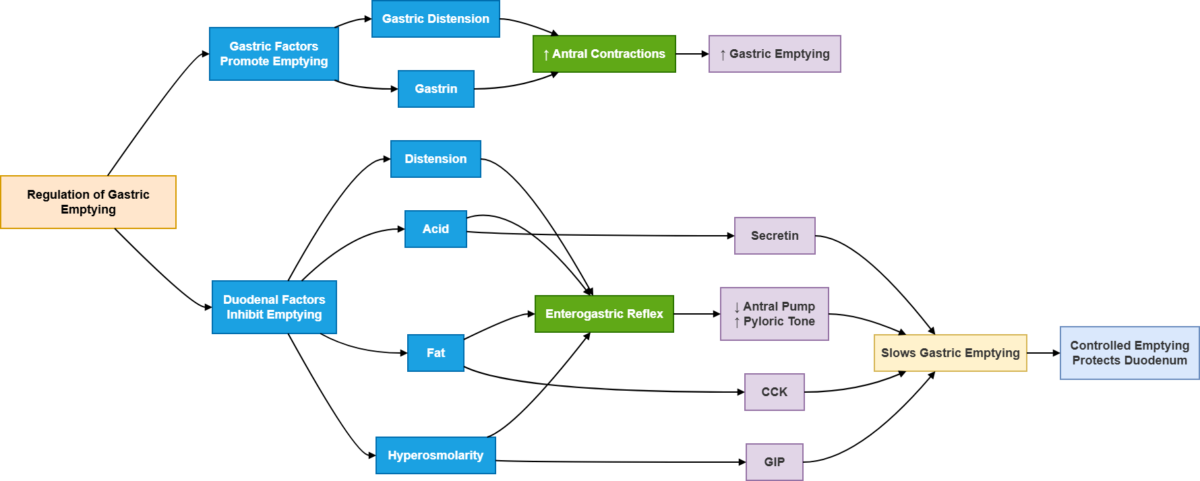
5: Regulation of Gastric Emptying
🧠 CORE
Gastric emptying is regulated by a balance between gastric forces promoting emptying and duodenal mechanisms inhibiting emptying.
Major regulatory components include:
- Gastric distension (major promoter)
- Gastrin hormone (mild promoter)
- Enteric nervous system reflexes
- Autonomic nervous system (vagus and sympathetic)
- Enterogastric reflex from duodenum
- Hormonal inhibition from intestine
- Duodenal distension
- Duodenal acidity
- Fat content in duodenum
- Hyperosmolar chyme
Stomach promotes emptying — Duodenum controls the rate.
🔬 CONCEPT EXPLAINED
I. Gastric Factors Promoting Gastric Emptying
(Stomach-Controlled Mechanisms)
These mechanisms originate from the stomach and increase the force of gastric emptying.
1. Gastric Distension (Most Important Promoter)
What it is:
Stretching of the stomach wall when food enters.
How it works:
- Food enters stomach → stomach wall stretches.
- Stretch receptors activate:
- Local enteric reflexes
- Vago-vagal reflexes
- These reflexes increase:
- Antral contractions
- Pyloric pump activity
- Stronger contractions push chyme toward pylorus.
Why it exists:
- Ensures food does not remain in stomach unnecessarily.
- Matches gastric emptying with meal size.
If it fails:
Gastric atony → weak contractions → delayed emptying → gastric retention.
2. Gastrin Hormone (Mild Promoter)
Source:
G cells of gastric antrum.
Stimulus for release:
- Protein-containing food
- Gastric distension
Actions:
- Increases gastric motility.
- Enhances pyloric pump activity.
- Slightly relaxes pylorus.
- Promotes gastric emptying.
Why it exists:
- Protein digestion requires active mixing and emptying.
If it fails:
Reduced gastrin → weak motility → delayed emptying.
II. Duodenal Factors Inhibiting Gastric Emptying
(Duodenum-Controlled Mechanisms — MOST IMPORTANT CONTROL)
The duodenum has the final authority over gastric emptying.
These inhibitory signals occur when duodenum is overloaded.
Major Duodenal Stimuli That Slow Gastric Emptying
1. Duodenal Distension
What happens:
- Excess chyme stretches duodenal wall.
- Sends inhibitory signals to stomach.
Effect:
- Reduces pyloric pump strength.
- Increases pyloric tone.
- Slows gastric emptying.
2. Duodenal Acidity (Low pH)
What happens:
- Acidic chyme enters duodenum.
- Duodenum needs time to neutralize acid.
Effect:
- Strong inhibition of gastric emptying.
- Prevents duodenal mucosal damage.
3. Fat in Duodenum
(Most Powerful Chemical Inhibitor)
What happens:
- Fat digestion is slow.
- Requires more time in intestine.
Effect:
- Strong suppression of gastric emptying.
4. Hyperosmolar Chyme
What happens:
- Highly concentrated chyme enters duodenum.
Effect:
- Slows gastric emptying.
- Allows dilution before absorption.
III. Neural Regulation
A. Enteric Nervous System (Local Reflex Control)
The enteric nervous system (ENS) coordinates local control of gastric emptying.
Mechanism:
- Duodenum detects:
- Distension
- Acidity
- Osmolarity
- Nutrient composition
- Signals pass through myenteric plexus.
- Effects on stomach:
- Reduced antral contractions.
- Increased pyloric constriction.
This local reflex is called:
Enterogastric Reflex
B. Autonomic Nervous System
Parasympathetic (Vagus Nerve)
Action:
- Increases gastric motility.
- Enhances pyloric pump.
- Promotes gastric emptying.
Pathway:
Vagus nerve → Gastric smooth muscle → Strong contractions → Increased emptying.
Sympathetic System
Action:
- Reduces gastric motility.
- Increases pyloric tone.
- Slows gastric emptying.
Functional Role:
During stress or danger → digestion slows → energy conserved.
IV. Hormonal Regulation
(Intestinal Hormones That Slow Gastric Emptying)
Hormones released from small intestine slow gastric emptying when digestion needs more time.
1. Cholecystokinin (CCK) — MOST IMPORTANT
Source:
I cells of duodenum and jejunum.
Stimulus:
Fat in duodenum.
Actions:
- Strongly inhibits gastric emptying.
- Reduces antral contractions.
- Increases pyloric tone.
- Promotes bile release.
- Stimulates pancreatic enzyme secretion.
Why it exists:
Fat digestion requires prolonged intestinal processing.
2. Secretin
Source:
S cells of duodenum.
Stimulus:
Acidic chyme.
Actions:
- Inhibits gastric emptying.
- Stimulates pancreatic bicarbonate secretion.
Purpose:
Neutralizes acid before digestion continues.
3. Gastric Inhibitory Peptide (GIP)
Source:
K cells of duodenum.
Stimulus:
Fat and carbohydrates.
Actions:
- Mild inhibition of gastric emptying.
- Stimulates insulin release.
⚠️ IF DAMAGED — Functional Consequences
Delayed Gastric Emptying
Cause → Effect
Autonomic neuropathy → weak gastric motility → delayed emptying → nausea, vomiting, fullness.
Seen in:
- Diabetes mellitus
- Vagal nerve injury
- Gastric surgery
Rapid Gastric Emptying
Cause → Effect
Loss of pyloric control → rapid chyme entry → intestinal overload → cramps and diarrhea.
Seen in:
- After gastric surgery
- Loss of pyloric regulation
4️⃣ Mechanism Flow
Gastric Motility and Emptying: Stepwise Flow
- Food enters the stomach.
- Fundus and body relax to store food.
- Gastric wall stretch activates local and vagal reflexes.
- Weak peristaltic waves begin in the upper stomach.
- Waves become stronger in the antrum.
- Antral contractions push chyme toward pylorus.
- Pylorus remains partly closed.
- Small liquid chyme passes into duodenum.
- Large particles are pushed backward by retropulsion.
- Repeated mixing and grinding form fine chyme.
- Duodenum checks acid, fat, osmolarity, and volume.
- If duodenum is overloaded, enterogastric reflex slows emptying.
- Gastric emptying continues gradually at a controlled rate.
5️⃣ Functional Integration
Structure → Function → Outcome
- Fundus and body
→ Relax and store food
→ Allow large meals without sudden pressure rise. - Antrum
→ Strong muscular contractions
→ Grinding and mixing of food. - Pylorus
→ Narrow muscular gate
→ Controls emptying and prevents large particles entering duodenum. - Interstitial cells of Cajal
→ Generate basic electrical rhythm
→ Coordinate gastric peristalsis. - Vagus nerve
→ Increases gastric motility
→ Promotes digestion and emptying. - Duodenum
→ Detects acid, fat, osmolarity, and distension
→ Slows gastric emptying when needed.
6️⃣ Clinical Correlation
1. Diabetic Gastroparesis
- Long-standing diabetes may damage autonomic nerves.
- Vagal dysfunction reduces gastric motility.
- Food remains in stomach for longer time.
- Patient may develop nausea, vomiting, bloating, and early satiety.
Cause → Effect:
Diabetic autonomic neuropathy → weak gastric contractions → delayed emptying → gastroparesis.
2. Pyloric Stenosis
- Narrowing of pyloric canal obstructs gastric emptying.
- Commonly discussed in infants.
- Stomach contracts strongly but chyme cannot pass easily.
- Causes projectile vomiting.
Cause → Effect:
Pyloric narrowing → gastric outlet obstruction → retained milk/food → vomiting.
3. Gastric Outlet Obstruction
- May occur due to ulcer-related scarring or tumors.
- Food cannot empty properly from stomach.
- Patient may have vomiting of undigested food, fullness, and dehydration.
Cause → Effect:
Blocked pyloric region → delayed gastric emptying → gastric distension → vomiting.
4. Rapid Gastric Emptying
- If gastric emptying is too fast, duodenum receives excessive chyme.
- This may cause cramps, diarrhea, dizziness, and discomfort.
- Commonly discussed after gastric surgery.
Cause → Effect:
Loss of normal gastric control → rapid duodenal filling → intestinal fluid shift → abdominal symptoms.
⭐ 7️⃣ Points to Remember
- The stomach stores, mixes, grinds, and empties food.
- Fundus and body mainly store food.
- Antrum is the main grinding region.
- Basic electrical rhythm of stomach is about 3 waves/minute.
- Interstitial cells of Cajal act as pacemaker cells.
- Pyloric pump means strong antral contractions.
- Retropulsion helps grind food into smaller particles.
- Pylorus acts as a gatekeeper between stomach and duodenum.
- Gastric distension and gastrin increase gastric emptying.
- Duodenal acid, fat, distension, and hyperosmolarity slow gastric emptying.
- CCK strongly slows gastric emptying when fat enters the duodenum.
- Diabetic gastroparesis is a classic example of delayed gastric emptying.