
📖 Step 2 — Learning Material
🔹 1️⃣ Introduction
- Glycogen metabolism is the process by which the body stores and mobilizes glucose for energy needs.
- Glycogen serves as the major storage form of glucose in humans.
- It is mainly present in the liver and skeletal muscles.
- Liver glycogen helps maintain blood glucose levels during fasting.
- Muscle glycogen provides rapid energy during muscle contraction and exercise.
- Glycogen metabolism includes two major processes:
- Glycogenesis → glycogen synthesis
- Glycogenolysis → glycogen breakdown
- Defects in glycogen metabolism produce glycogen storage diseases (GSDs), which commonly affect liver and muscle function.
- Understanding glycogen metabolism is essential for understanding fasting physiology, exercise metabolism, diabetes, and inherited metabolic disorders.
🔹 2️⃣ Foundation Concepts
Key Definitions
- Glycogen: Branched polymer of glucose used for energy storage.
- Glycogenesis: Formation of glycogen from glucose.
- Glycogenolysis: Breakdown of glycogen into glucose units.
- Branching enzyme: Enzyme that forms branches within glycogen.
- UDP-glucose: Activated glucose donor used in glycogen synthesis.
- Glycogenin: Primer protein required for initiation of glycogen synthesis.
Essential Terminology
- α-1,4 glycosidic bond: Linear linkage between glucose molecules.
- α-1,6 glycosidic bond: Bond responsible for branching.
- Granules: Cytoplasmic storage particles containing glycogen and enzymes.
- Hepatocytes: Liver cells storing glycogen for blood glucose maintenance.
- Myocytes: Muscle cells storing glycogen for local energy use.
Basic Overview
- Excess glucose is stored as glycogen after meals.
- Glycogen is rapidly mobilized during fasting or exercise.
- Insulin stimulates glycogen synthesis.
- Glucagon and epinephrine stimulate glycogen breakdown.
- Glycogen metabolism is highly regulated according to body energy needs.
🔹 3️⃣ Core Learning — Curriculum Coverage
A. Structure of Glycogen
🧠 CORE
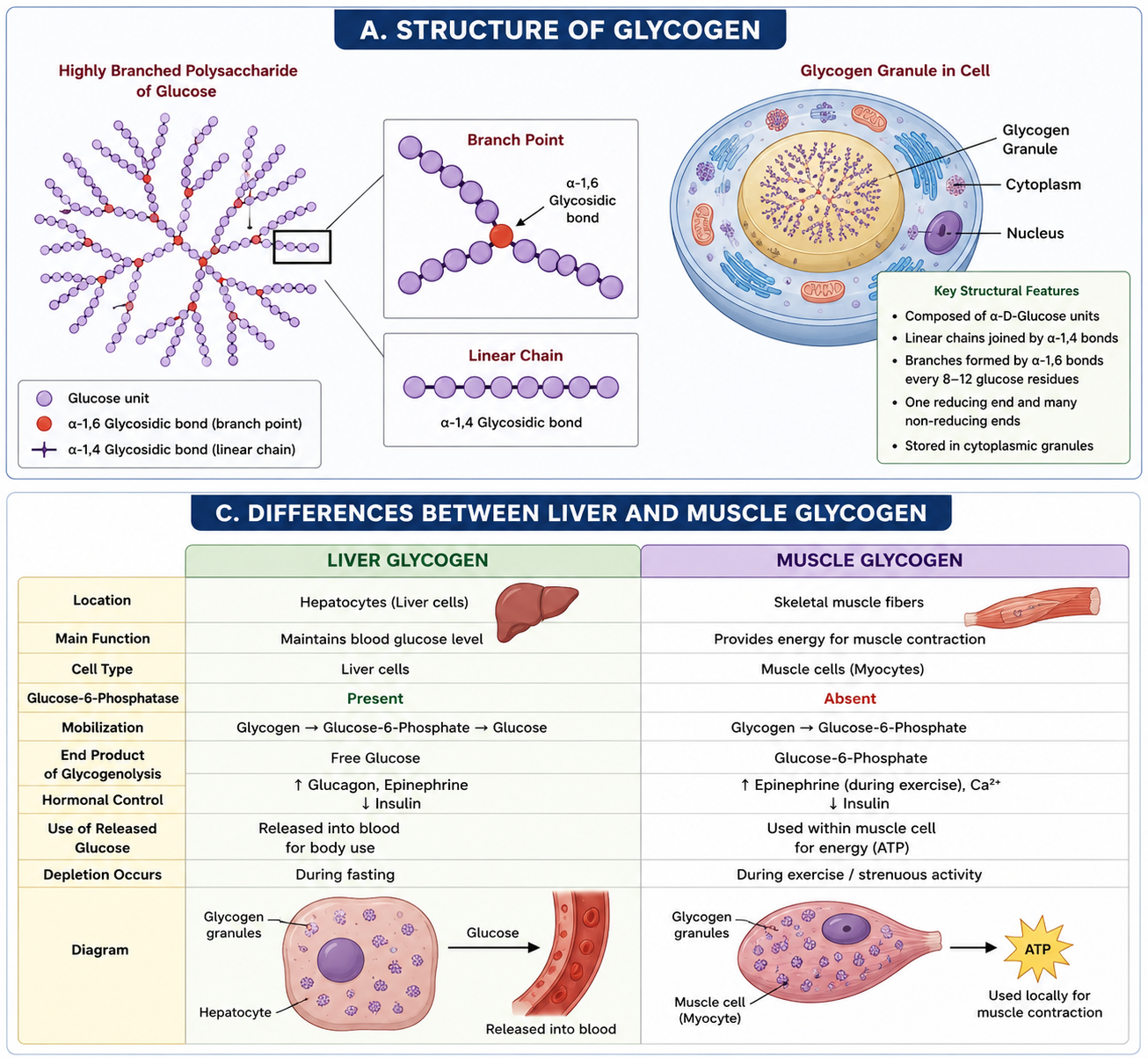
- Glycogen is a highly branched polysaccharide.
- It is composed entirely of glucose molecules.
- Linear chains are connected by α-1,4 glycosidic bonds.
- Branch points contain α-1,6 glycosidic bonds.
- Branches occur approximately every 8–12 glucose residues.
- Glycogen is stored in cytoplasmic granules.
- Glycogen has one reducing end and many non-reducing ends.
- Major storage sites:
- Liver
- Skeletal muscle
🔬 CONCEPT EXPLAINED
Glycogen is designed for rapid glucose storage and release. The linear α-1,4 bonds create chains, while α-1,6 branching increases compactness and solubility.
The branched structure creates many non-reducing ends. These ends allow multiple enzymes to act simultaneously during glycogen synthesis and breakdown. As a result, glucose can be mobilized very rapidly when energy is required.
The spherical branching pattern also allows efficient storage of large amounts of glucose without significantly increasing cellular osmotic pressure.
⚠️ IF DAMAGED
Cause → Effect
- Defective branching enzyme
→ Abnormal glycogen structure
→ Poor solubility
→ Liver dysfunction and muscle weakness - Excess abnormal glycogen accumulation
→ Cellular swelling
→ Organ enlargement - Reduced glycogen availability
→ Impaired glucose supply during fasting
B. Functional Significance of Glycogen Polymer
🧠 CORE
- Glycogen is the storage form of glucose.
- It provides rapid energy release.
- Branching increases solubility.
- Branching prevents osmotic overload.
- Multiple branch ends accelerate metabolism.
- Glycogen acts as a short-term energy reserve.
- Liver glycogen maintains blood glucose.
- Muscle glycogen supports contraction during exercise.
🔬 CONCEPT EXPLAINED
Free glucose molecules inside cells would create major osmotic problems. Converting glucose into glycogen allows thousands of glucose molecules to be stored as a single compact polymer.
Branching is functionally important because enzymes can work simultaneously at multiple branch ends. This enables extremely rapid glucose mobilization during stress, fasting, or exercise.
The glycogen polymer therefore solves two physiological problems:
- Safe glucose storage
- Rapid glucose availability
Structure → Function Relationship
| Structure | Functional Benefit |
|---|---|
| Branched polymer | Rapid synthesis and breakdown |
| Compact granule | Efficient storage |
| Multiple ends | Fast enzyme activity |
| Insoluble form | Prevents osmotic damage |
⚠️ IF DAMAGED
Cause → Effect
- Failure of glycogen storage
→ Reduced glucose reserve
→ Fasting hypoglycemia - Impaired glycogen mobilization
→ Muscle fatigue during exercise - Excess intracellular glucose
→ Osmotic swelling and cellular injury
C. Differences Between Liver and Muscle Glycogen
🧠 CORE
- Liver glycogen maintains blood glucose.
- Muscle glycogen provides local energy.
- Liver contains glucose-6-phosphatase.
- Muscle lacks glucose-6-phosphatase.
- Liver glycogen is depleted during fasting.
- Muscle glycogen is depleted during exercise.
- Liver responds mainly to glucagon.
- Muscle responds mainly to epinephrine and calcium.
🔬 CONCEPT EXPLAINED
Although glycogen structure is similar in both tissues, their functions differ significantly.
Liver Glycogen
- Acts as a glucose reservoir for the entire body.
- During fasting, glycogen is broken down and free glucose enters blood circulation.
- Hepatocytes contain glucose-6-phosphatase, which converts glucose-6-phosphate into free glucose.
Muscle Glycogen
- Used only within muscle cells.
- Supports ATP production during contraction.
- Muscle cells lack glucose-6-phosphatase, so glucose cannot enter the bloodstream.
Liver vs Muscle Glycogen
| Feature | Liver | Muscle |
|---|---|---|
| Main function | Maintain blood glucose | Energy for contraction |
| Hormonal control | Glucagon | Epinephrine |
| Glucose-6-phosphatase | Present | Absent |
| Used during | Fasting | Exercise |
⚠️ IF DAMAGED
Cause → Effect
- Liver glycogen depletion
→ Hypoglycemia during fasting - Muscle glycogen deficiency
→ Exercise intolerance - Defective glycogen breakdown in muscle
→ Muscle cramps and weakness
D. Glycogen Synthesis (Glycogenesis)
🧠 CORE
- Glycogenesis occurs mainly after meals.
- It converts excess glucose into glycogen.
- Occurs in liver and muscle cytoplasm.
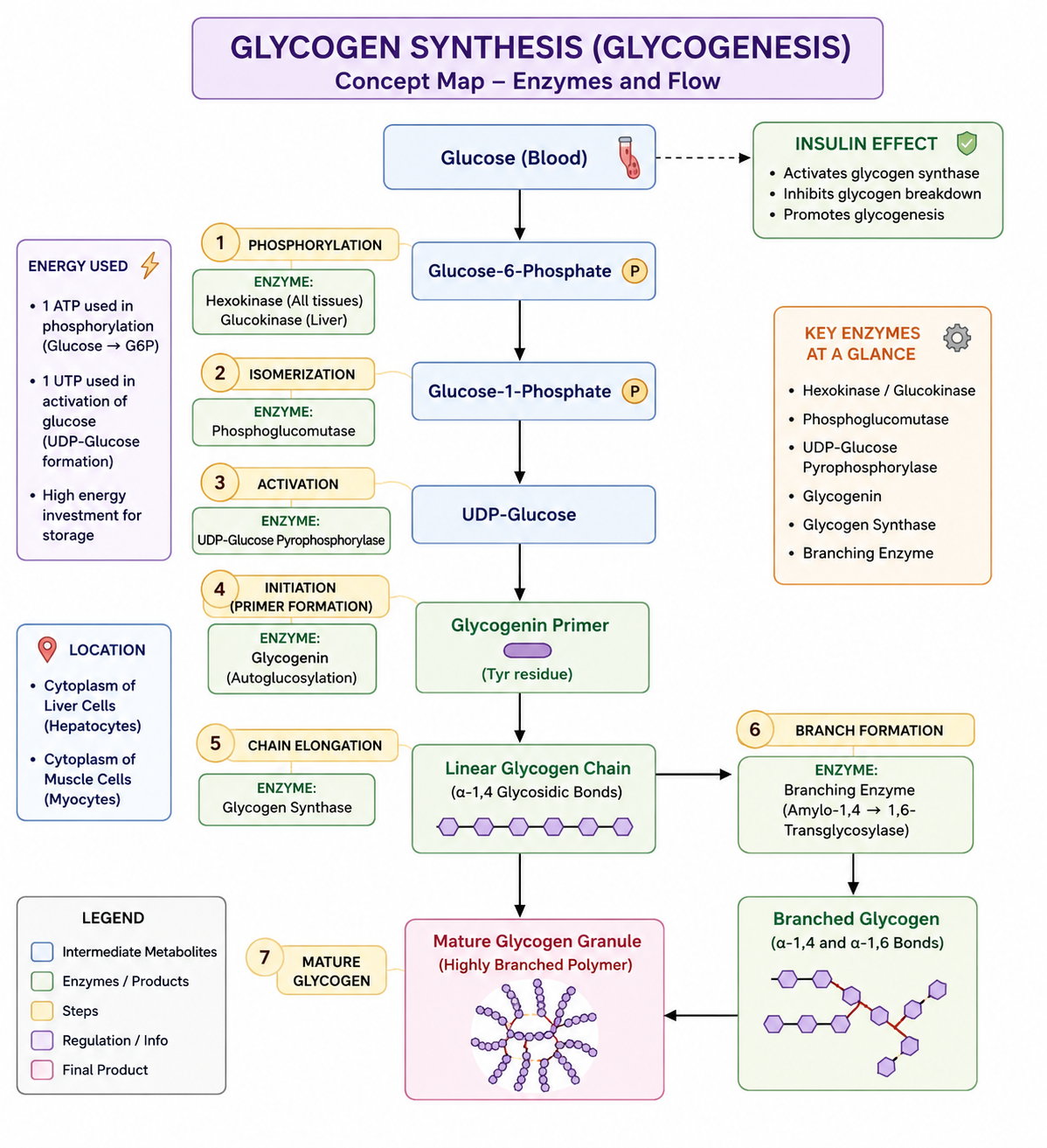
- Requires ATP and UTP energy.
- Insulin stimulates glycogenesis.
- Glycogen synthase is the key enzyme.
- Glycogenin acts as a primer.
- Branching enzyme forms α-1,6 branches.
🔬 CONCEPT EXPLAINED
After carbohydrate intake, blood glucose rises and insulin secretion increases. Cells take up glucose and convert it into glycogen for storage.
Glucose is first phosphorylated into glucose-6-phosphate. It is then converted into glucose-1-phosphate and activated into UDP-glucose.
Glycogen synthase adds glucose units to growing glycogen chains through α-1,4 bonds. The branching enzyme creates α-1,6 branches, producing the mature branched glycogen molecule.
⚠️ IF DAMAGED
Cause → Effect
- Glycogen synthase deficiency
→ Reduced glycogen formation
→ Poor energy reserve - Insulin deficiency
→ Reduced glycogenesis
→ Hyperglycemia - Branching enzyme defect
→ Abnormal glycogen accumulation
→ Liver cirrhosis and muscle dysfunction
E. Enzymes of Glycogenesis
🧠 CORE
- Hexokinase/glucokinase phosphorylates glucose.
- Phosphoglucomutase converts G6P to G1P.
- UDP-glucose pyrophosphorylase forms UDP-glucose.
- Glycogenin initiates glycogen synthesis.
- Glycogen synthase forms α-1,4 bonds.
- Branching enzyme forms α-1,6 branches.
- Glycogen synthase is rate-limiting.
- Insulin activates glycogen synthase.
🔬 CONCEPT EXPLAINED
Each enzyme performs a specialized step during glycogenesis.
Important Enzymes
- Hexokinase/Glucokinase
- Traps glucose inside the cell.
- Phosphoglucomutase
- Rearranges phosphate position.
- UDP-glucose pyrophosphorylase
- Activates glucose using UTP.
- Glycogenin
- Provides the initial glucose primer.
- Glycogen synthase
- Elongates glycogen chains.
- Branching enzyme
- Creates branches for compact storage.
⚠️ IF DAMAGED
Cause → Effect
- Glycogen synthase defect
→ Poor glycogen storage
→ Hypoglycemia - Branching enzyme deficiency
→ Abnormal glycogen accumulation
→ Hepatomegaly - Enzyme failure in muscle
→ Reduced exercise endurance
⚙️ 4️⃣ Functional Flow
Structure → Function → Outcome
Glycogen Branching
- Branched structure
→ Multiple enzyme access points
→ Rapid glucose mobilization
Liver Glycogen
- Contains glucose-6-phosphatase
→ Releases free glucose
→ Maintains blood glucose during fasting
Muscle Glycogen
- Stored near myofibrils
→ Rapid ATP generation
→ Sustains muscle contraction
Insulin Action
- Activates glycogenesis
→ Excess glucose storage
→ Prevention of hyperglycemia
🩺 5️⃣ Clinical Correlation
Glycogen Storage Diseases (GSDs)
Von Gierke Disease (Type I)
- Glucose-6-phosphatase deficiency
- Severe fasting hypoglycemia
- Hepatomegaly
- Lactic acidosis
Pompe Disease (Type II)
- Lysosomal acid maltase deficiency
- Glycogen accumulates in heart and muscle
- Cardiomegaly and muscle weakness
McArdle Disease (Type V)
- Muscle glycogen phosphorylase deficiency
- Exercise intolerance
- Muscle cramps
- Myoglobinuria
Andersen Disease (Type IV)
- Branching enzyme deficiency
- Abnormal glycogen formation
- Liver cirrhosis
📌 6️⃣ Summary Points
Points to Remember
- Glycogen is the storage form of glucose.
- Glycogen contains α-1,4 and α-1,6 bonds.
- Branching increases rapid glucose release.
- Liver glycogen maintains blood glucose.
- Muscle glycogen supports contraction.
- Glycogen synthase is the key glycogenesis enzyme.
- Glycogenin acts as the primer protein.
- Insulin stimulates glycogen synthesis.
- Glucagon stimulates glycogen breakdown in liver.
- Muscle lacks glucose-6-phosphatase.
- Glycogen storage diseases affect liver and muscle.
- Branching enzyme defects produce abnormal glycogen structure.