
📖 Step 2 — Learning Material
🔹 1️⃣ Introduction
Ketone body metabolism and complex lipid metabolism are essential components of lipid biochemistry that help maintain energy balance in the human body. Ketone bodies are mainly produced in the liver during fasting, starvation, uncontrolled diabetes mellitus, and prolonged exercise when glucose availability becomes limited. These ketone bodies serve as an alternative energy source for extrahepatic tissues such as brain, skeletal muscle, and heart.
Complex lipids including triacylglycerols, phospholipids, and sphingolipids are major structural and functional components of cells. They are important for membrane formation, energy storage, cell signaling, and nerve insulation. Disorders of lipid metabolism can lead to serious clinical conditions such as diabetic ketoacidosis, Niemann-Pick disease, and Farber disease.
Understanding these pathways helps explain how the body adapts during fasting and how abnormalities in lipid metabolism produce disease. These concepts are highly important for understanding metabolism, membrane biology, neurology, and endocrine disorders in clinical medicine.
🔹 2️⃣ Foundation Concepts
Key Definitions
- Ketone bodies: Water-soluble compounds produced from fatty acids in liver mitochondria.
- Ketogenesis: Formation of ketone bodies from acetyl-CoA.
- Ketolysis: Utilization of ketone bodies for energy production.
- Triacylglycerol (TAG): Storage form of fat composed of glycerol and three fatty acids.
- Phospholipids: Membrane lipids containing phosphate groups.
- Sphingolipids: Lipids containing sphingosine backbone important in nerve tissue.
- Ceramide: Basic structural unit of sphingolipids.
- Sphingomyelin: Major phospholipid present in myelin sheath.
- Glycosphingolipids: Sphingolipids containing carbohydrate groups.
🔹 3️⃣ Core Learning — Curriculum Coverage
Ketone Body Metabolism
Overview of Ketone Bodies
🧠 CORE
- Ketone bodies are produced in liver mitochondria.
- Main ketone bodies:
- Acetoacetate
- Beta-hydroxybutyrate
- Acetone
- Produced during carbohydrate deficiency.
- Derived mainly from fatty acid oxidation.
- Water-soluble fuel molecules.
- Used by brain, heart, and skeletal muscle.
- Liver produces but cannot utilize ketone bodies.
- Important during prolonged fasting.
🔬 CONCEPT EXPLAINED
During fasting or uncontrolled diabetes, glucose becomes deficient inside cells. Fat stores are broken down releasing fatty acids. These fatty acids enter liver mitochondria and undergo beta oxidation producing large amounts of acetyl-CoA.
When excess acetyl-CoA accumulates and oxaloacetate becomes depleted due to gluconeogenesis, acetyl-CoA cannot fully enter the TCA cycle. The liver converts excess acetyl-CoA into ketone bodies.
Ketone bodies are released into blood and transported to peripheral tissues where they are reconverted into acetyl-CoA for ATP production.
This adaptation allows survival during starvation by supplying energy to vital organs.
⚠️ IF DAMAGED
- Excess ketone production causes ketosis.
- Severe accumulation produces ketoacidosis.
- Blood pH falls causing metabolic acidosis.
- CNS depression and dehydration may occur.
- Severe diabetic ketoacidosis may cause coma.
Formation of Ketone Bodies (Ketogenesis)
🧠 CORE
- Occurs in liver mitochondria.
- Begins with excess acetyl-CoA.
- Main pathway during fasting and diabetes.
- HMG-CoA synthase is key enzyme.
- Produces acetoacetate first.
- Acetoacetate forms beta-hydroxybutyrate and acetone.
- Requires active fatty acid oxidation.
- Stimulated by glucagon.
- Inhibited by insulin.
🔬 CONCEPT EXPLAINED
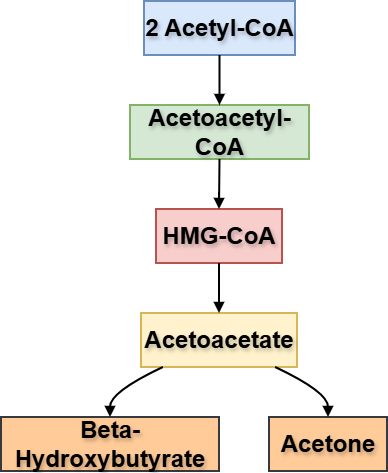
Ketogenesis starts when two acetyl-CoA molecules combine to form acetoacetyl-CoA. Another acetyl-CoA joins forming HMG-CoA through HMG-CoA synthase.
HMG-CoA lyase converts HMG-CoA into acetoacetate. Acetoacetate may:
- Convert into beta-hydroxybutyrate
- Spontaneously form acetone
Beta-hydroxybutyrate is the major circulating ketone body because it is more stable.
The pathway mainly functions when carbohydrate availability is low.
⚠️ IF DAMAGED
- Impaired ketogenesis reduces fasting adaptation.
- Energy deficiency develops during starvation.
- Excess ketogenesis causes diabetic ketoacidosis.
- Acetone accumulation produces fruity breath odor.
Factors Increasing Ketone Body Formation
🧠 CORE
- Starvation increases ketogenesis.
- Uncontrolled diabetes mellitus increases ketogenesis.
- Low carbohydrate diet stimulates ketone formation.
- Prolonged exercise increases fatty acid oxidation.
- Increased glucagon stimulates pathway.
- Insulin deficiency strongly promotes ketogenesis.
🔬 CONCEPT EXPLAINED
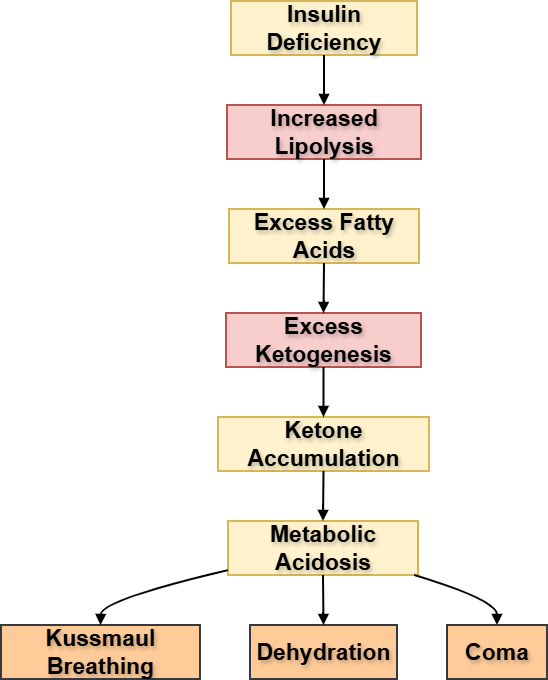
Insulin deficiency increases lipolysis in adipose tissue. Large amounts of fatty acids reach the liver. Beta oxidation generates excess acetyl-CoA.
Simultaneously, oxaloacetate is diverted toward gluconeogenesis, limiting TCA cycle activity. Excess acetyl-CoA is therefore redirected toward ketone body formation.
This metabolic shift helps preserve glucose for tissues that require it.
⚠️ IF DAMAGED
- Excessive ketogenesis causes severe acidosis.
- Electrolyte imbalance develops.
- Dehydration and shock may occur.
Utilization of Ketone Bodies
🧠 CORE
- Occurs in extrahepatic tissues.
- Brain utilizes ketone bodies during prolonged fasting.
- Heart muscle efficiently uses ketone bodies.
- Ketone bodies convert back into acetyl-CoA.
- Acetyl-CoA enters TCA cycle for ATP production.
- Liver cannot utilize ketone bodies.
- Thiophorase enzyme required for utilization.
🔬 CONCEPT EXPLAINED
Peripheral tissues take up ketone bodies from blood. Beta-hydroxybutyrate converts into acetoacetate. Acetoacetate then forms acetoacetyl-CoA.
Thiophorase enzyme converts acetoacetyl-CoA into acetyl-CoA molecules which enter the TCA cycle to generate ATP.
The liver lacks thiophorase, preventing self-utilization.
⚠️ IF DAMAGED
- Reduced ketone utilization decreases energy production.
- Brain adaptation during fasting becomes impaired.
- Weakness and fatigue develop.
Regulation of Ketone Body Metabolism
🧠 CORE
- Insulin inhibits ketogenesis.
- Glucagon stimulates ketogenesis.
- Fatty acid oxidation controls substrate supply.
- Carbohydrate deficiency increases ketone production.
- HMG-CoA synthase is major regulatory enzyme.
- Oxaloacetate availability affects pathway.
🔬 CONCEPT EXPLAINED
Insulin decreases lipolysis and reduces fatty acid entry into liver. Glucagon has opposite effects and promotes fatty acid oxidation.
Low carbohydrate availability reduces oxaloacetate levels because it is used in gluconeogenesis. Reduced oxaloacetate limits TCA cycle activity and promotes ketogenesis.
Thus ketogenesis is closely linked to overall energy balance.
⚠️ IF DAMAGED
- Loss of insulin control produces excessive ketone formation.
- Severe metabolic acidosis may occur.
Clinical Importance of Ketone Bodies
🧠 CORE
- Diabetic ketoacidosis is major clinical disorder.
- Common in uncontrolled type 1 diabetes mellitus.
- Hyperglycemia and ketosis occur together.
- Acidosis develops due to ketone accumulation.
- Fruity breath odor caused by acetone.
- Kussmaul breathing may occur.
🔬 CONCEPT EXPLAINED
In type 1 diabetes mellitus, insulin deficiency causes uncontrolled lipolysis and ketogenesis. Excess ketone bodies accumulate in blood faster than tissues can utilize them.
Ketone bodies are acidic, lowering blood pH. The body compensates through deep rapid breathing to remove CO₂.
Severe dehydration and electrolyte imbalance further worsen the condition.
⚠️ IF DAMAGED
- Untreated ketoacidosis may cause coma.
- Severe acidosis can become life-threatening.
Triacylglycerol Synthesis
🧠 CORE
- Occurs mainly in liver and adipose tissue.
- Glycerol-3-phosphate forms backbone.
- Fatty acyl-CoA molecules are added sequentially.
- Final product is triacylglycerol.
- TAG is major storage form of fat.
- Stored in adipose tissue.
🔬 CONCEPT EXPLAINED
Glycerol-3-phosphate combines with fatty acyl-CoA molecules to form phosphatidic acid. Removal of phosphate produces diacylglycerol, which then forms triacylglycerol after addition of third fatty acid.
TAG efficiently stores large amounts of energy because fatty acids contain high-energy bonds.
⚠️ IF DAMAGED
- Excess TAG accumulation causes fatty liver.
- Obesity and hyperlipidemia may develop.
Phosphatidic Acid Metabolism
🧠 CORE
- Central intermediate in lipid metabolism.
- Formed from glycerol-3-phosphate.
- Precursor of TAG and phospholipids.
- Contains glycerol backbone and phosphate group.
🔬 CONCEPT EXPLAINED
Phosphatidic acid acts as a branching point in lipid synthesis. It may:
- Lose phosphate to form diacylglycerol
- Form phospholipids for membranes
Thus it connects storage lipids and membrane lipids.
⚠️ IF DAMAGED
- Defective phospholipid synthesis impairs membrane integrity.
- Cellular dysfunction develops.
Glycerophospholipid Metabolism
🧠 CORE
- Major membrane lipids.
- Contain glycerol, fatty acids, phosphate group.
- Important for membrane fluidity.
- Participate in cell signaling.
- Broken down by phospholipases.
🔬 CONCEPT EXPLAINED
Different head groups attached to phosphatidic acid produce various phospholipids such as phosphatidylcholine and phosphatidylethanolamine.
Phospholipases degrade phospholipids by cleaving specific bonds. Breakdown products may act as signaling molecules.
⚠️ IF DAMAGED
- Membrane instability develops.
- Nerve and lung dysfunction may occur.
Sphingolipid Metabolism
Ceramide Metabolism
🧠 CORE
- Ceramide is core sphingolipid molecule.
- Formed from sphingosine and fatty acid.
- Precursor of sphingomyelin and glycosphingolipids.
- Important in membrane signaling.
🔬 CONCEPT EXPLAINED
Ceramide acts as a structural foundation for complex sphingolipids. Addition of phosphocholine forms sphingomyelin, while carbohydrate addition forms glycosphingolipids.
Ceramide also participates in apoptosis signaling pathways.
⚠️ IF DAMAGED
- Abnormal ceramide accumulation causes inflammatory disorders.
- Cellular signaling becomes impaired.
Sphingomyelin Metabolism
🧠 CORE
- Sphingomyelin is major myelin lipid.
- Important for nerve conduction.
- Synthesized from ceramide.
- Broken down by sphingomyelinase.
🔬 CONCEPT EXPLAINED
Sphingomyelin stabilizes myelin sheath surrounding nerve fibers. Degradation occurs inside lysosomes through sphingomyelinase enzyme.
Proper turnover is necessary for neural function.
⚠️ IF DAMAGED
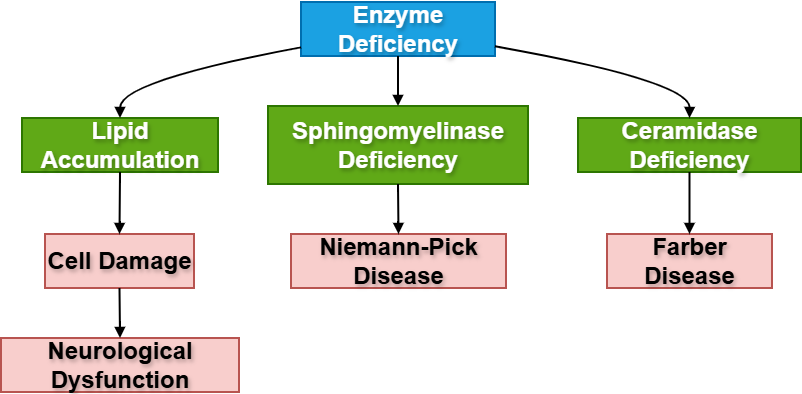
- Sphingomyelin accumulation causes Niemann-Pick disease.
- Neurodegeneration and hepatosplenomegaly develop.
Glycosphingolipid Metabolism
🧠 CORE
- Contain carbohydrate groups.
- Abundant in nervous tissue.
- Important for cell recognition.
- Synthesized from ceramide.
- Degraded inside lysosomes.
🔬 CONCEPT EXPLAINED
Different sugars added to ceramide form cerebrosides and gangliosides. These molecules participate in cell interaction and neural function.
Lysosomal enzymes sequentially remove sugars during degradation.
⚠️ IF DAMAGED
- Lipid accumulation causes lysosomal storage diseases.
- Progressive neurological damage occurs.
Disorders of Sphingolipid Metabolism
Niemann-Pick Disease
🧠 CORE
- Caused by sphingomyelinase deficiency.
- Sphingomyelin accumulates in lysosomes.
- Causes neurodegeneration.
- Hepatosplenomegaly common.
🔬 CONCEPT EXPLAINED
Failure of sphingomyelin degradation leads to accumulation within macrophages and neurons. Organ enlargement and neurological deterioration gradually occur.
⚠️ IF DAMAGED
- Severe neurological impairment develops.
- Early death may occur in severe forms.
Farber Disease
🧠 CORE
- Caused by ceramidase deficiency.
- Ceramide accumulates in tissues.
- Joint deformities occur.
- Neurological impairment may develop.
🔬 CONCEPT EXPLAINED
Failure of ceramide degradation causes progressive accumulation in connective tissues and nervous system leading to inflammation and dysfunction.
⚠️ IF DAMAGED
- Progressive disability develops.
- Chronic inflammation occurs.
⚙️ 4️⃣ Functional Flow
- Fasting → Increased lipolysis → Increased acetyl-CoA → Ketogenesis → Energy supply to brain and muscle
- Phospholipids → Cell membrane formation → Membrane stability → Normal cellular function
- Sphingomyelin → Myelin sheath formation → Rapid nerve conduction → Normal neurological function
🩺 5️⃣ Clinical Correlation
- Diabetic ketoacidosis
- Starvation ketosis
- Fatty liver disease
- Niemann-Pick disease
- Farber disease
- Membrane dysfunction disorders
📌 6️⃣ Summary Points
- Ketone bodies are produced only in liver mitochondria.
- Brain uses ketone bodies during prolonged fasting.
- Liver produces but cannot utilize ketone bodies.
- HMG-CoA synthase is key enzyme of ketogenesis.
- Insulin inhibits ketogenesis.
- TAG is the major storage form of fat.
- Phosphatidic acid is central intermediate in lipid synthesis.
- Ceramide is precursor of all sphingolipids.
- Sphingomyelin is important for myelin sheath.
- Niemann-Pick disease results from sphingomyelinase deficiency.
- Farber disease results from ceramidase deficiency.