
📖 Step 2 — Learning Material
🔹 1️⃣ Introduction
Fatty acid metabolism is a major biochemical process responsible for energy storage and energy production in the human body. Fatty acids are highly energy-rich molecules and serve as the main fuel source during fasting, prolonged exercise, and starvation. The liver, adipose tissue, and skeletal muscles play central roles in fatty acid synthesis and oxidation. Fatty acid synthesis mainly occurs in the fed state when excess carbohydrates are converted into fat for storage, while fatty acid oxidation becomes dominant during fasting to generate ATP. Proper regulation of fatty acid metabolism is essential for maintaining energy homeostasis. Disturbances in these pathways can lead to obesity, fatty liver disease, hypoglycemia, muscle weakness, and inherited metabolic disorders such as MCAD deficiency.
🔹 2️⃣ Foundation Concepts
Key Definitions
• Fatty Acid Synthesis: Formation of fatty acids from acetyl-CoA mainly in cytoplasm
• Fatty Acid Oxidation: Breakdown of fatty acids to produce ATP
• Beta Oxidation: Major pathway of fatty acid degradation occurring in mitochondria
• Acetyl-CoA: Central metabolic molecule used in lipid metabolism
• Fatty Acid Synthase: Multifunctional enzyme complex responsible for fatty acid synthesis
• Lipolysis: Breakdown of stored triglycerides into free fatty acids and glycerol
• Carnitine Shuttle: Transport system carrying fatty acids into mitochondria
• Palmitate: Major product of fatty acid synthesis (16-carbon fatty acid)
Basic Overview
• Fatty acid synthesis occurs mainly in liver, adipose tissue, and lactating mammary glands
• Fatty acid oxidation mainly occurs in liver and skeletal muscle
• Synthesis occurs in cytoplasm while oxidation occurs in mitochondria
• NADPH is required for synthesis
• FADH₂ and NADH are produced during oxidation
• Insulin promotes synthesis whereas glucagon promotes oxidation
• Fatty acids are major long-term energy storage molecules
🔹 3️⃣ Core Learning — Curriculum Coverage
1. Introduction and Physiological Importance of Fatty Acid Metabolism
🧠 CORE
• Fatty acid metabolism includes synthesis and degradation of fatty acids
• Provides long-term energy storage
• Supplies ATP during fasting and starvation
• Liver is central organ in lipid metabolism
• Adipose tissue stores triglycerides
• Skeletal muscle uses fatty acids for energy
• Brain cannot directly use long-chain fatty acids
• Excess carbohydrates are converted into fatty acids
🔬 CONCEPT EXPLAINED
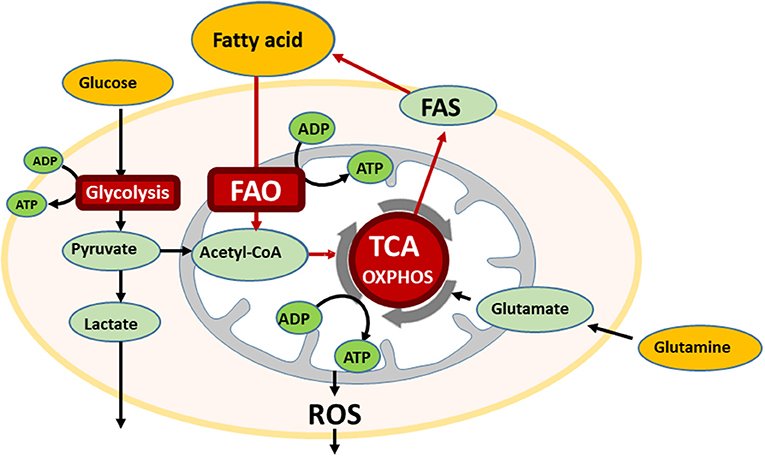
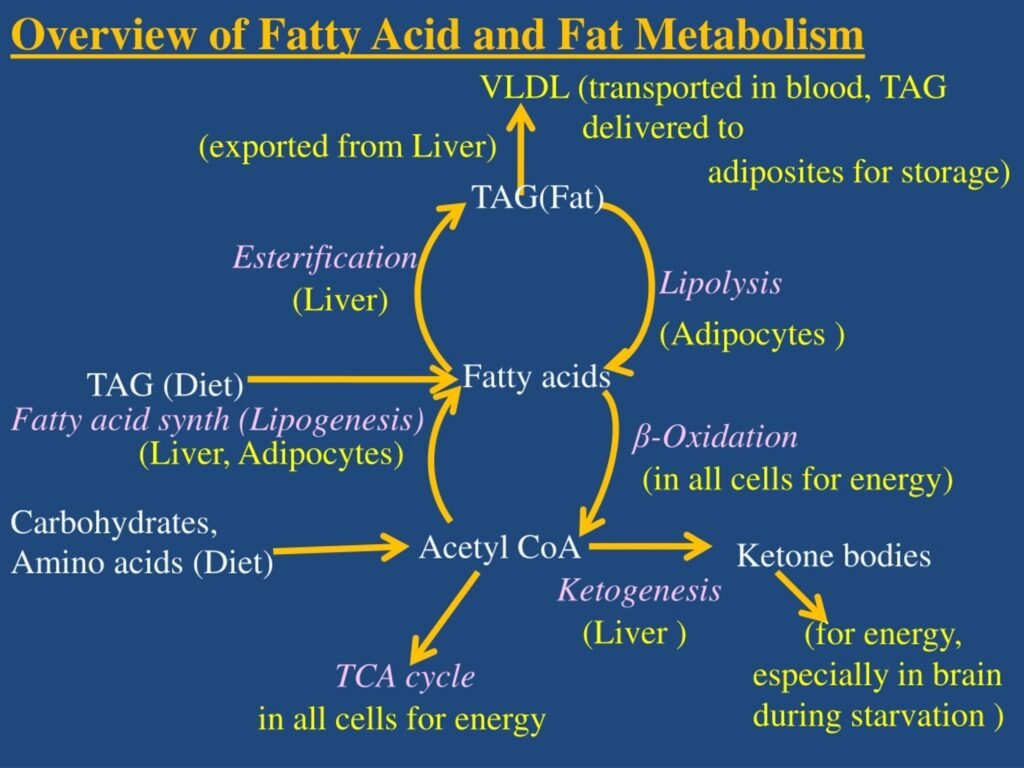
Fatty acid metabolism helps maintain the body’s energy balance. During the fed state, excess glucose is converted into fatty acids and stored as triglycerides in adipose tissue. During fasting, triglycerides are broken down and fatty acids are transported to tissues for ATP production.
The liver acts as the metabolic center because it synthesizes fatty acids, packages lipids into lipoproteins, and performs beta oxidation. Skeletal muscle heavily relies on fatty acid oxidation during prolonged exercise.
Fatty acids contain more energy than carbohydrates because they are highly reduced molecules rich in hydrogen atoms.
⚠️ IF DAMAGED
• Impaired fatty acid oxidation → reduced ATP production
• Excess fat accumulation → fatty liver and obesity
• Defective lipid metabolism → hypoglycemia during fasting
• Increased ketone production → ketoacidosis
2. Fatty Acid Synthesis
🧠 CORE
• Occurs mainly in cytoplasm
• Major organs: liver, adipose tissue, lactating mammary gland
• Acetyl-CoA is the starting substrate
• Citrate shuttle transports acetyl-CoA to cytoplasm
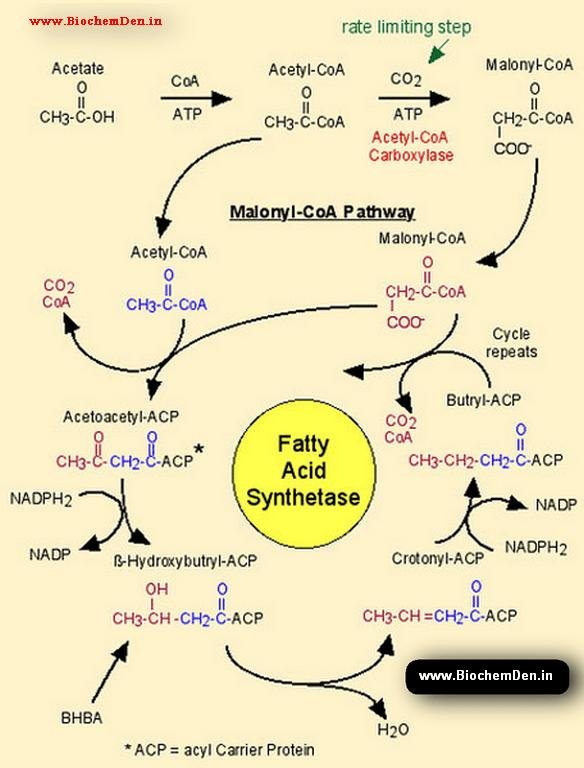
• Acetyl-CoA carboxylase is rate-limiting enzyme
• Fatty acid synthase forms palmitate
• NADPH provides reducing power
• Main product is palmitic acid (16 carbons)
🔬 CONCEPT EXPLAINED
Acetyl-CoA is produced inside mitochondria but fatty acid synthesis occurs in cytoplasm. Since acetyl-CoA cannot directly cross mitochondrial membrane, it combines with oxaloacetate to form citrate. Citrate enters cytoplasm where it regenerates acetyl-CoA.
The first committed step is conversion of acetyl-CoA into malonyl-CoA by acetyl-CoA carboxylase.
Acetyl−CoA+CO2+ATP→Malonyl−CoA+ADP+PiAcetyl{-}CoA + CO_2 + ATP \rightarrow Malonyl{-}CoA + ADP + P_i
Fatty acid synthase is a multifunctional enzyme complex that repeatedly adds two-carbon units to form palmitate.
Each cycle involves:
- Condensation
- Reduction
- Dehydration
- Reduction
NADPH is used during reduction steps.
⚠️ IF DAMAGED
• Defective synthesis → impaired fat storage
• Reduced NADPH → decreased synthesis
• Enzyme defects → metabolic imbalance
• Excess synthesis → obesity and fatty liver
3. Regulation and Modification of Fatty Acids
🧠 CORE
• Insulin stimulates fatty acid synthesis
• Glucagon inhibits fatty acid synthesis
• Citrate activates acetyl-CoA carboxylase
• Palmitoyl-CoA inhibits synthesis
• Elongation occurs in ER and mitochondria
• Desaturation introduces double bonds
• Humans cannot introduce double bonds beyond carbon 9
• Fatty acids cannot form glucose in humans
🔬 CONCEPT EXPLAINED
Fatty acid synthesis is tightly regulated according to nutritional state. During the fed state, insulin activates acetyl-CoA carboxylase and promotes synthesis. During fasting, glucagon inhibits the enzyme.
Elongation increases fatty acid chain length beyond 16 carbons. Desaturation introduces double bonds and increases membrane fluidity.
Humans cannot convert fatty acids into glucose because acetyl-CoA cannot be converted back into pyruvate. The pyruvate dehydrogenase reaction is irreversible.
Pyruvate→Acetyl−CoAPyruvate \rightarrow Acetyl{-}CoA
Thus, fatty acids cannot contribute to net glucose synthesis.
⚠️ IF DAMAGED
• Defective desaturation → abnormal membrane function
• Impaired elongation → defective lipid synthesis
• Excess synthesis → hyperlipidemia
• Failure of regulation → metabolic syndrome
4. Fatty Acid Oxidation
🧠 CORE
• Stored fats are mobilized by lipolysis
• Hormone-sensitive lipase breaks triglycerides
• Fatty acids are activated to fatty acyl-CoA
• Carnitine shuttle transports fatty acids into mitochondria
• Beta oxidation occurs in mitochondrial matrix
• Produces acetyl-CoA, NADH, and FADH₂
• Palmitate produces large ATP yield
• Odd-chain fatty acids form propionyl-CoA
🔬 CONCEPT EXPLAINED
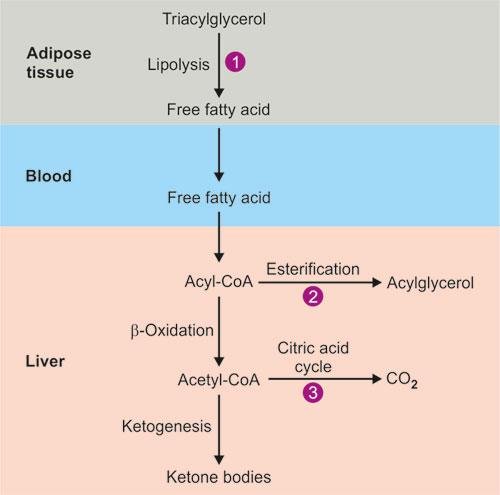
During fasting, glucagon and epinephrine stimulate lipolysis in adipose tissue. Free fatty acids travel in blood bound to albumin.
Fatty acids are activated in cytoplasm before entering mitochondria. Long-chain fatty acids require carnitine shuttle transport.
Beta oxidation removes two-carbon units sequentially as acetyl-CoA.
Each cycle includes:
- Oxidation
- Hydration
- Oxidation
- Thiolysis
Palmitate→8 Acetyl−CoA+7 NADH+7 FADH2Palmitate \rightarrow 8\ Acetyl{-}CoA + 7\ NADH + 7\ FADH_2
Complete oxidation of palmitate produces approximately 106 ATP.
Odd-chain fatty acids produce propionyl-CoA, which converts into succinyl-CoA and enters TCA cycle.
⚠️ IF DAMAGED
• Impaired oxidation → severe hypoglycemia
• Reduced ATP production → muscle weakness
• Accumulation of fatty acids → liver dysfunction
• Defective carnitine transport → exercise intolerance
5. Clinical Correlation and Genetic Disorders
🧠 CORE
• MCAD deficiency impairs medium-chain fatty acid oxidation
• Carnitine deficiency prevents mitochondrial transport
• Fasting intolerance is common
• Hypoketotic hypoglycemia is characteristic
• Patients develop lethargy and seizures
• Early diagnosis prevents complications
🔬 CONCEPT EXPLAINED
MCAD deficiency is an inherited disorder where medium-chain fatty acids cannot undergo beta oxidation. During fasting, ATP production falls dramatically because fats cannot be used efficiently.
Carnitine acyltransferase deficiency blocks transport of long-chain fatty acids into mitochondria.
These disorders become severe during prolonged fasting because glucose stores become depleted rapidly.
⚠️ IF DAMAGED
• Severe fasting hypoglycemia
• Hepatic dysfunction
• Muscle weakness
• Sudden infant death risk
• Reduced ketone body formation
6. Integrated Comparison of Fatty Acid Synthesis and Oxidation
🧠 CORE
• Synthesis occurs in cytoplasm
• Oxidation occurs in mitochondria
• Synthesis uses NADPH
• Oxidation produces NADH and FADH₂
• Insulin promotes synthesis
• Glucagon promotes oxidation
• Malonyl-CoA inhibits carnitine shuttle
• Both pathways are reciprocally regulated
🔬 CONCEPT EXPLAINED
Fatty acid synthesis and oxidation are opposite metabolic pathways and never occur actively at the same time.
During the fed state:
• Insulin increases synthesis
• Energy is stored
During fasting:
• Glucagon activates oxidation
• Energy is released
Malonyl-CoA prevents simultaneous oxidation by inhibiting carnitine transport into mitochondria.
⚠️ IF DAMAGED
• Simultaneous activation wastes energy
• Metabolic imbalance develops
• Excess lipid accumulation may occur
• Energy deficiency develops during fasting
⚙️ 4️⃣ Functional Flow
Fatty Acid Synthesis
- Glucose enters glycolysis
- Pyruvate enters mitochondria
- Acetyl-CoA forms citrate
- Citrate moves to cytoplasm
- Acetyl-CoA regenerated
- Malonyl-CoA formed
- Fatty acid synthase adds carbon units
- Palmitate produced
Beta Oxidation
- Lipolysis releases fatty acids
- Fatty acids activated to fatty acyl-CoA
- Carnitine shuttle transports into mitochondria
- Beta oxidation cycles occur
- Acetyl-CoA enters TCA cycle
- NADH and FADH₂ enter ETC
- ATP produced
🩺 5️⃣ Clinical Correlation
MCAD Deficiency
• Defective medium-chain fatty acid oxidation
• Causes hypoketotic hypoglycemia
• Presents during fasting
Carnitine Deficiency
• Impaired transport of fatty acids into mitochondria
• Causes muscle weakness and cardiomyopathy
Fatty Liver
• Excess fatty acid synthesis in liver
• Associated with obesity and diabetes
Ketoacidosis
• Excessive fatty acid oxidation
• Increased ketone body formation
📌 6️⃣ Summary Points
• Fatty acid synthesis occurs in cytoplasm
• Beta oxidation occurs in mitochondria
• Acetyl-CoA cannot directly cross mitochondrial membrane
• Citrate shuttle transports acetyl-CoA equivalents
• Acetyl-CoA carboxylase is rate-limiting enzyme of synthesis
• Palmitate is main product of fatty acid synthase
• Carnitine shuttle is essential for long-chain fatty acid oxidation
• Palmitate oxidation produces about 106 ATP
• Insulin promotes synthesis while glucagon promotes oxidation
• Malonyl-CoA inhibits fatty acid entry into mitochondria
• Odd-chain fatty acids produce propionyl-CoA
• MCAD deficiency causes fasting hypoglycemia