
📖 Step 2 — Learning Material
🔹 1️⃣ Introduction
Carbohydrate metabolism is not a single isolated pathway; it is an integrated network of pathways that maintain blood glucose and provide energy to tissues.
The major pathways include glycolysis, gluconeogenesis, glycogenesis, and glycogenolysis.
These pathways mainly occur in the liver, skeletal muscle, adipose tissue, brain, and red blood cells.
The liver acts as the central regulator of blood glucose, especially during fasting.
Skeletal muscle uses glucose mainly for its own energy needs.
Hormones such as insulin, glucagon, and adrenaline control these pathways according to the nutritional state.
Clinically, failure of carbohydrate metabolism leads to hypoglycemia, diabetes mellitus, glycogen storage diseases, and metabolic acidosis.
🔹 2️⃣ Foundation Concepts
Key Definitions
- Glycolysis: Breakdown of glucose into pyruvate or lactate to produce ATP.
- Gluconeogenesis: Formation of glucose from non-carbohydrate sources.
- Glycogenesis: Synthesis of glycogen from glucose.
- Glycogenolysis: Breakdown of glycogen into glucose or glucose-6-phosphate.
- Fed state: Metabolic state after meals when insulin is high.
- Fasting state: Metabolic state between meals when glucagon is high.
- Insulin: Hormone that promotes glucose uptake, glycogen synthesis, and fat storage.
- Glucagon: Hormone that increases blood glucose during fasting.
- Adrenaline: Hormone that increases glucose availability during stress or exercise.
- Blood glucose homeostasis: Maintenance of blood glucose within a normal range.
Basic Overview
- After meals, excess glucose is stored as glycogen.
- During fasting, stored glycogen is broken down to maintain blood glucose.
- During prolonged fasting, glucose is produced by gluconeogenesis.
- Different tissues use glucose differently according to their function.
- Brain mainly depends on glucose in normal conditions.
- RBCs depend completely on glycolysis because they lack mitochondria.
- Liver controls blood glucose for the whole body.
- Muscle stores glycogen for its own contraction needs.
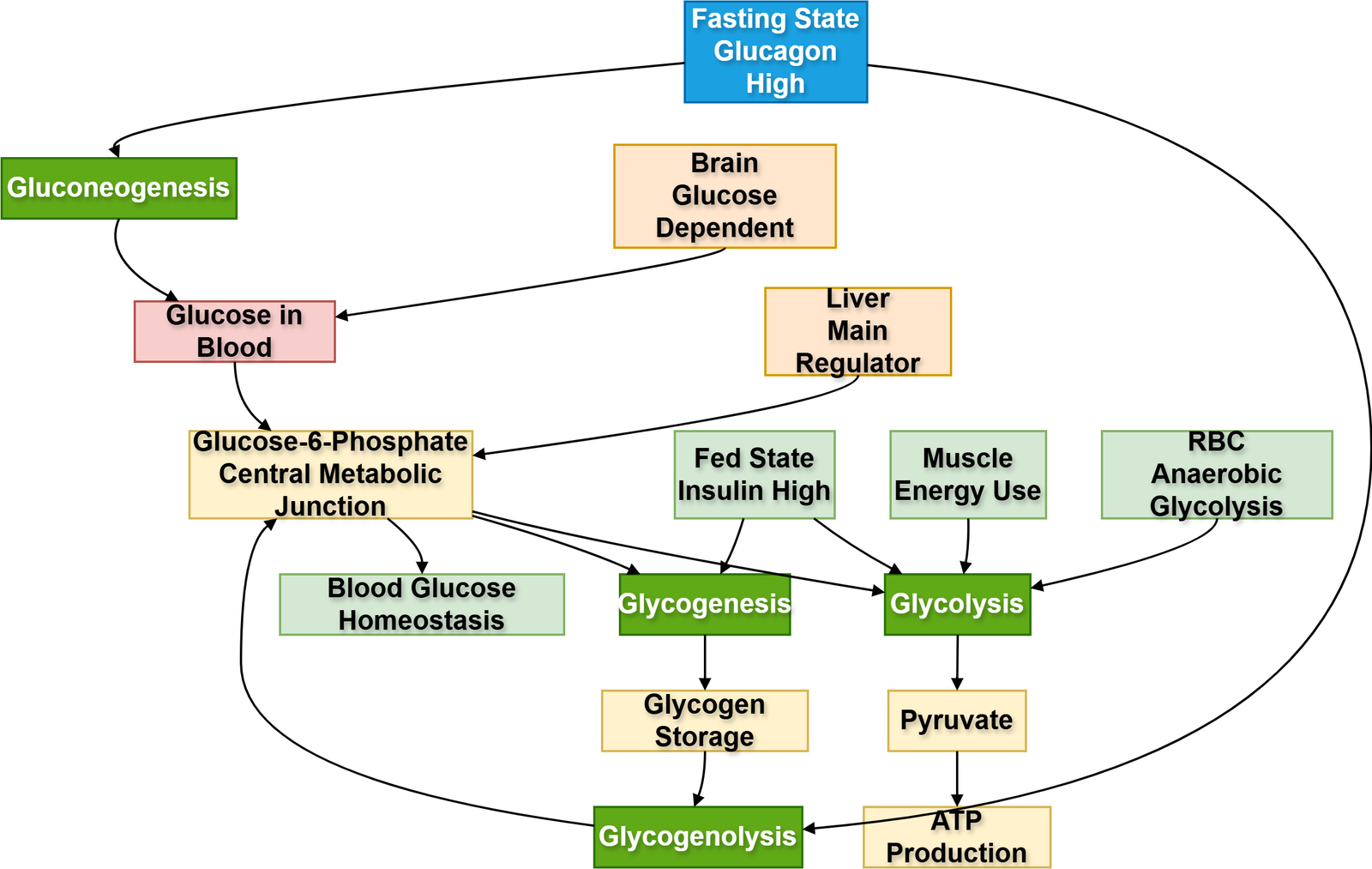
Master Integration Flow Map
🔹 3️⃣ Core Learning — Curriculum Coverage
1: Interrelationship Between Glycolysis, Gluconeogenesis, Glycogenesis and Glycogenolysis
🧠 CORE
- These four pathways work together to maintain glucose balance.
- Glycolysis uses glucose to produce ATP.
- Gluconeogenesis produces glucose during fasting.
- Glycogenesis stores excess glucose as glycogen.
- Glycogenolysis releases glucose from glycogen.
- Liver can perform all four processes.
- Muscle performs glycolysis, glycogenesis, and glycogenolysis, but cannot release free glucose into blood.
- Glycolysis and gluconeogenesis are opposite but not exact reverse pathways.
- Glycogenesis and glycogenolysis are controlled by nutritional and hormonal signals.
- These pathways prevent both hyperglycemia and hypoglycemia.
🔬 CONCEPT EXPLAINED
Carbohydrate metabolism works like a traffic control system. When glucose is abundant after a meal, the body uses it for energy through glycolysis and stores the excess as glycogen through glycogenesis.
When glucose is low during fasting, the body breaks down glycogen through glycogenolysis. If fasting continues and glycogen stores decrease, gluconeogenesis starts producing new glucose from lactate, glycerol, and amino acids.
The liver is the main organ that integrates these pathways. It stores glucose after meals and releases glucose during fasting. Muscle stores glycogen but uses it only for itself because it lacks glucose-6-phosphatase.
⚠️ IF DAMAGED
- Defective glycolysis → reduced ATP production → fatigue, hemolysis in RBC disorders.
- Defective gluconeogenesis → fasting hypoglycemia.
- Defective glycogenesis → poor glycogen storage → low energy reserve.
- Defective glycogenolysis → inability to mobilize glycogen → hypoglycemia or exercise intolerance.
- Poor hormonal control → diabetes mellitus or recurrent hypoglycemia.
2: Fed State Metabolism
🧠 CORE
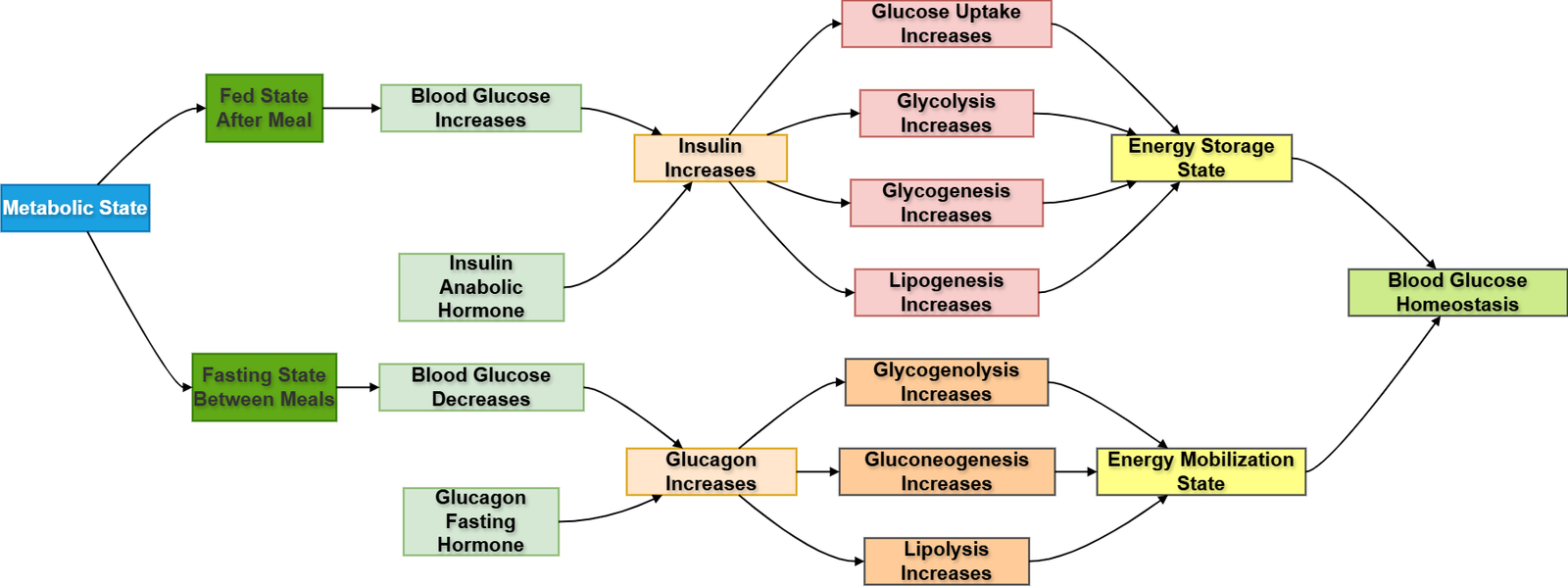
- Fed state occurs after eating.
- Blood glucose rises after carbohydrate digestion and absorption.
- Insulin secretion increases.
- Glucagon secretion decreases.
- Glucose enters liver, muscle, and adipose tissue.
- Glycolysis increases to produce ATP.
- Glycogenesis increases to store glucose as glycogen.
- Lipogenesis increases when glycogen stores are full.
- Gluconeogenesis and glycogenolysis are inhibited.
- Main goal is glucose utilization and storage.
🔬 CONCEPT EXPLAINED
In the fed state, the body behaves like a storage system. After a carbohydrate-rich meal, glucose enters the blood from the intestine. The pancreas detects increased blood glucose and releases insulin.
Insulin promotes glucose uptake in muscle and adipose tissue through GLUT-4 transporters. In the liver, insulin activates enzymes that convert glucose into glycogen. If glucose is more than required, the liver converts it into fatty acids.
The fed state prevents excessive rise in blood glucose and stores energy for later use.
⚠️ IF DAMAGED
- Insulin deficiency or resistance → glucose cannot enter tissues properly.
- Result → hyperglycemia.
- Liver continues glucose production despite high blood glucose.
- Muscle and adipose tissue show reduced glucose uptake.
- Long-term effect → diabetes mellitus complications.
3: Fasting State Metabolism
🧠 CORE
- Fasting state occurs between meals or during overnight fasting.
- Blood glucose begins to fall.
- Insulin decreases.
- Glucagon increases.
- Liver glycogenolysis starts first.
- Gluconeogenesis increases as fasting continues.
- Muscle protein may provide amino acids for glucose production.
- Adipose tissue releases glycerol and fatty acids.
- Brain continues to use glucose in short-term fasting.
- Main goal is maintenance of blood glucose.
🔬 CONCEPT EXPLAINED
During fasting, the body shifts from storage mode to glucose-sparing mode. The liver first breaks down glycogen to release glucose into the blood. This helps maintain glucose supply to the brain and RBCs.
As fasting continues, liver glycogen becomes depleted. Then gluconeogenesis becomes the major source of blood glucose. Lactate from RBCs, glycerol from fat breakdown, and amino acids from muscle are used to form glucose.
This fasting adaptation is essential because some tissues, especially RBCs, require glucose continuously.
⚠️ IF DAMAGED
- Failure of glycogenolysis → early fasting hypoglycemia.
- Failure of gluconeogenesis → severe fasting hypoglycemia.
- Liver disease → poor glucose regulation.
- Hormonal deficiency, especially glucagon or cortisol deficiency → fasting intolerance.
- In children, fasting hypoglycemia can occur more rapidly due to smaller glycogen stores.
4: Hormonal Regulation of Carbohydrate Metabolism
🧠 CORE
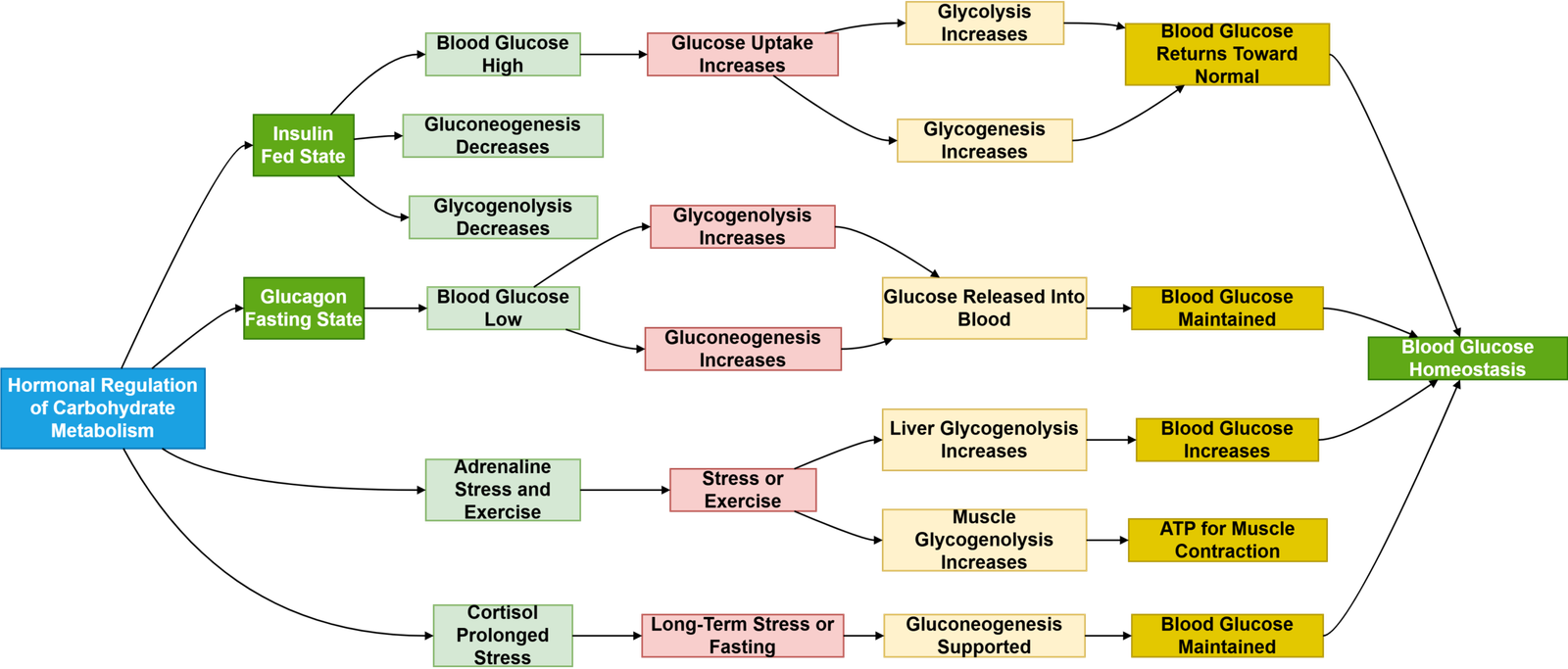
- Hormones control whether glucose is stored, used, or produced.
- Insulin is the main fed-state hormone.
- Glucagon is the main fasting-state hormone.
- Adrenaline acts during stress and exercise.
- Insulin lowers blood glucose.
- Glucagon raises blood glucose.
- Adrenaline increases glycogen breakdown.
- Cortisol supports gluconeogenesis during prolonged stress.
- Growth hormone reduces glucose uptake in some tissues.
- Hormonal balance maintains blood glucose homeostasis.
🔬 CONCEPT EXPLAINED
Insulin is released when blood glucose is high. It promotes glucose uptake, glycolysis, glycogenesis, and fat synthesis. Therefore, insulin is anabolic.
Glucagon is released when blood glucose is low. It mainly acts on the liver to stimulate glycogenolysis and gluconeogenesis. Therefore, glucagon prevents hypoglycemia.
Adrenaline acts during stress or exercise. In liver, it increases blood glucose. In muscle, it breaks down glycogen to provide energy for contraction.
⚠️ IF DAMAGED
- Insulin deficiency → diabetes mellitus.
- Excess insulin → hypoglycemia.
- Glucagon deficiency → poor fasting glucose response.
- Excess counter-regulatory hormones → hyperglycemia.
- Stress hormones in illness can worsen blood glucose control.
5: Tissue-Specific Carbohydrate Metabolism
🧠 CORE
- Different tissues handle glucose according to their function.
- Liver maintains blood glucose for the whole body.
- Muscle uses glucose for contraction.
- Brain mainly uses glucose for energy.
- RBCs depend only on glycolysis.
- Adipose tissue uses glucose for fat storage.
- Kidney contributes to gluconeogenesis during prolonged fasting.
- Liver contains glucose-6-phosphatase.
- Muscle lacks glucose-6-phosphatase.
- Tissue-specific enzymes explain different clinical presentations.
🔬 CONCEPT EXPLAINED
The liver is the central metabolic organ. It stores glucose after meals and releases glucose during fasting. This is possible because liver has glucose-6-phosphatase, which allows free glucose release into blood.
Skeletal muscle stores glycogen but uses it only for itself. During exercise, muscle glycogen is broken down and enters glycolysis to produce ATP for contraction.
Brain depends mainly on glucose under normal conditions because it has high energy demand. RBCs are completely dependent on anaerobic glycolysis because they lack mitochondria.
Adipose tissue uses glucose to form glycerol backbone for triglyceride synthesis.
⚠️ IF DAMAGED
- Liver dysfunction → fasting hypoglycemia.
- Muscle glycogen defects → cramps and exercise intolerance.
- RBC glycolytic enzyme defects → hemolytic anemia.
- Brain glucose deprivation → confusion, seizures, coma.
- Adipose insulin resistance → increased fatty acids and worsening diabetes.
⚙️ 4️⃣ Functional Flow
Structure → Function → Outcome
Liver
- Structure: Contains enzymes for glycolysis, gluconeogenesis, glycogenesis, and glycogenolysis.
- Function: Maintains blood glucose balance.
- Outcome: Prevents hypoglycemia during fasting and stores glucose after meals.
Skeletal Muscle
- Structure: Contains glycogen stores and glycolytic enzymes.
- Function: Produces ATP for contraction.
- Outcome: Supports exercise and movement.
Brain
- Structure: High glucose requirement and continuous energy demand.
- Function: Uses glucose for neuronal activity.
- Outcome: Maintains consciousness and normal brain function.
Red Blood Cells
- Structure: Lack mitochondria.
- Function: Depend completely on anaerobic glycolysis.
- Outcome: Produce ATP and lactate.
Adipose Tissue
- Structure: Insulin-sensitive GLUT-4 transporters.
- Function: Takes up glucose and stores energy as fat.
- Outcome: Provides long-term energy reserve.
🩺 5️⃣ Clinical Correlation
1. Diabetes Mellitus
- Insulin deficiency or resistance causes reduced glucose uptake.
- Liver continues glucose production.
- Result is persistent hyperglycemia.
- Important for understanding fed-state failure.
2. Hypoglycemia
- May occur due to excess insulin, fasting, liver disease, or enzyme defects.
- Brain is highly sensitive to low glucose.
- Symptoms include sweating, tremors, confusion, seizures, and coma.
3. Glycogen Storage Diseases
- Enzyme defects impair glycogen synthesis or breakdown.
- Liver forms cause fasting hypoglycemia.
- Muscle forms cause exercise intolerance and cramps.
4. Pyruvate Kinase Deficiency
- RBC glycolysis is impaired.
- ATP production decreases.
- RBC membrane becomes unstable.
- Result is hemolytic anemia.
5. Prolonged Fasting or Starvation
- Glycogen stores become depleted.
- Gluconeogenesis becomes important.
- Fat breakdown increases.
- Brain gradually adapts to ketone bodies, but RBCs still require glucose.
📌 6️⃣ Summary Points
- Liver is the main organ for blood glucose homeostasis.
- Insulin dominates the fed state.
- Glucagon dominates the fasting state.
- Glycolysis produces ATP from glucose.
- Glycogenesis stores glucose as glycogen.
- Glycogenolysis breaks glycogen during early fasting.
- Gluconeogenesis maintains glucose during prolonged fasting.
- Muscle glycogen is used only by muscle.
- RBCs depend completely on anaerobic glycolysis.
- Brain requires continuous glucose supply in normal conditions.
- Failure of insulin action causes hyperglycemia.
- Failure of liver glucose output causes fasting hypoglycemia.