
📖 Step 2 — Learning Material
🔹 1️⃣ Introduction
Cells require continuous energy to perform vital functions such as muscle contraction, nerve conduction, active transport, and biosynthesis. Most cellular ATP is generated inside mitochondria through oxidative phosphorylation, which is closely linked with the TCA cycle and electron transport chain (ETC). The reducing equivalents NADH and FADH₂ produced during metabolism donate electrons to the ETC to drive ATP production.
The inner mitochondrial membrane contains respiratory chain complexes that create a proton gradient essential for ATP synthesis. ATP synthase then converts this stored energy into ATP using a rotary mechanism.
Defects in oxidative phosphorylation lead to impaired energy production, causing muscle weakness, neurological disorders, and metabolic diseases. Understanding mitochondrial energy generation is essential for learning physiology, pathology, pharmacology, and clinical medicine.
🔹 2️⃣ Foundation Concepts
Key Definitions
- Oxidative Phosphorylation: Formation of ATP using energy released during electron transfer in the ETC.
- Electron Transport Chain (ETC): Series of protein complexes in inner mitochondrial membrane transferring electrons to oxygen.
- Proton Gradient: Difference in proton concentration across inner mitochondrial membrane.
- Proton Motive Force: Stored electrochemical energy generated by proton pumping.
- ATP Synthase (Complex V): Enzyme complex producing ATP from ADP + Pi.
- Reducing Equivalents: Electron carriers such as NADH and FADH₂.
- Coupling: Link between electron transport and ATP synthesis.
- Uncouplers: Substances separating electron transport from ATP production.
- Respiratory Inhibitors: Agents blocking ETC complexes.
Essential Terminology
- Inner mitochondrial membrane
- Matrix
- Intermembrane space
- Complex I–IV
- Cytochromes
- Coenzyme Q
- Chemiosmosis
- ATPase
- Oxidation
- Reduction
Basic Overview
- TCA cycle generates NADH and FADH₂.
- ETC oxidizes NADH and FADH₂.
- Electrons move through complexes I–IV.
- Energy released pumps protons into intermembrane space.
- Proton gradient stores energy.
- Protons flow back through ATP synthase.
- ATP synthase converts ADP into ATP.
- Oxygen acts as final electron acceptor.
Note: Tricarboxylic Acid (TCA) Cycle, also called the Krebs Cycle or Citric Acid Cycle, is the central aerobic metabolic pathway occurring in the mitochondrial matrix.
🔹 3️⃣ Core Learning — Curriculum Coverage
A. Oxidation of Reducing Equivalents (NADH, FADH₂) via Electron Transport Chain
🧠 CORE
- ETC is located in inner mitochondrial membrane.
- NADH donates electrons to Complex I.
- FADH₂ donates electrons to Complex II.
- Electrons move through CoQ and cytochromes.
- Oxygen is final electron acceptor.
- Water forms at end of ETC.
- Complexes I, III, IV pump protons.
- Proton pumping generates electrochemical gradient.
- NADH produces more ATP than FADH₂.
🔬 CONCEPT EXPLAINED
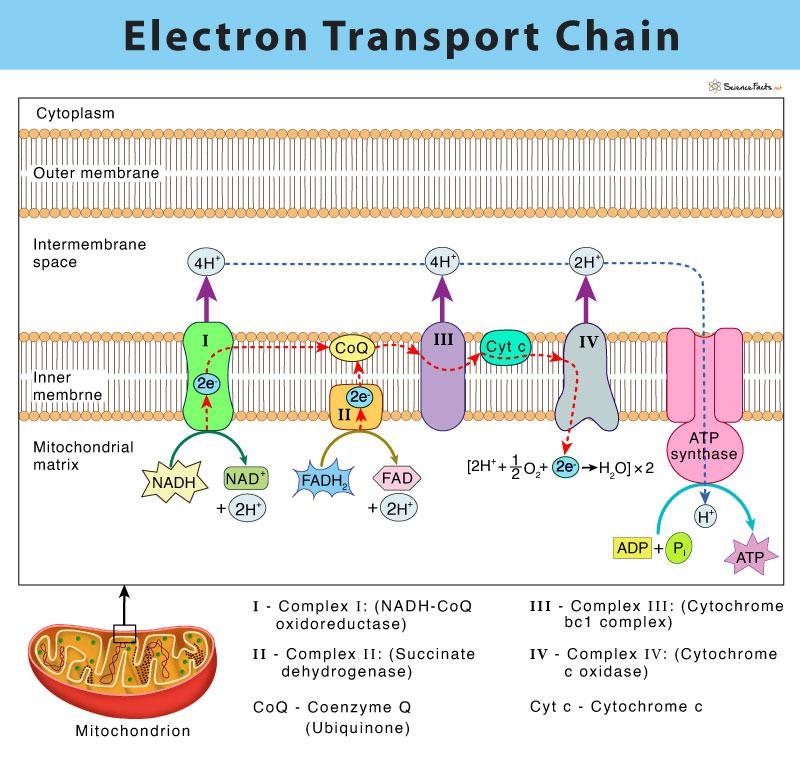
The TCA cycle produces NADH and FADH₂ containing high-energy electrons. These reducing equivalents transfer electrons into the ETC located within the inner mitochondrial membrane.
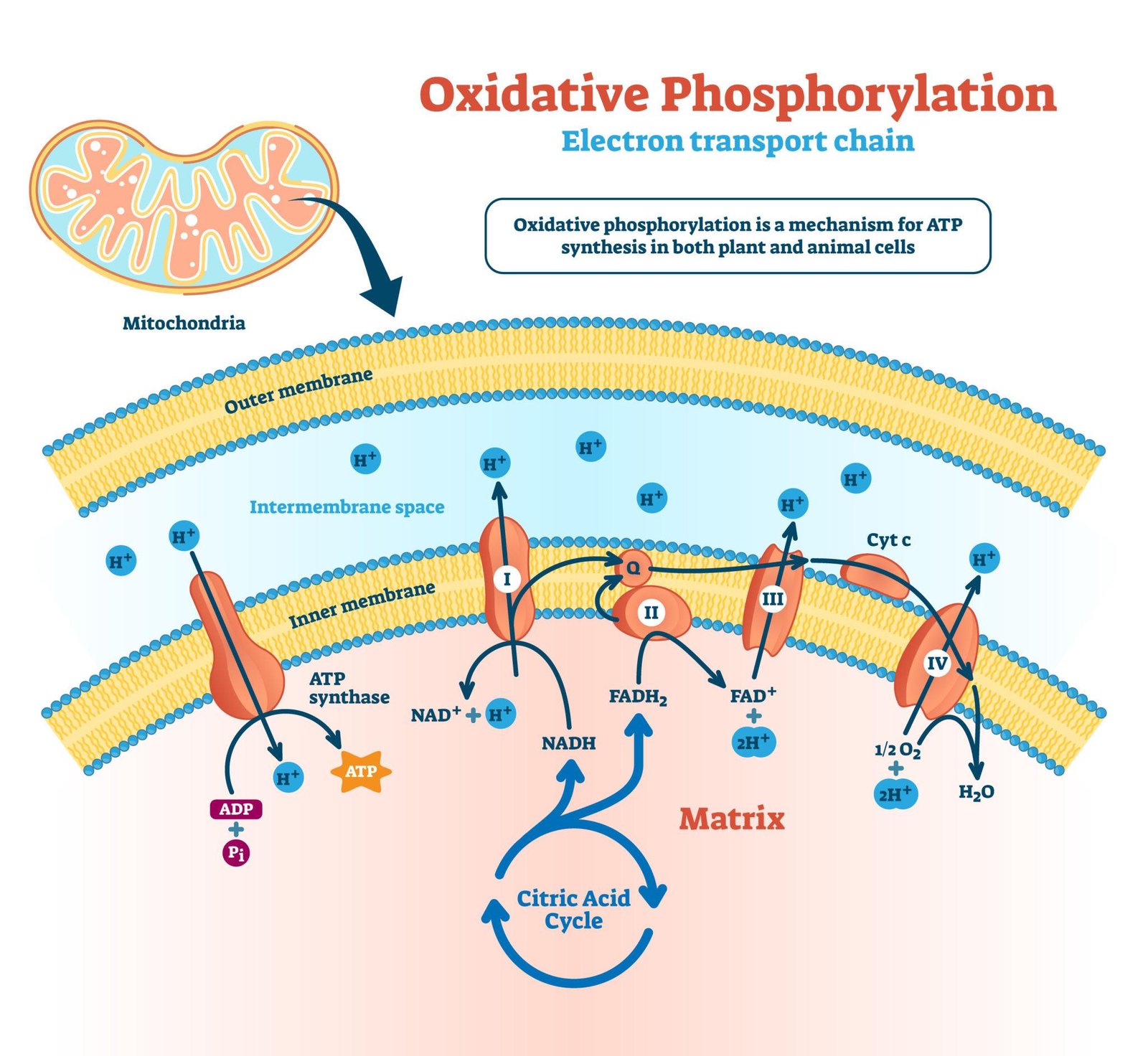
NADH transfers electrons to Complex I, while FADH₂ transfers electrons to Complex II. Electrons then pass through coenzyme Q, Complex III, cytochrome c, and Complex IV.
As electrons move down the chain, energy is released. This energy pumps protons from mitochondrial matrix into intermembrane space, creating a proton gradient.
At Complex IV, electrons combine with oxygen and hydrogen ions to form water. Oxygen is therefore essential for oxidative phosphorylation.
Structure → Function:
- Folded inner membrane increases surface area for ETC complexes.
- Membrane impermeability maintains proton gradient.
- Organized complexes ensure efficient electron transfer.
⚠️ IF DAMAGED
Cause → Effect
- Lack of oxygen → Electron transport stops → ATP production falls.
- Complex defects → Reduced proton pumping → Energy failure.
- Mitochondrial diseases → Muscle and nerve dysfunction.
- Cyanide poisoning → Complex IV inhibition → Cellular hypoxia.
A. Tricarboxylic Acid (TCA) Cycle Overview
🧠 CORE
- TCA cycle occurs in mitochondrial matrix.
- Also called Krebs cycle or citric acid cycle.
- Acetyl-CoA enters the TCA cycle.
- Final common pathway for carbohydrates, fats, and proteins.
- Generates NADH and FADH₂.
- Produces GTP (energy equivalent of ATP).
- Oxaloacetate regenerates during cycle.
- TCA cycle is indirectly aerobic because it depends on oxygen through ETC.
- TCA cycle is amphibolic because it participates in both catabolism and biosynthesis.
🔬 CONCEPT EXPLAINED
The TCA cycle is the central energy-generating pathway of aerobic metabolism. Acetyl-CoA formed from carbohydrates, fatty acids, and amino acids enters the cycle by combining with oxaloacetate to form citrate.
During cyclic reactions:
- Carbon dioxide is released.
- High-energy electrons are transferred to NAD⁺ and FAD forming NADH and FADH₂.
- One GTP molecule is generated.
The reducing equivalents (NADH and FADH₂) produced in the TCA cycle transfer electrons into the electron transport chain for ATP production through oxidative phosphorylation.
Structure → Function:
- Mitochondrial matrix contains TCA enzymes.
- Close relationship with inner mitochondrial membrane allows efficient transfer of reducing equivalents to ETC.
⚠️ IF DAMAGED
Cause → Effect
TCA inhibition → Reduced NADH/FADH₂ production → Reduced ATP generation.
Mitochondrial dysfunction → Energy failure → Muscle and nerve dysfunction.
Thiamine deficiency → Impaired oxidative metabolism → Neurological manifestations.
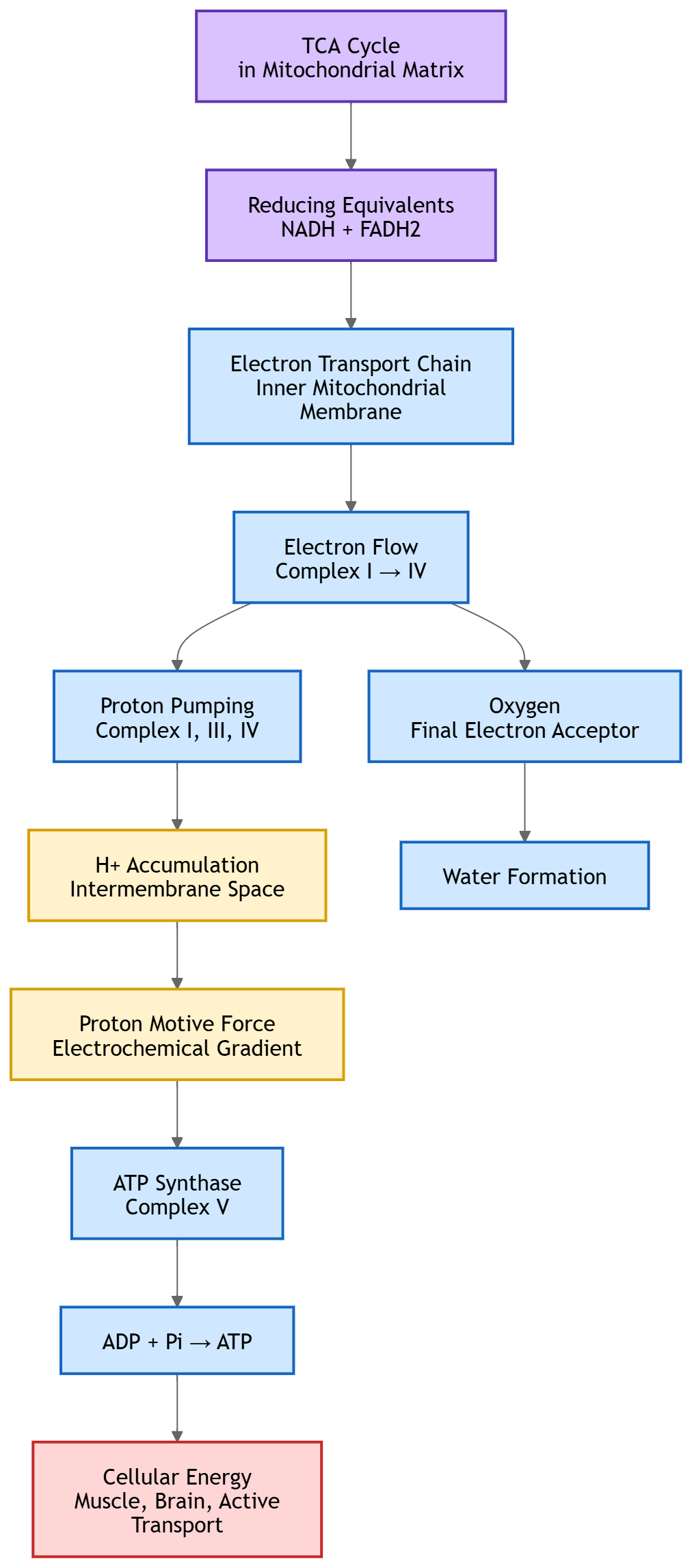
Functional Flow — Integrated Energy Production
Glucose
↓
Glycolysis
↓
Pyruvate
↓
Acetyl-CoA
↓
TCA Cycle
↓
NADH + FADH₂
↓
Electron Transport Chain
↓
Proton Gradient
↓
ATP Synthase
↓
ATP Production
CONCEPT MAP 1 — Master Energy Production Map
B. Generation of Proton Gradient Across Inner Mitochondrial Membrane
🧠 CORE
- Proton gradient forms due to proton pumping.
- Complexes I, III, IV pump H⁺ ions.
- Protons accumulate in intermembrane space.
- Matrix becomes relatively negative.
- Gradient stores potential energy.
- Inner membrane is proton impermeable.
- Proton gradient is essential for ATP synthesis.
🔬 CONCEPT EXPLAINED
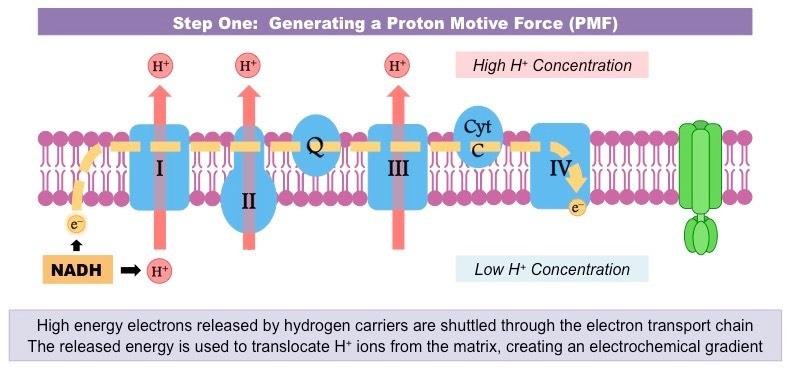
Electron transfer releases free energy. ETC complexes use this energy to pump protons across the inner mitochondrial membrane.
This creates:
- Concentration gradient
- Electrical gradient
Together these form an electrochemical gradient.
The intermembrane space becomes positively charged and acidic, while matrix becomes relatively negative and alkaline.
Structure → Function:
- Tight inner membrane prevents proton leakage.
- Cristae increase membrane surface area for greater ATP generation.
⚠️ IF DAMAGED
- Membrane damage → Proton leakage → ATP synthesis decreases.
- ETC inhibition → No proton pumping → Loss of energy production.
- Mitochondrial swelling → Collapse of gradient.
C. Proton Motive Force
🧠 CORE
- Proton motive force stores energy.
- Created by proton gradient.
- Has electrical and chemical components.
- Drives ATP synthesis.
- Powers transport processes.
- Essential for mitochondrial function.
🔬 CONCEPT EXPLAINED
The proton motive force is the stored electrochemical energy generated by proton accumulation outside the matrix.
Two components:
- Voltage difference
- pH difference
When protons move back into matrix through ATP synthase, stored energy converts into mechanical and chemical energy for ATP formation.
Structure → Function:
- Membrane polarity allows energy storage.
- Controlled proton movement ensures efficient ATP production.
⚠️ IF DAMAGED
- Loss of proton motive force → ATP synthesis stops.
- Proton leak → Heat production instead of ATP.
- Severe ATP depletion affects brain and muscles first.
D. ATP Synthesis by Oxidative Phosphorylation
🧠 CORE
- ATP formed from ADP + Pi.
- ATP synthase performs ATP production.
- Proton flow powers ATP formation.
- Chemiosmosis links ETC and ATP synthesis.
- Oxidative phosphorylation generates most cellular ATP.
- Occurs in mitochondria.
🔬 CONCEPT EXPLAINED
Protons flow down their gradient through ATP synthase. The movement of protons rotates parts of ATP synthase, causing conformational changes that synthesize ATP.
This process is called chemiosmosis.
Oxidative phosphorylation is highly efficient because energy from oxidation is directly converted into ATP.
Structure → Function:
- ATP synthase spans inner membrane.
- F₀ portion forms proton channel.
- F₁ portion synthesizes ATP.
⚠️ IF DAMAGED
- ATP synthase defects → Reduced ATP generation.
- ETC failure → No proton flow → ATP depletion.
- Cellular energy crisis causes organ dysfunction.
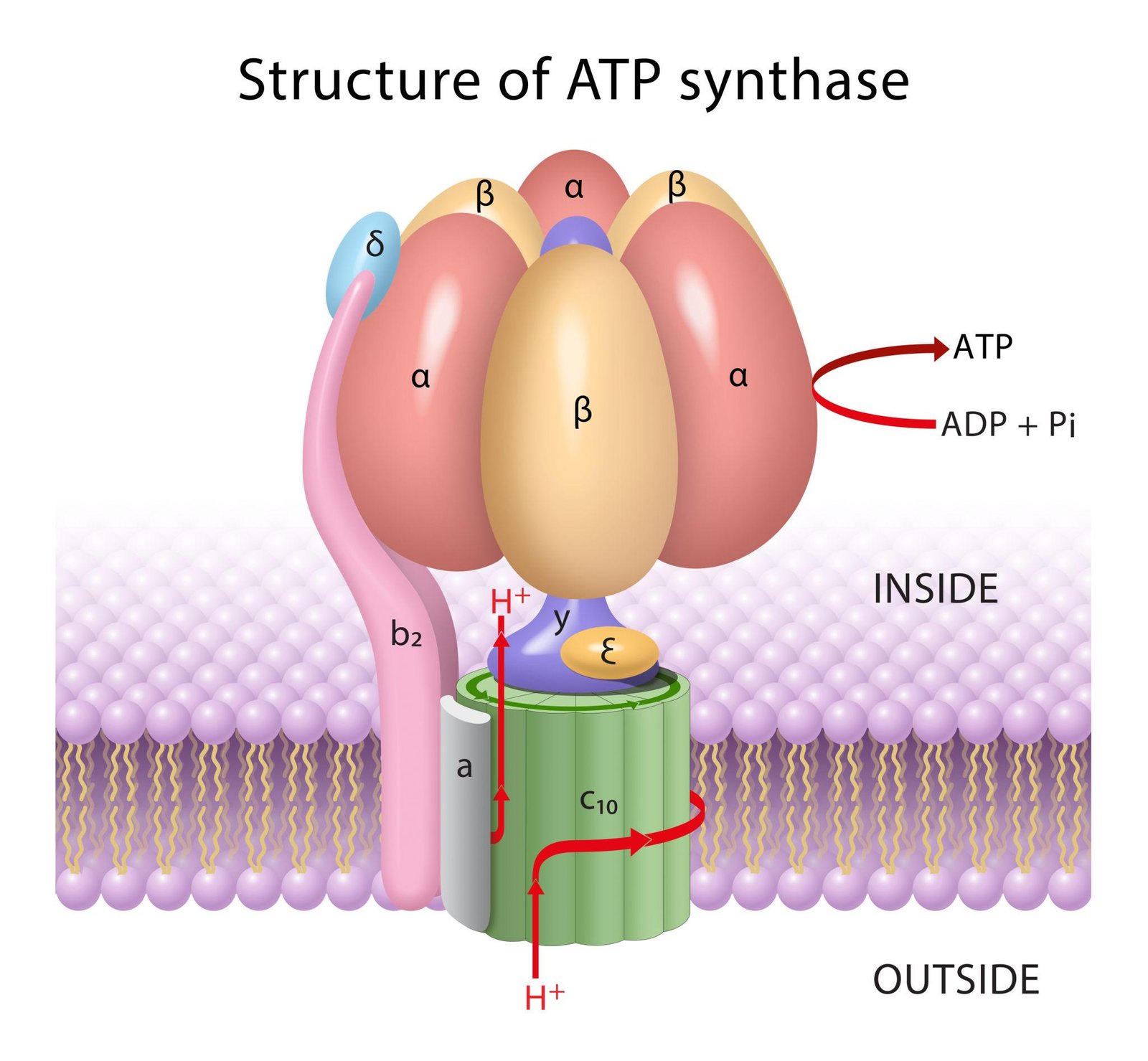
E. Structure of ATP Synthase (Complex V)
🧠 CORE
- ATP synthase is Complex V.
- Located in inner mitochondrial membrane.
- Has F₀ and F₁ components.
- F₀ forms proton channel.
- F₁ forms ATP.
- Rotary enzyme mechanism present.
🔬 CONCEPT EXPLAINED
ATP synthase resembles a molecular turbine.
Components:
- F₀ portion
- Embedded in membrane
- Allows proton movement
- F₁ portion
- Projects into matrix
- Contains catalytic ATP-forming sites
Proton movement through F₀ rotates central shaft, causing conformational changes in F₁ catalytic subunits.
Structure → Function:
- Rotational design converts electrochemical energy into chemical energy.
⚠️ IF DAMAGED
- Defective ATP synthase → Inadequate ATP production.
- Mutation in mitochondrial proteins → Neuromuscular disease.
- High-energy tissues affected most.
F. Rotary Mechanism of ATP Synthase
🧠 CORE
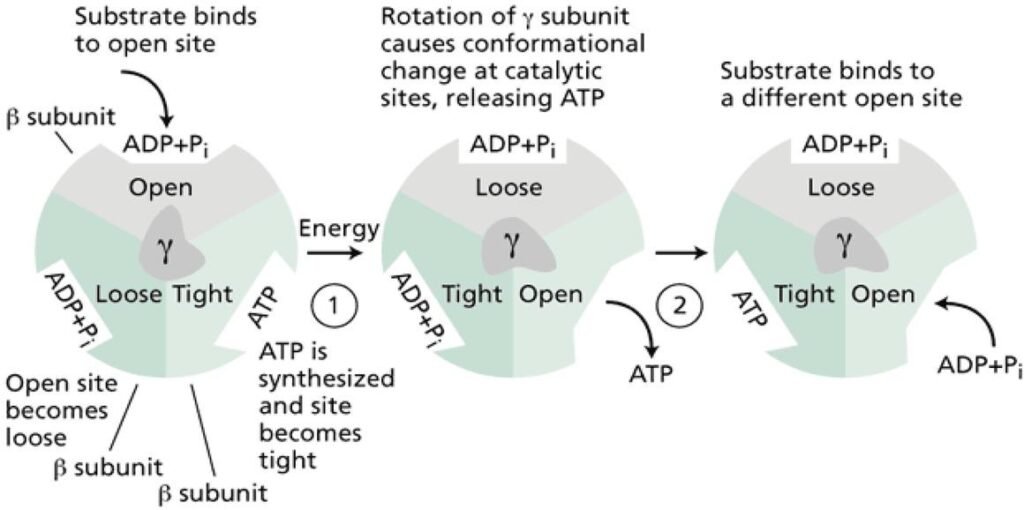
- Proton flow causes rotation.
- Rotation changes catalytic sites.
- ADP binds first.
- ATP formed during conformational change.
- ATP released after rotation.
- Mechanical energy converted into chemical energy.
🔬 CONCEPT EXPLAINED
As protons pass through F₀, the rotor turns. This rotation changes shape of F₁ catalytic subunits.
Three functional states:
- Loose — binds ADP + Pi
- Tight — synthesizes ATP
- Open — releases ATP
This rotational catalysis is highly energy efficient.
Structure → Function:
- Rotational movement enables continuous ATP generation.
⚠️ IF DAMAGED
- Blocked proton flow → No rotation → ATP synthesis stops.
- Structural defects impair energy conversion.
G. Control of Respiration Rate🧠 CORE
- Respiration depends on ATP demand.
- ADP availability controls ETC activity.
- Increased ADP increases oxygen consumption.
- Low ATP stimulates oxidative phosphorylation.
- Oxygen supply also regulates respiration.
🔬 CONCEPT EXPLAINED
When cells use ATP, ADP levels rise. Increased ADP stimulates ATP synthase activity, which increases proton flow and accelerates ETC activity.
This is called respiratory control.
Structure → Function:
- Tight coupling allows ATP production to match cellular demand.
⚠️ IF DAMAGED
- Poor oxygen supply → Reduced respiration.
- Mitochondrial dysfunction → Inadequate ATP response.
- Tissue hypoxia develops.
H. Coupling Between Oxidation and Phosphorylation
🧠 CORE
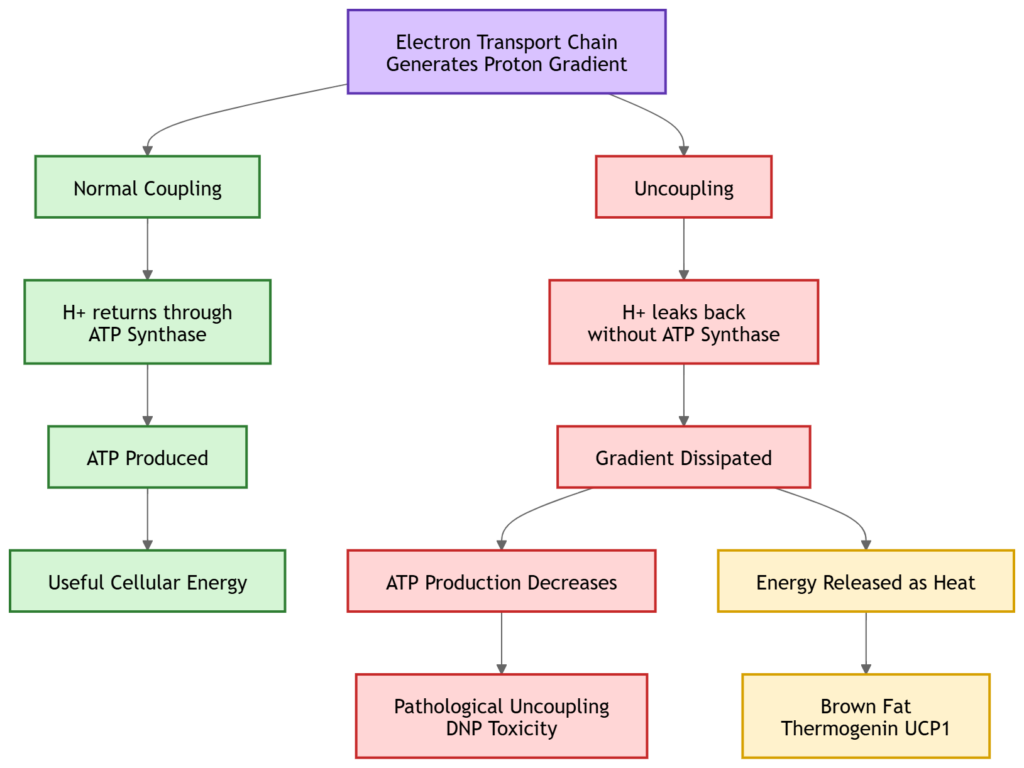
- Electron transport and ATP synthesis are linked.
- Proton gradient couples both processes.
- Oxidation drives phosphorylation.
- ATP synthesis requires intact membrane.
- Efficient coupling conserves energy.
🔬 CONCEPT EXPLAINED
Electron transfer creates proton gradient. ATP synthase uses this gradient for ATP production.
If ATP synthesis slows:
- Proton gradient increases
- Electron transport slows
If ATP demand rises:
- Protons flow rapidly
- ETC accelerates
Structure → Function:
- Membrane integrity is essential for coupling.
⚠️ IF DAMAGED
- Uncoupling → Heat generation instead of ATP.
- Membrane disruption → Energy wastage.
- Severe fatigue occurs.
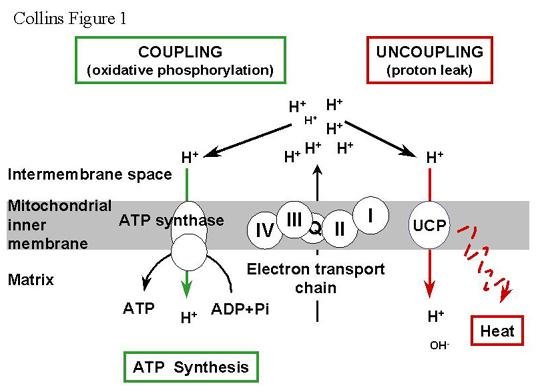
MAP 2 — Coupling vs Uncoupling
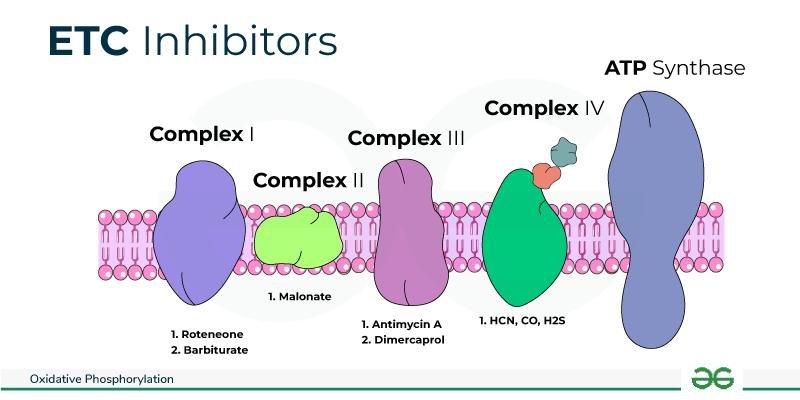
I. Respiratory Chain Inhibitors & Sites of Action
🧠 CORE
- Inhibitors block electron transport.
- Different toxins act on specific complexes.
- ATP production decreases.
- Oxygen utilization stops.
- Cellular hypoxia develops.
🔬 CONCEPT EXPLAINED
Important Inhibitors
| Inhibitor | Site of Action |
|---|---|
| Rotenone | Complex I |
| Antimycin A | Complex III |
| Cyanide | Complex IV |
| Carbon monoxide | Complex IV |
| Oligomycin | ATP synthase |
These agents stop electron transfer or ATP formation.
Structure → Function:
- Blocking one complex disrupts entire ETC.
⚠️ IF DAMAGED
- Cyanide poisoning → Rapid ATP depletion → Death.
- CO poisoning → Reduced oxygen utilization.
- ATP failure affects brain and heart rapidly.
J. Mechanism of Uncouplers
🧠 CORE
- Uncouplers dissipate proton gradient.
- ETC continues without ATP synthesis.
- Energy released as heat.
- Oxygen consumption increases.
- ATP production decreases.
🔬 CONCEPT EXPLAINED
Uncouplers carry protons across inner mitochondrial membrane without ATP synthase.
Therefore:
- ETC works rapidly
- Proton gradient collapses
- ATP is not generated
- Heat is produced
Examples:
- Dinitrophenol
- Thermogenin
Structure → Function:
- Loss of membrane proton integrity uncouples respiration.
⚠️ IF DAMAGED
- Excess uncoupling → Severe hyperthermia.
- ATP depletion → Organ failure.
- Toxic uncouplers may be fatal.
K. Physiological Role of Uncouplers in Heat Production
🧠 CORE
- Brown fat contains thermogenin.
- Thermogenin acts as physiological uncoupler.
- Produces heat instead of ATP.
- Important in newborns.
- Maintains body temperature.
🔬 CONCEPT EXPLAINED
Brown adipose tissue contains abundant mitochondria with thermogenin (UCP1).
Thermogenin allows protons to re-enter matrix without ATP synthesis. Energy is released as heat.
This non-shivering thermogenesis helps maintain body temperature in:
- Newborns
- Hibernating animals
Structure → Function:
- High mitochondrial density increases heat production capacity.
⚠️ IF DAMAGED
- Reduced brown fat activity → Poor thermoregulation.
- Excessive uncoupling → Heat injury.
MAP 3 — Respiratory Chain Inhibitors
⚙️ 4️⃣ Functional Flow
Oxidative Phosphorylation Mechanism
- TCA cycle generates NADH and FADH₂.
- NADH enters Complex I.
- FADH₂ enters Complex II.
- Electrons pass through ETC complexes.
- Complexes I, III, IV pump protons.
- Proton gradient develops.
- Proton motive force stores energy.
- Protons flow through ATP synthase.
- ATP synthase rotates.
- ADP + Pi convert into ATP.
- Oxygen accepts electrons.
- Water forms.
🩺 5️⃣ Clinical Correlation
Cyanide Poisoning
- Inhibits Complex IV
- Stops oxidative phosphorylation
- Causes severe cellular hypoxia
Carbon Monoxide Poisoning
- Blocks cytochrome oxidase
- Decreases oxygen utilization
- Leads to tissue hypoxia
Mitochondrial Disorders
- Defective ATP production
- Muscle weakness
- Neurological symptoms
Brown Fat Thermogenesis
- Important in neonatal temperature regulation
Oligomycin Toxicity
- Inhibits ATP synthase
- ATP production stops
📌 6️⃣ Summary Points
- ETC is located in inner mitochondrial membrane.
- NADH enters at Complex I.
- FADH₂ enters at Complex II.
- Complexes I, III, IV pump protons.
- Oxygen is final electron acceptor.
- Proton gradient generates proton motive force.
- ATP synthase is Complex V.
- ATP synthesis occurs by chemiosmosis.
- Cyanide inhibits Complex IV.
- Oligomycin inhibits ATP synthase.
- Uncouplers produce heat instead of ATP.
- Brown fat contains thermogenin (UCP1).